Economists: The US economy is showing significant divergence, making physical precious metals an increasingly prominent store of value.
2026-05-27 09:58:20
The current US economy is characterized by extreme fragmentation, with corporate profits hitting record highs while consumer confidence has plummeted to an all-time low.
Austrian economist Mark Thornton points out that this phenomenon is not an accidental economic paradox, but rather the inevitable result of decades of loose monetary policy. Coupled with personnel changes at the Federal Reserve, the pressure of high US debt, and the impact of geopolitical conflicts in the Middle East, global inflation has long-term structural support, traditional financial markets harbor significant hidden risks, and physical precious metals are therefore gaining long-term investment value.
Dr. Mark Thornton, a senior fellow at the Ludwig von Mises Institute, said that the long-term policy of artificially suppressing interest rates and expanding monetary liquidity has completely torn apart the social wealth distribution pattern, creating a wealth gap between asset holders and ordinary wage earners.
Currently, the US stock market is experiencing a historic rally driven by low-cost credit, with many core valuation indicators reaching century-old extremes. The Buffett Indicator and the S&P 500 Case-Shiller valuation data are both at historical highs, and the risk of a market bubble continues to accumulate.
This credit-driven growth model follows a typical Cantillon effect, with profits highly concentrated in large corporations, the banking system, and government agencies. Newly created money initially flows into a small number of capital groups, allowing them to enjoy the benefits of low-priced assets, while the inflationary pressures resulting from the diffusion of money circulation are entirely borne by ordinary consumers.
Statistics from the University of Michigan confirm the pressure on people's livelihoods. In May, the U.S. consumer confidence index fell to a record low of 44.8, with more than half of consumers saying that soaring prices have severely squeezed their personal finances.
Dr. Thornton raised sharp questions about the appointment of Kevin Warsh as the new chairman of the Federal Reserve. He stated that the rapid drop in gold and silver prices after the news of the hawkish official's appointment was not a random market fluctuation, but rather a deliberate suppression by large financial institutions that had prior knowledge of the decision. He claimed that leading New York banks and precious metals trading institutions knew about the appointment decision in advance and precisely manipulated market trends.
Some market observers suggested that the new Federal Reserve Chairman might follow Volcker's lead and implement aggressive interest rate hikes to suppress inflation, but Dr. Thornton explicitly denied this possibility. He stated that the US national debt as a percentage of GDP has exceeded 120%, breaching the critical threshold for debt sustainability. Significant interest rate hikes and increased government financing costs would directly impact the real economy, potentially triggering a systemic economic collapse. The heavy debt burden has effectively locked up the Federal Reserve's policy space for aggressive tightening.
The geopolitical conflict in the Middle East has further exacerbated global inflationary pressures. The disruption of shipping in the Strait of Hormuz has directly pushed up the price of refined oil products in the United States, while also impacting the global supply chain, leading to increased costs across the entire industry chain, including fertilizers and base metal mining.
Dr. Thornton stated that even if the Middle East conflict were to end immediately, it would take several years for the damaged industrial capacity in the Persian Gulf region to recover, and the structural gaps in the supply side could not be filled quickly.
The ongoing energy shock has fueled a supercycle in commodities, with the Commodity Research Bureau index continuing to climb and reaching a record high. This has pushed up global price levels across the board, creating a structural inflation pattern that is difficult to reverse, compounded by existing monetary inflation and supply-side pressures.
Against the backdrop of currency devaluation, geopolitical instability, and financial market bubbles, the market's risk aversion logic continues to intensify, and people are gradually turning to physical precious metal assets to hedge against risks.
The United States has enacted the Silver Act to promote the decentralized development of precious metal storage facilities and avoid the systemic risks of a single financial center. Many state governments have also introduced favorable policies. Texas has begun to build a local precious metal storage system and plans to abolish the capital gains tax on gold and silver assets.
Dr. Mark Thornton believes that completely eliminating taxes related to precious metals is a core measure to combat currency devaluation and protect the wealth of ordinary people. Grassroots-level policy adjustments are far more effective than top-down macroeconomic control in meeting real market demands and resolving structural economic contradictions.
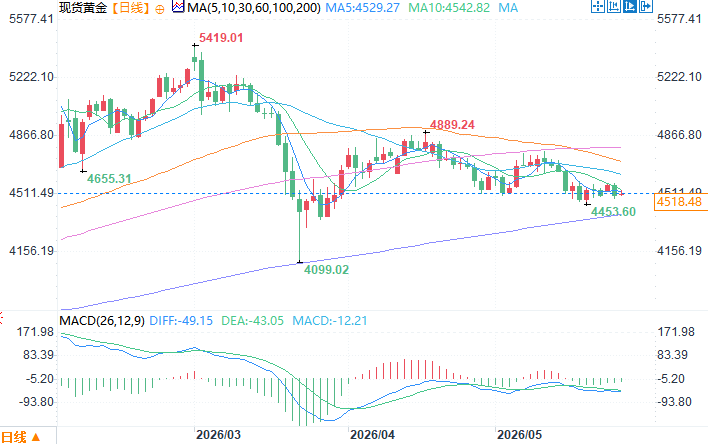
Spot gold daily chart source: EasyForex
At 9:58 AM Beijing time on May 27, spot gold was trading at $4509.48 per ounce.
Austrian economist Mark Thornton points out that this phenomenon is not an accidental economic paradox, but rather the inevitable result of decades of loose monetary policy. Coupled with personnel changes at the Federal Reserve, the pressure of high US debt, and the impact of geopolitical conflicts in the Middle East, global inflation has long-term structural support, traditional financial markets harbor significant hidden risks, and physical precious metals are therefore gaining long-term investment value.
Loose monetary policy has exacerbated economic fragmentation, and the Cantillon effect continues to unfold.
Dr. Mark Thornton, a senior fellow at the Ludwig von Mises Institute, said that the long-term policy of artificially suppressing interest rates and expanding monetary liquidity has completely torn apart the social wealth distribution pattern, creating a wealth gap between asset holders and ordinary wage earners.
Currently, the US stock market is experiencing a historic rally driven by low-cost credit, with many core valuation indicators reaching century-old extremes. The Buffett Indicator and the S&P 500 Case-Shiller valuation data are both at historical highs, and the risk of a market bubble continues to accumulate.
This credit-driven growth model follows a typical Cantillon effect, with profits highly concentrated in large corporations, the banking system, and government agencies. Newly created money initially flows into a small number of capital groups, allowing them to enjoy the benefits of low-priced assets, while the inflationary pressures resulting from the diffusion of money circulation are entirely borne by ordinary consumers.
Statistics from the University of Michigan confirm the pressure on people's livelihoods. In May, the U.S. consumer confidence index fell to a record low of 44.8, with more than half of consumers saying that soaring prices have severely squeezed their personal finances.
The Federal Reserve's personnel changes have sparked controversy, and aggressive interest rate hikes have reached a dead end.
Dr. Thornton raised sharp questions about the appointment of Kevin Warsh as the new chairman of the Federal Reserve. He stated that the rapid drop in gold and silver prices after the news of the hawkish official's appointment was not a random market fluctuation, but rather a deliberate suppression by large financial institutions that had prior knowledge of the decision. He claimed that leading New York banks and precious metals trading institutions knew about the appointment decision in advance and precisely manipulated market trends.
Some market observers suggested that the new Federal Reserve Chairman might follow Volcker's lead and implement aggressive interest rate hikes to suppress inflation, but Dr. Thornton explicitly denied this possibility. He stated that the US national debt as a percentage of GDP has exceeded 120%, breaching the critical threshold for debt sustainability. Significant interest rate hikes and increased government financing costs would directly impact the real economy, potentially triggering a systemic economic collapse. The heavy debt burden has effectively locked up the Federal Reserve's policy space for aggressive tightening.
Geopolitical conflicts coupled with damaged production capacity have led to a long-term entrenched structural inflation.
The geopolitical conflict in the Middle East has further exacerbated global inflationary pressures. The disruption of shipping in the Strait of Hormuz has directly pushed up the price of refined oil products in the United States, while also impacting the global supply chain, leading to increased costs across the entire industry chain, including fertilizers and base metal mining.
Dr. Thornton stated that even if the Middle East conflict were to end immediately, it would take several years for the damaged industrial capacity in the Persian Gulf region to recover, and the structural gaps in the supply side could not be filled quickly.
The ongoing energy shock has fueled a supercycle in commodities, with the Commodity Research Bureau index continuing to climb and reaching a record high. This has pushed up global price levels across the board, creating a structural inflation pattern that is difficult to reverse, compounded by existing monetary inflation and supply-side pressures.
The value of tangible assets is becoming increasingly apparent, and grassroots fiscal and tax reforms are key to breaking the deadlock.
Against the backdrop of currency devaluation, geopolitical instability, and financial market bubbles, the market's risk aversion logic continues to intensify, and people are gradually turning to physical precious metal assets to hedge against risks.
The United States has enacted the Silver Act to promote the decentralized development of precious metal storage facilities and avoid the systemic risks of a single financial center. Many state governments have also introduced favorable policies. Texas has begun to build a local precious metal storage system and plans to abolish the capital gains tax on gold and silver assets.
Dr. Mark Thornton believes that completely eliminating taxes related to precious metals is a core measure to combat currency devaluation and protect the wealth of ordinary people. Grassroots-level policy adjustments are far more effective than top-down macroeconomic control in meeting real market demands and resolving structural economic contradictions.
Spot gold daily chart source: EasyForex
At 9:58 AM Beijing time on May 27, spot gold was trading at $4509.48 per ounce.
- Risk Warning and Disclaimer
- The market involves risk, and trading may not be suitable for all investors. This article is for reference only and does not constitute personal investment advice, nor does it take into account certain users’ specific investment objectives, financial situation, or other needs. Any investment decisions made based on this information are at your own risk.