The 3 percentage point interest rate differential between the US and Japan is putting downward pressure on the yen. The technical outlook for USD/JPY is bullish; continue to monitor the 160 level.
2026-05-27 13:11:56
On Wednesday (May 27) during the Asian morning session, the US dollar fluctuated narrowly against the Japanese yen, currently trading around 159.20.
The yen's recent poor performance has failed to sustain demand against the dollar. In fact, the dollar has risen nearly 1% against the yen over the past 10 trading days, reflecting the yen's short-term weakness. However, in addition to buying pressure on the currency pair, the recent weakness of the dollar is also beginning to indicate a neutral phase.
This is mainly due to the conflicting rhetoric surrounding the Middle East, which has left the US dollar uncertain, while the Japanese yen has also failed to demonstrate clear appeal. If the geopolitical situation does not become clearer, this period of indecision may continue to influence the yen's exchange rate.

Last weekend, comments about the US and Iran intensifying their efforts to reach a peace agreement in the near future sparked some optimism. Such an agreement, if achieved, could allow the Strait of Hormuz to reopen and reduce some global geopolitical uncertainty, which could initially put downward pressure on the dollar.
However, a peace agreement has not yet been signed, and the US has launched new attacks in southern Iran, which could escalate tensions again and reduce hopes for a swift agreement. This neutral state is reflected in the US dollar index—currently hovering around 99, but its curve has clearly flattened, indicating a lack of clear direction for the dollar.
Despite the neutral dollar, the market remains cautious and has not seen a rapid increase in demand for the yen. This is likely because participants are waiting for greater clarity on the situation in the Middle East before taking more definitive positions. Therefore, unless there are significant developments, the neutral state of the dollar index is likely to continue to be reflected in the USD/JPY exchange rate, indicating that the yen has not yet regained its sustained appeal.
Interest rate dynamics between the two countries have been one of the main factors influencing the rise of the US dollar against the Japanese yen in recent months. The US benchmark interest rate remains at 3.75%, while Japan's is at 0.75%, with the interest rate differential still significantly favoring the dollar. Facing the dual challenges of weakening job growth momentum and potential inflationary pressures from the Middle East conflict, the Federal Reserve is expected to maintain interest rates unchanged in the near term, reinforcing a managed neutral outlook.
The short-term outlook for Japan is similar. While the Bank of Japan is concerned about inflation nearing its 2% target and real interest rates remaining low, the possibility of further rate hikes has not yet become clear. Market uncertainty regarding whether the Bank of Japan will maintain stable interest rates or begin a small rate hike in June has failed to provide a clear signal that interest rate differentials will soon narrow, thus limiting the likelihood of continued demand for the yen.
Therefore, interest rate differentials remain a key factor. Higher U.S. interest rates make its bond market more attractive relative to Japan, thus providing stronger support for demand for the dollar. Unless the Bank of Japan decides to raise interest rates to narrow the interest rate differential with the U.S., the yen may lack a solid foundation for a sustained recovery.
Despite the recent neutral movement of the USD/JPY exchange rate, the daily chart still maintains the major uptrend line that has been in place for several months. Unless a sell-off occurs to correct the trend in the short term, this structure is likely to remain the dominant pattern.
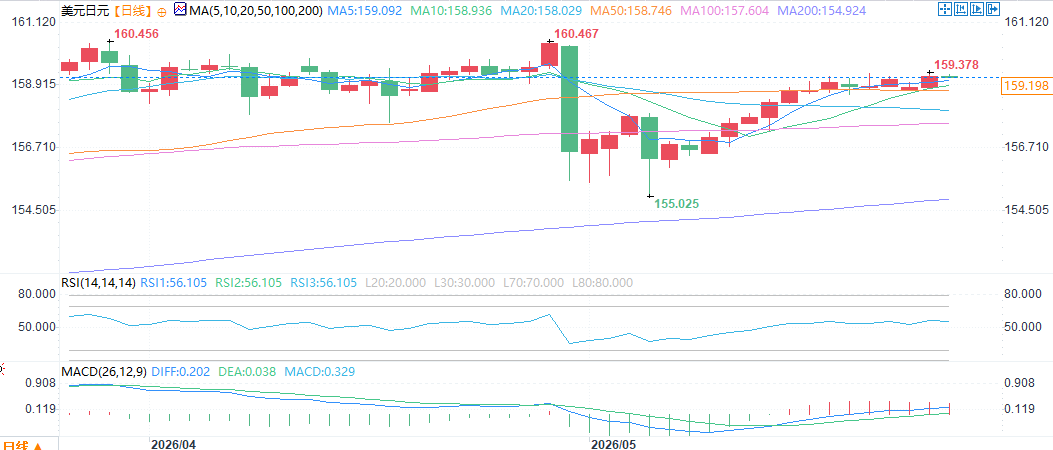
(USD/JPY daily chart, source: FX678)
The RSI has remained above the 50 neutral line, indicating that the average momentum over the past 14 trading days still reflects the buying bias. If this behavior continues, bullish pressure is likely to remain unchanged in the coming trading days.
Currently, the MACD indicator shows the DIFF line at 0.202 and the DEA line at 0.038. The DIFF line has crossed above the DEA line from below, forming a golden cross signal, and the golden cross opening is steadily widening. This is a typical signal of increasing bullish momentum, indicating that buying power is continuously accumulating.
Regarding the moving average system, the 5-day moving average (MA5) (159.09), 10-day moving average (MA10) (158.94), 20-day moving average (MA20) (158.03), and 50-day moving average (MA50) are all below the current price, forming short-term support; the 100-day moving average (MA100) (157.60) and 200-day moving average (MA200) are significantly lower than the current price, showing a bullish alignment. This alignment of "price above all major moving averages" indicates that the USD/JPY pair remains in a clear upward trend.
160.000 – Key resistance: a psychological level coinciding with recent highs. A move towards this area could reinforce the current buying bias and open the door to an extension of the uptrend line in the coming weeks.
155.025 – Key Support: Recent low, coinciding with the bottom of the uptrend line. This level is crucial; a break below it would completely negate the long-term bullish structure and give way to a more dominant selling bias that could last for weeks.
In conclusion, the USD/JPY pair is currently in a consolidation phase due to geopolitical uncertainties, with the USD/JPY interest rate differential remaining the core determinant of its medium-term direction. In the short term, developments in the Middle East and US PCE data may break the deadlock; in the medium term, unless the Bank of Japan clarifies its interest rate hike path to narrow the interest rate differential, the yen will struggle to establish a solid foundation for sustained recovery.
At 13:11 Beijing time on May 27, the USD/JPY exchange rate was 159.25/26.
The yen's recent poor performance has failed to sustain demand against the dollar. In fact, the dollar has risen nearly 1% against the yen over the past 10 trading days, reflecting the yen's short-term weakness. However, in addition to buying pressure on the currency pair, the recent weakness of the dollar is also beginning to indicate a neutral phase.
This is mainly due to the conflicting rhetoric surrounding the Middle East, which has left the US dollar uncertain, while the Japanese yen has also failed to demonstrate clear appeal. If the geopolitical situation does not become clearer, this period of indecision may continue to influence the yen's exchange rate.
Middle East Situation: Optimistic Expectations Coexist with Military Strikes, Dollar Remains Neutral
Last weekend, comments about the US and Iran intensifying their efforts to reach a peace agreement in the near future sparked some optimism. Such an agreement, if achieved, could allow the Strait of Hormuz to reopen and reduce some global geopolitical uncertainty, which could initially put downward pressure on the dollar.
However, a peace agreement has not yet been signed, and the US has launched new attacks in southern Iran, which could escalate tensions again and reduce hopes for a swift agreement. This neutral state is reflected in the US dollar index—currently hovering around 99, but its curve has clearly flattened, indicating a lack of clear direction for the dollar.
Despite the neutral dollar, the market remains cautious and has not seen a rapid increase in demand for the yen. This is likely because participants are waiting for greater clarity on the situation in the Middle East before taking more definitive positions. Therefore, unless there are significant developments, the neutral state of the dollar index is likely to continue to be reflected in the USD/JPY exchange rate, indicating that the yen has not yet regained its sustained appeal.
Interest rate differentials remain the dominant long-term factor: the US-Japan interest rate differential remains high.
Interest rate dynamics between the two countries have been one of the main factors influencing the rise of the US dollar against the Japanese yen in recent months. The US benchmark interest rate remains at 3.75%, while Japan's is at 0.75%, with the interest rate differential still significantly favoring the dollar. Facing the dual challenges of weakening job growth momentum and potential inflationary pressures from the Middle East conflict, the Federal Reserve is expected to maintain interest rates unchanged in the near term, reinforcing a managed neutral outlook.
The short-term outlook for Japan is similar. While the Bank of Japan is concerned about inflation nearing its 2% target and real interest rates remaining low, the possibility of further rate hikes has not yet become clear. Market uncertainty regarding whether the Bank of Japan will maintain stable interest rates or begin a small rate hike in June has failed to provide a clear signal that interest rate differentials will soon narrow, thus limiting the likelihood of continued demand for the yen.
Therefore, interest rate differentials remain a key factor. Higher U.S. interest rates make its bond market more attractive relative to Japan, thus providing stronger support for demand for the dollar. Unless the Bank of Japan decides to raise interest rates to narrow the interest rate differential with the U.S., the yen may lack a solid foundation for a sustained recovery.
USD/JPY Daily Technical Analysis
Despite the recent neutral movement of the USD/JPY exchange rate, the daily chart still maintains the major uptrend line that has been in place for several months. Unless a sell-off occurs to correct the trend in the short term, this structure is likely to remain the dominant pattern.
(USD/JPY daily chart, source: FX678)
The RSI has remained above the 50 neutral line, indicating that the average momentum over the past 14 trading days still reflects the buying bias. If this behavior continues, bullish pressure is likely to remain unchanged in the coming trading days.
Currently, the MACD indicator shows the DIFF line at 0.202 and the DEA line at 0.038. The DIFF line has crossed above the DEA line from below, forming a golden cross signal, and the golden cross opening is steadily widening. This is a typical signal of increasing bullish momentum, indicating that buying power is continuously accumulating.
Regarding the moving average system, the 5-day moving average (MA5) (159.09), 10-day moving average (MA10) (158.94), 20-day moving average (MA20) (158.03), and 50-day moving average (MA50) are all below the current price, forming short-term support; the 100-day moving average (MA100) (157.60) and 200-day moving average (MA200) are significantly lower than the current price, showing a bullish alignment. This alignment of "price above all major moving averages" indicates that the USD/JPY pair remains in a clear upward trend.
160.000 – Key resistance: a psychological level coinciding with recent highs. A move towards this area could reinforce the current buying bias and open the door to an extension of the uptrend line in the coming weeks.
155.025 – Key Support: Recent low, coinciding with the bottom of the uptrend line. This level is crucial; a break below it would completely negate the long-term bullish structure and give way to a more dominant selling bias that could last for weeks.
Interest rate differentials will dominate the medium-term trend; the yen's recovery depends on a policy shift.
In conclusion, the USD/JPY pair is currently in a consolidation phase due to geopolitical uncertainties, with the USD/JPY interest rate differential remaining the core determinant of its medium-term direction. In the short term, developments in the Middle East and US PCE data may break the deadlock; in the medium term, unless the Bank of Japan clarifies its interest rate hike path to narrow the interest rate differential, the yen will struggle to establish a solid foundation for sustained recovery.
At 13:11 Beijing time on May 27, the USD/JPY exchange rate was 159.25/26.
- Risk Warning and Disclaimer
- The market involves risk, and trading may not be suitable for all investors. This article is for reference only and does not constitute personal investment advice, nor does it take into account certain users’ specific investment objectives, financial situation, or other needs. Any investment decisions made based on this information are at your own risk.