Diverging consumer data put downward pressure on gold; PCE data may trigger a "sell the news" rally.
2026-05-27 16:02:54
On Wednesday (May 27), spot gold opened higher but then fluctuated downwards, currently trading down 0.46% around 4486, with an overall weak trend.
Influenced by expectations of hawkish monetary policies from global central banks, gold bulls have generally chosen to wait and see, significantly compressing the upside potential for prices. Geopolitical conflicts, inflationary pressures, and interest rate expectations have combined to become the core forces influencing gold price trends.
Meanwhile, the recent continuous decline in gold prices also suggests that market risk appetite is shifting. The fact that gold prices have failed to rise despite continuous positive news may indicate that the equity market is also approaching a turning point.
On Monday, the U.S. military launched a defensive strike against southern Iran, targeting missile sites and speedboats carrying out mine-laying operations.
The Iranian Foreign Ministry immediately condemned the move, asserting that the US action violated the ceasefire agreement that took effect in early April.
The Iranian Islamic Revolutionary Guard Corps has also made it clear that Iran has the legal right to retaliate against violations, and Iran's Supreme Leader Khamenei has stated that the Middle East will no longer provide shelter for US military bases.
Mohammad Akbarzadeh, deputy commander of the Iranian Islamic Revolutionary Guard Corps Navy, said on the evening of the 26th local time that the US and European economies are highly dependent on energy prices and are vulnerable to changes in the regional situation. This pressure puts the US in a "requesting" position regarding reaching an agreement with Iran.
Akbarzadeh also stated that U.S. hegemony is declining, the West's strategic judgment has failed, and regional countries and global powers have realized that the United States is no longer able to provide security guarantees for its allies.
The atmosphere for peace talks has deteriorated somewhat since the weekend, putting downward pressure on gold prices.
While there have been reports of progress in the interim peace talks between the US and Iran, the negotiations have been fraught with difficulties. US Secretary of State Marco Rubio revealed that the agreement would still take several days to be finalized.
On May 26 local time, Iranian President Pezechzian spoke by phone with the Emir of Qatar. Iran expressed its willingness to reach a dignified framework agreement to end regional tensions, while Qatar pledged to do its utmost to promote regional peace and stability.
On the same day, the Islamic Republic News Agency of Iran reported that Iran had fully restored its international internet connection.
Mohammad Akbarzadeh, deputy commander of the Iranian Islamic Revolutionary Guard Corps Navy, analyzed that the economies of Europe and the United States are highly dependent on energy, and the regional situation has put the United States in a passive position in negotiations, and the United States' global hegemony is gradually declining.
The details still support an agreement, but as Iran is gradually gaining the upper hand, the United States may find it difficult to sign the agreement due to its inability to back down.
Rising energy prices are exacerbating inflation concerns, forcing major central banks around the world to tighten monetary policy. The Reserve Bank of Australia raised interest rates in May, and the market widely predicts that the European Central Bank, the Bank of Japan, and the Reserve Bank of New Zealand will also raise rates this year after maintaining their current interest rates. Current market pricing indicates that the probability of a Federal Reserve rate hike in December is about 50%.
Federal Reserve official Kashkari went so far as to say that if the US-Iran conflict escalates into a protracted war, the US may initiate a series of interest rate hikes.
Gold is a non-interest-bearing asset, and its investment appeal has significantly decreased in a high-interest-rate and strong-dollar environment. The expectation of interest rate hikes has become a major negative factor that continues to suppress gold prices. Since the outbreak of geopolitical conflicts in late February, gold prices have fallen by about 15% cumulatively.
Bank of Japan Governor Kazuo Ueda also warned that a sharp rise in oil prices could have a comprehensive impact on the domestic inflation outlook. Commodity analyst Manav Modi stated that the latest inflation data from major economies confirms that central banks will maintain a hawkish stance, and there is a possibility of further interest rate hikes in the coming months.
The Conference Board Consumer Confidence Index (CCI) performed strongly, while the University of Michigan Consumer Sentiment Index (CSI) hit a 30-year low, showing a clear divergence between the two indicators.
Combining the statistical logic of the two data points, the CCI focuses on employment and the macro business environment, and its positive performance reflects the resilience of the current US job market; the CSI is more inclined to reflect residents' actual income and expenditure and their price perception, and its weakening performance reflects that people are experiencing significant inflationary pressure.
The combination of strong employment and high inflation has further reinforced market expectations that the Federal Reserve will maintain a hawkish policy, delay interest rate cuts, or even restart interest rate hikes.
Faced with this economic landscape, coupled with market high vigilance against continued rising inflation, most traders remained cautious and wait-and-see before the official release of the US personal consumption expenditure (PCE) core inflation data on Thursday. Trading activity was conservative, and funds chose to remain inactive for the time being, making it difficult for the market to experience a significant one-sided trend.
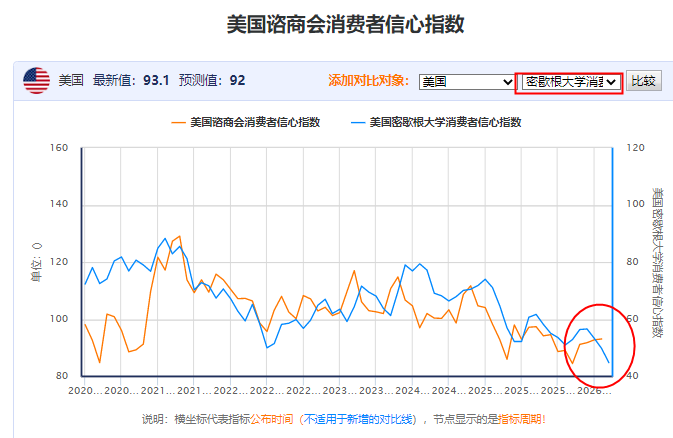
(The two major US consumer confidence indices diverge. Source: EasyForex)
The market is currently focused on two major data releases scheduled for Thursday: the U.S. Personal Consumption Expenditures Price Index and the preliminary U.S. GDP figures. Investors are hoping to glean new directions for gold prices from these data.
In summary, given the multiple factors including recurring geopolitical conflicts, persistent inflationary pressures, and strong expectations of global interest rate hikes, the short-term weakness in gold prices is unlikely to reverse.
The future trend will still need to be closely monitored in terms of the progress of US-Iran negotiations, changes in the situation in the Persian Gulf, and the performance of key US economic data. At the same time, experience shows that the weakening of gold prices may also indicate that the equity market may begin to adjust.
From a technical perspective, spot gold is still trading within a downward channel, with all moving averages arranged in a bearish pattern. The trading strategy leans towards selling on rallies, but if it deviates too far from the middle line of the channel, it may experience a rebound that could be more significant than expected, reflecting the exhaustion of negative news related to the PCE index.
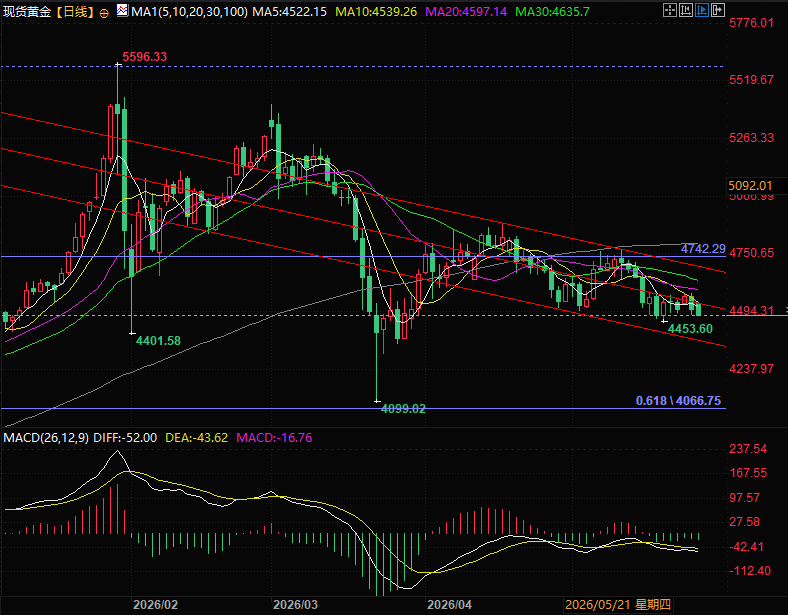
(Spot gold daily chart, source: FX678's subsidiary, EasyForex)
At 15:58 Beijing time, spot gold was trading at $4,481 per ounce.
Influenced by expectations of hawkish monetary policies from global central banks, gold bulls have generally chosen to wait and see, significantly compressing the upside potential for prices. Geopolitical conflicts, inflationary pressures, and interest rate expectations have combined to become the core forces influencing gold price trends.
Meanwhile, the recent continuous decline in gold prices also suggests that market risk appetite is shifting. The fact that gold prices have failed to rise despite continuous positive news may indicate that the equity market is also approaching a turning point.
The protracted conflict between the US and Iran is suppressing gold prices.
On Monday, the U.S. military launched a defensive strike against southern Iran, targeting missile sites and speedboats carrying out mine-laying operations.
The Iranian Foreign Ministry immediately condemned the move, asserting that the US action violated the ceasefire agreement that took effect in early April.
The Iranian Islamic Revolutionary Guard Corps has also made it clear that Iran has the legal right to retaliate against violations, and Iran's Supreme Leader Khamenei has stated that the Middle East will no longer provide shelter for US military bases.
Mohammad Akbarzadeh, deputy commander of the Iranian Islamic Revolutionary Guard Corps Navy, said on the evening of the 26th local time that the US and European economies are highly dependent on energy prices and are vulnerable to changes in the regional situation. This pressure puts the US in a "requesting" position regarding reaching an agreement with Iran.
Akbarzadeh also stated that U.S. hegemony is declining, the West's strategic judgment has failed, and regional countries and global powers have realized that the United States is no longer able to provide security guarantees for its allies.
The atmosphere for peace talks has deteriorated somewhat since the weekend, putting downward pressure on gold prices.
Diplomatic Updates: Peace Talks Face Setbacks, Multiple Parties Actively Mediate to Promote Peace
While there have been reports of progress in the interim peace talks between the US and Iran, the negotiations have been fraught with difficulties. US Secretary of State Marco Rubio revealed that the agreement would still take several days to be finalized.
On May 26 local time, Iranian President Pezechzian spoke by phone with the Emir of Qatar. Iran expressed its willingness to reach a dignified framework agreement to end regional tensions, while Qatar pledged to do its utmost to promote regional peace and stability.
On the same day, the Islamic Republic News Agency of Iran reported that Iran had fully restored its international internet connection.
Mohammad Akbarzadeh, deputy commander of the Iranian Islamic Revolutionary Guard Corps Navy, analyzed that the economies of Europe and the United States are highly dependent on energy, and the regional situation has put the United States in a passive position in negotiations, and the United States' global hegemony is gradually declining.
The details still support an agreement, but as Iran is gradually gaining the upper hand, the United States may find it difficult to sign the agreement due to its inability to back down.
Rising interest rate expectations: Global central banks lean hawkish, reducing gold's attractiveness.
Rising energy prices are exacerbating inflation concerns, forcing major central banks around the world to tighten monetary policy. The Reserve Bank of Australia raised interest rates in May, and the market widely predicts that the European Central Bank, the Bank of Japan, and the Reserve Bank of New Zealand will also raise rates this year after maintaining their current interest rates. Current market pricing indicates that the probability of a Federal Reserve rate hike in December is about 50%.
Federal Reserve official Kashkari went so far as to say that if the US-Iran conflict escalates into a protracted war, the US may initiate a series of interest rate hikes.
Gold is a non-interest-bearing asset, and its investment appeal has significantly decreased in a high-interest-rate and strong-dollar environment. The expectation of interest rate hikes has become a major negative factor that continues to suppress gold prices. Since the outbreak of geopolitical conflicts in late February, gold prices have fallen by about 15% cumulatively.
Bank of Japan Governor Kazuo Ueda also warned that a sharp rise in oil prices could have a comprehensive impact on the domestic inflation outlook. Commodity analyst Manav Modi stated that the latest inflation data from major economies confirms that central banks will maintain a hawkish stance, and there is a possibility of further interest rate hikes in the coming months.
Divergent consumer data suggests US inflation
The Conference Board Consumer Confidence Index (CCI) performed strongly, while the University of Michigan Consumer Sentiment Index (CSI) hit a 30-year low, showing a clear divergence between the two indicators.
Combining the statistical logic of the two data points, the CCI focuses on employment and the macro business environment, and its positive performance reflects the resilience of the current US job market; the CSI is more inclined to reflect residents' actual income and expenditure and their price perception, and its weakening performance reflects that people are experiencing significant inflationary pressure.
The combination of strong employment and high inflation has further reinforced market expectations that the Federal Reserve will maintain a hawkish policy, delay interest rate cuts, or even restart interest rate hikes.
Faced with this economic landscape, coupled with market high vigilance against continued rising inflation, most traders remained cautious and wait-and-see before the official release of the US personal consumption expenditure (PCE) core inflation data on Thursday. Trading activity was conservative, and funds chose to remain inactive for the time being, making it difficult for the market to experience a significant one-sided trend.
(The two major US consumer confidence indices diverge. Source: EasyForex)
Summary and Technical Analysis:
The market is currently focused on two major data releases scheduled for Thursday: the U.S. Personal Consumption Expenditures Price Index and the preliminary U.S. GDP figures. Investors are hoping to glean new directions for gold prices from these data.
In summary, given the multiple factors including recurring geopolitical conflicts, persistent inflationary pressures, and strong expectations of global interest rate hikes, the short-term weakness in gold prices is unlikely to reverse.
The future trend will still need to be closely monitored in terms of the progress of US-Iran negotiations, changes in the situation in the Persian Gulf, and the performance of key US economic data. At the same time, experience shows that the weakening of gold prices may also indicate that the equity market may begin to adjust.
From a technical perspective, spot gold is still trading within a downward channel, with all moving averages arranged in a bearish pattern. The trading strategy leans towards selling on rallies, but if it deviates too far from the middle line of the channel, it may experience a rebound that could be more significant than expected, reflecting the exhaustion of negative news related to the PCE index.
(Spot gold daily chart, source: FX678's subsidiary, EasyForex)
At 15:58 Beijing time, spot gold was trading at $4,481 per ounce.
- Risk Warning and Disclaimer
- The market involves risk, and trading may not be suitable for all investors. This article is for reference only and does not constitute personal investment advice, nor does it take into account certain users’ specific investment objectives, financial situation, or other needs. Any investment decisions made based on this information are at your own risk.