Gold Trading Alert: Gold Prices Plunge to Two-Month Low! Iranian Turmoil and Fed Rate Hike: Is the Bull Market About to End Early?
2026-05-28 07:43:19
Spot gold suffered a sharp drop on Wednesday (May 27), falling 1.1% to $4,456 per ounce, after hitting a low of $4,401.48, its lowest level since March 27. June gold futures also closed down 1.2% at $4,448.40. Within a single day, gold bulls' confidence was severely shaken, with the market shifting from previous safe-haven optimism to dual concerns about inflation and monetary tightening. This decline was not an isolated event, but rather the result of the continued escalation of geopolitical conflicts in the Middle East and a sharp reversal in expectations regarding US monetary policy. On Thursday (May 28), spot gold traded in a narrow range around $4,450, with market attention now focused on US April PCE data, durable goods orders, and initial jobless claims.
The situation in the Middle East remains the core driver of current gold price movements. Since the US and Israel launched attacks on Iran, the conflict has lasted for three months. The de facto blockade of the Strait of Hormuz, a global energy lifeline, has directly pushed up Brent crude oil prices, which in turn has led to global inflationary pressures. The market initially held some optimism about a swift end to the conflict, but this optimism is rapidly fading over time.
Iranian state television reported that both sides planned to restore shipping in the Strait of Hormuz to pre-war levels within a month, under a framework agreement, with joint management by Iran and Oman, while also demanding the withdrawal of US troops from the surrounding area. This news briefly helped to narrow some of the losses in gold prices. However, US President Trump quickly refuted the reports as "pure fabrication" and stated firmly: no one can control this international waterway, and Oman must abide by the rules or face severe consequences. Trump also emphasized that the US is unwilling to ease sanctions against Iran, nor will it allow Russia or China to take over Iran's highly enriched uranium stockpile, while insisting that the nuclear issue will not be easily compromised.
These tit-for-tat statements indicate that a peace agreement remains a distant prospect. Trump even linked ending the war agreement to pushing more countries to join the Abraham Accords, but this was rejected by the countries involved. The protracted conflict not only perpetuates expectations of tight energy supplies but also diminishes gold's appeal as a traditional safe-haven asset—as investors begin to worry that prolonged uncertainty will translate into more persistent inflation rather than short-lived safe-haven demand.
Gold has historically been seen as a hedge against inflation, but in a high-interest-rate environment, its lack of yield makes it vulnerable to pressure. Currently, the market widely bets that soaring energy prices will trigger inflation, forcing the Federal Reserve to raise interest rates by 25 basis points by the end of the year.
In her latest speech, Federal Reserve Governor Tim Cook clearly stated that maintaining the current interest rate is the right choice, but she is prepared to raise rates if necessary. She specifically pointed out that tariffs, the oil price increase due to the Iran war, and the surge in AI-related investment (data center construction driving up construction wages) are all contributing to rising prices. Cook emphasized that inflation has been above the 2% target for five consecutive years, and the consequences would be even more severe if inflation expectations permeate business and worker wage-setting behavior. She also closely monitors oil prices, stating that a return to an upward trend would be "very problematic."
Minneapolis Fed President Neel Kashkari shares a similar view, believing it's too early to discuss policy adjustments, but that curbing the escalating inflation risks must be a priority. Investors are closely awaiting Thursday's US PCE price index data for further policy clues. Against this backdrop, the dollar index rose 0.08% to 99.26 on Wednesday, marking its second consecutive day of strength, further reducing the attractiveness of gold holdings.
Echoing the decline in gold prices, international oil prices plunged more than 5% on Wednesday, with Brent crude falling to $94.29 and U.S. crude to $88.68. The drop in oil prices was mainly driven by market expectations of potential progress in U.S.-Iran peace talks. However, this optimism is also fragile—once the tough statements from Trump and other U.S. officials are digested, the risk premium for oil prices is likely to rebound quickly.
Shipping data shows that although traffic through the Strait of Hormuz remains far below the pre-war level of 125-140 ships per day, sporadic oil tankers are still passing through, which has temporarily alleviated some concerns about extreme supply. However, any breakdown in negotiations or escalation of new conflicts could cause oil prices to rebound instantly, pushing up global inflation expectations again and having a complex impact on gold.
In summary, gold is currently facing a double squeeze: on the one hand, the volatile safe-haven demand stemming from the unresolved geopolitical conflicts; on the other hand, the upward pressure on real interest rates due to the potential interest rate hikes by the Federal Reserve. A stronger US dollar and relatively stable Treasury yields (the 10-year Treasury yield slightly decreased to 4.477%) have also added downward pressure on gold.
However, gold has not completely lost its support. If US-Iran negotiations completely break down, the Strait of Hormuz remains blocked for an extended period, oil prices return to triple-digit levels, and inflation expectations spiral further out of control, gold's value as the ultimate safe-haven asset will remain prominent. While Federal Reserve officials are prepared to raise interest rates, they have also left a backdoor for a rate cut if the job market deteriorates, meaning that the policy path remains uncertain.
For investors, the risk of gold prices further testing lower support levels in the short term should be noted, especially around the time of the PCE data release. However, in the medium to long term, as long as global geopolitical risks do not completely subside, coupled with continued gold purchases by central banks and systemic inflationary pressures, gold still possesses solid investment value. The current pullback may be a window to observe the true market dynamics and identify entry opportunities.
In the coming days, with the release of US PCE data and further progress in US-Iran negotiations, gold prices are likely to experience more significant fluctuations. Whether the $4,400 level can be held may only be the beginning of this dramatic turn of events.
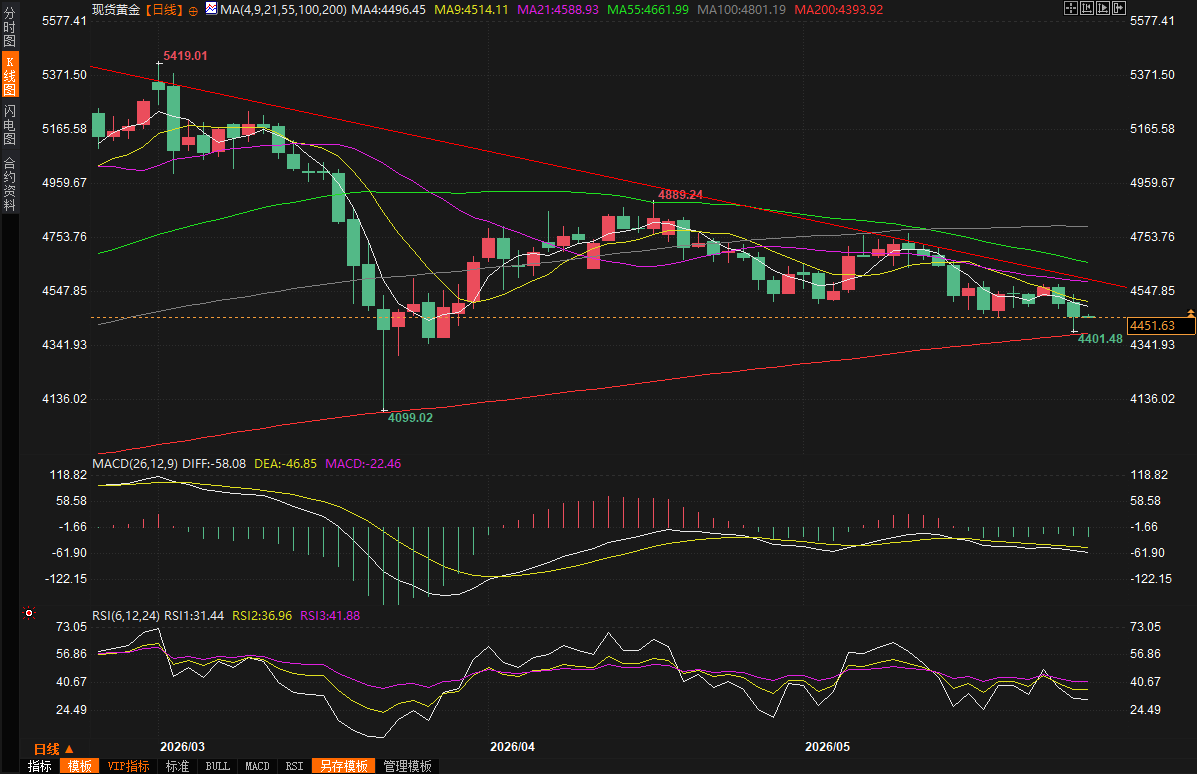
(Spot gold daily chart, source: FX678)
At 07:42 Beijing time, spot gold was trading at $4453.41 per ounce.
Geopolitical conflict looms large: the Strait of Hormuz presents the greatest uncertainty.
The situation in the Middle East remains the core driver of current gold price movements. Since the US and Israel launched attacks on Iran, the conflict has lasted for three months. The de facto blockade of the Strait of Hormuz, a global energy lifeline, has directly pushed up Brent crude oil prices, which in turn has led to global inflationary pressures. The market initially held some optimism about a swift end to the conflict, but this optimism is rapidly fading over time.
Iranian state television reported that both sides planned to restore shipping in the Strait of Hormuz to pre-war levels within a month, under a framework agreement, with joint management by Iran and Oman, while also demanding the withdrawal of US troops from the surrounding area. This news briefly helped to narrow some of the losses in gold prices. However, US President Trump quickly refuted the reports as "pure fabrication" and stated firmly: no one can control this international waterway, and Oman must abide by the rules or face severe consequences. Trump also emphasized that the US is unwilling to ease sanctions against Iran, nor will it allow Russia or China to take over Iran's highly enriched uranium stockpile, while insisting that the nuclear issue will not be easily compromised.
These tit-for-tat statements indicate that a peace agreement remains a distant prospect. Trump even linked ending the war agreement to pushing more countries to join the Abraham Accords, but this was rejected by the countries involved. The protracted conflict not only perpetuates expectations of tight energy supplies but also diminishes gold's appeal as a traditional safe-haven asset—as investors begin to worry that prolonged uncertainty will translate into more persistent inflation rather than short-lived safe-haven demand.
Inflationary pressures surge: Federal Reserve shifts from dovish to hawkish.
Gold has historically been seen as a hedge against inflation, but in a high-interest-rate environment, its lack of yield makes it vulnerable to pressure. Currently, the market widely bets that soaring energy prices will trigger inflation, forcing the Federal Reserve to raise interest rates by 25 basis points by the end of the year.
In her latest speech, Federal Reserve Governor Tim Cook clearly stated that maintaining the current interest rate is the right choice, but she is prepared to raise rates if necessary. She specifically pointed out that tariffs, the oil price increase due to the Iran war, and the surge in AI-related investment (data center construction driving up construction wages) are all contributing to rising prices. Cook emphasized that inflation has been above the 2% target for five consecutive years, and the consequences would be even more severe if inflation expectations permeate business and worker wage-setting behavior. She also closely monitors oil prices, stating that a return to an upward trend would be "very problematic."
Minneapolis Fed President Neel Kashkari shares a similar view, believing it's too early to discuss policy adjustments, but that curbing the escalating inflation risks must be a priority. Investors are closely awaiting Thursday's US PCE price index data for further policy clues. Against this backdrop, the dollar index rose 0.08% to 99.26 on Wednesday, marking its second consecutive day of strength, further reducing the attractiveness of gold holdings.
Oil price volatility and market sentiment transmission
Echoing the decline in gold prices, international oil prices plunged more than 5% on Wednesday, with Brent crude falling to $94.29 and U.S. crude to $88.68. The drop in oil prices was mainly driven by market expectations of potential progress in U.S.-Iran peace talks. However, this optimism is also fragile—once the tough statements from Trump and other U.S. officials are digested, the risk premium for oil prices is likely to rebound quickly.
Shipping data shows that although traffic through the Strait of Hormuz remains far below the pre-war level of 125-140 ships per day, sporadic oil tankers are still passing through, which has temporarily alleviated some concerns about extreme supply. However, any breakdown in negotiations or escalation of new conflicts could cause oil prices to rebound instantly, pushing up global inflation expectations again and having a complex impact on gold.
Gold Market Outlook: Short-term pressure, but medium- to long-term opportunities remain.
In summary, gold is currently facing a double squeeze: on the one hand, the volatile safe-haven demand stemming from the unresolved geopolitical conflicts; on the other hand, the upward pressure on real interest rates due to the potential interest rate hikes by the Federal Reserve. A stronger US dollar and relatively stable Treasury yields (the 10-year Treasury yield slightly decreased to 4.477%) have also added downward pressure on gold.
However, gold has not completely lost its support. If US-Iran negotiations completely break down, the Strait of Hormuz remains blocked for an extended period, oil prices return to triple-digit levels, and inflation expectations spiral further out of control, gold's value as the ultimate safe-haven asset will remain prominent. While Federal Reserve officials are prepared to raise interest rates, they have also left a backdoor for a rate cut if the job market deteriorates, meaning that the policy path remains uncertain.
For investors, the risk of gold prices further testing lower support levels in the short term should be noted, especially around the time of the PCE data release. However, in the medium to long term, as long as global geopolitical risks do not completely subside, coupled with continued gold purchases by central banks and systemic inflationary pressures, gold still possesses solid investment value. The current pullback may be a window to observe the true market dynamics and identify entry opportunities.
In the coming days, with the release of US PCE data and further progress in US-Iran negotiations, gold prices are likely to experience more significant fluctuations. Whether the $4,400 level can be held may only be the beginning of this dramatic turn of events.
(Spot gold daily chart, source: FX678)
At 07:42 Beijing time, spot gold was trading at $4453.41 per ounce.
- Risk Warning and Disclaimer
- The market involves risk, and trading may not be suitable for all investors. This article is for reference only and does not constitute personal investment advice, nor does it take into account certain users’ specific investment objectives, financial situation, or other needs. Any investment decisions made based on this information are at your own risk.