Crude oil trading alert: Escalating tensions between the US and Iran have raised supply concerns, causing oil prices to fluctuate slightly near key support levels.
2026-05-28 09:30:07
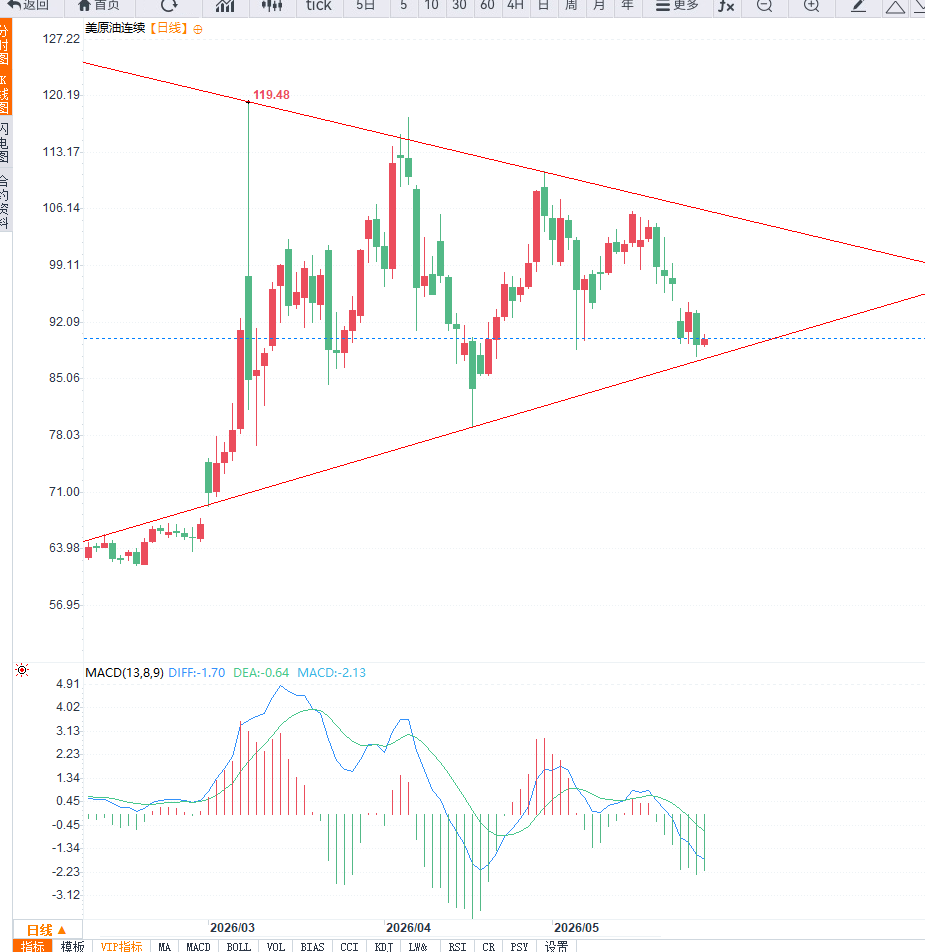
WTI crude oil maintained its rebound during Thursday's Asian trading session, trading around $90. This followed a renewed escalation of tensions between the US and Iran, which rapidly heightened market concerns about the security of the Middle East oil supply chain, pushing international oil prices to recover some of their earlier losses.

The U.S. military launched a new round of strikes on Wednesday against a military target in Iran deemed a threat to U.S. forces in the Middle East and to commercial shipping in the Strait of Hormuz. The U.S. military also intercepted and shot down several Iranian drones deemed threatening. Markets believe this military action could further escalate the situation in the Middle East and increase uncertainty surrounding global energy transportation.
The Strait of Hormuz is considered one of the world's most critical energy transport routes, handling approximately 20% of global seaborne crude oil shipments. Any disruption to transport in this region could quickly strain the global crude oil supply chain. Market funds would then flow back into safe-haven commodities such as crude oil, driving a synchronized rebound in WTI and Brent crude oil prices.
Meanwhile, US President Trump said on Wednesday that he would not rush to reach a deal with Iran, emphasizing that Iran's attempts to "buy time" would not work. This statement further reinforced market expectations of continued escalation of geopolitical risks in the Middle East in the coming weeks. Analysts believe that if the situation continues to deteriorate, the international crude oil market may re-induce a higher "geopolitical risk premium."
Besides geopolitical risks, US inventory data also supported oil prices. Data from the US Energy Information Administration (EIA) showed that US crude oil inventories decreased by 2.8 million barrels in the week ending May 22. While this was less than the significant drop of 9.1 million barrels in the previous week, it still indicated a continued tight supply in the US crude oil market. The market had widely expected that fuel demand would continue to rise with the arrival of the US summer driving season, further reducing inventory levels.
Global market reactions indicate that rising oil prices are beginning to provide new support for inflation expectations. The recent high levels of US Treasury yields are partly due to market concerns that rising energy prices may delay the Federal Reserve's future interest rate cuts. If WTI oil prices stabilize above $90, imported inflationary pressures on major global economies could further intensify.
From a daily chart perspective, WTI crude oil is currently maintaining a strong upward trend. After prices returned above $88, bullish momentum has clearly recovered, and the MACD indicator remains above the zero line, indicating that the medium-to-long-term upward trend has not been broken. Key resistance levels are currently at $90.50 and the $92 area. If Middle East risks continue to escalate, the possibility of oil prices further challenging the $100 mark cannot be ruled out. Important support levels are around $87 and $85.80, and these areas may become important reference points for short-term capital reallocation.
The 4-hour chart shows that WTI has formed a clear short-term rebound channel, with the RSI indicator rising back above 50, indicating strengthening short-term buying power. However, as prices return to the $90 mark, some short-term profit-taking may limit further gains. If subsequent EIA inventory data shows a stronger-than-expected decline, oil prices could break through the $92 mark; conversely, an unexpected increase in inventories could trigger a short-term market correction.
In addition, the performance of the US dollar is also worth noting. The dollar index has remained high recently, which theoretically should exert some downward pressure on dollar-denominated commodities. However, due to the more pronounced impact of current geopolitical risks on market sentiment, the oil market has temporarily ignored the negative impact of a strong dollar. If the situation in the Middle East continues to escalate, volatility in the energy market may further increase.
Market participants are currently focused on several key variables, including whether the US will further escalate its military action against Iran, whether commercial shipping across the Strait of Hormuz will be actually affected, and whether major global consuming countries will release strategic oil reserves to stabilize market supply. These factors could determine whether crude oil prices can remain high in the future.
Editor's Summary : The international crude oil market has re-entered a "geopolitically driven" phase. Escalating tensions between the US and Iran, coupled with a continued decline in US crude oil inventories, have significantly increased market concerns about tight global energy supplies. In the short term, WTI crude oil has once again approached the key psychological level of $90. If shipping risks in the Strait of Hormuz continue to escalate, international oil prices may rise further. However, with continued oil price increases, global inflationary pressures may rebound, potentially impacting the policy paths of major central banks such as the Federal Reserve. Investors should pay close attention to developments in the Middle East, US inventory data, and the global economic demand outlook. If supply risks continue to escalate, the crude oil market may remain highly volatile, but if geopolitical tensions ease, oil prices may also experience a rapid correction.
The U.S. military launched a new round of strikes on Wednesday against a military target in Iran deemed a threat to U.S. forces in the Middle East and to commercial shipping in the Strait of Hormuz. The U.S. military also intercepted and shot down several Iranian drones deemed threatening. Markets believe this military action could further escalate the situation in the Middle East and increase uncertainty surrounding global energy transportation.
The Strait of Hormuz is considered one of the world's most critical energy transport routes, handling approximately 20% of global seaborne crude oil shipments. Any disruption to transport in this region could quickly strain the global crude oil supply chain. Market funds would then flow back into safe-haven commodities such as crude oil, driving a synchronized rebound in WTI and Brent crude oil prices.
Meanwhile, US President Trump said on Wednesday that he would not rush to reach a deal with Iran, emphasizing that Iran's attempts to "buy time" would not work. This statement further reinforced market expectations of continued escalation of geopolitical risks in the Middle East in the coming weeks. Analysts believe that if the situation continues to deteriorate, the international crude oil market may re-induce a higher "geopolitical risk premium."
Besides geopolitical risks, US inventory data also supported oil prices. Data from the US Energy Information Administration (EIA) showed that US crude oil inventories decreased by 2.8 million barrels in the week ending May 22. While this was less than the significant drop of 9.1 million barrels in the previous week, it still indicated a continued tight supply in the US crude oil market. The market had widely expected that fuel demand would continue to rise with the arrival of the US summer driving season, further reducing inventory levels.
Global market reactions indicate that rising oil prices are beginning to provide new support for inflation expectations. The recent high levels of US Treasury yields are partly due to market concerns that rising energy prices may delay the Federal Reserve's future interest rate cuts. If WTI oil prices stabilize above $90, imported inflationary pressures on major global economies could further intensify.
From a daily chart perspective, WTI crude oil is currently maintaining a strong upward trend. After prices returned above $88, bullish momentum has clearly recovered, and the MACD indicator remains above the zero line, indicating that the medium-to-long-term upward trend has not been broken. Key resistance levels are currently at $90.50 and the $92 area. If Middle East risks continue to escalate, the possibility of oil prices further challenging the $100 mark cannot be ruled out. Important support levels are around $87 and $85.80, and these areas may become important reference points for short-term capital reallocation.
The 4-hour chart shows that WTI has formed a clear short-term rebound channel, with the RSI indicator rising back above 50, indicating strengthening short-term buying power. However, as prices return to the $90 mark, some short-term profit-taking may limit further gains. If subsequent EIA inventory data shows a stronger-than-expected decline, oil prices could break through the $92 mark; conversely, an unexpected increase in inventories could trigger a short-term market correction.
In addition, the performance of the US dollar is also worth noting. The dollar index has remained high recently, which theoretically should exert some downward pressure on dollar-denominated commodities. However, due to the more pronounced impact of current geopolitical risks on market sentiment, the oil market has temporarily ignored the negative impact of a strong dollar. If the situation in the Middle East continues to escalate, volatility in the energy market may further increase.
Market participants are currently focused on several key variables, including whether the US will further escalate its military action against Iran, whether commercial shipping across the Strait of Hormuz will be actually affected, and whether major global consuming countries will release strategic oil reserves to stabilize market supply. These factors could determine whether crude oil prices can remain high in the future.
Editor's Summary : The international crude oil market has re-entered a "geopolitically driven" phase. Escalating tensions between the US and Iran, coupled with a continued decline in US crude oil inventories, have significantly increased market concerns about tight global energy supplies. In the short term, WTI crude oil has once again approached the key psychological level of $90. If shipping risks in the Strait of Hormuz continue to escalate, international oil prices may rise further. However, with continued oil price increases, global inflationary pressures may rebound, potentially impacting the policy paths of major central banks such as the Federal Reserve. Investors should pay close attention to developments in the Middle East, US inventory data, and the global economic demand outlook. If supply risks continue to escalate, the crude oil market may remain highly volatile, but if geopolitical tensions ease, oil prices may also experience a rapid correction.
- Risk Warning and Disclaimer
- The market involves risk, and trading may not be suitable for all investors. This article is for reference only and does not constitute personal investment advice, nor does it take into account certain users’ specific investment objectives, financial situation, or other needs. Any investment decisions made based on this information are at your own risk.