The euro fell below 1.16 against the dollar, hitting a new low for the period; caution is advised against a potential acceleration of the decline.
2026-05-28 14:17:56
The euro continued its downward pressure against the US dollar (EUR/USD) during Thursday's Asian trading session, falling to around 1.1590, a new recent low. As the military conflict between the US and Iran escalates further, global market risk appetite has declined significantly, with funds flowing back into safe-haven assets such as the US dollar, leading to continued selling pressure on the euro.

Iran retaliated against the US military operation near Bandar Abbas airport. The Islamic Revolutionary Guard Corps (IRGC) stated that it had attacked a US military base and warned that if the US continued its attacks, Iran would take "more decisive" countermeasures. Meanwhile, three explosions were heard in eastern Bandar Abbas, and local air defense systems were briefly activated. Markets are concerned that the situation in the Middle East could escalate further, impacting global energy supplies and the stability of international financial markets.
Previously, US President Trump and some US officials had expressed optimism about reaching an agreement between the US and Iran, believing that an agreement could be announced in the short term. However, with the renewed escalation of military conflict between the two sides, market expectations for a long-term peace agreement have cooled significantly. Driven by risk aversion, the US dollar index (DXY) rose more than 0.3% on Thursday to around 99.53, hitting a one-week high. Meanwhile, S&P 500 futures fell by about 0.3%, indicating a significant deterioration in global investor risk appetite.
The core logic behind the dollar's rise stems primarily from safe-haven inflows and the market's repricing of the Federal Reserve's interest rate path. Escalating tensions in the Middle East have driven a rebound in international oil prices, raising concerns that global inflationary pressures may resurface, thus reinforcing the likelihood of the Fed maintaining high interest rates or even raising them further. The Strait of Hormuz handles approximately 20% of global seaborne crude oil transport; therefore, any military risks involving the region will quickly impact international oil prices and global market risk sentiment. With WTI crude oil approaching $89 again, market concerns about inflationary risks from rising energy prices have clearly intensified.
The market's focus has now shifted to the US April PCE price index data to be released later tonight. The market expects the annualized US PCE inflation rate to rise to 3.8%, higher than the previous 3.5%. Core PCE is expected to rise to 3.3%. Since the PCE is one of the most closely watched inflation indicators by the Federal Reserve, this data could directly influence market expectations regarding future interest rate policy. If the PCE data continues to exceed expectations, market bets on the Fed maintaining high interest rates may strengthen further, thus continuing to support the dollar's strength and putting further pressure on the EUR/USD exchange rate.
On the other hand, the market is also focused on Germany's May HICP inflation data to be released on Friday. As Germany is the Eurozone's largest economy, its inflation performance typically directly impacts expectations for the European Central Bank's (ECB) policy. Currently, there are still clearly hawkish voices within the ECB. Some ECB officials believe that high energy prices have begun to transmit to the overall economy, therefore, even if the situation in the Middle East eases in the future, the ECB may continue to maintain a relatively tight policy.
However, compared to the US economy, the Eurozone's overall growth remains weak. High energy prices are increasing operating costs for European businesses and could further drag down manufacturing and consumer performance. Therefore, against the backdrop of deteriorating global risk sentiment, the euro's overall performance remains relatively fragile.
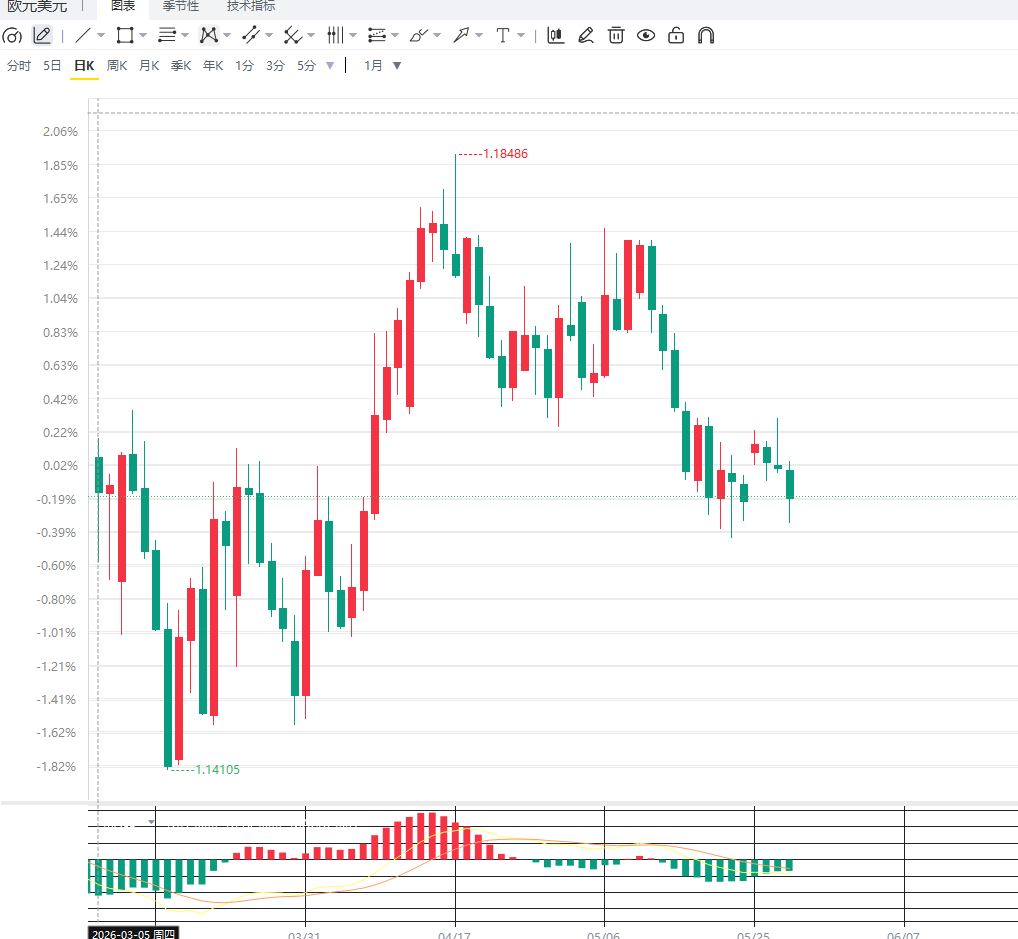
From a daily chart perspective, EUR/USD has recently broken below the key support area of 1.1600 and continues to trade below short-term moving averages, indicating a bearish overall technical structure. The MACD indicator has been declining after a bearish crossover at a high level, showing a significant weakening of medium- to long-term upward momentum. The first major support level is currently around 1.1550; a break below this level could lead to a further test of the 1.1500 psychological level. On the upside, resistance levels to watch are 1.1635 and 1.1680. Only a retest of these areas could allow the euro to resume its short-term rebound.
Furthermore, the persistently high yields on US Treasury bonds have also enhanced the attractiveness of dollar-denominated assets. Following the rise in 10-year US Treasury yields, global capital has flowed further into the dollar market, putting additional pressure on the euro. Overall, the EUR/USD exchange rate is currently under pressure from both the safe-haven dollar and concerns about the European economy. Changes in the Middle East situation and US PCE data will be the core factors determining the exchange rate's next move.
Editor's Summary : The current decline in the euro against the US dollar is primarily driven by the strengthening of the safe-haven dollar due to escalating tensions in the Middle East, and renewed market expectations that the Federal Reserve will maintain high interest rates. Meanwhile, the potential impact of high energy prices on the European economy is further weakening the euro's performance. Technically, EUR/USD has broken below a key support level, and the short-term overall structure is bearish. If US PCE data continues to exceed expectations, the US dollar index may further challenge the 100 level, while EUR/USD may continue to decline towards the 1.15 area. However, given the European Central Bank's hawkish stance, if German inflation data continues to rise, the euro may receive some policy support in the future. Investors should pay close attention to the US-Iran situation, European and American inflation data, and policy changes from major central banks.
Iran retaliated against the US military operation near Bandar Abbas airport. The Islamic Revolutionary Guard Corps (IRGC) stated that it had attacked a US military base and warned that if the US continued its attacks, Iran would take "more decisive" countermeasures. Meanwhile, three explosions were heard in eastern Bandar Abbas, and local air defense systems were briefly activated. Markets are concerned that the situation in the Middle East could escalate further, impacting global energy supplies and the stability of international financial markets.
Previously, US President Trump and some US officials had expressed optimism about reaching an agreement between the US and Iran, believing that an agreement could be announced in the short term. However, with the renewed escalation of military conflict between the two sides, market expectations for a long-term peace agreement have cooled significantly. Driven by risk aversion, the US dollar index (DXY) rose more than 0.3% on Thursday to around 99.53, hitting a one-week high. Meanwhile, S&P 500 futures fell by about 0.3%, indicating a significant deterioration in global investor risk appetite.
The core logic behind the dollar's rise stems primarily from safe-haven inflows and the market's repricing of the Federal Reserve's interest rate path. Escalating tensions in the Middle East have driven a rebound in international oil prices, raising concerns that global inflationary pressures may resurface, thus reinforcing the likelihood of the Fed maintaining high interest rates or even raising them further. The Strait of Hormuz handles approximately 20% of global seaborne crude oil transport; therefore, any military risks involving the region will quickly impact international oil prices and global market risk sentiment. With WTI crude oil approaching $89 again, market concerns about inflationary risks from rising energy prices have clearly intensified.
The market's focus has now shifted to the US April PCE price index data to be released later tonight. The market expects the annualized US PCE inflation rate to rise to 3.8%, higher than the previous 3.5%. Core PCE is expected to rise to 3.3%. Since the PCE is one of the most closely watched inflation indicators by the Federal Reserve, this data could directly influence market expectations regarding future interest rate policy. If the PCE data continues to exceed expectations, market bets on the Fed maintaining high interest rates may strengthen further, thus continuing to support the dollar's strength and putting further pressure on the EUR/USD exchange rate.
On the other hand, the market is also focused on Germany's May HICP inflation data to be released on Friday. As Germany is the Eurozone's largest economy, its inflation performance typically directly impacts expectations for the European Central Bank's (ECB) policy. Currently, there are still clearly hawkish voices within the ECB. Some ECB officials believe that high energy prices have begun to transmit to the overall economy, therefore, even if the situation in the Middle East eases in the future, the ECB may continue to maintain a relatively tight policy.
However, compared to the US economy, the Eurozone's overall growth remains weak. High energy prices are increasing operating costs for European businesses and could further drag down manufacturing and consumer performance. Therefore, against the backdrop of deteriorating global risk sentiment, the euro's overall performance remains relatively fragile.
From a daily chart perspective, EUR/USD has recently broken below the key support area of 1.1600 and continues to trade below short-term moving averages, indicating a bearish overall technical structure. The MACD indicator has been declining after a bearish crossover at a high level, showing a significant weakening of medium- to long-term upward momentum. The first major support level is currently around 1.1550; a break below this level could lead to a further test of the 1.1500 psychological level. On the upside, resistance levels to watch are 1.1635 and 1.1680. Only a retest of these areas could allow the euro to resume its short-term rebound.
Furthermore, the persistently high yields on US Treasury bonds have also enhanced the attractiveness of dollar-denominated assets. Following the rise in 10-year US Treasury yields, global capital has flowed further into the dollar market, putting additional pressure on the euro. Overall, the EUR/USD exchange rate is currently under pressure from both the safe-haven dollar and concerns about the European economy. Changes in the Middle East situation and US PCE data will be the core factors determining the exchange rate's next move.
Editor's Summary : The current decline in the euro against the US dollar is primarily driven by the strengthening of the safe-haven dollar due to escalating tensions in the Middle East, and renewed market expectations that the Federal Reserve will maintain high interest rates. Meanwhile, the potential impact of high energy prices on the European economy is further weakening the euro's performance. Technically, EUR/USD has broken below a key support level, and the short-term overall structure is bearish. If US PCE data continues to exceed expectations, the US dollar index may further challenge the 100 level, while EUR/USD may continue to decline towards the 1.15 area. However, given the European Central Bank's hawkish stance, if German inflation data continues to rise, the euro may receive some policy support in the future. Investors should pay close attention to the US-Iran situation, European and American inflation data, and policy changes from major central banks.
- Risk Warning and Disclaimer
- The market involves risk, and trading may not be suitable for all investors. This article is for reference only and does not constitute personal investment advice, nor does it take into account certain users’ specific investment objectives, financial situation, or other needs. Any investment decisions made based on this information are at your own risk.