Gold Trading Alert: US-Iran "Draft Ceasefire Agreement" Triggers Sharp V-Shaped Reversal in Gold Prices – Is it a Glimmer of Hope or a Smokescreen?
2026-05-29 07:44:21
The international gold market witnessed a dramatic reversal in the past trading day. Spot gold prices plummeted to a two-month low of $4366.52 per ounce on Thursday (May 28th), but just as bears were celebrating their victory, the situation suddenly reversed. Gold prices subsequently staged a strong rebound, ultimately not only recovering all losses but also closing up nearly 1% at $4495.59 per ounce, demonstrating a textbook example of a "bottoming out and rebounding" pattern. The US gold futures market also performed strongly, with the most active contract closing up 1.1% at $4532.40.
The immediate trigger for this round of price movements was a major news item that could reshape the geopolitical landscape of the Middle East—the United States and Iran reportedly reached an agreement to extend the ceasefire. From its intraday low to the final close, gold prices rebounded by more than $100 in just a few hours, demonstrating the market's extreme sensitivity to geopolitical news.
On Friday (May 29) in early Asian trading, spot gold traded in a narrow range, currently trading at $4,490 per ounce.
To understand this dramatic reversal in gold prices, we need to look back to the conflict between the United States and Israel against Iran, which broke out at the end of February this year. This three-month-long war has resulted in thousands of deaths and has completely upended the global energy market. For the gold market, this conflict has consistently played a double-edged sword role.
For a considerable period after the outbreak of the conflict, gold prices remained under pressure. This might seem counterintuitive—gold, as a traditional safe-haven asset, should be sought after during times of geopolitical turmoil. However, the reality is more complex. This Middle East conflict exacerbated global inflationary pressures by driving up energy prices, particularly impacting US inflation. Data shows that the average retail price of gasoline nationwide in the US rose by 12.3% in April, and gasoline prices have cumulatively increased by more than 50% since the outbreak of the war at the end of February. High inflation has forced the market to reassess the Federal Reserve's monetary policy path, and investors have begun to expect interest rates to remain at higher levels for a longer period.
It is against this backdrop that gold's safe-haven properties have been temporarily overshadowed. In an environment of rising interest rates, holding non-interest-bearing gold means an increased opportunity cost, and investors tend to turn to assets that can provide returns. This explains why gold has underperformed against the backdrop of persistent geopolitical risks.
However, news on Thursday changed this logic. According to four sources familiar with the matter, the United States and Iran have reached a draft memorandum of understanding on extending the ceasefire and restoring freedom of navigation in the Strait of Hormuz. The agreement plans to extend the ceasefire for another 60 days and allow ships to pass through this strategic waterway, while negotiators will address thorny issues such as Iran's nuclear program. Although the agreement still needs approval from US President Trump, and Iran's official Tasnim News Agency stated that the text of the agreement has not yet been finalized or confirmed, the news itself is enough to shake market expectations of a continued deterioration in the Middle East situation.
The V-shaped reversal in gold prices is not an isolated phenomenon; it is inextricably linked to the correlation between the US dollar and the oil market. Following the news, the US dollar index, which measures the dollar against a basket of currencies, surged and then retreated, closing down 0.23% at 99. This made dollar-denominated gold cheaper for overseas buyers. It is worth noting that the dollar index rose as much as 0.3% to 99.54 during the session, reaching a new high since April 8th, but as the ceasefire news gained traction, the dollar completely reversed its previous gains.
Meanwhile, Brent crude oil prices also declined after the report was published. The Strait of Hormuz is a crucial shipping route for about one-fifth of the world's oil and liquefied natural gas supplies, and any progress in restoring free navigation through the strait directly impacts energy price trends. The decline in oil prices further eased market concerns about runaway inflation, thereby reducing pressure on the Federal Reserve to raise interest rates.
As independent precious metals trader Tai Wong put it, "The trading gods seemed to be intervening in the gold market on Thursday. First came the poor PCE data, and now there are reports of an impending agreement to open the Strait of Hormuz, which has given gold a much-needed breather." This statement accurately captures the subtle shift in market sentiment.
Following the release of April inflation data by the U.S. Bureau of Economic Analysis, the market was initially pessimistic about gold. The data showed that in the 12 months ending in April, the personal consumption expenditures price index rose 3.8%, the largest increase since May 2023, a figure fully in line with economists' previous expectations. The core PCE price index, which is of greater market focus, rose 3.3% year-on-year, also above the Federal Reserve's 2% target level.
Looking at the month-on-month data, the PCE rose 0.4% in April, a slowdown from 0.7% in March. More importantly, the core PCE, excluding food and energy, rose only 0.2% month-on-month, also lower than the previous month's 0.3%. This suggests that although inflation remains high, the growth momentum may be peaking. Combined with the news that the first-quarter GDP growth rate was revised down from 2.0% to 1.6%, the market is beginning to reassess the true extent of the "stagflation" risk.
The statements from Federal Reserve officials also presented a delicate balance. New York Fed President Williams stated that given the current outlook, the Fed's monetary policy is in the right place, and he expects inflation to remain high in the short term, but pressures will ease later this year. St. Louis Fed President Musaleem, however, offered a more hawkish view at an economic conference in Iceland, stating that if inflation fails to slow within the next six months, the Fed may actually need to raise policy rates.
Financial markets currently expect the Federal Reserve to maintain its benchmark interest rate in the 3.50% to 3.75% range until 2027. This expectation itself already reflects the market's judgment that "interest rates will remain high for a longer period," and any marginal easing could become a catalyst for a gold price rebound.
When analyzing the gold market, important signals from the physical demand side cannot be ignored. Data shows that net gold imports via Hong Kong in April increased significantly by 81.2% compared to March. This astonishing growth rate indicates that despite gold prices being at historically high levels, physical demand from the world's largest gold consumer remains robust.
China's gold import growth is likely driven by multiple factors. On the one hand, with the traditional peak season for gold purchases approaching, jewelers and investors are actively stocking up. On the other hand, gold's appeal as a store of value has further increased. More importantly, this strong physical demand provides solid support for gold prices, explaining why gold prices quickly found buying support after falling to around $4,366.
In analyzing this market trend, caution and objectivity must be maintained. Regarding the news of a ceasefire agreement between the US and Iran, many uncertainties remain. First, the agreement still needs the approval of US President Trump, and the Trump administration has repeatedly stated that an agreement to end the conflict is close to being reached, but ultimately none has been implemented. Second, Iran's Tasnim News Agency, citing sources close to the negotiating team, explicitly stated that the text of the agreement has not yet been finalized or confirmed, casting doubt on the veracity of the news.
More noteworthy is that this news came shortly after a new round of retaliatory exchanges between the United States and Iran. The U.S. Central Command stated that it shot down five Iranian attack drones and struck a ground control station in the port city of Bandar Abbas. Iran's Islamic Revolutionary Guard Corps responded, claiming its target was a U.S. military base that planned the attack on Bandar Abbas and warning of a "more decisive response" should such an incident recur. Kuwaiti forces also intercepted a ballistic missile fired towards their country.
This series of events highlights the continued difficulty in transforming a fragile ceasefire into a lasting agreement. The market is clearly aware of this – although gold prices rebounded sharply from their lows, they failed to break through the $4,500 mark, and the closing price of $4,495.59 reflects the fierce struggle between bulls and bears at this level.
From a technical analysis perspective, Thursday's rebound after testing the lows is significant. $4366.52 was the lowest level since late March and also close to the 200-day moving average. The fact that gold prices rebounded quickly after testing this area indicates strong technical buying support at that level. Furthermore, the closing price regaining above $4490 resulted in a long lower shadow bullish candlestick on the daily chart, a pattern typically considered a signal of a short-term bottom.
The changes in the U.S. Treasury market are also noteworthy. The benchmark 10-year Treasury yield fell 2.4 basis points to 4.457%, while the two-year Treasury yield dipped slightly by 0.8 basis points to 4.025%. The shift in the yield curve reflects that market concerns about the economic growth outlook are outweighing concerns about inflation. Peter Cardillo, chief market economist at Spartan Capital Securities, offered a representative comment: "What today's data reveals is simply that we are facing stagflation, which is a big problem for the Fed."
The performance of the US stock market is equally noteworthy. The S&P 500 and Nasdaq both hit record closing highs, while the Dow Jones Industrial Average also closed at a record high. This pattern of simultaneous rises in risk assets and gold suggests that the market's current logic is shifting from a binary opposition of "safe haven vs. risk" to a shared expectation of a "repricing of monetary policy paths."
Looking ahead, the gold market will face a complex interplay of multiple forces. On the downside, if the US-Iran ceasefire agreement is ultimately approved and implemented by both leaderships, it will effectively alleviate geopolitical tensions and energy price pressures, thereby weakening the safe-haven demand for gold and its role as an inflation hedge. Falling oil prices will directly impact inflation data, potentially giving the Federal Reserve greater flexibility in monetary policy, but also reducing the necessity of holding gold.
On the positive side, US real disposable income is being eroded by inflation. Inflation-adjusted disposable income fell 0.5% in April, continuing its decline since February, with a year-on-year decrease of 1.1%, the largest drop since November 2022. The savings rate has fallen to a four-year low of 2.6%, constraining consumers' future spending power. The combination of slowing economic growth and high inflation is the classic investment scenario for gold.
Furthermore, the global trend of central bank gold purchases continues, and the significant increase in China's gold imports in April is also a positive sign. Even with gold prices at historically high levels, the resilience of physical demand has exceeded the expectations of many analysts.
The key lies in whether Trump will approve the agreement. If approved, shipping in the Strait of Hormuz will return to normal, marking a major turning point for the global energy market. Gold may face further downward pressure, and the support level at $4366 needs to be monitored. If the agreement stalls or Iran denies the validity of the news, the situation in the Middle East may escalate again, and gold could quickly break through the $4500 mark, challenging $4600 or even higher.
Regardless, gold investors need to closely monitor any news from Washington and Tehran in the coming period. The current gold market has entered a sensitive period driven by news, and any signal regarding progress in the ceasefire or escalation of the conflict could trigger sharp price fluctuations. In this environment, risk management is more important than the accuracy of directional judgments.
For long-term investors, gold's core value as a hedge against inflation and geopolitical risks remains unchanged. US real interest rates remain at historically low levels, global debt levels continue to rise, and central banks worldwide face difficult monetary policy choices; these structural factors all support gold's long-term performance. Short-term news disturbances may actually present a rare opportunity for long-term positioning.
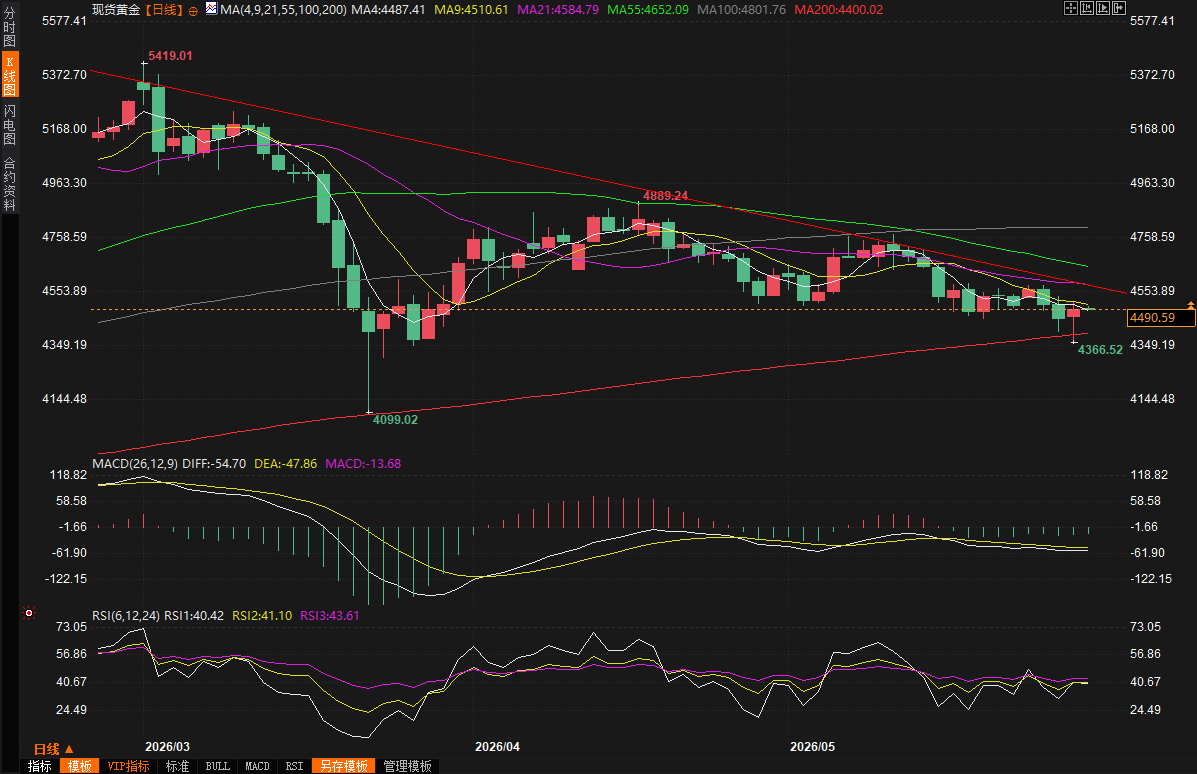
(Spot gold daily chart, source: FX678)
At 07:41 Beijing time, spot gold was trading at $4490.77 per ounce.
The immediate trigger for this round of price movements was a major news item that could reshape the geopolitical landscape of the Middle East—the United States and Iran reportedly reached an agreement to extend the ceasefire. From its intraday low to the final close, gold prices rebounded by more than $100 in just a few hours, demonstrating the market's extreme sensitivity to geopolitical news.
On Friday (May 29) in early Asian trading, spot gold traded in a narrow range, currently trading at $4,490 per ounce.
Geopolitics: A Double-Edged Sword – From Inflation Driver to a Dawn of Ceasefire
To understand this dramatic reversal in gold prices, we need to look back to the conflict between the United States and Israel against Iran, which broke out at the end of February this year. This three-month-long war has resulted in thousands of deaths and has completely upended the global energy market. For the gold market, this conflict has consistently played a double-edged sword role.
For a considerable period after the outbreak of the conflict, gold prices remained under pressure. This might seem counterintuitive—gold, as a traditional safe-haven asset, should be sought after during times of geopolitical turmoil. However, the reality is more complex. This Middle East conflict exacerbated global inflationary pressures by driving up energy prices, particularly impacting US inflation. Data shows that the average retail price of gasoline nationwide in the US rose by 12.3% in April, and gasoline prices have cumulatively increased by more than 50% since the outbreak of the war at the end of February. High inflation has forced the market to reassess the Federal Reserve's monetary policy path, and investors have begun to expect interest rates to remain at higher levels for a longer period.
It is against this backdrop that gold's safe-haven properties have been temporarily overshadowed. In an environment of rising interest rates, holding non-interest-bearing gold means an increased opportunity cost, and investors tend to turn to assets that can provide returns. This explains why gold has underperformed against the backdrop of persistent geopolitical risks.
However, news on Thursday changed this logic. According to four sources familiar with the matter, the United States and Iran have reached a draft memorandum of understanding on extending the ceasefire and restoring freedom of navigation in the Strait of Hormuz. The agreement plans to extend the ceasefire for another 60 days and allow ships to pass through this strategic waterway, while negotiators will address thorny issues such as Iran's nuclear program. Although the agreement still needs approval from US President Trump, and Iran's official Tasnim News Agency stated that the text of the agreement has not yet been finalized or confirmed, the news itself is enough to shake market expectations of a continued deterioration in the Middle East situation.
The Link Between the US Dollar and Oil Prices: A Breath of Fresh Air for Gold
The V-shaped reversal in gold prices is not an isolated phenomenon; it is inextricably linked to the correlation between the US dollar and the oil market. Following the news, the US dollar index, which measures the dollar against a basket of currencies, surged and then retreated, closing down 0.23% at 99. This made dollar-denominated gold cheaper for overseas buyers. It is worth noting that the dollar index rose as much as 0.3% to 99.54 during the session, reaching a new high since April 8th, but as the ceasefire news gained traction, the dollar completely reversed its previous gains.
Meanwhile, Brent crude oil prices also declined after the report was published. The Strait of Hormuz is a crucial shipping route for about one-fifth of the world's oil and liquefied natural gas supplies, and any progress in restoring free navigation through the strait directly impacts energy price trends. The decline in oil prices further eased market concerns about runaway inflation, thereby reducing pressure on the Federal Reserve to raise interest rates.
As independent precious metals trader Tai Wong put it, "The trading gods seemed to be intervening in the gold market on Thursday. First came the poor PCE data, and now there are reports of an impending agreement to open the Strait of Hormuz, which has given gold a much-needed breather." This statement accurately captures the subtle shift in market sentiment.
Two sides of the inflation data: Is the bad news fully priced in or is the pressure still there?
Following the release of April inflation data by the U.S. Bureau of Economic Analysis, the market was initially pessimistic about gold. The data showed that in the 12 months ending in April, the personal consumption expenditures price index rose 3.8%, the largest increase since May 2023, a figure fully in line with economists' previous expectations. The core PCE price index, which is of greater market focus, rose 3.3% year-on-year, also above the Federal Reserve's 2% target level.
Looking at the month-on-month data, the PCE rose 0.4% in April, a slowdown from 0.7% in March. More importantly, the core PCE, excluding food and energy, rose only 0.2% month-on-month, also lower than the previous month's 0.3%. This suggests that although inflation remains high, the growth momentum may be peaking. Combined with the news that the first-quarter GDP growth rate was revised down from 2.0% to 1.6%, the market is beginning to reassess the true extent of the "stagflation" risk.
The statements from Federal Reserve officials also presented a delicate balance. New York Fed President Williams stated that given the current outlook, the Fed's monetary policy is in the right place, and he expects inflation to remain high in the short term, but pressures will ease later this year. St. Louis Fed President Musaleem, however, offered a more hawkish view at an economic conference in Iceland, stating that if inflation fails to slow within the next six months, the Fed may actually need to raise policy rates.
Financial markets currently expect the Federal Reserve to maintain its benchmark interest rate in the 3.50% to 3.75% range until 2027. This expectation itself already reflects the market's judgment that "interest rates will remain high for a longer period," and any marginal easing could become a catalyst for a gold price rebound.
Positive signals from Chinese demand
When analyzing the gold market, important signals from the physical demand side cannot be ignored. Data shows that net gold imports via Hong Kong in April increased significantly by 81.2% compared to March. This astonishing growth rate indicates that despite gold prices being at historically high levels, physical demand from the world's largest gold consumer remains robust.
China's gold import growth is likely driven by multiple factors. On the one hand, with the traditional peak season for gold purchases approaching, jewelers and investors are actively stocking up. On the other hand, gold's appeal as a store of value has further increased. More importantly, this strong physical demand provides solid support for gold prices, explaining why gold prices quickly found buying support after falling to around $4,366.
The authenticity of the ceasefire agreement and the nuances of market reaction.
In analyzing this market trend, caution and objectivity must be maintained. Regarding the news of a ceasefire agreement between the US and Iran, many uncertainties remain. First, the agreement still needs the approval of US President Trump, and the Trump administration has repeatedly stated that an agreement to end the conflict is close to being reached, but ultimately none has been implemented. Second, Iran's Tasnim News Agency, citing sources close to the negotiating team, explicitly stated that the text of the agreement has not yet been finalized or confirmed, casting doubt on the veracity of the news.
More noteworthy is that this news came shortly after a new round of retaliatory exchanges between the United States and Iran. The U.S. Central Command stated that it shot down five Iranian attack drones and struck a ground control station in the port city of Bandar Abbas. Iran's Islamic Revolutionary Guard Corps responded, claiming its target was a U.S. military base that planned the attack on Bandar Abbas and warning of a "more decisive response" should such an incident recur. Kuwaiti forces also intercepted a ballistic missile fired towards their country.
This series of events highlights the continued difficulty in transforming a fragile ceasefire into a lasting agreement. The market is clearly aware of this – although gold prices rebounded sharply from their lows, they failed to break through the $4,500 mark, and the closing price of $4,495.59 reflects the fierce struggle between bulls and bears at this level.
The resonance of technical and financial factors
From a technical analysis perspective, Thursday's rebound after testing the lows is significant. $4366.52 was the lowest level since late March and also close to the 200-day moving average. The fact that gold prices rebounded quickly after testing this area indicates strong technical buying support at that level. Furthermore, the closing price regaining above $4490 resulted in a long lower shadow bullish candlestick on the daily chart, a pattern typically considered a signal of a short-term bottom.
The changes in the U.S. Treasury market are also noteworthy. The benchmark 10-year Treasury yield fell 2.4 basis points to 4.457%, while the two-year Treasury yield dipped slightly by 0.8 basis points to 4.025%. The shift in the yield curve reflects that market concerns about the economic growth outlook are outweighing concerns about inflation. Peter Cardillo, chief market economist at Spartan Capital Securities, offered a representative comment: "What today's data reveals is simply that we are facing stagflation, which is a big problem for the Fed."
The performance of the US stock market is equally noteworthy. The S&P 500 and Nasdaq both hit record closing highs, while the Dow Jones Industrial Average also closed at a record high. This pattern of simultaneous rises in risk assets and gold suggests that the market's current logic is shifting from a binary opposition of "safe haven vs. risk" to a shared expectation of a "repricing of monetary policy paths."
Market Outlook: Gold's Direction Amidst Mixed Bullish and Bearish Factors
Looking ahead, the gold market will face a complex interplay of multiple forces. On the downside, if the US-Iran ceasefire agreement is ultimately approved and implemented by both leaderships, it will effectively alleviate geopolitical tensions and energy price pressures, thereby weakening the safe-haven demand for gold and its role as an inflation hedge. Falling oil prices will directly impact inflation data, potentially giving the Federal Reserve greater flexibility in monetary policy, but also reducing the necessity of holding gold.
On the positive side, US real disposable income is being eroded by inflation. Inflation-adjusted disposable income fell 0.5% in April, continuing its decline since February, with a year-on-year decrease of 1.1%, the largest drop since November 2022. The savings rate has fallen to a four-year low of 2.6%, constraining consumers' future spending power. The combination of slowing economic growth and high inflation is the classic investment scenario for gold.
Furthermore, the global trend of central bank gold purchases continues, and the significant increase in China's gold imports in April is also a positive sign. Even with gold prices at historically high levels, the resilience of physical demand has exceeded the expectations of many analysts.
The key lies in whether Trump will approve the agreement. If approved, shipping in the Strait of Hormuz will return to normal, marking a major turning point for the global energy market. Gold may face further downward pressure, and the support level at $4366 needs to be monitored. If the agreement stalls or Iran denies the validity of the news, the situation in the Middle East may escalate again, and gold could quickly break through the $4500 mark, challenging $4600 or even higher.
Regardless, gold investors need to closely monitor any news from Washington and Tehran in the coming period. The current gold market has entered a sensitive period driven by news, and any signal regarding progress in the ceasefire or escalation of the conflict could trigger sharp price fluctuations. In this environment, risk management is more important than the accuracy of directional judgments.
For long-term investors, gold's core value as a hedge against inflation and geopolitical risks remains unchanged. US real interest rates remain at historically low levels, global debt levels continue to rise, and central banks worldwide face difficult monetary policy choices; these structural factors all support gold's long-term performance. Short-term news disturbances may actually present a rare opportunity for long-term positioning.
(Spot gold daily chart, source: FX678)
At 07:41 Beijing time, spot gold was trading at $4490.77 per ounce.
- Risk Warning and Disclaimer
- The market involves risk, and trading may not be suitable for all investors. This article is for reference only and does not constitute personal investment advice, nor does it take into account certain users’ specific investment objectives, financial situation, or other needs. Any investment decisions made based on this information are at your own risk.