Bond traders are betting on a rate hike before mid-2027; could the non-farm payroll report be the trigger?
2026-06-01 13:57:12
On Monday (June 1) during Asian trading hours, the 10-year US Treasury yield held steady above 4.45%, still about 50 basis points higher than levels before the conflict erupted at the end of February. The 2-year US Treasury yield remained around 4.03%, about 28 basis points higher than the upper limit of the Federal Reserve's current policy rate range of 3.5%-3.75%, indicating that the market is pricing in tighter monetary policy.
The US dollar index is currently hovering around the 99 mark, having fallen below 99.00 last week due to optimism surrounding a potential ceasefire between the US and Iran.
Bond traders are closely watching Friday's nonfarm payrolls report to validate their bets that the U.S. economy is strong enough to prompt the Federal Reserve to raise interest rates next year. Market expectations have undergone a fundamental reversal due to the surge in energy prices caused by the Iran war—previously, the market widely expected new Chairman Warsh to begin cutting rates soon, but now traders believe that a rate hike is highly likely before mid-2027, or even earlier.
This Friday's non-farm payroll report is expected to show an increase of about 90,000 jobs and keep the unemployment rate at 4.3%. Any strong data could further strengthen expectations of an interest rate hike.
Besides developments in the Middle East, a major focus for the market will be the monthly employment data to be released on Friday, which is expected to show that the labor market remained resilient in May.
The combination of high oil prices and renewed inflation could reinforce market expectations that officials will remove an accommodative bias from their policy statement in June (their first meeting as chairman).
Traders believe there is a high probability of a rate hike before mid-2027, or even earlier, highlighting how the surge in energy prices caused by the Iran war has completely overturned market expectations that Warsh would cut rates soon after taking office. According to CME interest rate futures, the market currently expects a 69.9% probability of the Federal Reserve raising rates by at least 25 basis points before July 2027.
According to calculations by financial media, the surge in bond yields since the outbreak of the conflict has tightened financial conditions, with an effect equivalent to a Federal Reserve interest rate hike of about 75 basis points.
George Catrambone, head of fixed income at DWS Americas, said, "Yields have already risen, which adds to the constraints on the U.S. economy and does some of the work for the Fed." He noted that as 2- to 10-year yields climb, "you're creating some headwinds that will eventually pass through."
Catrambone stated that, coupled with the erosion of wage growth by high inflation, the increasing pressure on U.S. consumers will drag down the economy. He prefers to hold two-year Treasury bonds and has bought 10-year Treasury bonds near recent highs.
The benchmark 10-year Treasury yield is currently around 4.45%, down from its highs a few weeks ago, falling along with oil prices as hopes for a peaceful resolution to the conflict emerge. The 10-year rate, which serves as a benchmark for mortgages and corporate lending, is still about 50 basis points higher than at the end of February.
All of this makes the May jobs report even more important. A range of other labor force indicators will also be released this week, including job openings data and ADP private sector hiring data.
"If inflation data remains high and job growth remains solid, then the market may begin pricing in a more aggressive rate hike by the Fed," said Gregory Faranello, head of U.S. interest rate trading and strategy at AmeriVet Securities. "A single rate hike wouldn't make a difference here."
Last week's data showed that the Federal Reserve's preferred inflation gauge—the Personal Consumption Expenditures (PCE) price index—rose 3.8% year-on-year in April, well above officials' long-term target of 2%. With increasing expectations of a Fed tightening policy, short-term Treasury yields have risen above the central bank's current policy range of 3.5%-3.75%.
The yield on the two-year Treasury note, which is particularly sensitive to expectations from the Federal Reserve, is around 4%, about 0.6 percentage points higher than at the end of February. This jump brings it closer to the yield level of longer-term Treasury bonds.
“Global markets, not just U.S. Treasury yields, are reflecting this dilemma: how high can we tolerate inflation? When, or even if, will it become a growth issue?” said Cindy Beaulieu, chief investment officer for Conning North America, which manages approximately $190 billion in assets.
A resilient labor market has bond traders and the Federal Reserve watching closely to see how inflation develops. A growing number of officials are saying they want the central bank to signal that the next move is just as likely as a rate hike or a rate cut.
At Wellington Management Company, portfolio manager Loren Moran had previously been “cautious” about government bonds due to the prospect of growth and inflation driven by capital spending related to the AI boom. However, with yields soaring and expectations of a Federal Reserve rate hike rising, she said that short-term bonds are “very attractive relative to long-term yields and offer a defensive safe haven.”
Bond traders are focused on Friday's non-farm payroll report to see if the U.S. economy is strong enough to prompt the Federal Reserve to raise interest rates next year. The surge in energy prices caused by the Iran war has completely overturned market expectations that Warsh would cut rates soon after taking office, and traders now believe that a rate hike before mid-2027 is highly likely.
The May non-farm payrolls report is expected to show an increase of 90,000 jobs and an unemployment rate of 4.3%, with strong data potentially further reinforcing expectations of an interest rate hike. Short-term bond yields have already exceeded the Fed's policy range of 3.5%-3.75%, and market focus is shifting from "whether an interest rate hike is needed" to "whether the economy can absorb the tightening already completed in the bond market."
Expectations of interest rate hikes in the bond market are providing significant bottom support for the US dollar index.
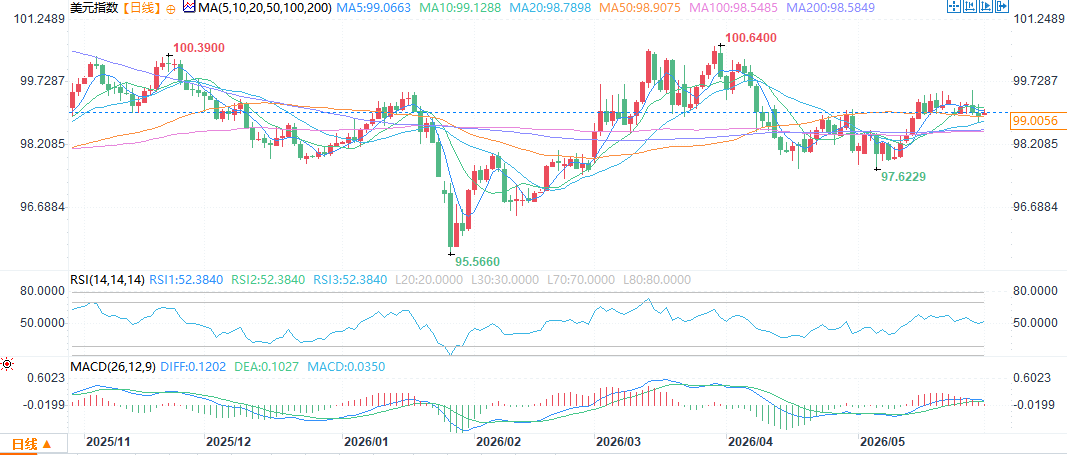
(US Dollar Index Daily Chart, Source: FX678)
The US dollar index is currently exhibiting a slightly bullish consolidation pattern on the daily chart. After rebounding from a low of 95.57, the price found secondary support at 97.6229 and continued to rise, currently trading around 99.00. Overall, it remains within a range where moving averages intertwine, indicating that short-term bullish momentum persists but faces some resistance. Looking at the moving average system, the price has broken above multiple moving averages, including the 20-day, 50-day, 100-day, and 200-day moving averages, forming a preliminary bullish alignment. Short-term moving averages are providing support, but the price is currently clearly under pressure from the psychological level of 100, resulting in a stalemate between bulls and bears in the 99-100 range.
In terms of indicators, the RSI is currently at 52.38, in the neutral-to-strong range, not yet in overbought territory, indicating that there is still room for short-term bullish momentum. The MACD's DIFF and DEA lines are running above the zero axis, and the histogram is positive, indicating that bullish momentum is still being released, although the slope has slowed down, suggesting a marginal weakening of upward momentum. Overall, the US dollar index is expected to fluctuate with a short-term bias towards strength. The key resistance levels are the psychological level of 100 and the previous high of 100.64, while the support level is in the 98.50-98.00 range. A break above the 100 level could open up further upside potential; otherwise, it is likely to maintain a high-level consolidation trend.
At 13:53 Beijing time on June 1, the US dollar index was at 99.00.
The US dollar index is currently hovering around the 99 mark, having fallen below 99.00 last week due to optimism surrounding a potential ceasefire between the US and Iran.
Bond traders are closely watching Friday's nonfarm payrolls report to validate their bets that the U.S. economy is strong enough to prompt the Federal Reserve to raise interest rates next year. Market expectations have undergone a fundamental reversal due to the surge in energy prices caused by the Iran war—previously, the market widely expected new Chairman Warsh to begin cutting rates soon, but now traders believe that a rate hike is highly likely before mid-2027, or even earlier.
This Friday's non-farm payroll report is expected to show an increase of about 90,000 jobs and keep the unemployment rate at 4.3%. Any strong data could further strengthen expectations of an interest rate hike.
Bond traders are betting on interest rate hikes, with non-farm payroll data becoming a key confirmation.
Besides developments in the Middle East, a major focus for the market will be the monthly employment data to be released on Friday, which is expected to show that the labor market remained resilient in May.
The combination of high oil prices and renewed inflation could reinforce market expectations that officials will remove an accommodative bias from their policy statement in June (their first meeting as chairman).
Traders believe there is a high probability of a rate hike before mid-2027, or even earlier, highlighting how the surge in energy prices caused by the Iran war has completely overturned market expectations that Warsh would cut rates soon after taking office. According to CME interest rate futures, the market currently expects a 69.9% probability of the Federal Reserve raising rates by at least 25 basis points before July 2027.
The rise in yields is equivalent to a 75 basis point rate hike by the Federal Reserve.
According to calculations by financial media, the surge in bond yields since the outbreak of the conflict has tightened financial conditions, with an effect equivalent to a Federal Reserve interest rate hike of about 75 basis points.
George Catrambone, head of fixed income at DWS Americas, said, "Yields have already risen, which adds to the constraints on the U.S. economy and does some of the work for the Fed." He noted that as 2- to 10-year yields climb, "you're creating some headwinds that will eventually pass through."
Consumers are under pressure, and traders favor short-term government bonds.
Catrambone stated that, coupled with the erosion of wage growth by high inflation, the increasing pressure on U.S. consumers will drag down the economy. He prefers to hold two-year Treasury bonds and has bought 10-year Treasury bonds near recent highs.
The benchmark 10-year Treasury yield is currently around 4.45%, down from its highs a few weeks ago, falling along with oil prices as hopes for a peaceful resolution to the conflict emerge. The 10-year rate, which serves as a benchmark for mortgages and corporate lending, is still about 50 basis points higher than at the end of February.
The employment report becomes a key variable at a market crossroads.
All of this makes the May jobs report even more important. A range of other labor force indicators will also be released this week, including job openings data and ADP private sector hiring data.
"If inflation data remains high and job growth remains solid, then the market may begin pricing in a more aggressive rate hike by the Fed," said Gregory Faranello, head of U.S. interest rate trading and strategy at AmeriVet Securities. "A single rate hike wouldn't make a difference here."
Inflation data supports expectations of interest rate hikes, and short-term bond yields are above the policy range.
Last week's data showed that the Federal Reserve's preferred inflation gauge—the Personal Consumption Expenditures (PCE) price index—rose 3.8% year-on-year in April, well above officials' long-term target of 2%. With increasing expectations of a Fed tightening policy, short-term Treasury yields have risen above the central bank's current policy range of 3.5%-3.75%.
The yield on the two-year Treasury note, which is particularly sensitive to expectations from the Federal Reserve, is around 4%, about 0.6 percentage points higher than at the end of February. This jump brings it closer to the yield level of longer-term Treasury bonds.
Market Dilemma: How High Can Inflation Be Tolerated? When Will It Threaten Growth?
“Global markets, not just U.S. Treasury yields, are reflecting this dilemma: how high can we tolerate inflation? When, or even if, will it become a growth issue?” said Cindy Beaulieu, chief investment officer for Conning North America, which manages approximately $190 billion in assets.
A resilient labor market has bond traders and the Federal Reserve watching closely to see how inflation develops. A growing number of officials are saying they want the central bank to signal that the next move is just as likely as a rate hike or a rate cut.
Investment Strategy: Short-term bonds are becoming increasingly attractive and can serve as a defensive safe haven.
At Wellington Management Company, portfolio manager Loren Moran had previously been “cautious” about government bonds due to the prospect of growth and inflation driven by capital spending related to the AI boom. However, with yields soaring and expectations of a Federal Reserve rate hike rising, she said that short-term bonds are “very attractive relative to long-term yields and offer a defensive safe haven.”
Bond traders are focused on Friday's non-farm payroll report to see if the U.S. economy is strong enough to prompt the Federal Reserve to raise interest rates next year. The surge in energy prices caused by the Iran war has completely overturned market expectations that Warsh would cut rates soon after taking office, and traders now believe that a rate hike before mid-2027 is highly likely.
The May non-farm payrolls report is expected to show an increase of 90,000 jobs and an unemployment rate of 4.3%, with strong data potentially further reinforcing expectations of an interest rate hike. Short-term bond yields have already exceeded the Fed's policy range of 3.5%-3.75%, and market focus is shifting from "whether an interest rate hike is needed" to "whether the economy can absorb the tightening already completed in the bond market."
US Dollar Index Daily Technical Analysis
Expectations of interest rate hikes in the bond market are providing significant bottom support for the US dollar index.
(US Dollar Index Daily Chart, Source: FX678)
The US dollar index is currently exhibiting a slightly bullish consolidation pattern on the daily chart. After rebounding from a low of 95.57, the price found secondary support at 97.6229 and continued to rise, currently trading around 99.00. Overall, it remains within a range where moving averages intertwine, indicating that short-term bullish momentum persists but faces some resistance. Looking at the moving average system, the price has broken above multiple moving averages, including the 20-day, 50-day, 100-day, and 200-day moving averages, forming a preliminary bullish alignment. Short-term moving averages are providing support, but the price is currently clearly under pressure from the psychological level of 100, resulting in a stalemate between bulls and bears in the 99-100 range.
In terms of indicators, the RSI is currently at 52.38, in the neutral-to-strong range, not yet in overbought territory, indicating that there is still room for short-term bullish momentum. The MACD's DIFF and DEA lines are running above the zero axis, and the histogram is positive, indicating that bullish momentum is still being released, although the slope has slowed down, suggesting a marginal weakening of upward momentum. Overall, the US dollar index is expected to fluctuate with a short-term bias towards strength. The key resistance levels are the psychological level of 100 and the previous high of 100.64, while the support level is in the 98.50-98.00 range. A break above the 100 level could open up further upside potential; otherwise, it is likely to maintain a high-level consolidation trend.
At 13:53 Beijing time on June 1, the US dollar index was at 99.00.
- Risk Warning and Disclaimer
- The market involves risk, and trading may not be suitable for all investors. This article is for reference only and does not constitute personal investment advice, nor does it take into account certain users’ specific investment objectives, financial situation, or other needs. Any investment decisions made based on this information are at your own risk.