The US dollar index is fluctuating around the 99 level, awaiting a directional move.
2026-06-01 15:33:09
The US dollar index (DXY) remained strong during Asian trading hours on Monday, trading around 99. The dollar continued to attract funds as markets reassessed the prospects for US-Iran negotiations and the future policy path of the Federal Reserve.

The market focus remains on the diplomatic negotiations between the United States and Iran. While communication channels remain open, significant uncertainty remains regarding the timing and final content of an agreement. Persistent risk aversion is supporting the US dollar as the world's primary reserve currency. Iranian Foreign Minister Araqchi stated that dialogue and information exchange between Iran and the United States are ongoing, but current speculation about the outcome of the negotiations lacks basis, and it is impossible to assess the progress before a clear result is available.
Meanwhile, US President Trump demanded adjustments to the proposed agreement, focusing on navigation arrangements in the Strait of Hormuz and the disposal of highly enriched uranium. The market believes these key issues are related to future security in the Middle East and the stability of global energy supplies, thus increasing the difficulty of reaching a final agreement in the short term.
The ongoing negotiations between the US and Iran have maintained a degree of safe-haven demand in the market, making the US dollar one of the biggest beneficiaries. Whenever geopolitical risks escalate, international capital tends to flow into dollar assets, thus supporting the dollar index.
Besides geopolitical factors, the outlook for US economic data is also a key focus for the market. The US May non-farm payroll report, to be released this Friday, will be a crucial event influencing market expectations.
The market currently expects the US to add approximately 96,000 non-farm jobs in May, with the unemployment rate expected to remain at 4.3%. If the final data exceeds market expectations, it will further demonstrate the resilience of the US economy and may strengthen market expectations that the Federal Reserve will maintain its tightening policy.
The performance of the job market directly impacts the Federal Reserve's future policy path; therefore, non-farm payroll data often has a significant influence on the US dollar index. If job growth is strong and the unemployment rate remains stable, the market may further increase its bets on future interest rate hikes. According to the latest market pricing, traders now expect the probability of a 25 basis point rate hike by the Fed before the end of the year to have risen to approximately 41%. This expectation is significantly higher than before, reflecting renewed market concerns about inflation risks and economic resilience.
The recent rebound in international oil prices from their lows has brought renewed market attention to the potential inflationary pressures from rising energy prices. If energy costs continue to rise, the Federal Reserve may need to maintain high interest rates for an extended period to ensure that inflation can steadily decline back to its target level.
Some market analysts have pointed out that "the core logic behind the current rise in the US dollar has gradually expanded from simple safe-haven demand to a dual driver of economic resilience and interest rate expectations." Meanwhile, the market will see the release of the US ISM Manufacturing PMI data on Monday evening. As an important indicator reflecting US manufacturing activity, this data helps investors assess the state of US economic growth.
If manufacturing activity improves, it will further strengthen expectations of a soft landing for the US economy and give the dollar new upward momentum; conversely, if the data is weak, it may weaken market expectations for future interest rate hikes.
From a global market perspective, the US dollar index is currently supported by three major factors: safe-haven demand, expectations of Federal Reserve policy, and the performance of the US economy. In contrast, the growth prospects of major economies such as Europe and Japan still face certain challenges, which also enhances the relative attractiveness of dollar assets.
From the daily chart, the US dollar index has rebounded steadily after stabilizing around 97.50, and has regained the 99 level. The overall structure indicates a gradual improvement in the medium-term market trend. The 98.50 area forms a key support level, while the 99.50 and 100.00 areas form key resistance zones. A break above the 100 level could open up further upside potential and challenge the 101.20 area. The RSI indicator has risen back to around 60, indicating increased buying power. The MACD indicator has formed a golden cross and continues to move upwards, reflecting a recovery in bullish momentum.
From the 4-hour chart, the US dollar index maintains a fluctuating upward structure. Short-term moving averages are in a bullish alignment, with the price consistently trading above them. The MACD indicator is above the zero line, and the red bars continue to expand, indicating that short-term momentum remains strong. The RSI indicator is around 65, not yet entering clearly overbought territory. Short-term support levels are located in the 98.80 and 98.50 area, while resistance levels are around 99.50 and 100.00. A break above 99.50 could lead to a further test of the 100 level; a break below 98.50 could potentially trigger a return to a correction phase.
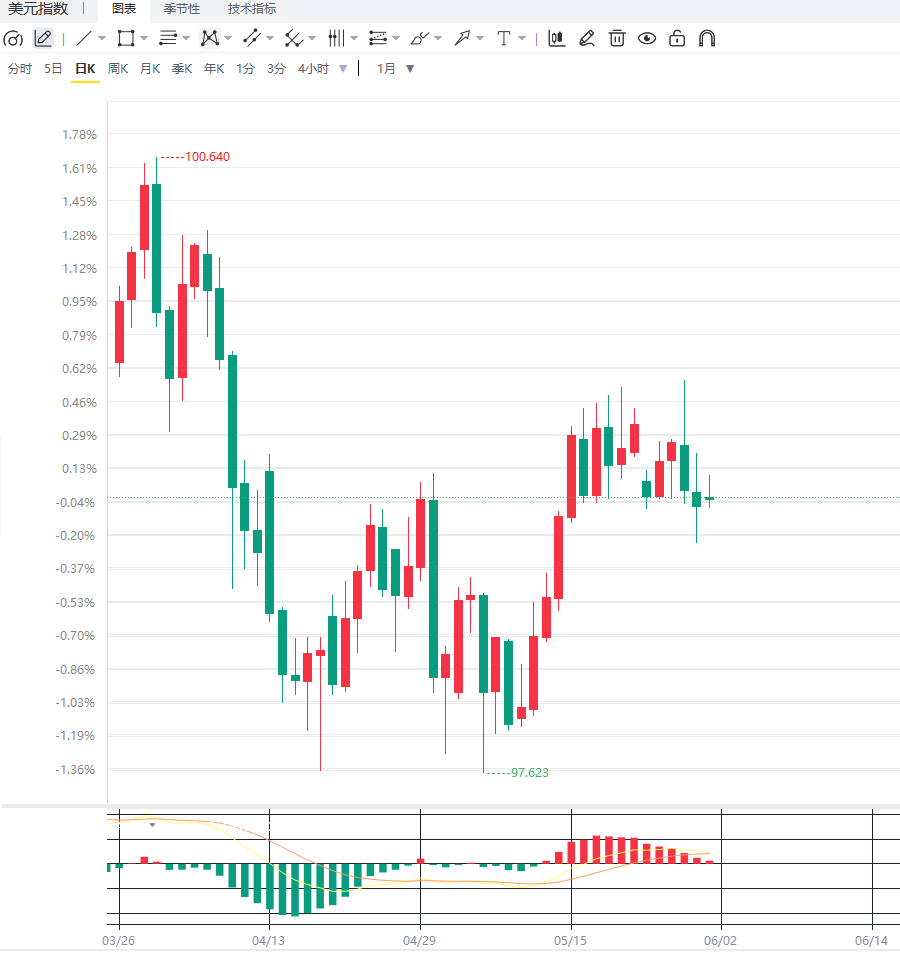
Editor's Summary : The US dollar index is currently driven by both safe-haven demand and monetary policy expectations. Significant uncertainties remain in the US-Iran agreement negotiations, maintaining a risk premium in the market, while the relatively robust US economic performance reinforces market expectations that the Federal Reserve will maintain a hawkish stance. From a market logic perspective, the dollar currently possesses both safe-haven appeal and interest rate advantages. Given the continued high level of global uncertainty, this advantage is likely to persist in the short term. Technically, the 99 level has been effectively held, indicating a gradual improvement in market sentiment. The 100 level will become a key target for bulls in the next phase, while 98.50 will be a crucial defensive level for the short-term trend. In the coming week, the US ISM Manufacturing PMI, the non-farm payroll report, and the progress of the US-Iran negotiations will be the three core variables influencing the dollar index's movement. If US economic data remains strong while geopolitical risks remain high, the dollar index is expected to further challenge the 100 level.
The market focus remains on the diplomatic negotiations between the United States and Iran. While communication channels remain open, significant uncertainty remains regarding the timing and final content of an agreement. Persistent risk aversion is supporting the US dollar as the world's primary reserve currency. Iranian Foreign Minister Araqchi stated that dialogue and information exchange between Iran and the United States are ongoing, but current speculation about the outcome of the negotiations lacks basis, and it is impossible to assess the progress before a clear result is available.
Meanwhile, US President Trump demanded adjustments to the proposed agreement, focusing on navigation arrangements in the Strait of Hormuz and the disposal of highly enriched uranium. The market believes these key issues are related to future security in the Middle East and the stability of global energy supplies, thus increasing the difficulty of reaching a final agreement in the short term.
The ongoing negotiations between the US and Iran have maintained a degree of safe-haven demand in the market, making the US dollar one of the biggest beneficiaries. Whenever geopolitical risks escalate, international capital tends to flow into dollar assets, thus supporting the dollar index.
Besides geopolitical factors, the outlook for US economic data is also a key focus for the market. The US May non-farm payroll report, to be released this Friday, will be a crucial event influencing market expectations.
The market currently expects the US to add approximately 96,000 non-farm jobs in May, with the unemployment rate expected to remain at 4.3%. If the final data exceeds market expectations, it will further demonstrate the resilience of the US economy and may strengthen market expectations that the Federal Reserve will maintain its tightening policy.
The performance of the job market directly impacts the Federal Reserve's future policy path; therefore, non-farm payroll data often has a significant influence on the US dollar index. If job growth is strong and the unemployment rate remains stable, the market may further increase its bets on future interest rate hikes. According to the latest market pricing, traders now expect the probability of a 25 basis point rate hike by the Fed before the end of the year to have risen to approximately 41%. This expectation is significantly higher than before, reflecting renewed market concerns about inflation risks and economic resilience.
The recent rebound in international oil prices from their lows has brought renewed market attention to the potential inflationary pressures from rising energy prices. If energy costs continue to rise, the Federal Reserve may need to maintain high interest rates for an extended period to ensure that inflation can steadily decline back to its target level.
Some market analysts have pointed out that "the core logic behind the current rise in the US dollar has gradually expanded from simple safe-haven demand to a dual driver of economic resilience and interest rate expectations." Meanwhile, the market will see the release of the US ISM Manufacturing PMI data on Monday evening. As an important indicator reflecting US manufacturing activity, this data helps investors assess the state of US economic growth.
If manufacturing activity improves, it will further strengthen expectations of a soft landing for the US economy and give the dollar new upward momentum; conversely, if the data is weak, it may weaken market expectations for future interest rate hikes.
From a global market perspective, the US dollar index is currently supported by three major factors: safe-haven demand, expectations of Federal Reserve policy, and the performance of the US economy. In contrast, the growth prospects of major economies such as Europe and Japan still face certain challenges, which also enhances the relative attractiveness of dollar assets.
From the daily chart, the US dollar index has rebounded steadily after stabilizing around 97.50, and has regained the 99 level. The overall structure indicates a gradual improvement in the medium-term market trend. The 98.50 area forms a key support level, while the 99.50 and 100.00 areas form key resistance zones. A break above the 100 level could open up further upside potential and challenge the 101.20 area. The RSI indicator has risen back to around 60, indicating increased buying power. The MACD indicator has formed a golden cross and continues to move upwards, reflecting a recovery in bullish momentum.
From the 4-hour chart, the US dollar index maintains a fluctuating upward structure. Short-term moving averages are in a bullish alignment, with the price consistently trading above them. The MACD indicator is above the zero line, and the red bars continue to expand, indicating that short-term momentum remains strong. The RSI indicator is around 65, not yet entering clearly overbought territory. Short-term support levels are located in the 98.80 and 98.50 area, while resistance levels are around 99.50 and 100.00. A break above 99.50 could lead to a further test of the 100 level; a break below 98.50 could potentially trigger a return to a correction phase.
Editor's Summary : The US dollar index is currently driven by both safe-haven demand and monetary policy expectations. Significant uncertainties remain in the US-Iran agreement negotiations, maintaining a risk premium in the market, while the relatively robust US economic performance reinforces market expectations that the Federal Reserve will maintain a hawkish stance. From a market logic perspective, the dollar currently possesses both safe-haven appeal and interest rate advantages. Given the continued high level of global uncertainty, this advantage is likely to persist in the short term. Technically, the 99 level has been effectively held, indicating a gradual improvement in market sentiment. The 100 level will become a key target for bulls in the next phase, while 98.50 will be a crucial defensive level for the short-term trend. In the coming week, the US ISM Manufacturing PMI, the non-farm payroll report, and the progress of the US-Iran negotiations will be the three core variables influencing the dollar index's movement. If US economic data remains strong while geopolitical risks remain high, the dollar index is expected to further challenge the 100 level.
- Risk Warning and Disclaimer
- The market involves risk, and trading may not be suitable for all investors. This article is for reference only and does not constitute personal investment advice, nor does it take into account certain users’ specific investment objectives, financial situation, or other needs. Any investment decisions made based on this information are at your own risk.