With inflation diverging across the Eurozone, can the European Central Bank take a "slow and steady" approach?
2026-06-01 16:34:12
On Monday (June 1) during the Asian session, the euro against the US dollar failed to maintain the momentum of the rebound from the 1.1585 support area over the past two days. It opened lower and fluctuated weakly, and has now slightly rebounded to around 1.11650, basically flat for the day.
The Danske Bank research team pointed out that the euro's performance against the dollar last week was mainly affected by the sharp drop in oil prices. Interest rates in both the US and the Eurozone have declined—the 10-year US Treasury yield has fallen more than 20 basis points from its mid-May high to 4.43%, but this had a limited impact on euro/dollar forex swaps, as Eurozone interest rates also fell.
Preliminary inflation data for the Eurozone in May showed that the overall inflation rise in Germany, France, Italy, and Spain (which account for about 75% of the overall CPI) was mainly driven by energy. The figures for France, Italy, and Spain were largely in line with expectations, while the CPI in Germany was unexpectedly low.
Overall, these data suggest that the ECB has more time to assess the impact of the energy shock before taking action. While a June rate hike seems inevitable, the likelihood of a second rate hike in July is decreasing.
A research team at Danske Bank noted that the euro closed last week near 1.1650 against the US dollar after a sharp drop in oil prices. Driven by progress in US-Iran ceasefire negotiations, Brent crude oil fell from $95 to around $92, easing market concerns about energy inflation and leading to a simultaneous decline in yields on European and American bonds. The euro rebounded after hitting a low of 1.1585 against the dollar at the beginning of the week, ultimately closing near 1.1650.
U.S. interest rates fell last week, with the 10-year Treasury yield dropping to 4.43%, down more than 20 basis points from its mid-May high. Lower oil prices and weak consumer spending data (the savings rate fell to 2.6% in April) prompted some traders to reassess the Federal Reserve's hawkish path, causing the 10-year Treasury yield to fall from a high of 4.68% to 4.43%, a near three-week low.
The impact of falling Eurozone interest rates on EUR/USD foreign exchange swaps was limited. The yield on German 10-year government bonds fell from 2.85% to 2.70%, and the overall interest rate differential between Europe and the US remained stable, resulting in no significant directional fluctuations in the foreign exchange swap market. This explains why the EUR/USD failed to break through the 1.1700 resistance level. Danske Bank believes that, given the stable interest rate differential, the EUR/USD is more likely to remain range-bound between 1.1580 and 1.1700 in the short term.
Major disagreements between the US and Iran over Iran's nuclear program and the Strait of Hormuz have complicated diplomatic efforts to end the three-month conflict in the Middle East.
Iran's chief negotiator, Mohammad Ghalibaf, stated that Iran would not accept any agreement until its national rights were fully guaranteed. Furthermore, reports indicate that the United States has strengthened its negotiating stance with Iran.
Israel's invasion of Lebanon has perpetuated geopolitical risk premiums, which helps reignite demand for the safe-haven dollar and puts headwinds on the euro against the dollar.
In the Eurozone, preliminary inflation data for May in Germany, France, Italy, and Spain (which account for approximately 75% of the overall CPI) showed that the rise in overall inflation was primarily driven by energy prices. This is largely consistent with the inflation trend in April, when rising energy prices contributed about two-thirds of the overall inflation increase.
Inflation data from France, Italy, and Spain were largely in line with market expectations, with year-on-year CPI increases in May around 2.8%, 3.0%, and 3.1% respectively, showing little change compared to April.
However, Germany's regional CPI was unexpectedly low. As the Eurozone's largest economy, several German states saw lower-than-expected CPI growth in May, with Bavaria and North Rhine-Westphalia experiencing declines of 0.2 and 0.3 percentage points respectively compared to April. This "German surprise" dragged down inflation expectations across the Eurozone and prompted new reflections on the European Central Bank's policy path.
Overall, these data suggest that the European Central Bank has more time to assess the impact of the energy shock before taking action.
Unlike the 2022 energy crisis, current core inflationary pressures have not spread widely—prices for core goods and services excluding energy have risen relatively moderately. This means the European Central Bank does not need to rush to "catch up with the curve," but can instead observe further developments in oil price trends and wage data.
While a June rate hike seems inevitable as the central bank needs to demonstrate its resolve to combat inflation, the likelihood of a second rate hike in July is decreasing.
Market pricing indicates that the probability of another 25 basis point rate hike in July has fallen from 60% a month ago to about 35% currently. If oil prices continue to fall or economic data weakens further in the coming weeks, the European Central Bank may press the pause button after its "insurance rate hike" in June and return to a "wait and assess" mode.
In the Eurozone, April's unemployment rate will be released this week. Danske Bank expects it to be 6.2%, in line with market consensus.
Although the unemployment rate is low, the labor market has softened – job growth has slowed and business expectations have weakened since the Iran war.
In addition, the final reading of the May manufacturing PMI will also be released, and the preliminary reading of 51.4 is expected to be confirmed.
In the United States, labor market data will be released throughout the week, culminating in Friday's non-farm payroll report. This data will provide important clues for the next policy path of central banks in Europe and the US.
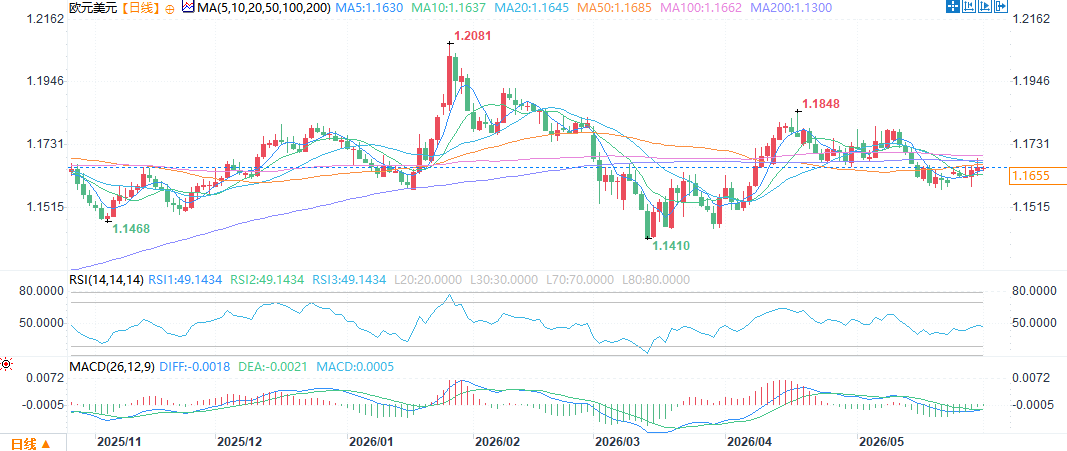
Technically, the euro/dollar pair is currently in a wide-range consolidation phase with an unclear direction on the daily chart. The price fell from the previous high of 1.2081, bottomed out at 1.1410, rebounded to 1.1848, and has recently fallen back again. It is currently trading around 1.1655, within a dense range where multiple moving averages intersect, indicating a stalemate between bulls and bears, with no clear one-sided trend at the moment.
At 15:33 Beijing time on June 1, the euro was trading at 1.1655/56 against the US dollar.
The Danske Bank research team pointed out that the euro's performance against the dollar last week was mainly affected by the sharp drop in oil prices. Interest rates in both the US and the Eurozone have declined—the 10-year US Treasury yield has fallen more than 20 basis points from its mid-May high to 4.43%, but this had a limited impact on euro/dollar forex swaps, as Eurozone interest rates also fell.
Preliminary inflation data for the Eurozone in May showed that the overall inflation rise in Germany, France, Italy, and Spain (which account for about 75% of the overall CPI) was mainly driven by energy. The figures for France, Italy, and Spain were largely in line with expectations, while the CPI in Germany was unexpectedly low.
Overall, these data suggest that the ECB has more time to assess the impact of the energy shock before taking action. While a June rate hike seems inevitable, the likelihood of a second rate hike in July is decreasing.
Last week in review: Oil prices plummeted, and interest rates in Europe and the US both fell.
A research team at Danske Bank noted that the euro closed last week near 1.1650 against the US dollar after a sharp drop in oil prices. Driven by progress in US-Iran ceasefire negotiations, Brent crude oil fell from $95 to around $92, easing market concerns about energy inflation and leading to a simultaneous decline in yields on European and American bonds. The euro rebounded after hitting a low of 1.1585 against the dollar at the beginning of the week, ultimately closing near 1.1650.
U.S. interest rates fell last week, with the 10-year Treasury yield dropping to 4.43%, down more than 20 basis points from its mid-May high. Lower oil prices and weak consumer spending data (the savings rate fell to 2.6% in April) prompted some traders to reassess the Federal Reserve's hawkish path, causing the 10-year Treasury yield to fall from a high of 4.68% to 4.43%, a near three-week low.
The impact of falling Eurozone interest rates on EUR/USD foreign exchange swaps was limited. The yield on German 10-year government bonds fell from 2.85% to 2.70%, and the overall interest rate differential between Europe and the US remained stable, resulting in no significant directional fluctuations in the foreign exchange swap market. This explains why the EUR/USD failed to break through the 1.1700 resistance level. Danske Bank believes that, given the stable interest rate differential, the EUR/USD is more likely to remain range-bound between 1.1580 and 1.1700 in the short term.
The differences between the US and Iran deepen, and Israel invades Lebanon.
Major disagreements between the US and Iran over Iran's nuclear program and the Strait of Hormuz have complicated diplomatic efforts to end the three-month conflict in the Middle East.
Iran's chief negotiator, Mohammad Ghalibaf, stated that Iran would not accept any agreement until its national rights were fully guaranteed. Furthermore, reports indicate that the United States has strengthened its negotiating stance with Iran.
Israel's invasion of Lebanon has perpetuated geopolitical risk premiums, which helps reignite demand for the safe-haven dollar and puts headwinds on the euro against the dollar.
Eurozone inflation: Energy-driven rise, German data unexpectedly low
In the Eurozone, preliminary inflation data for May in Germany, France, Italy, and Spain (which account for approximately 75% of the overall CPI) showed that the rise in overall inflation was primarily driven by energy prices. This is largely consistent with the inflation trend in April, when rising energy prices contributed about two-thirds of the overall inflation increase.
Inflation data from France, Italy, and Spain were largely in line with market expectations, with year-on-year CPI increases in May around 2.8%, 3.0%, and 3.1% respectively, showing little change compared to April.
However, Germany's regional CPI was unexpectedly low. As the Eurozone's largest economy, several German states saw lower-than-expected CPI growth in May, with Bavaria and North Rhine-Westphalia experiencing declines of 0.2 and 0.3 percentage points respectively compared to April. This "German surprise" dragged down inflation expectations across the Eurozone and prompted new reflections on the European Central Bank's policy path.
Overall, these data suggest that the European Central Bank has more time to assess the impact of the energy shock before taking action.
Unlike the 2022 energy crisis, current core inflationary pressures have not spread widely—prices for core goods and services excluding energy have risen relatively moderately. This means the European Central Bank does not need to rush to "catch up with the curve," but can instead observe further developments in oil price trends and wage data.
While a June rate hike seems inevitable as the central bank needs to demonstrate its resolve to combat inflation, the likelihood of a second rate hike in July is decreasing.
Market pricing indicates that the probability of another 25 basis point rate hike in July has fallen from 60% a month ago to about 35% currently. If oil prices continue to fall or economic data weakens further in the coming weeks, the European Central Bank may press the pause button after its "insurance rate hike" in June and return to a "wait and assess" mode.
This Week's Data Preview
In the Eurozone, April's unemployment rate will be released this week. Danske Bank expects it to be 6.2%, in line with market consensus.
Although the unemployment rate is low, the labor market has softened – job growth has slowed and business expectations have weakened since the Iran war.
In addition, the final reading of the May manufacturing PMI will also be released, and the preliminary reading of 51.4 is expected to be confirmed.
In the United States, labor market data will be released throughout the week, culminating in Friday's non-farm payroll report. This data will provide important clues for the next policy path of central banks in Europe and the US.
Technically, the euro/dollar pair is currently in a wide-range consolidation phase with an unclear direction on the daily chart. The price fell from the previous high of 1.2081, bottomed out at 1.1410, rebounded to 1.1848, and has recently fallen back again. It is currently trading around 1.1655, within a dense range where multiple moving averages intersect, indicating a stalemate between bulls and bears, with no clear one-sided trend at the moment.
At 15:33 Beijing time on June 1, the euro was trading at 1.1655/56 against the US dollar.
- Risk Warning and Disclaimer
- The market involves risk, and trading may not be suitable for all investors. This article is for reference only and does not constitute personal investment advice, nor does it take into account certain users’ specific investment objectives, financial situation, or other needs. Any investment decisions made based on this information are at your own risk.