Negotiations delayed by another week; long positions in crude oil decreased significantly, but its investment value became apparent.
2026-06-01 20:12:34
On Monday (June 1), international oil prices rebounded after rising during the Asian and European sessions. As previously mentioned, the United States is unlikely to compromise until it obtains a satisfactory agreement.
US President Trump recently stated publicly that Iran is indeed willing to reach an agreement, emphasizing that the agreement would "explicitly prohibit" Iran from possessing nuclear weapons, while accusing the media of spreading "fake news" about the agreement downplaying the nuclear aspect.
However, the negotiation process did not speed up as a result—after meeting with advisors last Friday, Trump made new demands on the proposed agreement, requiring tougher wording in the commitments to Iran's nuclear program and guarantees to reopen the Strait of Hormuz. This adjustment will extend the negotiations for another week.
Despite signals from both sides that they are "close to reaching an agreement," core sticking points such as Iran's uranium enrichment, the dispute over the lifting of US sanctions against Iran, and the question of control over the Strait of Hormuz remain unresolved, and market doubts about the prospects of the negotiations persist.
This constant geopolitical tension keeps the crude oil market caught in a tug-of-war between optimistic expectations and real risks, becoming the core driver of short-term price fluctuations.
The current crude oil market presents a significant contradictory situation: on the one hand, influenced by positive signals from the US-Iran negotiations, the two major benchmark oil prices have retreated from their previous four-year highs;
Meanwhile, according to Iranian media Fars News, the Iranian Islamic Revolutionary Guard Corps Navy stated that 15 ships, including four oil tankers, passed through the Strait of Hormuz in the past 24 hours after obtaining permission from Iran. This indicates that the navigation situation in the strait is also improving, which is unfavorable for oil prices.
International oil prices have fallen sharply, with the market generally expecting geopolitical disturbances to be short-term events.
On the other hand, inventory data in the physical market reveals severe supply pressure.
Data shows that the Middle East's daily crude oil exports have plummeted from 18.3 million barrels before the crisis to 8.8 million barrels, a drop of more than 50%, and the global oil market will face a supply gap of 500,000 to 8 million barrels per day in 2026.
More alarmingly, global crude oil inventories are being depleted at an accelerated pace. Goldman Sachs estimates that by the end of April, global crude oil inventories were equivalent to only 101 days of demand, and are expected to fall below the "100-day warning line" to 98 days by the end of May, with only 73 days' worth of usable inventory remaining.
The U.S. strategic petroleum reserves are declining at an unprecedented rate in recent years, and commercial inventories are also at low levels. If the Strait of Hormuz closure continues until June, the global available commercial inventory buffer will be completely exhausted.
The root of this contradiction lies in the disconnect between market expectations and actual supply and demand: the futures market regards the progress of negotiations as a short-term negative factor, but ignores the structural damage on the supply side—even if an agreement is reached, it will still take weeks or even months for the Strait of Hormuz to open to navigation, tankers to return, and oil fields to resume production, and there is a significant time lag in restarting water-driven oil fields in countries such as Kuwait and Iraq.
At the Bernstein Conference, Chevron CEO Mike Worth stated bluntly that the continued decline in inventories means that oil prices are likely to rise in the next two months, and even if the parties to the conflict reach a ceasefire agreement, the negative impact of the war on energy prices will continue for several months.
The fluctuations in market sentiment are directly reflected in fund flows. Data from the U.S. Commodity Futures Trading Commission (CFTC) shows that in the week ending May 26, net long positions held by speculators in WTI crude oil decreased by 19,186 contracts to 91,163 contracts (some data sources show an adjusted figure of 67,157 contracts).
This change clearly indicates that short-term speculative funds are cooling their bullish expectations for crude oil prices, and investors are reassessing factors such as supply and demand, the macroeconomy, and geopolitical negotiations.
From a technical perspective, the high oil prices in the early stage have had a suppressive effect on the demand side. Refineries in the Asia-Pacific region have maintained low operating rates, and imports by major buyers such as China, Japan and South Korea have been at low levels. The physical premium of Middle Eastern crude oil has fallen to the lowest level since the Russia-Ukraine conflict, and the market presents a short-term pattern of "weak supply and demand".
However, institutions generally warn that this technical correction lacks fundamental support: the proposed slight increase in OPEC+ production in July is more symbolic, and most member countries will find it difficult to meet their production targets given the obstruction of exports through the Strait of Hormuz; as for non-OPEC oil-producing countries, the momentum of US shale oil production has slowed significantly, and the Permian Basin is approaching its peak production capacity, making it difficult to make up for the supply gap in the Middle East.
Even if the US-Iran negotiations achieve a breakthrough, the deep-seated contradictions in the oil market will still be difficult to resolve quickly.
This crisis has exposed vulnerabilities in energy security. Governments and companies around the world may accelerate the replenishment of strategic oil reserves, creating long-term rigid demand. Secondly, the supply chain recovery cycle is lengthy, and the time lag between the reopening of channels and the restoration of production capacity will continue to disrupt the market.
Analysts predict that the average price of Brent crude oil will reach $90.44 per barrel in 2026, and the average price of U.S. crude oil will be $84.63 per barrel, an increase of about 40% compared to before the outbreak of war in February.
In extreme scenarios, if depletion of inventories leads to physical shortages, oil prices could surge to historic levels of $150-200 per barrel. In the long term, this high oil price cycle could continue for 1-2 years, or even until the third quarter of 2027.
For investors, the frequent positive news from the negotiations has created opportunities as oil bulls leave the market. The recent positive news from the negotiations has led to a sharp correction in oil prices, presenting a buying opportunity. Previously, escalating conflict was a selling point, but now positive news from the negotiations is a buying point for oil prices. The mindset has changed quickly. As the supply disruption period lengthens, if the stalemate between the US and Iran continues and oil supply cannot match oil demand, oil prices may experience a significant short squeeze.
From a technical perspective, oil prices retraced to the important support level of 87, which is the 50% Fibonacci retracement level. At the same time, 87 is also the defensive point where the bulls previously made huge volume moves.
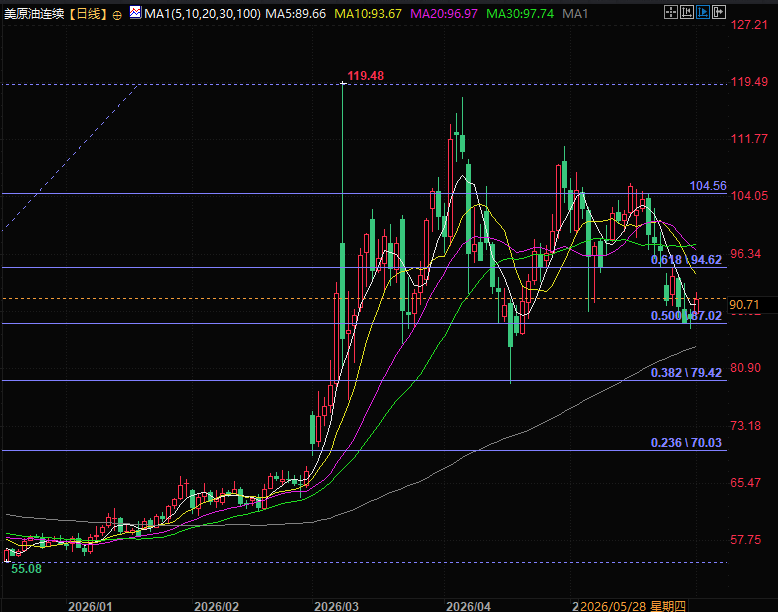
(WTI crude oil futures daily chart, source: FX678)
At 20:03 Beijing time, WTI crude oil futures were trading at $90.34 per barrel.
US President Trump recently stated publicly that Iran is indeed willing to reach an agreement, emphasizing that the agreement would "explicitly prohibit" Iran from possessing nuclear weapons, while accusing the media of spreading "fake news" about the agreement downplaying the nuclear aspect.
However, the negotiation process did not speed up as a result—after meeting with advisors last Friday, Trump made new demands on the proposed agreement, requiring tougher wording in the commitments to Iran's nuclear program and guarantees to reopen the Strait of Hormuz. This adjustment will extend the negotiations for another week.
Despite signals from both sides that they are "close to reaching an agreement," core sticking points such as Iran's uranium enrichment, the dispute over the lifting of US sanctions against Iran, and the question of control over the Strait of Hormuz remain unresolved, and market doubts about the prospects of the negotiations persist.
This constant geopolitical tension keeps the crude oil market caught in a tug-of-war between optimistic expectations and real risks, becoming the core driver of short-term price fluctuations.
Market contradictions become apparent: Beneath the surface of oil price correction, concerns remain about dwindling inventories and supply gaps.
The current crude oil market presents a significant contradictory situation: on the one hand, influenced by positive signals from the US-Iran negotiations, the two major benchmark oil prices have retreated from their previous four-year highs;
Meanwhile, according to Iranian media Fars News, the Iranian Islamic Revolutionary Guard Corps Navy stated that 15 ships, including four oil tankers, passed through the Strait of Hormuz in the past 24 hours after obtaining permission from Iran. This indicates that the navigation situation in the strait is also improving, which is unfavorable for oil prices.
International oil prices have fallen sharply, with the market generally expecting geopolitical disturbances to be short-term events.
On the other hand, inventory data in the physical market reveals severe supply pressure.
Data shows that the Middle East's daily crude oil exports have plummeted from 18.3 million barrels before the crisis to 8.8 million barrels, a drop of more than 50%, and the global oil market will face a supply gap of 500,000 to 8 million barrels per day in 2026.
More alarmingly, global crude oil inventories are being depleted at an accelerated pace. Goldman Sachs estimates that by the end of April, global crude oil inventories were equivalent to only 101 days of demand, and are expected to fall below the "100-day warning line" to 98 days by the end of May, with only 73 days' worth of usable inventory remaining.
The U.S. strategic petroleum reserves are declining at an unprecedented rate in recent years, and commercial inventories are also at low levels. If the Strait of Hormuz closure continues until June, the global available commercial inventory buffer will be completely exhausted.
The root of this contradiction lies in the disconnect between market expectations and actual supply and demand: the futures market regards the progress of negotiations as a short-term negative factor, but ignores the structural damage on the supply side—even if an agreement is reached, it will still take weeks or even months for the Strait of Hormuz to open to navigation, tankers to return, and oil fields to resume production, and there is a significant time lag in restarting water-driven oil fields in countries such as Kuwait and Iraq.
At the Bernstein Conference, Chevron CEO Mike Worth stated bluntly that the continued decline in inventories means that oil prices are likely to rise in the next two months, and even if the parties to the conflict reach a ceasefire agreement, the negative impact of the war on energy prices will continue for several months.
Fund flows reflect diverging expectations: Technical corrections lead to a significant decrease in long positions.
The fluctuations in market sentiment are directly reflected in fund flows. Data from the U.S. Commodity Futures Trading Commission (CFTC) shows that in the week ending May 26, net long positions held by speculators in WTI crude oil decreased by 19,186 contracts to 91,163 contracts (some data sources show an adjusted figure of 67,157 contracts).
This change clearly indicates that short-term speculative funds are cooling their bullish expectations for crude oil prices, and investors are reassessing factors such as supply and demand, the macroeconomy, and geopolitical negotiations.
From a technical perspective, the high oil prices in the early stage have had a suppressive effect on the demand side. Refineries in the Asia-Pacific region have maintained low operating rates, and imports by major buyers such as China, Japan and South Korea have been at low levels. The physical premium of Middle Eastern crude oil has fallen to the lowest level since the Russia-Ukraine conflict, and the market presents a short-term pattern of "weak supply and demand".
However, institutions generally warn that this technical correction lacks fundamental support: the proposed slight increase in OPEC+ production in July is more symbolic, and most member countries will find it difficult to meet their production targets given the obstruction of exports through the Strait of Hormuz; as for non-OPEC oil-producing countries, the momentum of US shale oil production has slowed significantly, and the Permian Basin is approaching its peak production capacity, making it difficult to make up for the supply gap in the Middle East.
Structural constraints remain difficult to break: the high oil price cycle may continue until 2027.
Even if the US-Iran negotiations achieve a breakthrough, the deep-seated contradictions in the oil market will still be difficult to resolve quickly.
This crisis has exposed vulnerabilities in energy security. Governments and companies around the world may accelerate the replenishment of strategic oil reserves, creating long-term rigid demand. Secondly, the supply chain recovery cycle is lengthy, and the time lag between the reopening of channels and the restoration of production capacity will continue to disrupt the market.
Analysts predict that the average price of Brent crude oil will reach $90.44 per barrel in 2026, and the average price of U.S. crude oil will be $84.63 per barrel, an increase of about 40% compared to before the outbreak of war in February.
In extreme scenarios, if depletion of inventories leads to physical shortages, oil prices could surge to historic levels of $150-200 per barrel. In the long term, this high oil price cycle could continue for 1-2 years, or even until the third quarter of 2027.
Summary and Technical Analysis:
For investors, the frequent positive news from the negotiations has created opportunities as oil bulls leave the market. The recent positive news from the negotiations has led to a sharp correction in oil prices, presenting a buying opportunity. Previously, escalating conflict was a selling point, but now positive news from the negotiations is a buying point for oil prices. The mindset has changed quickly. As the supply disruption period lengthens, if the stalemate between the US and Iran continues and oil supply cannot match oil demand, oil prices may experience a significant short squeeze.
From a technical perspective, oil prices retraced to the important support level of 87, which is the 50% Fibonacci retracement level. At the same time, 87 is also the defensive point where the bulls previously made huge volume moves.
(WTI crude oil futures daily chart, source: FX678)
At 20:03 Beijing time, WTI crude oil futures were trading at $90.34 per barrel.
- Risk Warning and Disclaimer
- The market involves risk, and trading may not be suitable for all investors. This article is for reference only and does not constitute personal investment advice, nor does it take into account certain users’ specific investment objectives, financial situation, or other needs. Any investment decisions made based on this information are at your own risk.