The USD/JPY pair is nearing the 160 level! A rebound of over 1.5% in May could be the deciding factor; non-farm payroll data may prove crucial.
2026-06-02 14:06:44
On Tuesday (June 2) during Asian trading hours, the USD/JPY pair traded around 159.70, holding onto overnight gains and just shy of the psychological level of 160. The pair has risen more than 1.5% since rebounding from its early May lows.

While no one knows when a ceasefire in the Gulf will truly be implemented or when energy supplies will be able to freely pass through the Strait of Hormuz, the ongoing uncertainty exposes a major vulnerability for Japan. Japan relies on imports from the Middle East for approximately 90% of its oil, and even if oil prices remain around $95, its annual import bill will increase by tens of billions of dollars. Coupled with the impact of a depreciating yen, Japan is facing a double squeeze of "high oil prices + a weak yen," with real wages declining for the 13th consecutive month in April.
As a major net energy importer, Japan faces headwinds from rising energy prices, which threaten its terms of trade and current account position. The United States, on the other hand, faces the opposite driving force—as the world's largest oil producer, high oil prices improve the profitability and terms of trade for its energy companies, thus supporting the dollar.
Coupled with persistent US economic exceptionalism—partly driven by the continued construction of AI infrastructure—this forms a strong combination for the dollar's appreciation against the yen. US companies have announced approximately $1.5 trillion in AI investment plans, while Japan lags significantly behind in AI investment, with funds continuing to flow from Japan to the US, providing structural support for the dollar against the yen.
But beyond the ongoing noise of Gulf-related headlines, something more significant may be needed to trigger a meaningful decline in the dollar against the yen.
Currently, this could indicate a genuine US growth panic driven by deteriorating labor market conditions, similar to what happened in 2024 and 2025. Historical precedent suggests that only a substantial deterioration in the fundamentals of the US economy, rather than short-term disturbances from Middle East news, can alter the direction of the USD/JPY exchange rate. Geopolitical news can trigger intraday volatility, but it cannot reverse the medium-term trend driven by interest rate differentials and growth disparities.
This is precisely why this week's series of US economic data is particularly important. From JOLTS to ADP and Friday's non-farm payrolls, this series of data will collectively reflect the true state of the US labor market. The market expects non-farm payrolls to increase by approximately 85,000 to 90,000 in May, with an unemployment rate of 4.3%.
If the data falls significantly short of expectations, USD/JPY may retrace to the 158.30-157.90 area; if the data is strong, the 160 level will face a direct challenge. Labor market data has become the key factor determining the current USD/JPY exchange rate.
The Citi Economic Surprise Index shows that over the past year, not only has the US (blue line) consistently delivered economic surprises, but Japanese data (red line) has also generally exceeded expectations. However, despite this, this has provided little support for the yen. On the contrary, a weaker yen may contribute to the resilience of the Japanese economy by improving export competitiveness and helping to boost imported inflation.
Therefore, the fact that Japanese data continues to exceed expectations appears to be secondary for USD/JPY. Market focus remains firmly on whether upcoming US data can continue to support the "American exceptionalism" narrative, which has helped support the USD/JPY rebound in recent months.
This week is packed with US economic data, starting with Friday's non-farm payrolls report. Before that, Tuesday's JOLTS report is worth watching. Even more noteworthy is whether the improvements in hiring and turnover rates seen in March have carried over into April—both typically associated with stronger labor market conditions. Further increases would reinforce the view that the labor market remains robust, reducing the likelihood of a growth panic that could trigger a meaningful decline in USD/JPY.
The ISM Services PMI will also be closely watched, as it covers the largest and most important part of the US economy. The ADP employment data could also cause volatility, as it has been a good predictor of private sector hiring trends in recent months, preceding the official non-farm payroll report.
In Japan, the focus will be on Governor Kazuo Ueda's speech on Wednesday. With the market continuing to favor a rate hike this month (with a probability of about 75%), he needs to demonstrate confidence in continuing the normalization policy. Failure to do so could trigger a new round of yen weakness, pushing the USD/JPY exchange rate above the 160 level.
The 10-year Japanese government bond auction later on Tuesday is also worth watching. Recently, the yield on 10-year JGBs surged to 2.809%, a new high since 1996. Weak demand at the auction could further push up yields, forcing the Bank of Japan to adjust its policy; robust demand, on the other hand, would help stabilize the bond market.
Investors will look for clues about their willingness to allocate Japanese bonds in the auctions, which will directly affect the market's judgment on the Bank of Japan's policy path.
Technically, the USD/JPY pair is currently trading around 159.70, with the price firmly above all moving averages across different timeframes. The 20-day, 50-day, 100-day, and 200-day moving averages are rising in ascending order, indicating a healthy medium- to long-term bullish trend. After reaching a high of 160.47, the price retraced slightly, then quickly dipped to a low of 155.02 in May before rapidly recovering. After testing short-term moving averages, it has resumed its upward trend. 160.47 is now the primary short-term resistance level, while 155.02 and 152.09 form a key medium-term support zone.
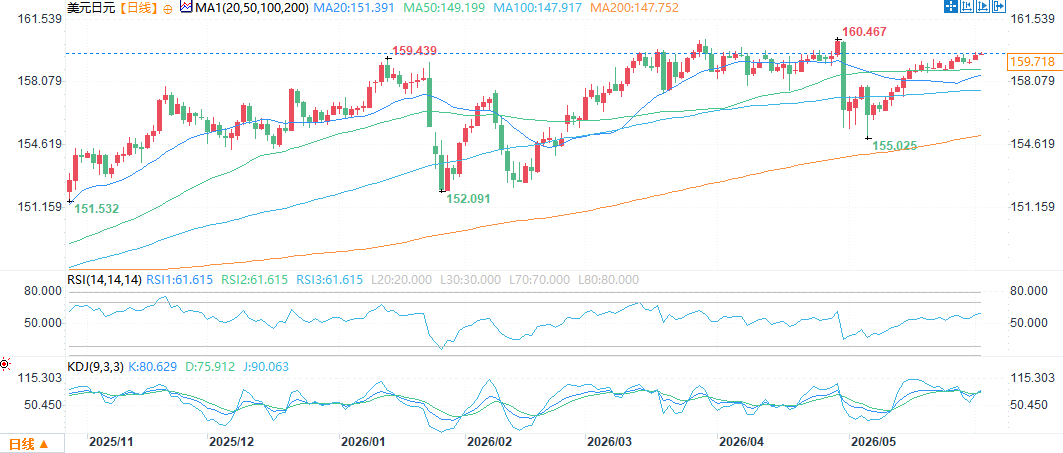
(USD/JPY daily chart, source: FX678)
On the indicator side, the RSI value is 61.61, which is above the 50 center, indicating that the bulls are in control and there is still room for the price to fall below the 70 overbought line.
Driven by rising expectations of a Fed rate hike and divergent monetary policies between the US and Japan, the overall trend remains bullish. Short-term pressure comes from the 160 level. If it falls back under pressure, support is seen around 158. Once it stabilizes above the previous high, it will open up further upside potential. As long as the moving average system is not effectively broken, the medium-term uptrend remains unchanged.
At 14:04 Beijing time on June 2, the USD/JPY exchange rate was 159.72/73.
Energy shock: Japan suffers more, while the US benefits and supports the dollar.
While no one knows when a ceasefire in the Gulf will truly be implemented or when energy supplies will be able to freely pass through the Strait of Hormuz, the ongoing uncertainty exposes a major vulnerability for Japan. Japan relies on imports from the Middle East for approximately 90% of its oil, and even if oil prices remain around $95, its annual import bill will increase by tens of billions of dollars. Coupled with the impact of a depreciating yen, Japan is facing a double squeeze of "high oil prices + a weak yen," with real wages declining for the 13th consecutive month in April.
As a major net energy importer, Japan faces headwinds from rising energy prices, which threaten its terms of trade and current account position. The United States, on the other hand, faces the opposite driving force—as the world's largest oil producer, high oil prices improve the profitability and terms of trade for its energy companies, thus supporting the dollar.
Coupled with persistent US economic exceptionalism—partly driven by the continued construction of AI infrastructure—this forms a strong combination for the dollar's appreciation against the yen. US companies have announced approximately $1.5 trillion in AI investment plans, while Japan lags significantly behind in AI investment, with funds continuing to flow from Japan to the US, providing structural support for the dollar against the yen.
The real catalyst for the decline in the US dollar against the Japanese yen: the deterioration of the US labor market.
But beyond the ongoing noise of Gulf-related headlines, something more significant may be needed to trigger a meaningful decline in the dollar against the yen.
Currently, this could indicate a genuine US growth panic driven by deteriorating labor market conditions, similar to what happened in 2024 and 2025. Historical precedent suggests that only a substantial deterioration in the fundamentals of the US economy, rather than short-term disturbances from Middle East news, can alter the direction of the USD/JPY exchange rate. Geopolitical news can trigger intraday volatility, but it cannot reverse the medium-term trend driven by interest rate differentials and growth disparities.
This is precisely why this week's series of US economic data is particularly important. From JOLTS to ADP and Friday's non-farm payrolls, this series of data will collectively reflect the true state of the US labor market. The market expects non-farm payrolls to increase by approximately 85,000 to 90,000 in May, with an unemployment rate of 4.3%.
If the data falls significantly short of expectations, USD/JPY may retrace to the 158.30-157.90 area; if the data is strong, the 160 level will face a direct challenge. Labor market data has become the key factor determining the current USD/JPY exchange rate.
Economic Surprise Index: Positive Japanese data, but limited support for the yen.
The Citi Economic Surprise Index shows that over the past year, not only has the US (blue line) consistently delivered economic surprises, but Japanese data (red line) has also generally exceeded expectations. However, despite this, this has provided little support for the yen. On the contrary, a weaker yen may contribute to the resilience of the Japanese economy by improving export competitiveness and helping to boost imported inflation.
Therefore, the fact that Japanese data continues to exceed expectations appears to be secondary for USD/JPY. Market focus remains firmly on whether upcoming US data can continue to support the "American exceptionalism" narrative, which has helped support the USD/JPY rebound in recent months.
Key data this week: Searching for cracks in the US labor market
This week is packed with US economic data, starting with Friday's non-farm payrolls report. Before that, Tuesday's JOLTS report is worth watching. Even more noteworthy is whether the improvements in hiring and turnover rates seen in March have carried over into April—both typically associated with stronger labor market conditions. Further increases would reinforce the view that the labor market remains robust, reducing the likelihood of a growth panic that could trigger a meaningful decline in USD/JPY.
The ISM Services PMI will also be closely watched, as it covers the largest and most important part of the US economy. The ADP employment data could also cause volatility, as it has been a good predictor of private sector hiring trends in recent months, preceding the official non-farm payroll report.
From Japan: Kazuo Ueda's speech on Wednesday will be key.
In Japan, the focus will be on Governor Kazuo Ueda's speech on Wednesday. With the market continuing to favor a rate hike this month (with a probability of about 75%), he needs to demonstrate confidence in continuing the normalization policy. Failure to do so could trigger a new round of yen weakness, pushing the USD/JPY exchange rate above the 160 level.
The 10-year Japanese government bond auction later on Tuesday is also worth watching. Recently, the yield on 10-year JGBs surged to 2.809%, a new high since 1996. Weak demand at the auction could further push up yields, forcing the Bank of Japan to adjust its policy; robust demand, on the other hand, would help stabilize the bond market.
Investors will look for clues about their willingness to allocate Japanese bonds in the auctions, which will directly affect the market's judgment on the Bank of Japan's policy path.
Technically, the USD/JPY pair is currently trading around 159.70, with the price firmly above all moving averages across different timeframes. The 20-day, 50-day, 100-day, and 200-day moving averages are rising in ascending order, indicating a healthy medium- to long-term bullish trend. After reaching a high of 160.47, the price retraced slightly, then quickly dipped to a low of 155.02 in May before rapidly recovering. After testing short-term moving averages, it has resumed its upward trend. 160.47 is now the primary short-term resistance level, while 155.02 and 152.09 form a key medium-term support zone.
(USD/JPY daily chart, source: FX678)
On the indicator side, the RSI value is 61.61, which is above the 50 center, indicating that the bulls are in control and there is still room for the price to fall below the 70 overbought line.
Driven by rising expectations of a Fed rate hike and divergent monetary policies between the US and Japan, the overall trend remains bullish. Short-term pressure comes from the 160 level. If it falls back under pressure, support is seen around 158. Once it stabilizes above the previous high, it will open up further upside potential. As long as the moving average system is not effectively broken, the medium-term uptrend remains unchanged.
At 14:04 Beijing time on June 2, the USD/JPY exchange rate was 159.72/73.
- Risk Warning and Disclaimer
- The market involves risk, and trading may not be suitable for all investors. This article is for reference only and does not constitute personal investment advice, nor does it take into account certain users’ specific investment objectives, financial situation, or other needs. Any investment decisions made based on this information are at your own risk.