Crude oil analysis: A single-day surge does not change the downward trend; the $90 mark is in grave danger?
2026-06-02 18:35:00
In late May, US crude oil prices experienced a dramatic plunge. From a high of $110.93 at the end of April, prices plummeted to a low of $86.35, a drop of nearly 20%. This sharp decline was entirely driven by geopolitical events, with three waves of major negative news hitting the market in quick succession, giving bulls almost no chance to breathe.
Looking back at the whole process: On May 16, the negative inventory data set a low point; on May 19, news of a de-escalation in US-Iran peace talks added further pressure; in the early hours of May 24, Trump suddenly announced an agreement and the opening of the Strait of Hormuz, causing a single-day plunge of more than 9%. These three waves of sudden news formed a "double whammy" of negative news, completely crushing market risk appetite and causing oil prices to plummet by nearly one-fifth from their highs.
Oil prices rebounded strongly yesterday (May 29), with a single-day increase reaching 8%. This surge was mainly driven by unexpected major news from Iran, representing profit-taking by short sellers and a technical rebound from oversold conditions. As the situation quickly de-escalated, the rally failed to continue. The market quickly realized that the overall context of conflict resolution and de-escalation remained unchanged. Although Israel stated it would continue military operations, unless there is a larger-scale unexpected escalation, it is unlikely to create a shock strong enough to reverse the trend.
Technical Analysis
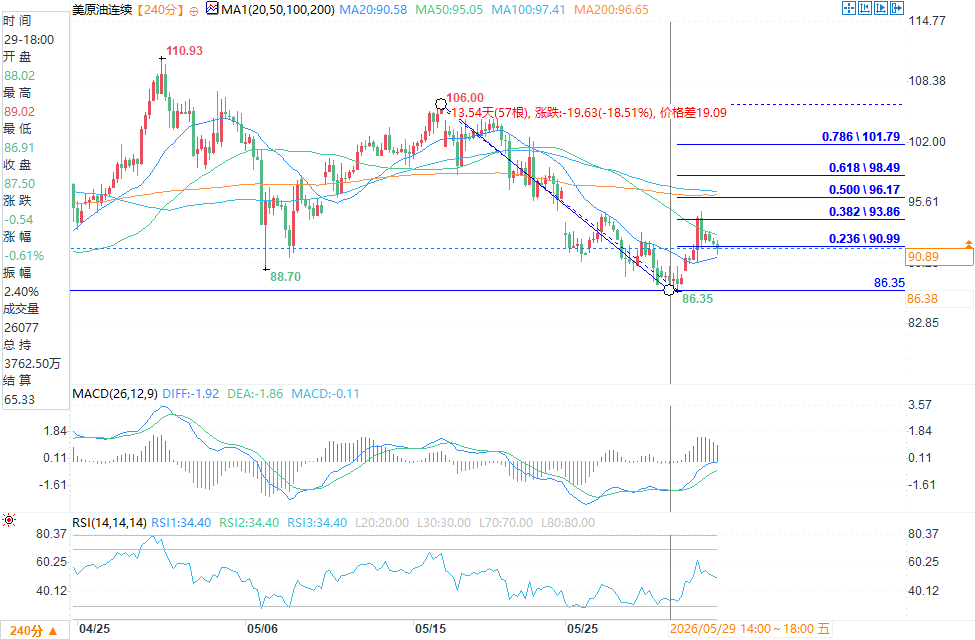
(WTI crude oil daily chart source: FX678)
From the 4-hour candlestick chart, the current price is fluctuating wildly around $90.99 (the 0.236 Fibonacci retracement level). Although yesterday's rebound briefly broke above the 0.382 level (approximately $93.86), it quickly returned to this range, indicating heavy overhead resistance. Multiple moving averages (MA20, MA50, MA100, especially the MA200 near $96.65) continue to firmly suppress the price, forming layers of resistance.
In terms of technical indicators, the MACD (26,12,9) is still running below the zero axis, with DIFF at -1.92 and DEA at -1.86. Although the bearish momentum has weakened slightly, the overall trend has not reversed. The RSI (14) is hovering around 34, fluctuating at a low level but not yet entering a deep oversold state, and there is still room for adjustment in the short term.
Looking ahead, the $90.99 level is unlikely to hold. Without new major positive news, a decisive break below this level would likely see oil prices directly test the previous low of $86.35. The API and EIA inventory data to be released this Wednesday and Thursday are expected to have a limited impact in a market currently dominated by geopolitical headlines. Market attention remains focused on whether new developments will emerge in the news.
In the baseline scenario, crude oil prices will continue to decline, and in the short term, they will likely fluctuate within the $86-$94 range to digest previous losses. Of course, risk scenarios cannot be ignored: if the conflict in the Middle East unexpectedly escalates (e.g., large-scale military action or a strong response from Iran), oil prices could still rebound rapidly to $94 or even higher, but this is currently considered a low-probability event.
In terms of trading strategy, short sellers may consider placing orders around $90.99-$93, with a stop-loss set above the recent rebound high, and an initial target of $86.35. Long positions, on the other hand, need to wait for a clearer trend reversal signal (such as a MACD golden cross coupled with RSI above 50). Currently, it is only suitable to play the rebound with a small position, and it is not advisable to chase the rise with a large position.
Summarize
Yesterday's 8% gain was more of an emotional release than a trend reversal. The overall geopolitical easing remains unchanged, the technical charts still show a bearish alignment, and the downward channel for oil prices has not yet closed. Investors need to remain cautious, closely monitor the latest developments in the Middle East and Trump's statements, and strictly control positions and risks in a highly volatile environment.
With the conflict easing, oil prices will likely continue to seek a new equilibrium, a process that may be accompanied by more volatility and challenges.
Looking back at the whole process: On May 16, the negative inventory data set a low point; on May 19, news of a de-escalation in US-Iran peace talks added further pressure; in the early hours of May 24, Trump suddenly announced an agreement and the opening of the Strait of Hormuz, causing a single-day plunge of more than 9%. These three waves of sudden news formed a "double whammy" of negative news, completely crushing market risk appetite and causing oil prices to plummet by nearly one-fifth from their highs.
Oil prices rebounded strongly yesterday (May 29), with a single-day increase reaching 8%. This surge was mainly driven by unexpected major news from Iran, representing profit-taking by short sellers and a technical rebound from oversold conditions. As the situation quickly de-escalated, the rally failed to continue. The market quickly realized that the overall context of conflict resolution and de-escalation remained unchanged. Although Israel stated it would continue military operations, unless there is a larger-scale unexpected escalation, it is unlikely to create a shock strong enough to reverse the trend.
Technical Analysis
(WTI crude oil daily chart source: FX678)
From the 4-hour candlestick chart, the current price is fluctuating wildly around $90.99 (the 0.236 Fibonacci retracement level). Although yesterday's rebound briefly broke above the 0.382 level (approximately $93.86), it quickly returned to this range, indicating heavy overhead resistance. Multiple moving averages (MA20, MA50, MA100, especially the MA200 near $96.65) continue to firmly suppress the price, forming layers of resistance.
In terms of technical indicators, the MACD (26,12,9) is still running below the zero axis, with DIFF at -1.92 and DEA at -1.86. Although the bearish momentum has weakened slightly, the overall trend has not reversed. The RSI (14) is hovering around 34, fluctuating at a low level but not yet entering a deep oversold state, and there is still room for adjustment in the short term.
Looking ahead, the $90.99 level is unlikely to hold. Without new major positive news, a decisive break below this level would likely see oil prices directly test the previous low of $86.35. The API and EIA inventory data to be released this Wednesday and Thursday are expected to have a limited impact in a market currently dominated by geopolitical headlines. Market attention remains focused on whether new developments will emerge in the news.
In the baseline scenario, crude oil prices will continue to decline, and in the short term, they will likely fluctuate within the $86-$94 range to digest previous losses. Of course, risk scenarios cannot be ignored: if the conflict in the Middle East unexpectedly escalates (e.g., large-scale military action or a strong response from Iran), oil prices could still rebound rapidly to $94 or even higher, but this is currently considered a low-probability event.
In terms of trading strategy, short sellers may consider placing orders around $90.99-$93, with a stop-loss set above the recent rebound high, and an initial target of $86.35. Long positions, on the other hand, need to wait for a clearer trend reversal signal (such as a MACD golden cross coupled with RSI above 50). Currently, it is only suitable to play the rebound with a small position, and it is not advisable to chase the rise with a large position.
Summarize
Yesterday's 8% gain was more of an emotional release than a trend reversal. The overall geopolitical easing remains unchanged, the technical charts still show a bearish alignment, and the downward channel for oil prices has not yet closed. Investors need to remain cautious, closely monitor the latest developments in the Middle East and Trump's statements, and strictly control positions and risks in a highly volatile environment.
With the conflict easing, oil prices will likely continue to seek a new equilibrium, a process that may be accompanied by more volatility and challenges.
- Risk Warning and Disclaimer
- The market involves risk, and trading may not be suitable for all investors. This article is for reference only and does not constitute personal investment advice, nor does it take into account certain users’ specific investment objectives, financial situation, or other needs. Any investment decisions made based on this information are at your own risk.