Multiple factors are temporarily suppressing oil prices, but institutions predict a significant surge this summer.
2026-06-03 13:14:07
The current disruption to navigation in the Strait of Hormuz has caused a historic interruption in crude oil supply, but international oil prices have not reached new historical highs. The market is hoping for a swift resolution to geopolitical tensions, a buffer from global inventories, and a temporary halt to spot crude oil purchases by major Asian countries. These factors, coupled with high prices forcing a rapid contraction in demand, are collectively limiting the upside potential of oil prices.
As overseas crude oil destocking rates continue to break records, the demand reduction may become permanent. With expectations that major Asian countries will restart restocking later, institutions generally predict that the shortage of crude oil spot supply will materialize this summer, and there is potential for a significant surge in oil prices.
As the US-Iran conflict enters its fourth month, the initial surplus of global inventories has temporarily absorbed the supply pressure, slowing the surge in oil prices. Data from Kepler shows that, excluding major Asian countries, the reduction of onshore inventories in other parts of the world is accelerating. In early May, the global daily reduction was 1.5 million barrels, and it has now risen to 1.7 million barrels.
Patrick De Haan, head of petroleum analysis at GasBuddy, said that since the outbreak of the conflict in early March, Americans have spent an additional $40 billion on gasoline, with daily additional fuel costs ranging from $400 million to $600 million. The U.S. strategic petroleum reserve is about to hit its lowest level since 1983, and the reserve safety cushion is constantly thinning.
After oil prices stabilized above the $100 mark, many countries introduced policies to curb fuel consumption. In Asia, fuel consumption was reduced by shortening the working hours of public officials and encouraging working from home. In Europe and the United States, residents voluntarily reduced their travel due to rising gasoline and airfare prices. As a result, end-user fuel consumption continued to decline, becoming a key factor in stabilizing oil prices in the short term.
High oil prices are forcing consumers to adjust their consumption habits, and the fact that major Asian countries have ample reserves and have temporarily suspended their purchases has effectively suppressed the rise in crude oil prices.
In a research report, three JPMorgan analysts, Natasha Kaneva, Lyuba Savinova, and Artem Fakhretdinov, noted that the unexpected 9% decline in crude oil demand in the Asian giant, a reduction of 1.5 million barrels per day, was primarily driven by the shift in domestic consumption towards new energy vehicles.
Sales of new energy vehicles continue to rise in Eurasia, while in the United States, where there are no car purchase subsidies, people are also actively reducing their private car trips.
The core long-term question in the market is whether the pent-up demand after the geopolitical crisis can be fully restored. To avoid the risk of subsequent energy supply disruptions, countries are likely to accelerate the development of solar power, wind power, and new energy vehicles, meaning that some of the temporarily reduced crude oil consumption may never recover.
JPMorgan analysts speculate that the global economy may have to adapt to a long-term 9% decline in oil demand.
Goldman Sachs analysts said that the current contraction in demand has offset the upward pressure on prices caused by the shortage of spot goods, but the global inventory buffer is nearing its end.
As domestic industrial and refining demand recovers, major Asian countries are bound to resume spot crude oil purchases, exacerbating the supply-demand gap. The longer the Strait of Hormuz remains blocked, the faster the global energy shift away from the Middle East will proceed, further solidifying the downward trend in crude oil demand.
With both inventories bottoming out and procurement picking up, the current shortage of crude oil in the spot market is expected to materialize this summer, potentially leading to a strong upward trend in oil prices.
In summary, current inventory levels and reduced demand form two protective barriers for oil prices, but both supporting conditions are gradually weakening. Against the backdrop of continued geopolitical stalemate, the global crude oil supply and demand fundamentals continue to tighten. After a period of short-term price consolidation, a trend of upward movement this summer is now the mainstream market expectation.
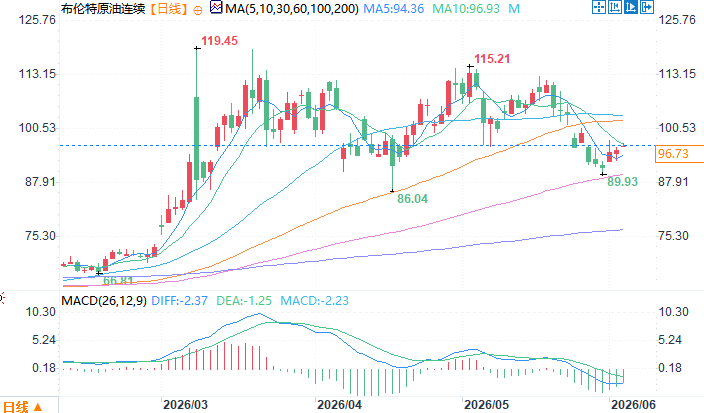
Brent crude oil daily chart source: EasyForex
At 13:13 Beijing time on June 3, Brent crude oil futures were trading at $96.98 per barrel.
As overseas crude oil destocking rates continue to break records, the demand reduction may become permanent. With expectations that major Asian countries will restart restocking later, institutions generally predict that the shortage of crude oil spot supply will materialize this summer, and there is potential for a significant surge in oil prices.
Inventory depletion is accelerating, and overseas buffer space continues to shrink.
As the US-Iran conflict enters its fourth month, the initial surplus of global inventories has temporarily absorbed the supply pressure, slowing the surge in oil prices. Data from Kepler shows that, excluding major Asian countries, the reduction of onshore inventories in other parts of the world is accelerating. In early May, the global daily reduction was 1.5 million barrels, and it has now risen to 1.7 million barrels.
Patrick De Haan, head of petroleum analysis at GasBuddy, said that since the outbreak of the conflict in early March, Americans have spent an additional $40 billion on gasoline, with daily additional fuel costs ranging from $400 million to $600 million. The U.S. strategic petroleum reserve is about to hit its lowest level since 1983, and the reserve safety cushion is constantly thinning.
After oil prices stabilized above the $100 mark, many countries introduced policies to curb fuel consumption. In Asia, fuel consumption was reduced by shortening the working hours of public officials and encouraging working from home. In Europe and the United States, residents voluntarily reduced their travel due to rising gasoline and airfare prices. As a result, end-user fuel consumption continued to decline, becoming a key factor in stabilizing oil prices in the short term.
High prices trigger a collapse in demand, and some consumption may disappear permanently.
High oil prices are forcing consumers to adjust their consumption habits, and the fact that major Asian countries have ample reserves and have temporarily suspended their purchases has effectively suppressed the rise in crude oil prices.
In a research report, three JPMorgan analysts, Natasha Kaneva, Lyuba Savinova, and Artem Fakhretdinov, noted that the unexpected 9% decline in crude oil demand in the Asian giant, a reduction of 1.5 million barrels per day, was primarily driven by the shift in domestic consumption towards new energy vehicles.
Sales of new energy vehicles continue to rise in Eurasia, while in the United States, where there are no car purchase subsidies, people are also actively reducing their private car trips.
The core long-term question in the market is whether the pent-up demand after the geopolitical crisis can be fully restored. To avoid the risk of subsequent energy supply disruptions, countries are likely to accelerate the development of solar power, wind power, and new energy vehicles, meaning that some of the temporarily reduced crude oil consumption may never recover.
JPMorgan analysts speculate that the global economy may have to adapt to a long-term 9% decline in oil demand.
The supply and demand dynamics are about to reverse, increasing the certainty of an oil price increase this summer.
Goldman Sachs analysts said that the current contraction in demand has offset the upward pressure on prices caused by the shortage of spot goods, but the global inventory buffer is nearing its end.
As domestic industrial and refining demand recovers, major Asian countries are bound to resume spot crude oil purchases, exacerbating the supply-demand gap. The longer the Strait of Hormuz remains blocked, the faster the global energy shift away from the Middle East will proceed, further solidifying the downward trend in crude oil demand.
With both inventories bottoming out and procurement picking up, the current shortage of crude oil in the spot market is expected to materialize this summer, potentially leading to a strong upward trend in oil prices.
Summarize
In summary, current inventory levels and reduced demand form two protective barriers for oil prices, but both supporting conditions are gradually weakening. Against the backdrop of continued geopolitical stalemate, the global crude oil supply and demand fundamentals continue to tighten. After a period of short-term price consolidation, a trend of upward movement this summer is now the mainstream market expectation.
Brent crude oil daily chart source: EasyForex
At 13:13 Beijing time on June 3, Brent crude oil futures were trading at $96.98 per barrel.
- Risk Warning and Disclaimer
- The market involves risk, and trading may not be suitable for all investors. This article is for reference only and does not constitute personal investment advice, nor does it take into account certain users’ specific investment objectives, financial situation, or other needs. Any investment decisions made based on this information are at your own risk.