Even the largest-ever reserve release couldn't save the situation! IEA: The supply gap is too large; the only solution is to "suppress demand."
2026-06-03 13:19:24
On Wednesday (June 3) during the Asian session, international crude oil prices fluctuated higher, with WTI crude oil rising by more than 1% to above $94.50 per barrel, and Brent crude oil also rising by more than 1% to around $97 per barrel.
The current strength in oil prices is supported by solid fundamentals. Toril Bosoni, head of the International Energy Agency's (IEA) Oil Industry and Markets division, said on Tuesday that if the rate of decline in inventories continues at its current level, global oil inventories could fall to critical levels before the summer demand peak. Summer in the Northern Hemisphere is typically the peak season for fuel demand as people travel by car or plane for vacations.
Bosoni noted, "We are seeing inventory declines continue into the summer, and there is a possibility—or rather, a high probability—that inventories will fall to critical or historical lows before the summer demand peak."
Speaking at the S&P Global Energy Middle East Oil and Gas Conference in London, Bosoni said that even if an agreement is reached today, reopening the Strait of Hormuz would take six to eight months. This means that even with a diplomatic breakthrough, the supply disruptions will be difficult to alleviate quickly in the short term.
This relatively pessimistic assessment is not an isolated case; many institutions also hold a cautious attitude towards the timetable for the reopening of the Taiwan Strait.
In its latest report on the Iranian crisis, JPMorgan Chase explicitly stated that the likelihood of the Strait of Hormuz reopening in June is "extremely low."
The report argues that the current Brent crude oil price of over $95 per barrel already reflects market expectations for a short-term reopening of the Strait of Hormuz, but the upside risks to oil prices far outweigh the downside risks. If the reopening is delayed by one week, the Brent crude oil price forecast for the end of 2026 needs to be revised upwards by $5; if the blockade continues, Brent crude oil prices may surge to an extreme level of $150 per barrel in the second half of the year.
S&P Global Energy listed five key conditions for the recovery of commercial shipping: ship traffic recovering to 50%-90% of pre-war levels and remaining stable for 1 to 4 weeks; a 30 to 45-day observation period; availability of commercial insurance; physical security (including mine clearance); and normalization of fleet deployment. S&P estimates that more than 800 vessels remain stranded in the Gulf region, and shipping activity will remain below normal levels until the second half of 2026.
Bosoni added that tight inventories could prompt the IEA to coordinate another emergency release of strategic reserves, but no such discussions have taken place yet—because about half of the first 400 million barrels of crude oil released in March has not yet entered the market.
She emphasized, "In any case, emergency releases of strategic reserves are only a stopgap measure and cannot solve the fundamental problem. The supply gap is so large that narrowing it will have to rely on the demand side." The so-called "demand destruction" refers to the fact that high oil prices force consumers to reduce their purchases, thereby causing supply and demand to return to balance.
In practice, the largest release of reserves in history failed to effectively suppress oil prices. After the IEA announced the release of 400 million barrels of strategic petroleum reserves in March, international oil prices briefly fell but then surged, with Brent crude returning above $100.
An analysis report by the US investment firm Bernstein points out that releasing reserves can buy time, but it cannot solve the crisis.
Brookings Institution energy expert Gross put it more bluntly: the release of strategic oil reserves is equivalent to about 7% of global demand, while the disruption of shipping across the strait actually impacts global demand by 15% to 17%, leaving an unfillable gap.
Bosoni stated that the IEA has observed rising oil prices and a weak economic outlook leading to a decline in demand for transportation fuels. She added, "The most significant market-moving adjustment we've seen is coming from the demand side."
A prime example comes from Japan. Its crude oil imports in April plummeted by approximately 66% to 850,000 barrels per day, the lowest level since 1962. Although imports are projected to rebound to around 1.7 million barrels per day in May, the overall import volume is still significantly lower than before the conflict. This sharp contraction in demand has played a significant balancing role in the global market, and to some extent explains why oil price increases were relatively limited after the closure of the Strait of Hormuz.
The IEA stated that since the end of February, oil supplies from Gulf oil-producing countries have decreased by approximately 14 million barrels per day, a scale equivalent to nearly 15% of global daily consumption disappearing instantly, an unprecedented event in history.
Meanwhile, oil-producing countries in the Americas are striving to fill the gap. EIA data shows that U.S. crude oil production is projected at 13.51 million barrels per day in 2026, accounting for approximately 22% of global production, with the 2027 production forecast revised upwards to 13.95 million barrels per day. Brazil, Guyana, and Argentina are the main drivers of non-OPEC supply growth, with Brazil's pre-salt oil fields, Guyana's Uaru project, and Argentina's Vaca Muerta shale region all contributing to the increase. However, Venezuela, due to the long-term decline of its oil industry, currently produces less than 1 million barrels per day, limiting its short-term contribution to supply.
The IEA, in its latest monthly oil market report, predicts that supply in the Americas will increase by 1.5 million barrels per day in 2026, an upward revision of 600,000 barrels per day from its initial forecast. However, Bosoni stated that these increases will only "slightly offset" the supply losses east of the Suez Canal. The supply losses are as high as 14 million barrels per day, and even if the Americas' increases materialize, they will only fill about one-tenth of the gap.
From a daily chart perspective, US crude oil futures previously formed a double top at 119.48 and 117.63, indicating a slowdown in the medium-term upward momentum. The current price is under pressure below the 20-day and 50-day moving averages, facing short-term resistance at the 96.5-97.6 USD moving average; the previous low of 86.35 USD forms a key support level. The MACD is running below the zero line, indicating remaining bearish momentum, while the RSI is near the 50 level, a key support/resistance level, suggesting a balanced struggle between bulls and bears.
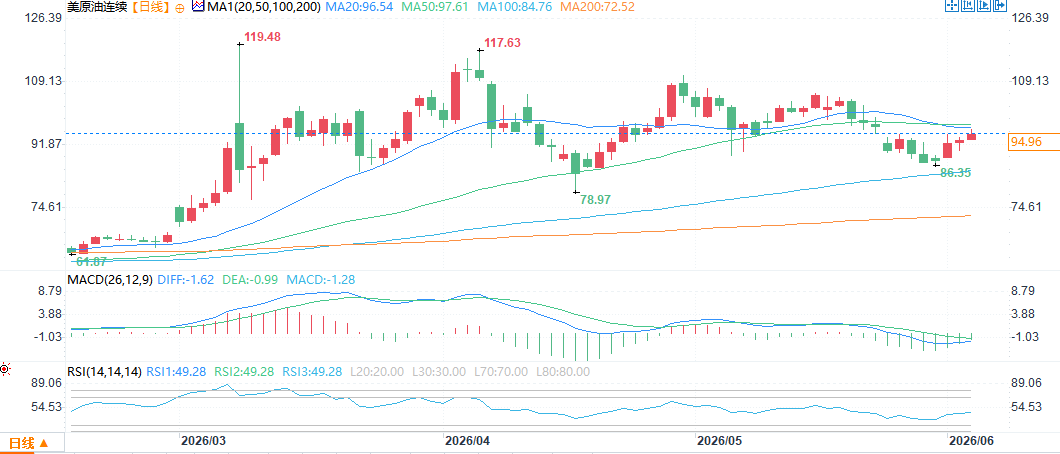
(US crude oil futures daily chart, source: FX678)
At 13:19 Beijing time on June 3, US crude oil futures were trading at $94.92 per barrel.
The current strength in oil prices is supported by solid fundamentals. Toril Bosoni, head of the International Energy Agency's (IEA) Oil Industry and Markets division, said on Tuesday that if the rate of decline in inventories continues at its current level, global oil inventories could fall to critical levels before the summer demand peak. Summer in the Northern Hemisphere is typically the peak season for fuel demand as people travel by car or plane for vacations.
Bosoni noted, "We are seeing inventory declines continue into the summer, and there is a possibility—or rather, a high probability—that inventories will fall to critical or historical lows before the summer demand peak."
Strait of Hormuz: Even if an agreement is reached today, reopening will still take six to eight months.
Speaking at the S&P Global Energy Middle East Oil and Gas Conference in London, Bosoni said that even if an agreement is reached today, reopening the Strait of Hormuz would take six to eight months. This means that even with a diplomatic breakthrough, the supply disruptions will be difficult to alleviate quickly in the short term.
This relatively pessimistic assessment is not an isolated case; many institutions also hold a cautious attitude towards the timetable for the reopening of the Taiwan Strait.
In its latest report on the Iranian crisis, JPMorgan Chase explicitly stated that the likelihood of the Strait of Hormuz reopening in June is "extremely low."
The report argues that the current Brent crude oil price of over $95 per barrel already reflects market expectations for a short-term reopening of the Strait of Hormuz, but the upside risks to oil prices far outweigh the downside risks. If the reopening is delayed by one week, the Brent crude oil price forecast for the end of 2026 needs to be revised upwards by $5; if the blockade continues, Brent crude oil prices may surge to an extreme level of $150 per barrel in the second half of the year.
S&P Global Energy listed five key conditions for the recovery of commercial shipping: ship traffic recovering to 50%-90% of pre-war levels and remaining stable for 1 to 4 weeks; a 30 to 45-day observation period; availability of commercial insurance; physical security (including mine clearance); and normalization of fleet deployment. S&P estimates that more than 800 vessels remain stranded in the Gulf region, and shipping activity will remain below normal levels until the second half of 2026.
Emergency release of reserves: a stopgap measure that cannot solve the fundamental problem.
Bosoni added that tight inventories could prompt the IEA to coordinate another emergency release of strategic reserves, but no such discussions have taken place yet—because about half of the first 400 million barrels of crude oil released in March has not yet entered the market.
She emphasized, "In any case, emergency releases of strategic reserves are only a stopgap measure and cannot solve the fundamental problem. The supply gap is so large that narrowing it will have to rely on the demand side." The so-called "demand destruction" refers to the fact that high oil prices force consumers to reduce their purchases, thereby causing supply and demand to return to balance.
In practice, the largest release of reserves in history failed to effectively suppress oil prices. After the IEA announced the release of 400 million barrels of strategic petroleum reserves in March, international oil prices briefly fell but then surged, with Brent crude returning above $100.
An analysis report by the US investment firm Bernstein points out that releasing reserves can buy time, but it cannot solve the crisis.
Brookings Institution energy expert Gross put it more bluntly: the release of strategic oil reserves is equivalent to about 7% of global demand, while the disruption of shipping across the strait actually impacts global demand by 15% to 17%, leaving an unfillable gap.
Demand-side signals: High oil prices have begun to suppress consumption.
Bosoni stated that the IEA has observed rising oil prices and a weak economic outlook leading to a decline in demand for transportation fuels. She added, "The most significant market-moving adjustment we've seen is coming from the demand side."
A prime example comes from Japan. Its crude oil imports in April plummeted by approximately 66% to 850,000 barrels per day, the lowest level since 1962. Although imports are projected to rebound to around 1.7 million barrels per day in May, the overall import volume is still significantly lower than before the conflict. This sharp contraction in demand has played a significant balancing role in the global market, and to some extent explains why oil price increases were relatively limited after the closure of the Strait of Hormuz.
Supply-side comparison: The Gulf region will lose 14 million barrels per day, while the Americas will only be able to "slightly offset" this loss.
The IEA stated that since the end of February, oil supplies from Gulf oil-producing countries have decreased by approximately 14 million barrels per day, a scale equivalent to nearly 15% of global daily consumption disappearing instantly, an unprecedented event in history.
Meanwhile, oil-producing countries in the Americas are striving to fill the gap. EIA data shows that U.S. crude oil production is projected at 13.51 million barrels per day in 2026, accounting for approximately 22% of global production, with the 2027 production forecast revised upwards to 13.95 million barrels per day. Brazil, Guyana, and Argentina are the main drivers of non-OPEC supply growth, with Brazil's pre-salt oil fields, Guyana's Uaru project, and Argentina's Vaca Muerta shale region all contributing to the increase. However, Venezuela, due to the long-term decline of its oil industry, currently produces less than 1 million barrels per day, limiting its short-term contribution to supply.
The IEA, in its latest monthly oil market report, predicts that supply in the Americas will increase by 1.5 million barrels per day in 2026, an upward revision of 600,000 barrels per day from its initial forecast. However, Bosoni stated that these increases will only "slightly offset" the supply losses east of the Suez Canal. The supply losses are as high as 14 million barrels per day, and even if the Americas' increases materialize, they will only fill about one-tenth of the gap.
From a daily chart perspective, US crude oil futures previously formed a double top at 119.48 and 117.63, indicating a slowdown in the medium-term upward momentum. The current price is under pressure below the 20-day and 50-day moving averages, facing short-term resistance at the 96.5-97.6 USD moving average; the previous low of 86.35 USD forms a key support level. The MACD is running below the zero line, indicating remaining bearish momentum, while the RSI is near the 50 level, a key support/resistance level, suggesting a balanced struggle between bulls and bears.
(US crude oil futures daily chart, source: FX678)
At 13:19 Beijing time on June 3, US crude oil futures were trading at $94.92 per barrel.
- Risk Warning and Disclaimer
- The market involves risk, and trading may not be suitable for all investors. This article is for reference only and does not constitute personal investment advice, nor does it take into account certain users’ specific investment objectives, financial situation, or other needs. Any investment decisions made based on this information are at your own risk.