The dollar index remained high, and coupled with volatile geopolitical situations, the dollar rebounded sharply against the rupee.
2026-06-03 13:54:43
The US dollar continued its rebound against the Indian rupee (USD/INR) during Wednesday's Asian trading session, rising to around 95.67, a recent high. The continued rise in international oil prices and the outflow of overseas funds from the Indian capital market were the main factors driving the strength of the USD/INR.
In the international energy market, WTI crude oil prices rose to around $95, a significant rebound from previous lows. The price increase was mainly driven by renewed tensions in the Middle East. Recent negotiations between the US and Iran have been fraught with uncertainty, reigniting market concerns about the security of energy transport through the Strait of Hormuz.
The U.S. Central Command announced the successful interception of missile and drone attacks targeting Kuwait and Bahrain, and retaliated against Iran's Qeshm Island. These events have further exacerbated market concerns about an escalation of regional conflict. As the Persian Gulf region plays a crucial role in global energy transportation, any changes in the situation directly impact international oil prices.
For India, the impact of rising oil prices is particularly pronounced. As one of the world's major energy importers, India's crude oil demand has long relied on overseas supplies. The market generally believes that the continued rise in international oil prices will increase India's import costs and add pressure to its current account, thereby weakening the Indian rupee's performance.
Analysts point out that when international oil prices remain high, Indian companies increase energy spending, and importers' demand for US dollars rises accordingly, which typically drives up the dollar against the Indian rupee. The current rebound of WTI crude oil prices to around $93 has also kept the market focused on India's future inflation trends.
Meanwhile, continued capital outflows from overseas markets further increased pressure on the Indian rupee. Data shows that overseas institutional investors net sold approximately 836.292 billion rupees in equity assets on Tuesday, following a net outflow of approximately 391.168 billion rupees in the previous trading day. The large-scale capital withdrawals over two consecutive trading days indicate that international investors remain cautious about current market risks.
Market participants believe that the uncertain prospects of US-Iran negotiations and declining global risk appetite are key reasons why some international funds are reducing their exposure to emerging markets. Capital outflows have increased demand for the US dollar, further supporting the appreciation of the USD/INR exchange rate. It is worth noting that the Reserve Bank of India may intervene in the market soon by selling US dollars to slow the rupee's depreciation. However, the market generally believes that against the backdrop of rising international oil prices and a generally strong US dollar, simple foreign exchange intervention is unlikely to fundamentally change the short-term trend.
Investors are currently closely watching the Reserve Bank of India's (RBI) monetary policy meeting. The three-day meeting has begun, and the final results will be announced on Friday. The mainstream market expectation is that the RBI will maintain the current interest rate level, but some institutions predict a possible 25 basis point rate hike.
Besides the interest rate decision, the market is paying close attention to the remarks made by Reserve Bank of India Governor Sanjay Malhotra regarding the economic growth and inflation outlook. With rising energy prices, inflation risks may resurface, which will be a crucial factor for the central bank's policy-making. The first-quarter GDP data for India, released on the same day, is also closely watched by the market. Currently, the market expects India's first-quarter GDP growth to be around 7.2%, lower than the previous figure of 7.8%. If there are further signs of slowing economic growth, it could affect market assessments of India's economic prospects.
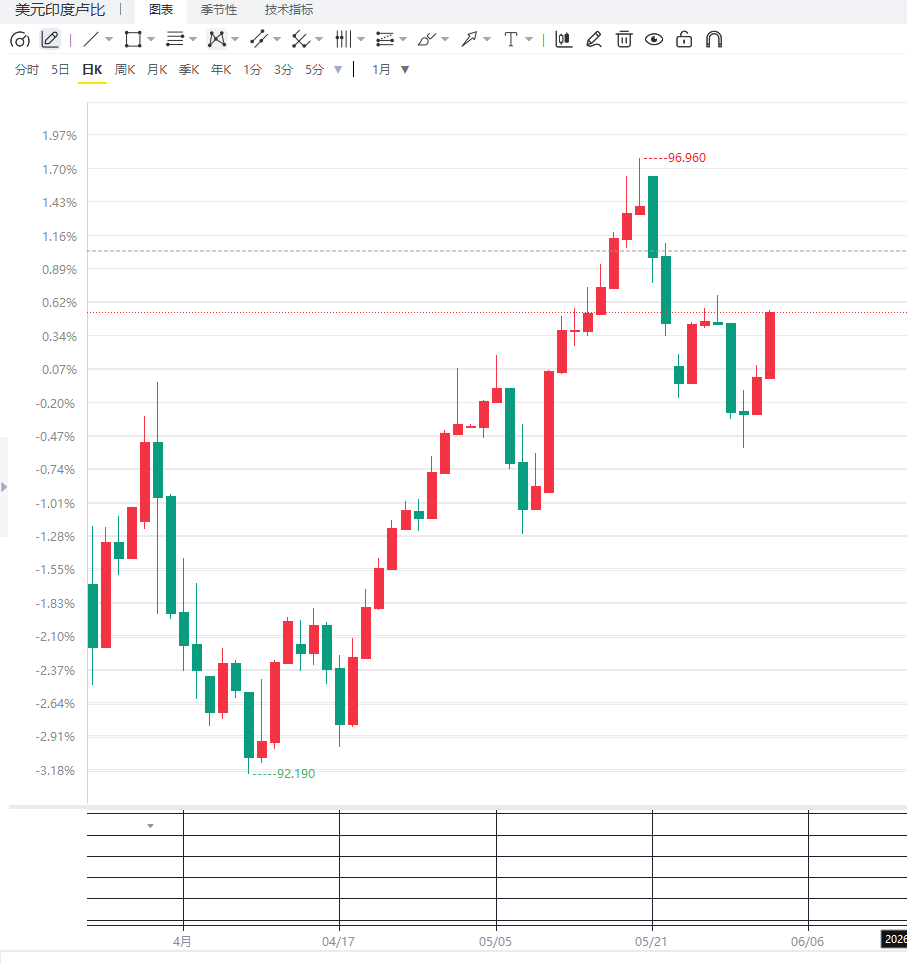
From a technical perspective, the USD/INR pair has climbed back above its 20-day exponential moving average at 95.43, indicating a gradually strengthening short-term trend. The price returning above key moving averages reflects increased buying pressure. The daily chart shows the Relative Strength Index (RSI) hovering around 54, in neutral to bullish territory, suggesting improving upward momentum but not yet overbought conditions. Currently, 95.43 forms the first short-term support level; a break below this level could lead to a pullback to test support around 94.46. On the upside, 96.19 is a significant resistance level. A break above this level could see the pair further challenge the historical high of 97.09. Overall, given high oil prices, foreign capital outflows, and a strong US dollar, the USD/INR pair remains bullish in the short term.
Editor's Summary:
The Indian rupee is currently facing pressure from both external and internal factors. Rising international oil prices are increasing energy import costs, while continued foreign capital outflows are weakening the support from capital inflows. Meanwhile, the market is awaiting the Reserve Bank of India's (RBI) interest rate decision and GDP data to assess future economic growth prospects. In the short term, if tensions in the Middle East continue and further drive up oil prices, the USD/IRR exchange rate may still have room to rise. However, RBI intervention and policy statements may alleviate market volatility to some extent. In the coming weeks, changes in energy prices, capital flows, and monetary policy expectations will be key factors determining the exchange rate's direction.
In the international energy market, WTI crude oil prices rose to around $95, a significant rebound from previous lows. The price increase was mainly driven by renewed tensions in the Middle East. Recent negotiations between the US and Iran have been fraught with uncertainty, reigniting market concerns about the security of energy transport through the Strait of Hormuz.
The U.S. Central Command announced the successful interception of missile and drone attacks targeting Kuwait and Bahrain, and retaliated against Iran's Qeshm Island. These events have further exacerbated market concerns about an escalation of regional conflict. As the Persian Gulf region plays a crucial role in global energy transportation, any changes in the situation directly impact international oil prices.
For India, the impact of rising oil prices is particularly pronounced. As one of the world's major energy importers, India's crude oil demand has long relied on overseas supplies. The market generally believes that the continued rise in international oil prices will increase India's import costs and add pressure to its current account, thereby weakening the Indian rupee's performance.
Analysts point out that when international oil prices remain high, Indian companies increase energy spending, and importers' demand for US dollars rises accordingly, which typically drives up the dollar against the Indian rupee. The current rebound of WTI crude oil prices to around $93 has also kept the market focused on India's future inflation trends.
Meanwhile, continued capital outflows from overseas markets further increased pressure on the Indian rupee. Data shows that overseas institutional investors net sold approximately 836.292 billion rupees in equity assets on Tuesday, following a net outflow of approximately 391.168 billion rupees in the previous trading day. The large-scale capital withdrawals over two consecutive trading days indicate that international investors remain cautious about current market risks.
Market participants believe that the uncertain prospects of US-Iran negotiations and declining global risk appetite are key reasons why some international funds are reducing their exposure to emerging markets. Capital outflows have increased demand for the US dollar, further supporting the appreciation of the USD/INR exchange rate. It is worth noting that the Reserve Bank of India may intervene in the market soon by selling US dollars to slow the rupee's depreciation. However, the market generally believes that against the backdrop of rising international oil prices and a generally strong US dollar, simple foreign exchange intervention is unlikely to fundamentally change the short-term trend.
Investors are currently closely watching the Reserve Bank of India's (RBI) monetary policy meeting. The three-day meeting has begun, and the final results will be announced on Friday. The mainstream market expectation is that the RBI will maintain the current interest rate level, but some institutions predict a possible 25 basis point rate hike.
Besides the interest rate decision, the market is paying close attention to the remarks made by Reserve Bank of India Governor Sanjay Malhotra regarding the economic growth and inflation outlook. With rising energy prices, inflation risks may resurface, which will be a crucial factor for the central bank's policy-making. The first-quarter GDP data for India, released on the same day, is also closely watched by the market. Currently, the market expects India's first-quarter GDP growth to be around 7.2%, lower than the previous figure of 7.8%. If there are further signs of slowing economic growth, it could affect market assessments of India's economic prospects.
From a technical perspective, the USD/INR pair has climbed back above its 20-day exponential moving average at 95.43, indicating a gradually strengthening short-term trend. The price returning above key moving averages reflects increased buying pressure. The daily chart shows the Relative Strength Index (RSI) hovering around 54, in neutral to bullish territory, suggesting improving upward momentum but not yet overbought conditions. Currently, 95.43 forms the first short-term support level; a break below this level could lead to a pullback to test support around 94.46. On the upside, 96.19 is a significant resistance level. A break above this level could see the pair further challenge the historical high of 97.09. Overall, given high oil prices, foreign capital outflows, and a strong US dollar, the USD/INR pair remains bullish in the short term.
Editor's Summary:
The Indian rupee is currently facing pressure from both external and internal factors. Rising international oil prices are increasing energy import costs, while continued foreign capital outflows are weakening the support from capital inflows. Meanwhile, the market is awaiting the Reserve Bank of India's (RBI) interest rate decision and GDP data to assess future economic growth prospects. In the short term, if tensions in the Middle East continue and further drive up oil prices, the USD/IRR exchange rate may still have room to rise. However, RBI intervention and policy statements may alleviate market volatility to some extent. In the coming weeks, changes in energy prices, capital flows, and monetary policy expectations will be key factors determining the exchange rate's direction.
- Risk Warning and Disclaimer
- The market involves risk, and trading may not be suitable for all investors. This article is for reference only and does not constitute personal investment advice, nor does it take into account certain users’ specific investment objectives, financial situation, or other needs. Any investment decisions made based on this information are at your own risk.