The US dollar hit a near two-week high against the Canadian dollar and may accelerate its upward movement.
2026-06-04 14:46:19
The US dollar (USD/CAD) continued its recent upward trend in Asian trading on Thursday, breaking through the 1.3900 level and reaching a near two-week high. Amid a generally strong US dollar, deteriorating Canadian economic fundamentals were a significant factor driving the exchange rate higher.

Recent Canadian economic data continues to signal weakness. Data shows that the Canadian economy experienced negative growth for the second consecutive quarter in the first quarter of 2026, officially entering a technical recession. The slowdown in economic activity not only affects business investment and household consumption but also exacerbates market concerns about future growth prospects.
Meanwhile, the Canadian labor market is also facing challenges. The unemployment rate continues to rise, job growth has slowed significantly, and consumer demand is showing signs of cooling. The market generally believes that if the economic weakness persists, the Bank of Canada may be forced to adopt a more accommodative policy stance to support economic recovery.
Shifting expectations regarding monetary policy are directly impacting the Canadian dollar's performance. Slowing economic growth and a deteriorating job market have fueled investor expectations that the Bank of Canada will maintain its accommodative monetary policy. The lower interest rate environment has reduced the attractiveness of Canadian dollar assets, leading to capital outflows and suppressing the Canadian dollar's performance.
In contrast, the US economy has demonstrated greater resilience. Recent employment data has consistently exceeded market expectations, indicating that the US labor market remains robust. Strong employment performance not only supports consumer activity but also strengthens market confidence in a soft landing for the US economy. However, with renewed inflationary pressures from rising energy prices, market expectations regarding the Federal Reserve's future policy path have shifted again. Currently, the market generally believes that the Fed may maintain its high-interest-rate policy for an extended period.
Market estimates suggest traders now expect a greater than 50% probability of further tightening by the Federal Reserve. This expectation has kept US Treasury yields high and continues to attract international capital inflows into dollar assets, supporting the dollar index. Furthermore, the situation in the Middle East remains a significant variable influencing the exchange rate market. Meanwhile, negotiations between the US and Iran regarding the nuclear issue and security in the Strait of Hormuz have yet to yield any breakthroughs.
For the Canadian dollar, rising oil prices are generally a positive factor. As one of the world's major energy exporters, Canada benefits from higher energy prices. The recent continuous rise in international crude oil prices has alleviated some of the downward pressure on the Canadian dollar. Furthermore, the recent ceasefire agreement between Lebanon and Israel has cooled some market demand for safe-haven assets, thus curbing safe-haven buying of the US dollar. This is also one of the important reasons why the US dollar has not seen a larger increase against the Canadian dollar.
However, from an overall fundamental perspective, the gap between the weak Canadian economy and the resilient US economy remains significant. Even with high oil prices, the Canadian dollar is unlikely to escape the pressure from slowing economic growth and weakening policy expectations in the short term. The market is currently awaiting the upcoming employment data from the US and Canada. In particular, the US non-farm payroll report will be a crucial indicator of the Federal Reserve's future policy direction. If the US job market continues to be strong, the US dollar is expected to receive further support; if Canadian employment data continues to deteriorate, it could further exacerbate the weakness of the Canadian dollar.
From a daily chart perspective, the USD/CAD pair maintains an overall upward trend. The price has regained support above both the 20-day and 50-day moving averages, gradually strengthening the bullish structure. The MACD indicator is running above the zero line, with the red histogram bars continuing to expand, indicating increasing upward momentum. The RSI indicator is hovering around 62, reflecting a bullish market sentiment but not yet entering extreme overbought territory. Key support levels to watch are 1.3840 and 1.3780, while resistance levels are 1.3980 and 1.4050.
From a 4-hour chart perspective, the exchange rate has maintained a strong consolidation after breaking through 1.3900. The MACD indicator maintains a golden cross structure, and the short-term upward trend has not been broken. The RSI remains above 60, indicating that the bulls still have a clear advantage. If it breaks through the 1.3980 resistance, it may further test the 1.4050 area; if it falls below the 1.3840 support, it may retrace to around 1.3780 to find new support.
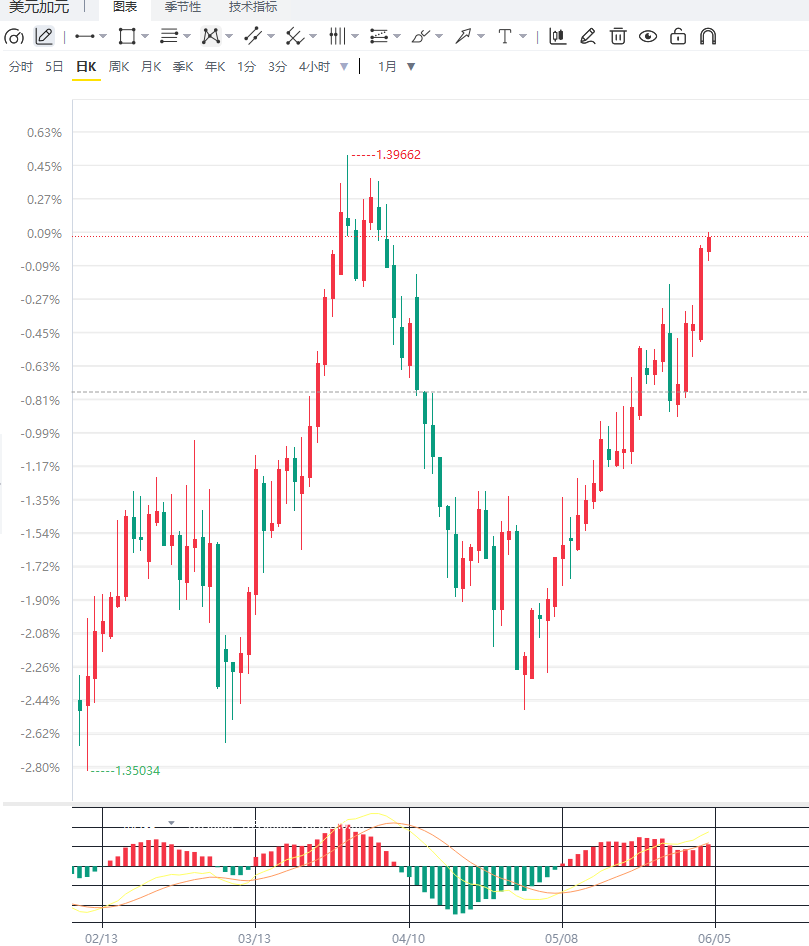
Editor's Summary : The recent rise in the USD/CAD exchange rate reflects the significant divergence between the economic performance of the US and Canada. Canada's economy has contracted for two consecutive quarters, confirming a technical recession. Coupled with a cooling job market and weak consumer demand, this has led to greater pessimism regarding the Bank of Canada's future policy outlook. Meanwhile, the resilience of the US economy and expectations of high interest rates from the Federal Reserve continue to support the US dollar. Employment data will be a crucial catalyst in determining the exchange rate's direction. If the US job market continues to show resilience while Canadian economic data deteriorates further, the USD/CAD pair could challenge the area above 1.4000. However, persistently high international oil prices and changes in the Middle East situation may still provide some support for the Canadian dollar, therefore market volatility is expected to remain at a high level.
Recent Canadian economic data continues to signal weakness. Data shows that the Canadian economy experienced negative growth for the second consecutive quarter in the first quarter of 2026, officially entering a technical recession. The slowdown in economic activity not only affects business investment and household consumption but also exacerbates market concerns about future growth prospects.
Meanwhile, the Canadian labor market is also facing challenges. The unemployment rate continues to rise, job growth has slowed significantly, and consumer demand is showing signs of cooling. The market generally believes that if the economic weakness persists, the Bank of Canada may be forced to adopt a more accommodative policy stance to support economic recovery.
Shifting expectations regarding monetary policy are directly impacting the Canadian dollar's performance. Slowing economic growth and a deteriorating job market have fueled investor expectations that the Bank of Canada will maintain its accommodative monetary policy. The lower interest rate environment has reduced the attractiveness of Canadian dollar assets, leading to capital outflows and suppressing the Canadian dollar's performance.
In contrast, the US economy has demonstrated greater resilience. Recent employment data has consistently exceeded market expectations, indicating that the US labor market remains robust. Strong employment performance not only supports consumer activity but also strengthens market confidence in a soft landing for the US economy. However, with renewed inflationary pressures from rising energy prices, market expectations regarding the Federal Reserve's future policy path have shifted again. Currently, the market generally believes that the Fed may maintain its high-interest-rate policy for an extended period.
Market estimates suggest traders now expect a greater than 50% probability of further tightening by the Federal Reserve. This expectation has kept US Treasury yields high and continues to attract international capital inflows into dollar assets, supporting the dollar index. Furthermore, the situation in the Middle East remains a significant variable influencing the exchange rate market. Meanwhile, negotiations between the US and Iran regarding the nuclear issue and security in the Strait of Hormuz have yet to yield any breakthroughs.
For the Canadian dollar, rising oil prices are generally a positive factor. As one of the world's major energy exporters, Canada benefits from higher energy prices. The recent continuous rise in international crude oil prices has alleviated some of the downward pressure on the Canadian dollar. Furthermore, the recent ceasefire agreement between Lebanon and Israel has cooled some market demand for safe-haven assets, thus curbing safe-haven buying of the US dollar. This is also one of the important reasons why the US dollar has not seen a larger increase against the Canadian dollar.
However, from an overall fundamental perspective, the gap between the weak Canadian economy and the resilient US economy remains significant. Even with high oil prices, the Canadian dollar is unlikely to escape the pressure from slowing economic growth and weakening policy expectations in the short term. The market is currently awaiting the upcoming employment data from the US and Canada. In particular, the US non-farm payroll report will be a crucial indicator of the Federal Reserve's future policy direction. If the US job market continues to be strong, the US dollar is expected to receive further support; if Canadian employment data continues to deteriorate, it could further exacerbate the weakness of the Canadian dollar.
From a daily chart perspective, the USD/CAD pair maintains an overall upward trend. The price has regained support above both the 20-day and 50-day moving averages, gradually strengthening the bullish structure. The MACD indicator is running above the zero line, with the red histogram bars continuing to expand, indicating increasing upward momentum. The RSI indicator is hovering around 62, reflecting a bullish market sentiment but not yet entering extreme overbought territory. Key support levels to watch are 1.3840 and 1.3780, while resistance levels are 1.3980 and 1.4050.
From a 4-hour chart perspective, the exchange rate has maintained a strong consolidation after breaking through 1.3900. The MACD indicator maintains a golden cross structure, and the short-term upward trend has not been broken. The RSI remains above 60, indicating that the bulls still have a clear advantage. If it breaks through the 1.3980 resistance, it may further test the 1.4050 area; if it falls below the 1.3840 support, it may retrace to around 1.3780 to find new support.
Editor's Summary : The recent rise in the USD/CAD exchange rate reflects the significant divergence between the economic performance of the US and Canada. Canada's economy has contracted for two consecutive quarters, confirming a technical recession. Coupled with a cooling job market and weak consumer demand, this has led to greater pessimism regarding the Bank of Canada's future policy outlook. Meanwhile, the resilience of the US economy and expectations of high interest rates from the Federal Reserve continue to support the US dollar. Employment data will be a crucial catalyst in determining the exchange rate's direction. If the US job market continues to show resilience while Canadian economic data deteriorates further, the USD/CAD pair could challenge the area above 1.4000. However, persistently high international oil prices and changes in the Middle East situation may still provide some support for the Canadian dollar, therefore market volatility is expected to remain at a high level.
- Risk Warning and Disclaimer
- The market involves risk, and trading may not be suitable for all investors. This article is for reference only and does not constitute personal investment advice, nor does it take into account certain users’ specific investment objectives, financial situation, or other needs. Any investment decisions made based on this information are at your own risk.