A ceasefire between Israel and Lebanon alleviated geopolitical risk premiums, causing international crude oil futures to plummet by 3%.
2026-06-05 00:01:55
On Thursday (June 4), WTI crude oil futures for July delivery plummeted by over 3%. Following the ceasefire agreement between Israel and Lebanon, oil prices retreated from $97 per barrel. The 50-day moving average is currently at $97.67 per barrel, and the 20-day moving average is at $96.37 per barrel. The geopolitical risk premium that had previously propelled oil prices close to the $100 mark was quickly stripped away. However, the fundamental bearish factors did not materialize simultaneously: the U.S. Energy Information Administration (EIA) disclosed a sharp decrease of 8 million barrels in crude oil inventories, Russian officials acknowledged a decline in domestic crude oil production, and shipping restrictions in the Strait of Hormuz remain in place. The current ceasefire agreement is fragile, with significant resistance from short-term moving averages. The following analysis combines technical and fundamental factors.
With the ceasefire between Israel and Lebanon implemented, geopolitical risk premiums quickly subsided.
On Thursday, Israel and Lebanon signed a ceasefire agreement, immediately easing geopolitical tensions and reducing risk premiums in the oil market. Trump stated that the US-Iran negotiations might see substantial progress this weekend; Iranian Foreign Minister Araqchi responded that no major breakthrough had been achieved yet, but the two sides were still consulting and exchanging proposals. Influenced by the news that "the weekend negotiations may break the ice," the market saw a mass exodus of long positions, leading to a sell-off in oil prices.
However, the stability of the ceasefire remains questionable: Hezbollah leader Naeem Qassem warned that as long as Lebanese villages continue to be attacked, security in northern Israel cannot be achieved; Iran has made it clear that a comprehensive agreement between the US and Iran is contingent on the complete end of Hezbollah-related fighting in Lebanon, a condition that has not yet been met.
One-fifth of the world's crude oil and liquefied natural gas are transported through the Strait of Hormuz, but navigation through the strait remains restricted. The market is anticipating a diplomatic boost, but no concrete agreement has yet been reached between the US and Iran. If a breakthrough is achieved in US-Iran negotiations and the strait reopens, Iranian crude oil will flow into the international market in large quantities; conversely, if the ceasefire breaks down, geopolitical premiums will quickly return, pushing up oil prices.
EIA inventory data: US crude oil inventories fell sharply by 8 million barrels, far exceeding market expectations.
The U.S. Energy Information Administration (EIA) released inventory data for the week ending May 29: U.S. commercial crude oil inventories fell sharply by 8 million barrels week-on-week, while the market had only expected a decrease of 4 million barrels; the current total inventory is 433.7 million barrels, 3% lower than the average for the same period in the past five years; all types of petroleum inventories decreased by 2.6 million barrels at the same time.
Over the past four weeks, the average daily supply of U.S. refined petroleum products was 20.4 million barrels, a 3% year-on-year increase; refinery utilization remained at 94.7%, preparing for the peak summer gasoline travel season. Even with a significant increase of 1.2 million barrels per day in crude oil imports this week, crude oil inventories continued to decline substantially. Breaking down inventories: gasoline inventories increased by 3.4 million barrels, and distillate fuel (diesel, etc.) inventories increased by 1.5 million barrels, but crude oil inventories continued to decrease; refineries continued to consume stored crude oil, but new crude oil replenishment lagged behind demand.
Russia officially announces decline in crude oil production for the first time.
Russian Deputy Prime Minister Novak publicly stated that Russian crude oil production has been declining since the beginning of the year due to unplanned refinery maintenance, marking the first time a senior Russian official has formally acknowledged a production contraction. Coupled with OPEC+'s proactive supply controls, Russian production cuts have further tightened the already low-than-seasonal global crude oil supply.
Weak demand has become the ceiling for oil price increases.
Iranian and Russian crude oil suppliers were forced to lower their prices to promote sales, with Iranian crude oil trading at a discount for the first time since April, while the premium for Russian crude oil spot prices also narrowed.
Inventory reduction and Russian production cuts have provided some support for WTI and Brent prices, but only a recovery in crude oil purchases can lead to a sustained surge in international oil prices.
July WTI Crude Oil Daily Technical Analysis
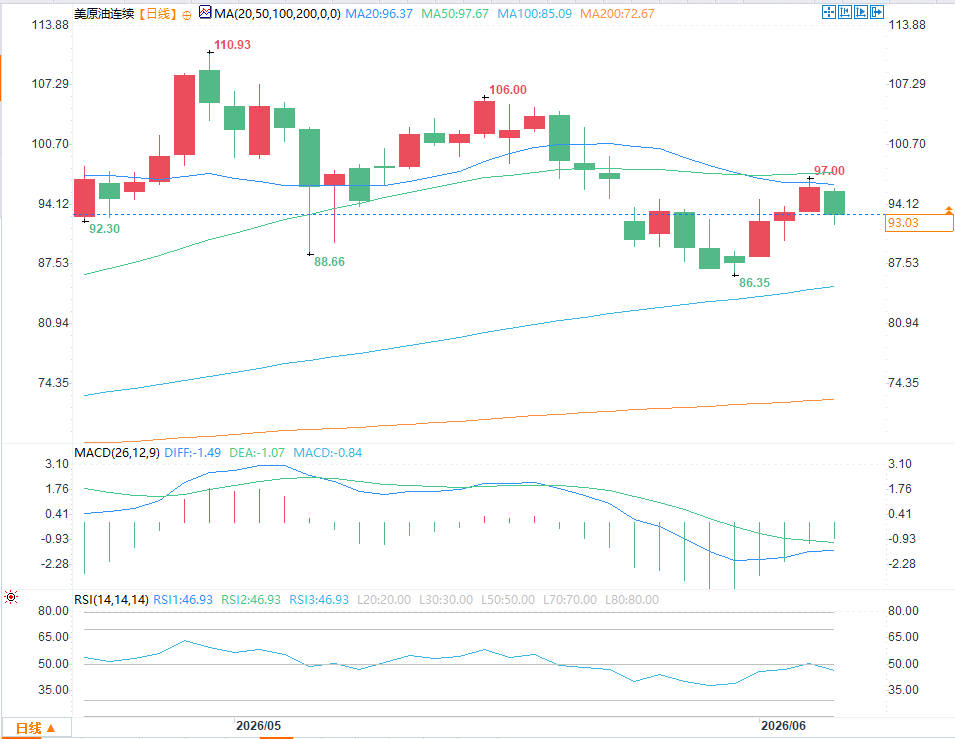
(WTI crude oil daily chart source: FX678)
WTI crude oil's daily chart shows a medium-to-long-term upward support level established by the 200-day and 100-day moving averages, indicating a continued bullish trend in the medium term. However, short-term weakness is attributed to the realization of geopolitical gains, leading to a pullback. Oil prices previously reached a short-term high near $97, after which bullish momentum weakened, resulting in a clear pullback and a short-term bearish pattern with lower highs. Currently, the 50-day moving average at $97.67 and the 20-day moving average at $96.37 are above the current price action, forming a double resistance level rather than support, and serving as a key short-term support/resistance level.
If prices subsequently stabilize above the 20/50-day moving average range, oil prices will begin a rebound and recovery. The $99-$100 level, previously a support, will now become strong resistance. Only a return above this range will allow the upward trend to resume. If the rebound is met with resistance and prices remain under pressure below the moving averages, oil prices will further decline to around $93, then the $91-$88 support range. In extreme downside, the key support level to watch is the previous low of $86.35. Only a decisive break below $86.35 would pose a risk of ending the medium-term upward trend in crude oil.
Overall, oil prices are trending slightly weaker in the short term, with the price action hovering around the short-term moving averages. Until this resistance is broken, the overall trend will remain one of weak consolidation.
Key areas to watch in the future
The ceasefire between Israel and Lebanon caused WTI crude oil to plummet by over 3% in a single day, but the fundamental supply and demand dynamics of crude oil remain unchanged: EIA crude oil inventories have more than doubled, Russian production is declining, the Strait of Hormuz remains closed to shipping, US inventories are below the five-year average, and refineries are operating at high capacity in preparation for summer demand. The ceasefire only mitigates some of the geopolitical premium but does not resolve the current global shortage of physical crude oil.
Only when the US and Iran implement a formal agreement, Iranian crude oil is shipped out, and navigation in the Strait of Hormuz resumes, will the downside potential for crude oil prices be fully unlocked; weak demand caps the upper limit of oil price increases, while tight spot inventories continue to raise the downside support for crude oil.
Summary of key short-term levels
WTI July contract: The 50-day moving average of $97.67 and the 20-day moving average of $96.37 are short-term resistance levels, which will determine the height of the rebound; $97 has become a secondary high point in this stage; the downward trend under pressure from the moving averages will continue, and if it breaks below $93, it will fall to $91-$88, with an extreme downside target of the previous low of $86.35.
With the ceasefire between Israel and Lebanon implemented, geopolitical risk premiums quickly subsided.
On Thursday, Israel and Lebanon signed a ceasefire agreement, immediately easing geopolitical tensions and reducing risk premiums in the oil market. Trump stated that the US-Iran negotiations might see substantial progress this weekend; Iranian Foreign Minister Araqchi responded that no major breakthrough had been achieved yet, but the two sides were still consulting and exchanging proposals. Influenced by the news that "the weekend negotiations may break the ice," the market saw a mass exodus of long positions, leading to a sell-off in oil prices.
However, the stability of the ceasefire remains questionable: Hezbollah leader Naeem Qassem warned that as long as Lebanese villages continue to be attacked, security in northern Israel cannot be achieved; Iran has made it clear that a comprehensive agreement between the US and Iran is contingent on the complete end of Hezbollah-related fighting in Lebanon, a condition that has not yet been met.
One-fifth of the world's crude oil and liquefied natural gas are transported through the Strait of Hormuz, but navigation through the strait remains restricted. The market is anticipating a diplomatic boost, but no concrete agreement has yet been reached between the US and Iran. If a breakthrough is achieved in US-Iran negotiations and the strait reopens, Iranian crude oil will flow into the international market in large quantities; conversely, if the ceasefire breaks down, geopolitical premiums will quickly return, pushing up oil prices.
EIA inventory data: US crude oil inventories fell sharply by 8 million barrels, far exceeding market expectations.
The U.S. Energy Information Administration (EIA) released inventory data for the week ending May 29: U.S. commercial crude oil inventories fell sharply by 8 million barrels week-on-week, while the market had only expected a decrease of 4 million barrels; the current total inventory is 433.7 million barrels, 3% lower than the average for the same period in the past five years; all types of petroleum inventories decreased by 2.6 million barrels at the same time.
Over the past four weeks, the average daily supply of U.S. refined petroleum products was 20.4 million barrels, a 3% year-on-year increase; refinery utilization remained at 94.7%, preparing for the peak summer gasoline travel season. Even with a significant increase of 1.2 million barrels per day in crude oil imports this week, crude oil inventories continued to decline substantially. Breaking down inventories: gasoline inventories increased by 3.4 million barrels, and distillate fuel (diesel, etc.) inventories increased by 1.5 million barrels, but crude oil inventories continued to decrease; refineries continued to consume stored crude oil, but new crude oil replenishment lagged behind demand.
Russia officially announces decline in crude oil production for the first time.
Russian Deputy Prime Minister Novak publicly stated that Russian crude oil production has been declining since the beginning of the year due to unplanned refinery maintenance, marking the first time a senior Russian official has formally acknowledged a production contraction. Coupled with OPEC+'s proactive supply controls, Russian production cuts have further tightened the already low-than-seasonal global crude oil supply.
Weak demand has become the ceiling for oil price increases.
Iranian and Russian crude oil suppliers were forced to lower their prices to promote sales, with Iranian crude oil trading at a discount for the first time since April, while the premium for Russian crude oil spot prices also narrowed.
Inventory reduction and Russian production cuts have provided some support for WTI and Brent prices, but only a recovery in crude oil purchases can lead to a sustained surge in international oil prices.
July WTI Crude Oil Daily Technical Analysis
(WTI crude oil daily chart source: FX678)
WTI crude oil's daily chart shows a medium-to-long-term upward support level established by the 200-day and 100-day moving averages, indicating a continued bullish trend in the medium term. However, short-term weakness is attributed to the realization of geopolitical gains, leading to a pullback. Oil prices previously reached a short-term high near $97, after which bullish momentum weakened, resulting in a clear pullback and a short-term bearish pattern with lower highs. Currently, the 50-day moving average at $97.67 and the 20-day moving average at $96.37 are above the current price action, forming a double resistance level rather than support, and serving as a key short-term support/resistance level.
If prices subsequently stabilize above the 20/50-day moving average range, oil prices will begin a rebound and recovery. The $99-$100 level, previously a support, will now become strong resistance. Only a return above this range will allow the upward trend to resume. If the rebound is met with resistance and prices remain under pressure below the moving averages, oil prices will further decline to around $93, then the $91-$88 support range. In extreme downside, the key support level to watch is the previous low of $86.35. Only a decisive break below $86.35 would pose a risk of ending the medium-term upward trend in crude oil.
Overall, oil prices are trending slightly weaker in the short term, with the price action hovering around the short-term moving averages. Until this resistance is broken, the overall trend will remain one of weak consolidation.
Key areas to watch in the future
The ceasefire between Israel and Lebanon caused WTI crude oil to plummet by over 3% in a single day, but the fundamental supply and demand dynamics of crude oil remain unchanged: EIA crude oil inventories have more than doubled, Russian production is declining, the Strait of Hormuz remains closed to shipping, US inventories are below the five-year average, and refineries are operating at high capacity in preparation for summer demand. The ceasefire only mitigates some of the geopolitical premium but does not resolve the current global shortage of physical crude oil.
Only when the US and Iran implement a formal agreement, Iranian crude oil is shipped out, and navigation in the Strait of Hormuz resumes, will the downside potential for crude oil prices be fully unlocked; weak demand caps the upper limit of oil price increases, while tight spot inventories continue to raise the downside support for crude oil.
Summary of key short-term levels
WTI July contract: The 50-day moving average of $97.67 and the 20-day moving average of $96.37 are short-term resistance levels, which will determine the height of the rebound; $97 has become a secondary high point in this stage; the downward trend under pressure from the moving averages will continue, and if it breaks below $93, it will fall to $91-$88, with an extreme downside target of the previous low of $86.35.
- Risk Warning and Disclaimer
- The market involves risk, and trading may not be suitable for all investors. This article is for reference only and does not constitute personal investment advice, nor does it take into account certain users’ specific investment objectives, financial situation, or other needs. Any investment decisions made based on this information are at your own risk.