Warsh's "stagflation" dilemma: Raising interest rates to combat inflation, or betting on AI deflation?
2026-06-05 08:56:15
The US economy has been boosted by the artificial intelligence investment boom, but is also under pressure from rising prices caused by the US-Iran conflict. This "stagflation" scenario is reflected in the movement of the US dollar index – on Friday (June 5) during the Asian session, after recording a slight decline yesterday, the dollar index is currently fluctuating narrowly, hovering around 99.45. The market is filled with anticipation and unease about Warsh's first policy meeting to be chaired in two weeks.
A survey released by the Federal Reserve on Wednesday showed that policy maneuvering around interest rate hikes has already begun as Warsh hosts his first policy meeting in two weeks.
The Beige Book paints a picture of "stagflation": weak consumer demand and rising cost pressures coexist, a thorny situation for any new Federal Reserve chairman, especially one appointed by a president who expects interest rate cuts.
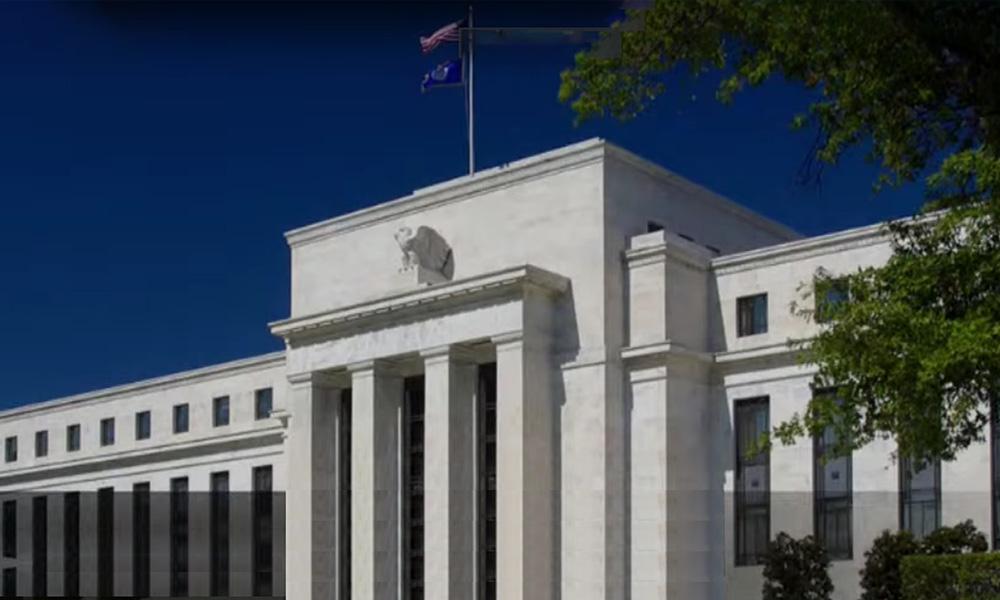
According to the Beige Book, compiled from qualitative economic data collected by the Federal Reserve’s 12 regional banks, most regions of the United States experienced higher inflation in late April and late May due to rising energy costs related to the war with Iran, the effects of which spilled over into areas such as transportation, packaging, groceries, and fertilizers.
The report found that "overall, there are reports of rising credit card usage, declining foot traffic at retail stores, and strong demand for essential goods." This is a serious warning sign for an economy that has long been supported by consumer spending.
The report also noted that consumers are shifting towards hybrid vehicles or reducing car purchases; the number of empty export containers has decreased due to anticipated weak domestic demand; rising energy costs have driven up fertilizer prices, and New York apple growers expect a significant reduction in their harvest later this year due to the exorbitant cost of fertilizer. Manufacturing companies reported weakening demand due to consumer caution; one plastics equipment manufacturer stated that customers are postponing capital investments due to anticipated oil shortages.
Confluence's chief analyst, Patrick Fearon-Hernandez, pointed out that the Beige Book shows that AI-driven investment momentum continues to support economic growth, the ISM services PMI rose to 54.5, new orders accelerated, and inventories accumulated to their highest level since 2010, as companies are accelerating procurement to hedge against potential supply disruptions from the conflict in Iran.
The agency believes that while the economic outlook remains resilient over the next three to six months, emerging signs of weakness—including tighter consumer budgets, cautious hiring by businesses, and pressure on profit margins—suggest that the economy is increasingly vulnerable to downturns. Investment in AI infrastructure remains a key support and may partially offset the impact of slowing consumption.
Dallas Fed President Logan said Wednesday that her concerns are growing that interest rates may need to be raised later this year. She noted that inflationary pressures remain stubbornly high despite continued booming investment in artificial intelligence.
As of April 2026, key US inflation indicators monitored by the Federal Reserve remained high: the CPI rose 3.8% year-on-year, and core CPI rose 2.8% year-on-year; PCE rose 3.8% year-on-year, and core PCE rose 3.3% year-on-year, all well above the Fed's 2% target. The rebound in inflation was primarily driven by energy prices inflated by geopolitical conflicts in the Middle East. Rising fuel costs, such as gasoline, have been widely transmitted through transportation, packaging, and groceries, leading to an overall price increase. Housing costs also remained high due to adjustments in statistical methods. Meanwhile, real average hourly earnings fell 0.3% year-on-year, the first negative growth in nearly three years, indicating that price increases have outpaced nominal wage growth, eroding household purchasing power. Although the surge in artificial intelligence investment has supported economic growth to some extent, it has failed to effectively curb inflationary pressures.
Warsh believes that artificial intelligence is a profound productivity revolution that could create room for the Federal Reserve to cut interest rates without triggering inflation. He has explicitly stated that AI "will be a significant deflationary force" capable of boosting productivity and enhancing American competitiveness, and therefore he has called for "lower interest rates to support households and small and medium-sized businesses."
This stance is related to his attempt to replicate former Federal Reserve Chairman Alan Greenspan's "productivity miracle" of the 1990s. Warsh believes that, with his deep network in Silicon Valley and close observation of the speed of technological change, he understands the disruptive potential of AI more profoundly than the average macroeconomist. In his view, the Federal Reserve underestimated the productivity gains brought by AI while remaining overly concerned about inflation, which sowed the seeds of policy misjudgment.
However, this viewpoint has sparked widespread controversy on Wall Street and in the economics community. Critics argue that Warsh's logic may not hold true in the short term: AI infrastructure development is generating enormous capital demand—major tech companies plan to invest over $700 billion in AI-related equipment this year, directly driving up chip, energy, and material prices. Market indicators show that memory semiconductor prices have surged 17-fold in a year, the exact opposite of the "deflation" Warsh claims. Apollo's chief economist bluntly stated that the AI boom will undoubtedly push up inflation in its initial stages, potentially dashing Warsh's hopes for rapid interest rate cuts.
As a harbinger of future inflationary pressures, the Federal Reserve Bank report stated that "businesses are adjusting wages and the cost of living more frequently in response to rising fuel and other household cost pressures."
The US economy that Warsh took over exhibits characteristics of stagflation: investment in artificial intelligence is driving moderate growth, but the energy shock triggered by the Iran war is pushing up prices across the economy, while consumer spending is showing signs of weakness. The Beige Book shows that data center construction in nine regions has boosted investment and labor demand, but cost pressures and a pullback in consumption are equally prevalent in other sectors. Fed officials such as Logan have expressed the urgency of raising interest rates, while Warsh himself had previously been optimistic about the deflationary potential of artificial intelligence. At the June meeting, Warsh will face a choice: continue tightening to curb inflation, or believe that deflationary forces will open up room for rate cuts. The market expects him to give a clear signal at his first policy meeting.
Market expectations for Warsh's decision are being priced into fluctuations in the US dollar index.
The US dollar index is likely to maintain a strong and volatile trend. If Warsh leans hawkish at the June meeting (acknowledging the necessity of interest rate hikes), the dollar may break through the 100 mark; conversely, if he bets on AI deflation and releases dovish signals, the dollar may come under pressure.
The US dollar index has been fluctuating and rebounding from a low of 95.57 on the daily chart, and is currently trading around 99.45. In the short term, it is approaching the previous high of 99.56 resistance, with a key resistance level above at 100.64. The short, medium and long-term moving averages are all trending upwards to support the market, while the support below lies at the MA50 (98.88) and the previous low of 97.62. Overall, it is in a slightly stronger fluctuation pattern after the rebound.
The MACD remains above the zero line with the red bars continuing, indicating stable short-term bullish momentum. The RSI is in the bullish zone but has not yet become overbought, suggesting a short-term bullish trend. A break above 99.56 would lead to further gains, while a break below 98.88 would end this short-term upward trend.
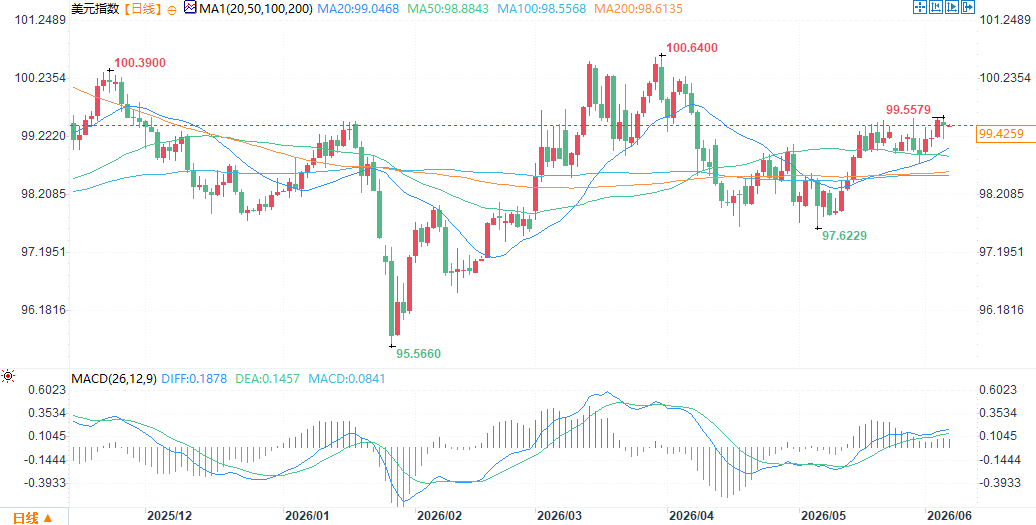
(US Dollar Index Daily Chart, Source: FX678)
At 8:55 AM Beijing time on June 5, the US dollar index was at 99.42.
A survey released by the Federal Reserve on Wednesday showed that policy maneuvering around interest rate hikes has already begun as Warsh hosts his first policy meeting in two weeks.
The Beige Book paints a picture of "stagflation": weak consumer demand and rising cost pressures coexist, a thorny situation for any new Federal Reserve chairman, especially one appointed by a president who expects interest rate cuts.
The Beige Book reveals signs of stagflation: weakening demand and rising costs.
According to the Beige Book, compiled from qualitative economic data collected by the Federal Reserve’s 12 regional banks, most regions of the United States experienced higher inflation in late April and late May due to rising energy costs related to the war with Iran, the effects of which spilled over into areas such as transportation, packaging, groceries, and fertilizers.
The report found that "overall, there are reports of rising credit card usage, declining foot traffic at retail stores, and strong demand for essential goods." This is a serious warning sign for an economy that has long been supported by consumer spending.
The report also noted that consumers are shifting towards hybrid vehicles or reducing car purchases; the number of empty export containers has decreased due to anticipated weak domestic demand; rising energy costs have driven up fertilizer prices, and New York apple growers expect a significant reduction in their harvest later this year due to the exorbitant cost of fertilizer. Manufacturing companies reported weakening demand due to consumer caution; one plastics equipment manufacturer stated that customers are postponing capital investments due to anticipated oil shortages.
AI investment cannot mask the persistent problem of inflation.
Confluence's chief analyst, Patrick Fearon-Hernandez, pointed out that the Beige Book shows that AI-driven investment momentum continues to support economic growth, the ISM services PMI rose to 54.5, new orders accelerated, and inventories accumulated to their highest level since 2010, as companies are accelerating procurement to hedge against potential supply disruptions from the conflict in Iran.
The agency believes that while the economic outlook remains resilient over the next three to six months, emerging signs of weakness—including tighter consumer budgets, cautious hiring by businesses, and pressure on profit margins—suggest that the economy is increasingly vulnerable to downturns. Investment in AI infrastructure remains a key support and may partially offset the impact of slowing consumption.
Dallas Fed President Logan said Wednesday that her concerns are growing that interest rates may need to be raised later this year. She noted that inflationary pressures remain stubbornly high despite continued booming investment in artificial intelligence.
As of April 2026, key US inflation indicators monitored by the Federal Reserve remained high: the CPI rose 3.8% year-on-year, and core CPI rose 2.8% year-on-year; PCE rose 3.8% year-on-year, and core PCE rose 3.3% year-on-year, all well above the Fed's 2% target. The rebound in inflation was primarily driven by energy prices inflated by geopolitical conflicts in the Middle East. Rising fuel costs, such as gasoline, have been widely transmitted through transportation, packaging, and groceries, leading to an overall price increase. Housing costs also remained high due to adjustments in statistical methods. Meanwhile, real average hourly earnings fell 0.3% year-on-year, the first negative growth in nearly three years, indicating that price increases have outpaced nominal wage growth, eroding household purchasing power. Although the surge in artificial intelligence investment has supported economic growth to some extent, it has failed to effectively curb inflationary pressures.
Artificial Intelligence: The Contradiction Between Deflationary Potential and Inflationary Reality
Warsh believes that artificial intelligence is a profound productivity revolution that could create room for the Federal Reserve to cut interest rates without triggering inflation. He has explicitly stated that AI "will be a significant deflationary force" capable of boosting productivity and enhancing American competitiveness, and therefore he has called for "lower interest rates to support households and small and medium-sized businesses."
This stance is related to his attempt to replicate former Federal Reserve Chairman Alan Greenspan's "productivity miracle" of the 1990s. Warsh believes that, with his deep network in Silicon Valley and close observation of the speed of technological change, he understands the disruptive potential of AI more profoundly than the average macroeconomist. In his view, the Federal Reserve underestimated the productivity gains brought by AI while remaining overly concerned about inflation, which sowed the seeds of policy misjudgment.
However, this viewpoint has sparked widespread controversy on Wall Street and in the economics community. Critics argue that Warsh's logic may not hold true in the short term: AI infrastructure development is generating enormous capital demand—major tech companies plan to invest over $700 billion in AI-related equipment this year, directly driving up chip, energy, and material prices. Market indicators show that memory semiconductor prices have surged 17-fold in a year, the exact opposite of the "deflation" Warsh claims. Apollo's chief economist bluntly stated that the AI boom will undoubtedly push up inflation in its initial stages, potentially dashing Warsh's hopes for rapid interest rate cuts.
Outlook for Inflationary Pressures: Increased Frequency of Wage Adjustments
As a harbinger of future inflationary pressures, the Federal Reserve Bank report stated that "businesses are adjusting wages and the cost of living more frequently in response to rising fuel and other household cost pressures."
The US economy that Warsh took over exhibits characteristics of stagflation: investment in artificial intelligence is driving moderate growth, but the energy shock triggered by the Iran war is pushing up prices across the economy, while consumer spending is showing signs of weakness. The Beige Book shows that data center construction in nine regions has boosted investment and labor demand, but cost pressures and a pullback in consumption are equally prevalent in other sectors. Fed officials such as Logan have expressed the urgency of raising interest rates, while Warsh himself had previously been optimistic about the deflationary potential of artificial intelligence. At the June meeting, Warsh will face a choice: continue tightening to curb inflation, or believe that deflationary forces will open up room for rate cuts. The market expects him to give a clear signal at his first policy meeting.
Market expectations for Warsh's decision are being priced into fluctuations in the US dollar index.
The US dollar index is likely to maintain a strong and volatile trend. If Warsh leans hawkish at the June meeting (acknowledging the necessity of interest rate hikes), the dollar may break through the 100 mark; conversely, if he bets on AI deflation and releases dovish signals, the dollar may come under pressure.
The US dollar index has been fluctuating and rebounding from a low of 95.57 on the daily chart, and is currently trading around 99.45. In the short term, it is approaching the previous high of 99.56 resistance, with a key resistance level above at 100.64. The short, medium and long-term moving averages are all trending upwards to support the market, while the support below lies at the MA50 (98.88) and the previous low of 97.62. Overall, it is in a slightly stronger fluctuation pattern after the rebound.
The MACD remains above the zero line with the red bars continuing, indicating stable short-term bullish momentum. The RSI is in the bullish zone but has not yet become overbought, suggesting a short-term bullish trend. A break above 99.56 would lead to further gains, while a break below 98.88 would end this short-term upward trend.
(US Dollar Index Daily Chart, Source: FX678)
At 8:55 AM Beijing time on June 5, the US dollar index was at 99.42.
- Risk Warning and Disclaimer
- The market involves risk, and trading may not be suitable for all investors. This article is for reference only and does not constitute personal investment advice, nor does it take into account certain users’ specific investment objectives, financial situation, or other needs. Any investment decisions made based on this information are at your own risk.