Gold prices fluctuated lower ahead of the non-farm payrolls report; if the data exceeds expectations, prices may break down further.
2026-06-05 12:06:54
The U.S. May non-farm payrolls report will be released on Friday at 8:30 p.m. (Beijing time).
Ahead of the release of non-farm payroll data, market sentiment turned cautious. On Friday (June 5) during the Asian session, spot gold fluctuated lower, currently down more than 0.6% to below $4,440 per ounce.
The upcoming May non-farm payrolls report will provide the final data update on the U.S. labor market before new Federal Reserve Chairman Warsh chairs his first policy meeting later this month.
Traders now expect job growth to slow after two consecutive months of increases exceeding 100,000. The previous strong data reinforced the impression that the labor market remains resilient, despite ongoing concerns about persistent inflation and high global interest rates amid a volatile geopolitical backdrop.
The April report showed 115,000 new jobs added, a slowdown from the strong 178,000 in March, but this figure is still enough to maintain the possibility of the Federal Reserve raising interest rates again last month.
However, in recent weeks, the prospect of a framework agreement between the US and Iran (which could ease tensions in the Strait of Hormuz) and the stabilization of core PCE inflation readings have led the market to firmly shift its expectations toward unchanged interest rates, and the case for raising rates has essentially disappeared.
Investors expect job growth to slow further to around 85,000 in May, with the unemployment rate expected to remain stable at 4.3%. Average hourly earnings are expected to rise 0.3% month-over-month from 0.2% previously, while annual wage growth is expected to slow slightly to 3.5% from 3.6% previously.
Bank of America is relatively optimistic, forecasting 95,000 new nonfarm payroll jobs in May, based on factors including low initial jobless claims, strong ADP data, and an additional boost to the hotel and restaurant industry due to early hiring following the 2026 World Cup. The bank believes the upside risks to the employment data are more prominent.
Does the slowdown in job growth indicate a broader weakness in the labor market?
JPMorgan Chase points out that the May data has a unique seasonal pattern—statistics over the past 15 years show that new jobs in May are often lower than the moving average of the previous three months.
ADP Chief Economist Nela Richardson said that May’s hiring growth was “more broad-based than at any time in recent years” and that the labor market continues to show “continued growth momentum” as the summer hiring season approaches.
On the other hand, the latest decline in turnover rates suggests that the labor market is not entirely robust, and worker confidence appears cautious against the backdrop of high geopolitical uncertainty.
Even so, this environment may encourage Warsh to remain patient and closely monitor subsequent economic data, rather than rushing into either easing or tightening – especially given that Treasury yields have remained above 4.0%.
Furthermore, given the hawkish tone of the latest Federal Reserve meeting minutes and the need for broader committee support, it may be difficult for Warsh to immediately cut interest rates as President Trump has requested. Such a move could also raise concerns about the Fed's independence and potentially damage the chairman's credibility.
Conversely, stronger-than-expected triple-digit job growth data could reignite expectations of another rate hike or continued quantitative tightening—a point Walsh emphasized during his Senate hearing.
If the May non-farm payroll data significantly exceeds expectations, the market will reprice the Federal Reserve's policy path. Strong employment data indicates a still-tight labor market and greater-than-expected economic resilience, providing a rationale for the Fed to maintain its tightening stance or even raise interest rates further.
As a result, Treasury yields may rebound again, with the 2-year Treasury yield potentially returning above 4.2%. Since gold is a non-interest-bearing asset, rising Treasury yields will directly increase the opportunity cost of holding gold, prompting investors to sell gold and shift towards interest-bearing assets.
In addition, the US dollar may strengthen as hawkish expectations align, further suppressing gold prices denominated in US dollars.
Gold prices initially surged and then retreated, currently trading around $4440 per ounce. The price is under pressure from the 20-day and 50-day moving averages, and has fallen back to the key level of the 200-day moving average, where it is expected to form a double bottom support with the previous low of $4366.
The MACD is below the zero line, the green bars are narrowing, and the bearish momentum continues to weaken, but there is no golden cross signal yet. The short-term range is locked at 4366-4543. Only if it can hold above 4543 can a rebound begin. If it falls below the support of 4427, the downside risk will increase. The market is mainly consolidating at low levels and grinding to the bottom.
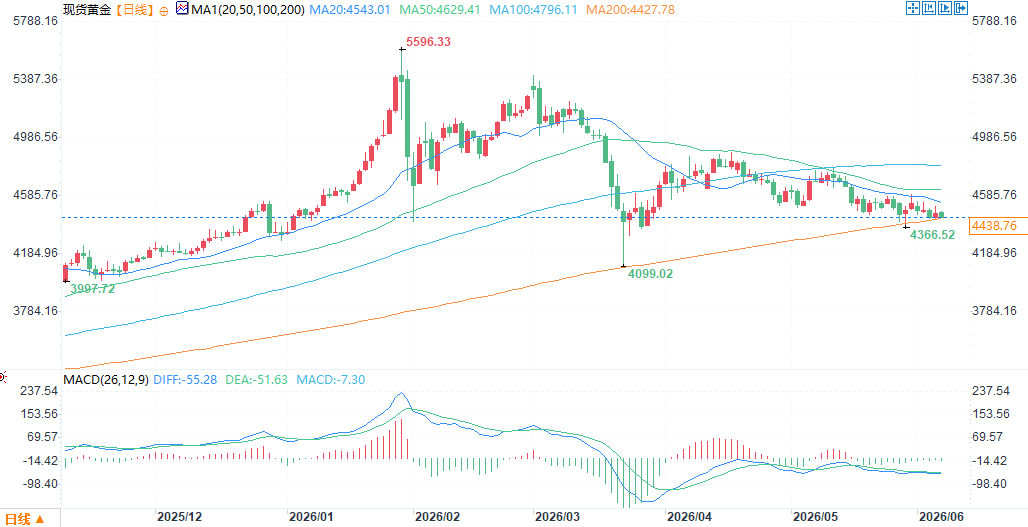
(Spot gold daily chart, source: FX678)
At 12:05 Beijing time on June 5, spot gold was trading at $4443.10 per ounce.
Ahead of the release of non-farm payroll data, market sentiment turned cautious. On Friday (June 5) during the Asian session, spot gold fluctuated lower, currently down more than 0.6% to below $4,440 per ounce.
Nonfarm payroll growth is expected to continue to slow.
The upcoming May non-farm payrolls report will provide the final data update on the U.S. labor market before new Federal Reserve Chairman Warsh chairs his first policy meeting later this month.
Traders now expect job growth to slow after two consecutive months of increases exceeding 100,000. The previous strong data reinforced the impression that the labor market remains resilient, despite ongoing concerns about persistent inflation and high global interest rates amid a volatile geopolitical backdrop.
The April report showed 115,000 new jobs added, a slowdown from the strong 178,000 in March, but this figure is still enough to maintain the possibility of the Federal Reserve raising interest rates again last month.
However, in recent weeks, the prospect of a framework agreement between the US and Iran (which could ease tensions in the Strait of Hormuz) and the stabilization of core PCE inflation readings have led the market to firmly shift its expectations toward unchanged interest rates, and the case for raising rates has essentially disappeared.
Investors expect job growth to slow further to around 85,000 in May, with the unemployment rate expected to remain stable at 4.3%. Average hourly earnings are expected to rise 0.3% month-over-month from 0.2% previously, while annual wage growth is expected to slow slightly to 3.5% from 3.6% previously.
Bank of America is relatively optimistic, forecasting 95,000 new nonfarm payroll jobs in May, based on factors including low initial jobless claims, strong ADP data, and an additional boost to the hotel and restaurant industry due to early hiring following the 2026 World Cup. The bank believes the upside risks to the employment data are more prominent.
Should the market worry about slowing job growth?
Does the slowdown in job growth indicate a broader weakness in the labor market?
JPMorgan Chase points out that the May data has a unique seasonal pattern—statistics over the past 15 years show that new jobs in May are often lower than the moving average of the previous three months.
ADP Chief Economist Nela Richardson said that May’s hiring growth was “more broad-based than at any time in recent years” and that the labor market continues to show “continued growth momentum” as the summer hiring season approaches.
How might Walsh respond to the non-farm payroll report?
On the other hand, the latest decline in turnover rates suggests that the labor market is not entirely robust, and worker confidence appears cautious against the backdrop of high geopolitical uncertainty.
Even so, this environment may encourage Warsh to remain patient and closely monitor subsequent economic data, rather than rushing into either easing or tightening – especially given that Treasury yields have remained above 4.0%.
Furthermore, given the hawkish tone of the latest Federal Reserve meeting minutes and the need for broader committee support, it may be difficult for Warsh to immediately cut interest rates as President Trump has requested. Such a move could also raise concerns about the Fed's independence and potentially damage the chairman's credibility.
Conversely, stronger-than-expected triple-digit job growth data could reignite expectations of another rate hike or continued quantitative tightening—a point Walsh emphasized during his Senate hearing.
Gold prices may come under pressure if non-farm payrolls data exceeds expectations.
If the May non-farm payroll data significantly exceeds expectations, the market will reprice the Federal Reserve's policy path. Strong employment data indicates a still-tight labor market and greater-than-expected economic resilience, providing a rationale for the Fed to maintain its tightening stance or even raise interest rates further.
As a result, Treasury yields may rebound again, with the 2-year Treasury yield potentially returning above 4.2%. Since gold is a non-interest-bearing asset, rising Treasury yields will directly increase the opportunity cost of holding gold, prompting investors to sell gold and shift towards interest-bearing assets.
In addition, the US dollar may strengthen as hawkish expectations align, further suppressing gold prices denominated in US dollars.
Technical Analysis
Gold prices initially surged and then retreated, currently trading around $4440 per ounce. The price is under pressure from the 20-day and 50-day moving averages, and has fallen back to the key level of the 200-day moving average, where it is expected to form a double bottom support with the previous low of $4366.
The MACD is below the zero line, the green bars are narrowing, and the bearish momentum continues to weaken, but there is no golden cross signal yet. The short-term range is locked at 4366-4543. Only if it can hold above 4543 can a rebound begin. If it falls below the support of 4427, the downside risk will increase. The market is mainly consolidating at low levels and grinding to the bottom.
(Spot gold daily chart, source: FX678)
At 12:05 Beijing time on June 5, spot gold was trading at $4443.10 per ounce.
- Risk Warning and Disclaimer
- The market involves risk, and trading may not be suitable for all investors. This article is for reference only and does not constitute personal investment advice, nor does it take into account certain users’ specific investment objectives, financial situation, or other needs. Any investment decisions made based on this information are at your own risk.