Dramatic changes in the global economic landscape have ushered in a long-term bull market for commodities, with gold and copper becoming core assets.
2026-06-05 12:03:36
With the profound restructuring of the global economic order, the combined effects of intensified geopolitical competition, increased strategic resource reserves, and the expansion of artificial intelligence infrastructure have ushered in a new cycle characterized by scarcity of physical assets and rising inflation.
Several top financial institution executives predict that the era of low inflation and globalization that lasted for decades has come to an end, and commodities will usher in a long-term bull market. Gold's status as a global strategic reserve will be further consolidated, and core industrial metals such as industrial copper will also see a sustained upward trend. The traditional asset allocation logic of hedging between stocks and bonds has been completely overturned.
At the Thorne Investment Forum in Montreal, Karen Karniol-Tambour, co-chief investment officer of Bridgewater Associates, and Louis-Vincent Gave, CEO of Gavcar Consulting, agreed that the global economy has moved beyond the efficiency-first globalization model and is now entering a new phase of geopolitical competition and resource reserves.
Karen Cañol-Tampour stated that the world is currently entering an era of "neo-mercantilism," where countries prioritize national security and economic resilience, rather than simply pursuing economic efficiency. Shortcomings in various sectors can become bargaining chips in geopolitical games.
Against this backdrop, countries are actively rebuilding supply chains, upgrading domestic production capacity, improving energy infrastructure, and stockpiling strategic materials, sparking a global scramble for physical resources. Simultaneously, the large-scale implementation of the artificial intelligence industry has driven explosive demand for energy, electricity transmission, and industrial metals, fundamentally reshaping market supply and demand structures. The long-term low-inflation environment has come to an end, and high inflation has become a new characteristic of the global economy.
Louis-Vincent Gaff added that the deteriorating demographic structure, rising fiscal deficits, and increased rigid government spending in developed economies have further solidified the fundamentals of long-term inflation.
The dramatic changes in the macroeconomic environment have completely overturned the asset allocation system that has been in use for thirty years. Louis-Vincent Gaff stated that over the past thirty years, government bonds, with their stable safe-haven properties, have become the core asset for hedging against stock risk and an important safety net for investment portfolios. However, in the current high-inflation environment, the market has repeatedly seen simultaneous declines in both stocks and bonds, rendering the traditional hedging function of bonds completely ineffective.
Countries continue to increase fiscal spending on defense, supply chain repair, and energy transition, significantly driving up capital costs across society. Karen Cañool-Tampour stated that with the ongoing large-scale global infrastructure and strategic deployments, a systemic increase in capital costs is inevitable, and the era of long-term low interest rates and low-cost financing has come to an end.
The logic behind global reserve asset allocation is undergoing a fundamental shift. Previously, countries used US Treasury bonds as core reserve assets, relying on their high liquidity to cope with global crises and exchange for various resources. However, the outbreak of the Russia-Ukraine conflict and the resulting restrictions on overseas reserve assets have led countries to re-evaluate the security of their reserves.
Louis-Vincent Gaff stated that the influence of the US dollar's financial hegemony continues to weaken, and many countries have initiated the US debt swap model, continuously stockpiling physical commodities such as crude oil, agricultural products, and industrial raw materials. Physical assets are gradually replacing financial assets and becoming the core pillar of the global reserve system, and this trend continues to support commodity inflation.
Both industry leaders are optimistic about commodity investment opportunities over the next three years, but their core investment targets differ.
Karen Canioll-Tampour stated that with the current fragmentation of the global geopolitical situation and a significant increase in market uncertainty, central banks and institutions around the world are continuously increasing their allocations to gold as a safe haven, and the structural demand for gold continues to expand, making it the best commodity allocation choice at present.
Louis-Vincent Gaff, however, is more bullish on industrial copper. He argues that the market is overly focused on the semiconductor sector while neglecting the long-term weakness in power infrastructure. Large-scale construction of data centers, photovoltaic power plants, and power grid upgrades heavily relies on industrial metals such as copper and aluminum. Amid the global energy transition and infrastructure upgrade wave, copper's scarcity continues to be highlighted, giving it strong long-term upside potential and making it a better investment than semiconductor stocks.
In summary, geopolitical restructuring, resource competition, AI infrastructure development, and fiscal inflation are all working in tandem to propel the world into a bull market cycle for commodities.
The traditional financial asset allocation logic has failed, and the value of physical assets continues to stand out. Gold, relying on its safe-haven properties, and copper, relying on its industrial demand, will lead the commodity market in the long term and become the most certain investment theme in the coming years .
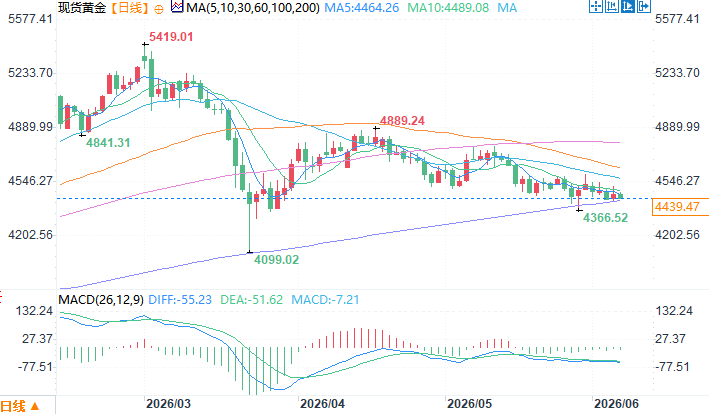
Spot gold daily chart source: EasyForex
At 12:02 Beijing time on June 5, spot gold was trading at $4443.47 per ounce.
Several top financial institution executives predict that the era of low inflation and globalization that lasted for decades has come to an end, and commodities will usher in a long-term bull market. Gold's status as a global strategic reserve will be further consolidated, and core industrial metals such as industrial copper will also see a sustained upward trend. The traditional asset allocation logic of hedging between stocks and bonds has been completely overturned.
The changing landscape of the times has fueled inflation through a new form of mercantilism.
At the Thorne Investment Forum in Montreal, Karen Karniol-Tambour, co-chief investment officer of Bridgewater Associates, and Louis-Vincent Gave, CEO of Gavcar Consulting, agreed that the global economy has moved beyond the efficiency-first globalization model and is now entering a new phase of geopolitical competition and resource reserves.
Karen Cañol-Tampour stated that the world is currently entering an era of "neo-mercantilism," where countries prioritize national security and economic resilience, rather than simply pursuing economic efficiency. Shortcomings in various sectors can become bargaining chips in geopolitical games.
Against this backdrop, countries are actively rebuilding supply chains, upgrading domestic production capacity, improving energy infrastructure, and stockpiling strategic materials, sparking a global scramble for physical resources. Simultaneously, the large-scale implementation of the artificial intelligence industry has driven explosive demand for energy, electricity transmission, and industrial metals, fundamentally reshaping market supply and demand structures. The long-term low-inflation environment has come to an end, and high inflation has become a new characteristic of the global economy.
Louis-Vincent Gaff added that the deteriorating demographic structure, rising fiscal deficits, and increased rigid government spending in developed economies have further solidified the fundamentals of long-term inflation.
Asset logic has been restructured, and the traditional hedging function of bonds has become completely ineffective.
The dramatic changes in the macroeconomic environment have completely overturned the asset allocation system that has been in use for thirty years. Louis-Vincent Gaff stated that over the past thirty years, government bonds, with their stable safe-haven properties, have become the core asset for hedging against stock risk and an important safety net for investment portfolios. However, in the current high-inflation environment, the market has repeatedly seen simultaneous declines in both stocks and bonds, rendering the traditional hedging function of bonds completely ineffective.
Countries continue to increase fiscal spending on defense, supply chain repair, and energy transition, significantly driving up capital costs across society. Karen Cañool-Tampour stated that with the ongoing large-scale global infrastructure and strategic deployments, a systemic increase in capital costs is inevitable, and the era of long-term low interest rates and low-cost financing has come to an end.
Reserve system reform: Commodities replace US Treasury bonds as the new core
The logic behind global reserve asset allocation is undergoing a fundamental shift. Previously, countries used US Treasury bonds as core reserve assets, relying on their high liquidity to cope with global crises and exchange for various resources. However, the outbreak of the Russia-Ukraine conflict and the resulting restrictions on overseas reserve assets have led countries to re-evaluate the security of their reserves.
Louis-Vincent Gaff stated that the influence of the US dollar's financial hegemony continues to weaken, and many countries have initiated the US debt swap model, continuously stockpiling physical commodities such as crude oil, agricultural products, and industrial raw materials. Physical assets are gradually replacing financial assets and becoming the core pillar of the global reserve system, and this trend continues to support commodity inflation.
With clear opportunities in the sector, gold and industrial copper are the optimal investment targets.
Both industry leaders are optimistic about commodity investment opportunities over the next three years, but their core investment targets differ.
Karen Canioll-Tampour stated that with the current fragmentation of the global geopolitical situation and a significant increase in market uncertainty, central banks and institutions around the world are continuously increasing their allocations to gold as a safe haven, and the structural demand for gold continues to expand, making it the best commodity allocation choice at present.
Louis-Vincent Gaff, however, is more bullish on industrial copper. He argues that the market is overly focused on the semiconductor sector while neglecting the long-term weakness in power infrastructure. Large-scale construction of data centers, photovoltaic power plants, and power grid upgrades heavily relies on industrial metals such as copper and aluminum. Amid the global energy transition and infrastructure upgrade wave, copper's scarcity continues to be highlighted, giving it strong long-term upside potential and making it a better investment than semiconductor stocks.
Summarize
In summary, geopolitical restructuring, resource competition, AI infrastructure development, and fiscal inflation are all working in tandem to propel the world into a bull market cycle for commodities.
The traditional financial asset allocation logic has failed, and the value of physical assets continues to stand out. Gold, relying on its safe-haven properties, and copper, relying on its industrial demand, will lead the commodity market in the long term and become the most certain investment theme in the coming years .
Spot gold daily chart source: EasyForex
At 12:02 Beijing time on June 5, spot gold was trading at $4443.47 per ounce.
- Risk Warning and Disclaimer
- The market involves risk, and trading may not be suitable for all investors. This article is for reference only and does not constitute personal investment advice, nor does it take into account certain users’ specific investment objectives, financial situation, or other needs. Any investment decisions made based on this information are at your own risk.