Leading indicators point to better-than-expected non-farm payrolls, and the low volatility pattern of the US dollar index is facing a turning point.
2026-06-05 12:26:21
On Friday (June 5) during the Asian session, the US dollar index fluctuated narrowly and is currently down slightly, trading around 99.42.
Based on several indicators, including the rebound in the ISM Manufacturing Employment Index, the ADP report showing an increase of 122,000 jobs, and a slight rise in the four-week moving average of initial jobless claims, this month's employment report may exceed expectations, with overall job growth likely between 120,000 and 160,000. Despite frequent news of AI-related layoffs, macroeconomic data has not yet shown signs of a widespread slowdown. The recent low volatility of the US dollar index may be unsustainable.
The May non-farm payroll report will be released at 20:30 Beijing time on Friday.
Traders and economists expect 85,000 new jobs to be added in May, with average hourly earnings rising 0.3% month-over-month (3.4% year-over-year) and the unemployment rate remaining at 4.3%.
Goldman Sachs expects only 60,000 new jobs to be created, and its team of analysts pointed out that the "big data job growth indicator" they track slowed down in May.
Bank of America is relatively optimistic, predicting that non-farm payrolls will increase by 95,000 in May, based on factors including low initial jobless claims, strong ADP employment, and an additional boost to the hotel and catering industry due to the early start of hiring for the 2026 World Cup.
StoneX senior market analyst Matt Simpson pointed out that the non-farm payroll report "has unexpectedly risen in the past two months." Combined with the background of improved ISM services PMI, job growth may continue to support the Fed's "higher and longer" narrative, and may even reignite discussions about interest rate hikes.
Has the "job market doomsday" for AI already begun to emerge? Even if so, the signs are extremely faint. Recent high-profile layoffs at Meta (8,000), Cisco (4,000), and IBM (7,800) have all been attributed to efficiency improvements brought about by AI.
A Challenger report shows that AI has become the leading cause of layoffs in the past three months, with 21,500 people laid off in April and the latest report showing that the number has risen to 38,000, accounting for 40%.
Nevertheless, macroeconomic data has not yet indicated a widespread slowdown. The non-farm payroll reports for the past two months have both exceeded expectations, and the US labor market has remained relatively resilient, averaging about 80,000 new jobs per month this year, enough to keep the unemployment rate at a historically low 4.3%. The market expects the May report to continue the pattern of "low hiring, low layoffs" seen over the past year or so: moderate job growth, a stable unemployment rate, and continued gradual wage increases.
Amid the continued closure of the Strait of Hormuz, oil prices remain high, and rising energy costs are pushing up US inflation—the April CPI rose to 3.8% year-on-year, well above the Federal Reserve's 2% target. Although new Chairman Warsh previously expressed optimism about AI's deflationary potential and was seen as dovish by the market, real data is challenging this optimistic expectation. Traders have begun pricing in the possibility of a rate hike this year, with the CME FedWatch tool showing the probability of at least one rate hike before December has risen to about 50%, a significant increase from a month ago.
The shift in market expectations stems primarily from three pressures: high energy prices, a resilient labor market, and the AI investment boom that has, in fact, boosted demand in the short term. For Warsh, this presents a thorny dilemma—if he adheres to the AI deflationary logic and remains inactive, he risks runaway inflation; if he follows the data and shifts to a hawkish stance, he may go against Trump's desire for interest rate cuts. The first policy meeting on June 17 will be a crucial moment for the market to test Warsh's true position.
Based on four historically reliable leading indicators, the May non-farm payroll report may be on the rise. Specifically, the ISM manufacturing employment index rose to 48.6 from 46.4 last month, while the services employment index remained largely unchanged at around 47.9; the ADP employment report showed an increase of 122,000 jobs, higher than the 109,000 in the previous month; and the four-week moving average of initial jobless claims rose slightly from 203,000 to 215,000.
Based on these figures, non-farm payrolls this month are projected to increase by between 120,000 and 160,000, higher than the market consensus of 85,000. However, the uncertainty is significant due to factors such as survey response rates. It is important to emphasize that monthly fluctuations in the non-farm payroll report are extremely difficult to predict, and any forecast should not be relied upon excessively.
The US dollar index is currently trading around 99.40, above the 20-day moving average. It has been rising from a low of 97.62 recently, testing a recent high of 99.55. The short, medium and long-term moving averages are arranged in a bullish pattern, establishing a medium-term upward trend with multiple moving averages providing support below.
The MACD indicator maintains a red bar above the zero line, with the DIFF and DEA lines steadily rising, indicating sustained bullish momentum. Short-term resistance lies around 99.55; a break above this level would open up further upside potential, while pullbacks would find support at the moving averages. The short-term outlook is for a slightly bullish, oscillating pattern.
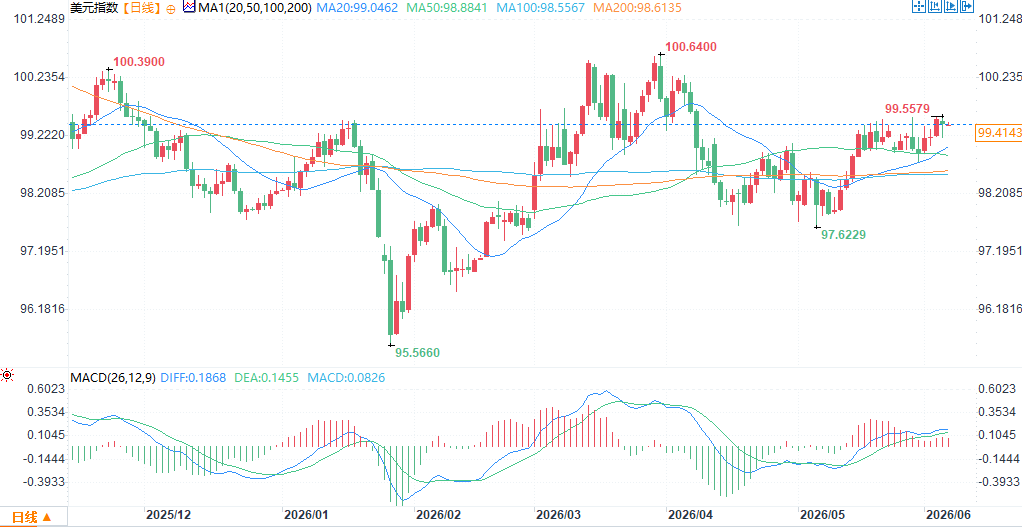
(US Dollar Index Daily Chart, Source: FX678)
At 12:25 Beijing time on June 5, the US dollar index was at 99.41.
Based on several indicators, including the rebound in the ISM Manufacturing Employment Index, the ADP report showing an increase of 122,000 jobs, and a slight rise in the four-week moving average of initial jobless claims, this month's employment report may exceed expectations, with overall job growth likely between 120,000 and 160,000. Despite frequent news of AI-related layoffs, macroeconomic data has not yet shown signs of a widespread slowdown. The recent low volatility of the US dollar index may be unsustainable.
Non-farm payroll report expectations
The May non-farm payroll report will be released at 20:30 Beijing time on Friday.
Traders and economists expect 85,000 new jobs to be added in May, with average hourly earnings rising 0.3% month-over-month (3.4% year-over-year) and the unemployment rate remaining at 4.3%.
Goldman Sachs expects only 60,000 new jobs to be created, and its team of analysts pointed out that the "big data job growth indicator" they track slowed down in May.
Bank of America is relatively optimistic, predicting that non-farm payrolls will increase by 95,000 in May, based on factors including low initial jobless claims, strong ADP employment, and an additional boost to the hotel and catering industry due to the early start of hiring for the 2026 World Cup.
StoneX senior market analyst Matt Simpson pointed out that the non-farm payroll report "has unexpectedly risen in the past two months." Combined with the background of improved ISM services PMI, job growth may continue to support the Fed's "higher and longer" narrative, and may even reignite discussions about interest rate hikes.
Is the AI "job market doomsday" coming?
Has the "job market doomsday" for AI already begun to emerge? Even if so, the signs are extremely faint. Recent high-profile layoffs at Meta (8,000), Cisco (4,000), and IBM (7,800) have all been attributed to efficiency improvements brought about by AI.
A Challenger report shows that AI has become the leading cause of layoffs in the past three months, with 21,500 people laid off in April and the latest report showing that the number has risen to 38,000, accounting for 40%.
Nevertheless, macroeconomic data has not yet indicated a widespread slowdown. The non-farm payroll reports for the past two months have both exceeded expectations, and the US labor market has remained relatively resilient, averaging about 80,000 new jobs per month this year, enough to keep the unemployment rate at a historically low 4.3%. The market expects the May report to continue the pattern of "low hiring, low layoffs" seen over the past year or so: moderate job growth, a stable unemployment rate, and continued gradual wage increases.
Inflation and Interest Rate Expectations
Amid the continued closure of the Strait of Hormuz, oil prices remain high, and rising energy costs are pushing up US inflation—the April CPI rose to 3.8% year-on-year, well above the Federal Reserve's 2% target. Although new Chairman Warsh previously expressed optimism about AI's deflationary potential and was seen as dovish by the market, real data is challenging this optimistic expectation. Traders have begun pricing in the possibility of a rate hike this year, with the CME FedWatch tool showing the probability of at least one rate hike before December has risen to about 50%, a significant increase from a month ago.
The shift in market expectations stems primarily from three pressures: high energy prices, a resilient labor market, and the AI investment boom that has, in fact, boosted demand in the short term. For Warsh, this presents a thorny dilemma—if he adheres to the AI deflationary logic and remains inactive, he risks runaway inflation; if he follows the data and shifts to a hawkish stance, he may go against Trump's desire for interest rate cuts. The first policy meeting on June 17 will be a crucial moment for the market to test Warsh's true position.
Non-farm payroll forecast: Four leading indicators
Based on four historically reliable leading indicators, the May non-farm payroll report may be on the rise. Specifically, the ISM manufacturing employment index rose to 48.6 from 46.4 last month, while the services employment index remained largely unchanged at around 47.9; the ADP employment report showed an increase of 122,000 jobs, higher than the 109,000 in the previous month; and the four-week moving average of initial jobless claims rose slightly from 203,000 to 215,000.
Based on these figures, non-farm payrolls this month are projected to increase by between 120,000 and 160,000, higher than the market consensus of 85,000. However, the uncertainty is significant due to factors such as survey response rates. It is important to emphasize that monthly fluctuations in the non-farm payroll report are extremely difficult to predict, and any forecast should not be relied upon excessively.
Technical Analysis of the US Dollar Index
The US dollar index is currently trading around 99.40, above the 20-day moving average. It has been rising from a low of 97.62 recently, testing a recent high of 99.55. The short, medium and long-term moving averages are arranged in a bullish pattern, establishing a medium-term upward trend with multiple moving averages providing support below.
The MACD indicator maintains a red bar above the zero line, with the DIFF and DEA lines steadily rising, indicating sustained bullish momentum. Short-term resistance lies around 99.55; a break above this level would open up further upside potential, while pullbacks would find support at the moving averages. The short-term outlook is for a slightly bullish, oscillating pattern.
(US Dollar Index Daily Chart, Source: FX678)
At 12:25 Beijing time on June 5, the US dollar index was at 99.41.
- Risk Warning and Disclaimer
- The market involves risk, and trading may not be suitable for all investors. This article is for reference only and does not constitute personal investment advice, nor does it take into account certain users’ specific investment objectives, financial situation, or other needs. Any investment decisions made based on this information are at your own risk.