Geopolitical factors driving up inflation have delayed the timing of gold price breakouts, prompting institutions to lower their year-to-date gold and silver price forecasts.
2026-06-05 13:14:53
According to Carsten Fritsch, a commodities analyst at Commerzbank, the ongoing conflict in Iran is pushing up global inflation, and gold is unlikely to break out of its range in the short term due to expectations of a Fed rate hike, forcing a delay in a breakout.
Affected by changes in interest rate pricing, institutions have lowered their target price for gold this year. However, the structural logic supporting gold prices in the medium to long term remains solid. Silver prices have also seen a downward revision due to weakening industrial demand. The tight supply-demand balance is still beneficial for rising prices in the long term.
Fritsch stated that gold's price movement broke with traditional fundamental patterns after the outbreak of the conflict in Iran. As a classic hedge against inflation and a safe-haven asset, gold, instead of attracting a large influx of safe-haven funds amid rising energy prices and geopolitical turmoil in the Middle East, has instead fallen into a weak consolidation phase.
The core reason is that after geopolitical factors pushed up oil prices, market expectations for the Federal Reserve's monetary policy underwent a fundamental reversal, passively increasing the holding cost of non-interest-bearing gold and suppressing short-term buying interest.
Before the conflict erupted, the market generally bet on a 50 basis point rate cut by the Federal Reserve throughout the year, which would be beneficial for precious metal pricing. However, Brent crude oil prices rose due to geopolitical disturbances, and a rebound in inflation changed market pricing. Federal funds futures showed that the year-end policy rate expectation had risen to 3.8%, compared with the current real interest rate of slightly over 3.6%. The market has fully priced in a rate hike this year, and a 25 basis point rate hike in the spring of 2027 has also been fully priced in. CME Group's interest rate tools statistics show that the probability of a rate hike in December has exceeded 50%.
As a result, Deutsche Bank lowered its year-to-date gold price target from $5,000/oz to $4,800/oz. With current spot gold priced around $4,440/oz, this represents an approximately 8% upside from the target price. The baseline scenario predicts that after a two-month buffer period, the Strait of Hormuz will reopen to navigation, oil prices will fall, and expectations of interest rate hikes will cool, creating an opportunity for gold prices to break upwards.
Fritz added that the German fundamentals team does not agree that the Fed will raise interest rates this year. Their baseline forecast is that the policy rate will remain unchanged and the first round of rate cuts will be postponed to the second quarter of 2027. Therefore, they are sticking to their long-term forecast of $5,200/ounce for gold by the end of 2027.
Central banks around the world continue to increase their gold holdings due to concerns about the safety of dollar reserve assets. Coupled with rising government debt and relatively loose monetary conditions, these core factors that have long supported gold prices have not changed.
Along with adjustments in gold price expectations, silver price forecasts have been lowered accordingly, with the year-to-date target price reduced to $80/ounce . This is due to two main factors: firstly, a weakening sentiment across the precious metals sector; and secondly, a second consecutive year of contraction in industrial demand for silver, hitting a four-year low.
The global spot silver supply and demand situation remains tight. Institutions have slightly lowered their silver price target for the end of 2027 to $90 per ounce, compared to the previous target of $95, still optimistic about the long-term upward trend of silver.
Overall, the expectation of a Fed rate hike in the short term is the key variable suppressing the rise of gold and silver. The inflationary benefits brought by the Iranian geopolitical situation are offset by the negative impact of monetary policy, and the short-term oscillating pattern of gold and silver will continue.
Looking at the medium to long term, structural benefits such as central bank gold purchases and a high-debt environment remain unchanged. After a short period of consolidation, gold and silver still have investment value for a phased upward trend.
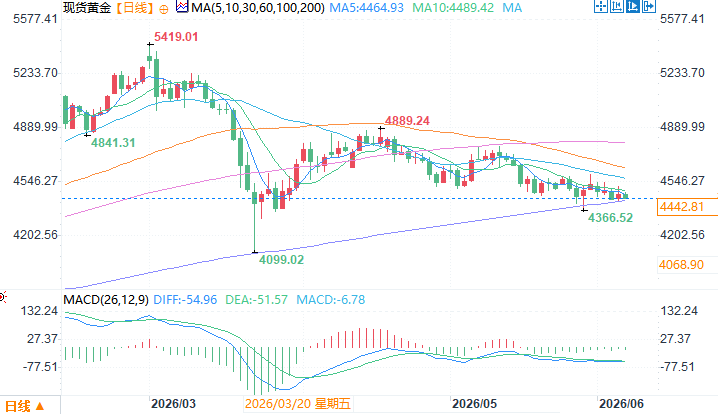
Spot gold daily chart source: EasyForex
At 13:14 Beijing time on June 5, spot gold was trading at $4448.81 per ounce.
Affected by changes in interest rate pricing, institutions have lowered their target price for gold this year. However, the structural logic supporting gold prices in the medium to long term remains solid. Silver prices have also seen a downward revision due to weakening industrial demand. The tight supply-demand balance is still beneficial for rising prices in the long term.
Unusual Market Logic: Geopolitical and Inflationary Factors Fails to materialize, Gold Prices Under Pressure Amid Volatility.
Fritsch stated that gold's price movement broke with traditional fundamental patterns after the outbreak of the conflict in Iran. As a classic hedge against inflation and a safe-haven asset, gold, instead of attracting a large influx of safe-haven funds amid rising energy prices and geopolitical turmoil in the Middle East, has instead fallen into a weak consolidation phase.
The core reason is that after geopolitical factors pushed up oil prices, market expectations for the Federal Reserve's monetary policy underwent a fundamental reversal, passively increasing the holding cost of non-interest-bearing gold and suppressing short-term buying interest.
A significant shift in interest rate expectations limits the upside potential for gold prices in the short term.
Before the conflict erupted, the market generally bet on a 50 basis point rate cut by the Federal Reserve throughout the year, which would be beneficial for precious metal pricing. However, Brent crude oil prices rose due to geopolitical disturbances, and a rebound in inflation changed market pricing. Federal funds futures showed that the year-end policy rate expectation had risen to 3.8%, compared with the current real interest rate of slightly over 3.6%. The market has fully priced in a rate hike this year, and a 25 basis point rate hike in the spring of 2027 has also been fully priced in. CME Group's interest rate tools statistics show that the probability of a rate hike in December has exceeded 50%.
As a result, Deutsche Bank lowered its year-to-date gold price target from $5,000/oz to $4,800/oz. With current spot gold priced around $4,440/oz, this represents an approximately 8% upside from the target price. The baseline scenario predicts that after a two-month buffer period, the Strait of Hormuz will reopen to navigation, oil prices will fall, and expectations of interest rate hikes will cool, creating an opportunity for gold prices to break upwards.
The medium- to long-term outlook remains unchanged, and the gold price target for 2027 remains high.
Fritz added that the German fundamentals team does not agree that the Fed will raise interest rates this year. Their baseline forecast is that the policy rate will remain unchanged and the first round of rate cuts will be postponed to the second quarter of 2027. Therefore, they are sticking to their long-term forecast of $5,200/ounce for gold by the end of 2027.
Central banks around the world continue to increase their gold holdings due to concerns about the safety of dollar reserve assets. Coupled with rising government debt and relatively loose monetary conditions, these core factors that have long supported gold prices have not changed.
Silver futures saw downward revisions, with industrial demand weakening but long-term upside potential still expected.
Along with adjustments in gold price expectations, silver price forecasts have been lowered accordingly, with the year-to-date target price reduced to $80/ounce . This is due to two main factors: firstly, a weakening sentiment across the precious metals sector; and secondly, a second consecutive year of contraction in industrial demand for silver, hitting a four-year low.
The global spot silver supply and demand situation remains tight. Institutions have slightly lowered their silver price target for the end of 2027 to $90 per ounce, compared to the previous target of $95, still optimistic about the long-term upward trend of silver.
Summarize
Overall, the expectation of a Fed rate hike in the short term is the key variable suppressing the rise of gold and silver. The inflationary benefits brought by the Iranian geopolitical situation are offset by the negative impact of monetary policy, and the short-term oscillating pattern of gold and silver will continue.
Looking at the medium to long term, structural benefits such as central bank gold purchases and a high-debt environment remain unchanged. After a short period of consolidation, gold and silver still have investment value for a phased upward trend.
Spot gold daily chart source: EasyForex
At 13:14 Beijing time on June 5, spot gold was trading at $4448.81 per ounce.
- Risk Warning and Disclaimer
- The market involves risk, and trading may not be suitable for all investors. This article is for reference only and does not constitute personal investment advice, nor does it take into account certain users’ specific investment objectives, financial situation, or other needs. Any investment decisions made based on this information are at your own risk.