The euro/yen pair is approaching the upper boundary of its converging range, awaiting a directional move.
2026-06-05 14:00:09
The euro traded in a range against the yen (EUR/JPY) during Friday's Asian trading session, hovering around 185.80. After a slight rise in the previous session, the market entered a consolidation phase, but the overall trend remained bullish.

The core factor currently influencing the euro/yen exchange rate is the policy divergence between the European Central Bank (ECB) and the Bank of Japan (BOJ). The ECB maintains a hawkish stance, and the market widely expects it to have further room to tighten policy. Meanwhile, although the BOJ is gradually exiting its ultra-loose monetary policy, its overall interest rates remain significantly lower than those of major European economies. This interest rate differential continues to support the euro.
Recent strong wage data from Japan has boosted market expectations for future interest rate hikes by the Bank of Japan. However, the yen's overall appreciation potential is temporarily limited due to the Japanese government's close monitoring of exchange rate fluctuations and the market's continued observation of the Bank of Japan's future policy adjustments. Market sentiment remains stable, with investor demand for euro-denominated assets remaining robust, while the yen is influenced by both policy expectations and the risk of government intervention. Against this backdrop, the euro/yen exchange rate has generally remained high.
Technical analysis shows that the exchange rate is currently trading above both the 9-day and 50-day exponential moving averages, indicating that the short- and medium-term trend remains bullish. In particular, the 9-day moving average consistently stays above the 50-day moving average, reflecting that buying power still holds a certain advantage in the market. Meanwhile, the 14-day Relative Strength Index (RSI) is around 56, remaining above 50 but not yet entering overbought territory. This means that upward momentum still exists, and the market has not shown obvious signs of overheating, leaving room for further upward movement.
From a daily chart perspective, the EUR/JPY pair is currently approaching the upper edge of a descending channel. The current channel top is around 186.20, a key technical resistance level that the market is watching closely. A decisive break and hold above this level would be seen as a new bullish confirmation signal, suggesting the previous correction may have officially ended. A break above the 186.20 resistance area would target the historical high near 187.95, the all-time high reached on April 17th and a crucial target for the bulls.
However, the risk of a technical pullback should still be noted during the upward trend. From a support structure perspective, the 9-day moving average at 185.60 forms the first support level, while the 50-day moving average around 185.10 is a more crucial medium-term support area. If the exchange rate breaks below these moving average support levels, it will mean that the short-term upward structure has been broken, and the market may enter a deeper correction phase. At that time, the downside target may be around 181.87, the three-month low formed on March 16, with further support at the 180.81 area, the nearly six-month low reached on February 12.
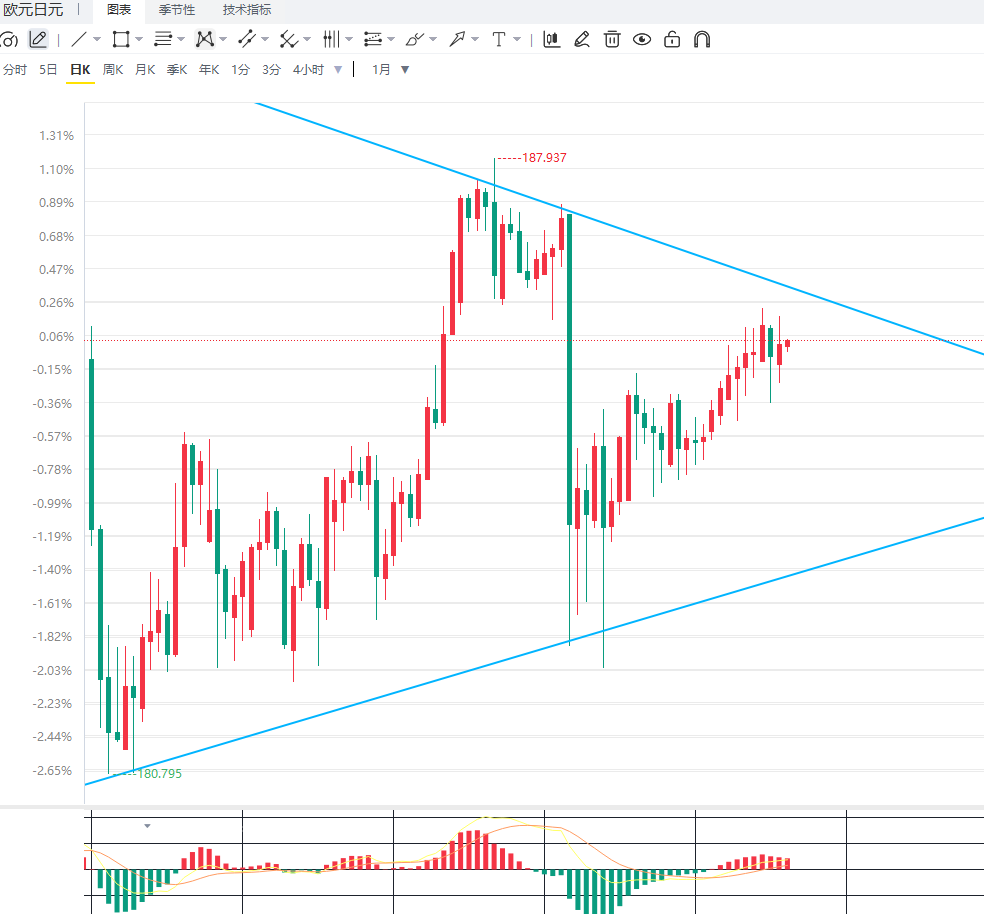
Editor's Summary : The EUR/JPY pair is currently maintaining a generally strong trend, with moving averages and momentum indicators supporting a bullish advantage. The European Central Bank's relatively hawkish policy expectations and the Bank of Japan's cautious approach to policy normalization provide fundamental support for the exchange rate. In the short term, the upper edge of the descending channel around 186.20 will be a crucial watershed in determining the subsequent trend. A successful breakout could see the market further challenge the historical high of 187.95; a failed breakout, however, warrants caution regarding the risk of a technical correction. Investors should pay close attention to the impact of the European Central Bank's policy moves, the Bank of Japan's meeting results, and changes in global risk sentiment on the currency market.
The core factor currently influencing the euro/yen exchange rate is the policy divergence between the European Central Bank (ECB) and the Bank of Japan (BOJ). The ECB maintains a hawkish stance, and the market widely expects it to have further room to tighten policy. Meanwhile, although the BOJ is gradually exiting its ultra-loose monetary policy, its overall interest rates remain significantly lower than those of major European economies. This interest rate differential continues to support the euro.
Recent strong wage data from Japan has boosted market expectations for future interest rate hikes by the Bank of Japan. However, the yen's overall appreciation potential is temporarily limited due to the Japanese government's close monitoring of exchange rate fluctuations and the market's continued observation of the Bank of Japan's future policy adjustments. Market sentiment remains stable, with investor demand for euro-denominated assets remaining robust, while the yen is influenced by both policy expectations and the risk of government intervention. Against this backdrop, the euro/yen exchange rate has generally remained high.
Technical analysis shows that the exchange rate is currently trading above both the 9-day and 50-day exponential moving averages, indicating that the short- and medium-term trend remains bullish. In particular, the 9-day moving average consistently stays above the 50-day moving average, reflecting that buying power still holds a certain advantage in the market. Meanwhile, the 14-day Relative Strength Index (RSI) is around 56, remaining above 50 but not yet entering overbought territory. This means that upward momentum still exists, and the market has not shown obvious signs of overheating, leaving room for further upward movement.
From a daily chart perspective, the EUR/JPY pair is currently approaching the upper edge of a descending channel. The current channel top is around 186.20, a key technical resistance level that the market is watching closely. A decisive break and hold above this level would be seen as a new bullish confirmation signal, suggesting the previous correction may have officially ended. A break above the 186.20 resistance area would target the historical high near 187.95, the all-time high reached on April 17th and a crucial target for the bulls.
However, the risk of a technical pullback should still be noted during the upward trend. From a support structure perspective, the 9-day moving average at 185.60 forms the first support level, while the 50-day moving average around 185.10 is a more crucial medium-term support area. If the exchange rate breaks below these moving average support levels, it will mean that the short-term upward structure has been broken, and the market may enter a deeper correction phase. At that time, the downside target may be around 181.87, the three-month low formed on March 16, with further support at the 180.81 area, the nearly six-month low reached on February 12.
Editor's Summary : The EUR/JPY pair is currently maintaining a generally strong trend, with moving averages and momentum indicators supporting a bullish advantage. The European Central Bank's relatively hawkish policy expectations and the Bank of Japan's cautious approach to policy normalization provide fundamental support for the exchange rate. In the short term, the upper edge of the descending channel around 186.20 will be a crucial watershed in determining the subsequent trend. A successful breakout could see the market further challenge the historical high of 187.95; a failed breakout, however, warrants caution regarding the risk of a technical correction. Investors should pay close attention to the impact of the European Central Bank's policy moves, the Bank of Japan's meeting results, and changes in global risk sentiment on the currency market.
- Risk Warning and Disclaimer
- The market involves risk, and trading may not be suitable for all investors. This article is for reference only and does not constitute personal investment advice, nor does it take into account certain users’ specific investment objectives, financial situation, or other needs. Any investment decisions made based on this information are at your own risk.