With the US non-farm payroll data about to be released, hawkish comments from the Federal Reserve are supporting the dollar index to remain above the 99 level.
2026-06-05 15:26:00
During Friday's Asian trading session, the US dollar index (DXY) fluctuated narrowly around 99.40, with overall market trading relatively cautious. With the US May non-farm payrolls report due soon, investors are temporarily reducing directional bets, awaiting key economic data to provide new guidance for future market movements.

Looking at the performance of major currencies, the US dollar remained generally stable. The Australian dollar, however, was relatively weak, with the US dollar/AUD exchange rate recording some gains. Meanwhile, the euro, pound sterling, Canadian dollar, and Swiss franc saw relatively limited fluctuations against the US dollar, indicating that the market is in a wait-and-see phase before the release of important data.
This non-farm payroll report is considered one of the most important U.S. economic indicators in recent times. The market expects the U.S. to add approximately 85,000 non-farm jobs in May, down from 115,000 in April, reflecting a possible slowdown in the expansion of the U.S. labor market.
Meanwhile, the US unemployment rate is projected to remain unchanged at 4.3%, indicating that the overall job market remains relatively stable. Regarding wages, the annualized rate of increase in average hourly earnings is expected to slow to 3.4% from the previous 3.6%, but the monthly rate is projected to rise from 0.2% to 0.3%, suggesting that wage pressures persist.
Typically, non-farm payroll data directly influences market expectations regarding the Federal Reserve's monetary policy. A stronger job market provides a stronger case for the Fed to maintain high interest rates; conversely, a significant weakening of the job market may increase market expectations for future policy adjustments.
However, the market logic this time is different from the past. Recently, several Federal Reserve officials have explicitly stated that the biggest risk is not a slowdown in the job market, but rather a potential resurgence of inflationary pressures. Therefore, even if employment data falls slightly short of market expectations, its impact on the dollar and interest rate expectations may be relatively limited.
Minneapolis Federal Reserve President Neel Kashkari previously stated that the Fed's primary concern right now is inflation exceeding its target, rather than a moderate cooling in the labor market. He pointed out that while changes in the job market are also worth noting, controlling inflation remains the current policy priority.
Meanwhile, Kansas City Fed President Schmid expressed a similar view. He believes that the biggest challenge facing the US economy remains the risk of inflation, and the Fed's future considerations are whether to maintain current interest rates or raise them further to ensure inflation returns to the target range.
These hawkish statements have clearly altered market expectations regarding future policy paths. Investors are increasingly inclined to believe that the Federal Reserve will maintain a restrictive policy environment for an extended period, thus providing sustained support for the dollar. In addition to economic data, the situation in the Middle East is also attracting market attention. Significant uncertainty remains regarding the progress of negotiations between the US and Iran on a long-term peace agreement. Investors are closely monitoring the latest statements from both sides, hoping to glean insights into whether geopolitical risks will continue to impact global energy markets and inflation prospects.
If tensions in the Middle East remain high, international energy prices may stay high, further increasing global inflationary pressures and strengthening market expectations that the Federal Reserve will maintain high interest rates. This situation would be conducive to maintaining a strong US dollar.
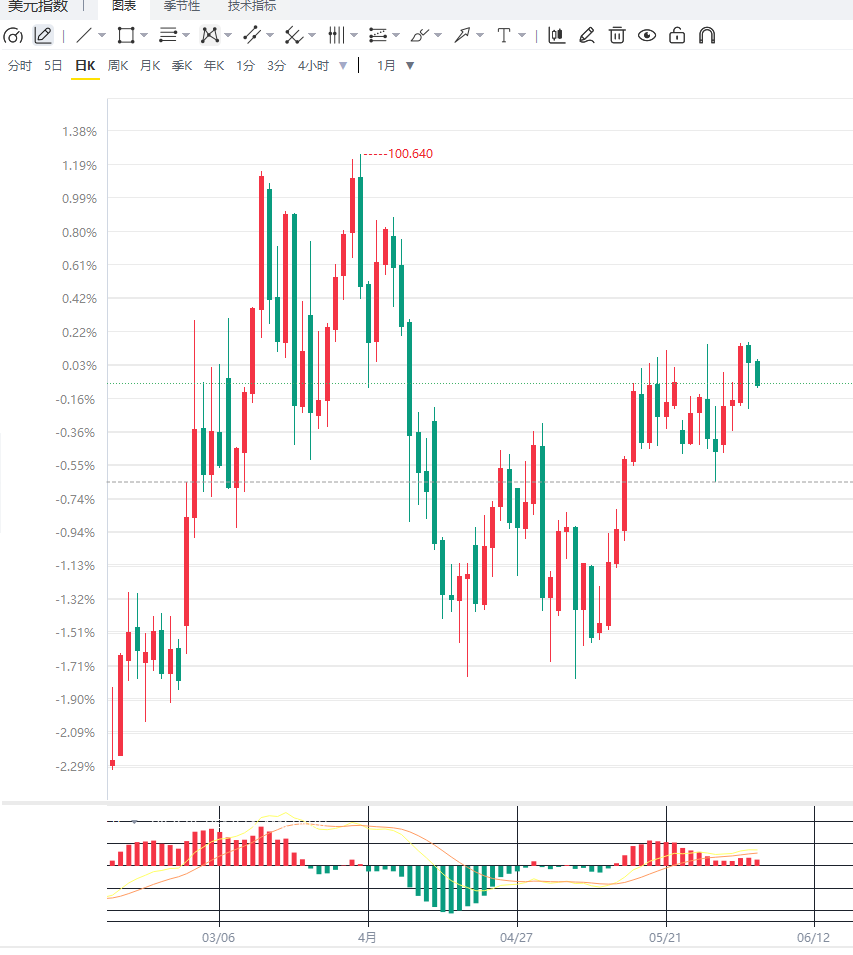
From a daily chart perspective, the US dollar index is currently maintaining a slightly bullish, oscillating pattern. The price continues to trade above key support levels, indicating that overall market confidence has not weakened significantly. The current key support level is around 99.00, with further support at the 98.50 area; key resistance levels are at the psychological level of 100.00 and around 100.80. The MACD indicator is gradually approaching the zero line, suggesting that the market is accumulating new directional momentum. The RSI indicator is hovering around 50, reflecting a relatively balanced market with bullish and bearish forces, awaiting the non-farm payroll data to break this equilibrium.
From a 4-hour chart perspective, the US dollar index is maintaining a range-bound consolidation structure. Short-term moving averages are flattening, indicating a strong wait-and-see attitude in the market. If the non-farm payroll data is strong, the US dollar index is expected to break through the 100 mark and further challenge the 100.80 area; if the data is significantly weaker than expected, it may retest the 99.00 or even 98.50 support area.
Editor's Viewpoint <br/>The US dollar market is currently in a critical data window, with the US non-farm payroll report being a significant catalyst for short-term price movements. However, compared to the past, market focus has shifted somewhat from employment to inflation, and the continued hawkish signals from Federal Reserve officials are reinforcing expectations of a prolonged period of high interest rates. In the medium term, the dollar's performance will continue to be influenced by US economic performance, inflation changes, and the Federal Reserve's policy path. If inflationary pressures persist and the job market remains resilient, the dollar is likely to continue to receive support; conversely, a significant slowdown in economic growth could put temporary pressure on the dollar. Investors should pay close attention to the non-farm payroll data, inflation indicators, and subsequent statements from Federal Reserve officials.
Looking at the performance of major currencies, the US dollar remained generally stable. The Australian dollar, however, was relatively weak, with the US dollar/AUD exchange rate recording some gains. Meanwhile, the euro, pound sterling, Canadian dollar, and Swiss franc saw relatively limited fluctuations against the US dollar, indicating that the market is in a wait-and-see phase before the release of important data.
This non-farm payroll report is considered one of the most important U.S. economic indicators in recent times. The market expects the U.S. to add approximately 85,000 non-farm jobs in May, down from 115,000 in April, reflecting a possible slowdown in the expansion of the U.S. labor market.
Meanwhile, the US unemployment rate is projected to remain unchanged at 4.3%, indicating that the overall job market remains relatively stable. Regarding wages, the annualized rate of increase in average hourly earnings is expected to slow to 3.4% from the previous 3.6%, but the monthly rate is projected to rise from 0.2% to 0.3%, suggesting that wage pressures persist.
Typically, non-farm payroll data directly influences market expectations regarding the Federal Reserve's monetary policy. A stronger job market provides a stronger case for the Fed to maintain high interest rates; conversely, a significant weakening of the job market may increase market expectations for future policy adjustments.
However, the market logic this time is different from the past. Recently, several Federal Reserve officials have explicitly stated that the biggest risk is not a slowdown in the job market, but rather a potential resurgence of inflationary pressures. Therefore, even if employment data falls slightly short of market expectations, its impact on the dollar and interest rate expectations may be relatively limited.
Minneapolis Federal Reserve President Neel Kashkari previously stated that the Fed's primary concern right now is inflation exceeding its target, rather than a moderate cooling in the labor market. He pointed out that while changes in the job market are also worth noting, controlling inflation remains the current policy priority.
Meanwhile, Kansas City Fed President Schmid expressed a similar view. He believes that the biggest challenge facing the US economy remains the risk of inflation, and the Fed's future considerations are whether to maintain current interest rates or raise them further to ensure inflation returns to the target range.
These hawkish statements have clearly altered market expectations regarding future policy paths. Investors are increasingly inclined to believe that the Federal Reserve will maintain a restrictive policy environment for an extended period, thus providing sustained support for the dollar. In addition to economic data, the situation in the Middle East is also attracting market attention. Significant uncertainty remains regarding the progress of negotiations between the US and Iran on a long-term peace agreement. Investors are closely monitoring the latest statements from both sides, hoping to glean insights into whether geopolitical risks will continue to impact global energy markets and inflation prospects.
If tensions in the Middle East remain high, international energy prices may stay high, further increasing global inflationary pressures and strengthening market expectations that the Federal Reserve will maintain high interest rates. This situation would be conducive to maintaining a strong US dollar.
From a daily chart perspective, the US dollar index is currently maintaining a slightly bullish, oscillating pattern. The price continues to trade above key support levels, indicating that overall market confidence has not weakened significantly. The current key support level is around 99.00, with further support at the 98.50 area; key resistance levels are at the psychological level of 100.00 and around 100.80. The MACD indicator is gradually approaching the zero line, suggesting that the market is accumulating new directional momentum. The RSI indicator is hovering around 50, reflecting a relatively balanced market with bullish and bearish forces, awaiting the non-farm payroll data to break this equilibrium.
From a 4-hour chart perspective, the US dollar index is maintaining a range-bound consolidation structure. Short-term moving averages are flattening, indicating a strong wait-and-see attitude in the market. If the non-farm payroll data is strong, the US dollar index is expected to break through the 100 mark and further challenge the 100.80 area; if the data is significantly weaker than expected, it may retest the 99.00 or even 98.50 support area.
Editor's Viewpoint <br/>The US dollar market is currently in a critical data window, with the US non-farm payroll report being a significant catalyst for short-term price movements. However, compared to the past, market focus has shifted somewhat from employment to inflation, and the continued hawkish signals from Federal Reserve officials are reinforcing expectations of a prolonged period of high interest rates. In the medium term, the dollar's performance will continue to be influenced by US economic performance, inflation changes, and the Federal Reserve's policy path. If inflationary pressures persist and the job market remains resilient, the dollar is likely to continue to receive support; conversely, a significant slowdown in economic growth could put temporary pressure on the dollar. Investors should pay close attention to the non-farm payroll data, inflation indicators, and subsequent statements from Federal Reserve officials.
- Risk Warning and Disclaimer
- The market involves risk, and trading may not be suitable for all investors. This article is for reference only and does not constitute personal investment advice, nor does it take into account certain users’ specific investment objectives, financial situation, or other needs. Any investment decisions made based on this information are at your own risk.