Why is the Australian dollar strengthening against the trend despite the ongoing conflict in the Middle East?
2026-06-08 09:15:04
On Monday (June 8) in early Asian trading, the Australian dollar weakened to around 0.7023 against the US dollar before rebounding. Currently, the exchange rate is up about 0.2% and trading around 0.7050.
Last weekend, Iran launched multiple missile strikes into northern Israel, sparking market concerns about a protracted conflict in the Middle East. Iranian officials warned that any Israeli attack on Lebanon or Iran would be met with a "devastating and comprehensive response."
Meanwhile, US President Trump said he would call Israeli Prime Minister Netanyahu and ask him not to take retaliatory action to avoid the "breakdown" of the trilateral ceasefire agreement.
As the market gradually digested geopolitical risks, and with the negotiation channels between the United States and Iran not yet completely closed, the demand for safe-haven assets subsided during the session, limiting the further upside potential of the US dollar.
Data released by the U.S. Bureau of Labor Statistics last Friday showed that U.S. nonfarm payrolls increased by 172,000 in May, with the previous figure revised upward to 179,000, marking the third consecutive month of strong growth. The unemployment rate remained at 4.3%. This optimistic report provided fundamental support for the dollar, but the dollar failed to maintain its strength after entering the Asian session on Monday.
Analysis indicates that the main reasons include: the market has already partially priced in the positive data; there are still disagreements about the Fed's policy outlook; and employment and inflation signals have not yet formed a consensus.
Meanwhile, following the Iranian missile attack over the weekend, neither the US nor Iran took further escalation measures, leading to a marginal easing of market risk aversion and weakening safe-haven buying of the US dollar. Against this backdrop, the US dollar weakened during the Asian trading session, creating a window for a rebound in non-US currencies such as the Australian dollar. Market focus is now shifting to this week's Federal Reserve interest rate decision and US CPI data.
The Reserve Bank of Australia's (RBA) hawkish stance was one of the key factors that enabled the Australian dollar to open lower and then rise.
Reserve Bank of Australia Governor Michelle Bullock previously emphasized that after three rate hikes earlier this year that pushed the cash rate to 4.35%, the central bank will remain strictly focused on curbing inflation.
Block added that current inflation levels remain too high, and the Board will take all necessary actions to achieve its mandate of price stability and full employment. This hawkish stance contrasts sharply with recent market expectations of a shift in Federal Reserve policy, providing a unique support for the Australian dollar.
It is worth noting that market expectations of a policy divergence between the Reserve Bank of Australia (RBA) and the Federal Reserve are continuing to strengthen, becoming a key variable in the medium-term trend of the Australian dollar.
TD Securities strategists point out that Australia is entering a rare phase of “one-sided RBA tightening” – the RBA is expected to continue raising interest rates, while the Federal Reserve is likely to begin a rate-cutting cycle against the backdrop of declining inflation.
The agency's analysis suggests that the divergence in policy paths between the two central banks is widening, a situation almost unique among G10 currencies. Historical experience indicates that this policy divergence provides structural support for the Australian dollar, with its appreciation often exceeding the predictions of traditional interest rate differential models. Looking back at a similar monetary policy divergence cycle in 2018-2019, the Australian dollar appreciated by more than 8% against the US dollar within six months.
In addition, Australia's strong trade surplus and continuous inflow of overseas capital provide an additional safety margin for the Australian dollar.
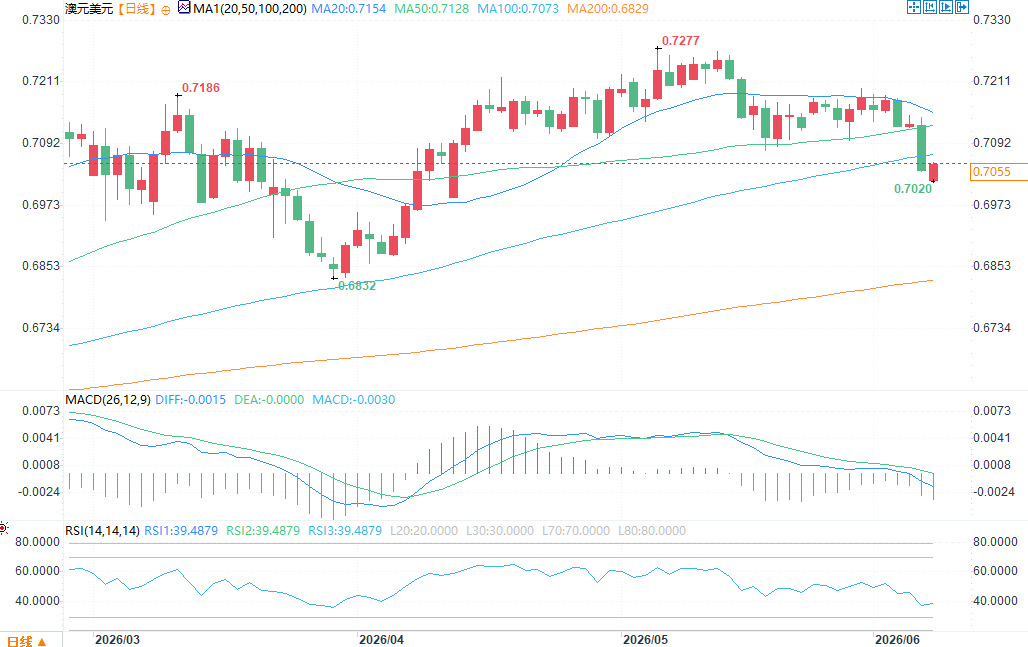
The Australian dollar is currently in a weak consolidation phase on the daily chart, having retreated from its highs. A double-top pattern formed at 0.7186 and 0.7277, and the price has fallen to around 0.7050, breaking below the 20-day, 50-day, and 100-day moving averages, indicating a weakening short-term trend. Key support is at 0.7000, with strong support at 0.6832; resistance is concentrated at 0.7092 and above the moving average range.
In terms of technical indicators, the MACD crossed below the zero line to form a death cross, and the green bars released bearish momentum; the RSI is 39.49, which is in the neutral to weak range, close to oversold but has not triggered a clear rebound signal.
In summary, the exchange rate is weak in the short term. If it fails to hold above 0.7092, it will likely test the 0.7000 support level. If it breaks through the resistance level with increased volume, it may rebound to test the moving average resistance. On a larger timeframe, it remains supported by the 200-day moving average (MA200). Currently, the market is mainly in a weak, oscillating pattern, and fundamental factors should be closely monitored for potential disruptions.
(AUD/USD daily chart, source: FX678)
At 9:14 AM Beijing time on June 8, the Australian dollar was trading at 0.7057/58 against the US dollar.
Last weekend, Iran launched multiple missile strikes into northern Israel, sparking market concerns about a protracted conflict in the Middle East. Iranian officials warned that any Israeli attack on Lebanon or Iran would be met with a "devastating and comprehensive response."
Meanwhile, US President Trump said he would call Israeli Prime Minister Netanyahu and ask him not to take retaliatory action to avoid the "breakdown" of the trilateral ceasefire agreement.
As the market gradually digested geopolitical risks, and with the negotiation channels between the United States and Iran not yet completely closed, the demand for safe-haven assets subsided during the session, limiting the further upside potential of the US dollar.
US jobs data provided support for the dollar, but the market had already partially priced it in.
Data released by the U.S. Bureau of Labor Statistics last Friday showed that U.S. nonfarm payrolls increased by 172,000 in May, with the previous figure revised upward to 179,000, marking the third consecutive month of strong growth. The unemployment rate remained at 4.3%. This optimistic report provided fundamental support for the dollar, but the dollar failed to maintain its strength after entering the Asian session on Monday.
Analysis indicates that the main reasons include: the market has already partially priced in the positive data; there are still disagreements about the Fed's policy outlook; and employment and inflation signals have not yet formed a consensus.
Meanwhile, following the Iranian missile attack over the weekend, neither the US nor Iran took further escalation measures, leading to a marginal easing of market risk aversion and weakening safe-haven buying of the US dollar. Against this backdrop, the US dollar weakened during the Asian trading session, creating a window for a rebound in non-US currencies such as the Australian dollar. Market focus is now shifting to this week's Federal Reserve interest rate decision and US CPI data.
The Reserve Bank of Australia's hawkish stance provides key support for the Australian dollar.
The Reserve Bank of Australia's (RBA) hawkish stance was one of the key factors that enabled the Australian dollar to open lower and then rise.
Reserve Bank of Australia Governor Michelle Bullock previously emphasized that after three rate hikes earlier this year that pushed the cash rate to 4.35%, the central bank will remain strictly focused on curbing inflation.
Block added that current inflation levels remain too high, and the Board will take all necessary actions to achieve its mandate of price stability and full employment. This hawkish stance contrasts sharply with recent market expectations of a shift in Federal Reserve policy, providing a unique support for the Australian dollar.
It is worth noting that market expectations of a policy divergence between the Reserve Bank of Australia (RBA) and the Federal Reserve are continuing to strengthen, becoming a key variable in the medium-term trend of the Australian dollar.
TD Securities strategists point out that Australia is entering a rare phase of “one-sided RBA tightening” – the RBA is expected to continue raising interest rates, while the Federal Reserve is likely to begin a rate-cutting cycle against the backdrop of declining inflation.
The agency's analysis suggests that the divergence in policy paths between the two central banks is widening, a situation almost unique among G10 currencies. Historical experience indicates that this policy divergence provides structural support for the Australian dollar, with its appreciation often exceeding the predictions of traditional interest rate differential models. Looking back at a similar monetary policy divergence cycle in 2018-2019, the Australian dollar appreciated by more than 8% against the US dollar within six months.
In addition, Australia's strong trade surplus and continuous inflow of overseas capital provide an additional safety margin for the Australian dollar.
Technical Analysis
The Australian dollar is currently in a weak consolidation phase on the daily chart, having retreated from its highs. A double-top pattern formed at 0.7186 and 0.7277, and the price has fallen to around 0.7050, breaking below the 20-day, 50-day, and 100-day moving averages, indicating a weakening short-term trend. Key support is at 0.7000, with strong support at 0.6832; resistance is concentrated at 0.7092 and above the moving average range.
In terms of technical indicators, the MACD crossed below the zero line to form a death cross, and the green bars released bearish momentum; the RSI is 39.49, which is in the neutral to weak range, close to oversold but has not triggered a clear rebound signal.
In summary, the exchange rate is weak in the short term. If it fails to hold above 0.7092, it will likely test the 0.7000 support level. If it breaks through the resistance level with increased volume, it may rebound to test the moving average resistance. On a larger timeframe, it remains supported by the 200-day moving average (MA200). Currently, the market is mainly in a weak, oscillating pattern, and fundamental factors should be closely monitored for potential disruptions.
(AUD/USD daily chart, source: FX678)
At 9:14 AM Beijing time on June 8, the Australian dollar was trading at 0.7057/58 against the US dollar.
- Risk Warning and Disclaimer
- The market involves risk, and trading may not be suitable for all investors. This article is for reference only and does not constitute personal investment advice, nor does it take into account certain users’ specific investment objectives, financial situation, or other needs. Any investment decisions made based on this information are at your own risk.