Better-than-expected non-farm payroll data boosted the US dollar, causing gold to break below its consolidation range and potentially accelerate its decline.
2026-06-08 09:54:31
The international gold market saw a slight rebound after opening this week. After a pullback in the previous trading day, spot gold regained its footing above $4,330 per ounce during the Asian trading session. However, the overall rebound was relatively limited, indicating that the market is still assessing the balance between geopolitical risks and the outlook for monetary policy.

Tensions between Israel and Iran escalated again over the weekend. The Israeli military stated it had successfully intercepted multiple missile attacks from Iran, marking a significant resurgence in tensions since early April. Meanwhile, Iran warned of a "full and forceful response" should further military action be taken against Lebanon or Iranian territory. Market concerns about a potential escalation of the regional conflict have led to a renewed flow of safe-haven funds into the gold market. As a traditional safe-haven asset, gold typically attracts investors during periods of heightened global uncertainty, and the ongoing geopolitical tensions continue to provide support for gold prices.
Meanwhile, the United States is pushing for diplomatic mediation. President Trump stated he would communicate with Israeli Prime Minister Netanyahu in hopes of preventing further escalation. Trump also emphasized his desire to continue negotiations with Iran, believing there is still a chance for an agreement. However, given the current situation, the market remains cautious about a full de-escalation in the short term. Despite a slight recovery in safe-haven demand, gold's upside potential is significantly limited by strong US economic data.
Data released by the U.S. Bureau of Labor Statistics showed that U.S. nonfarm payrolls increased by 172,000 in May, significantly higher than the market expectation of 85,000 and far exceeding the levels previously predicted by most institutions. Although slightly slower than the revised previous figure of 179,000, the overall job market still showed strong resilience. Furthermore, the U.S. unemployment rate remained at 4.3% in May, in line with market expectations, indicating that there are no obvious signs of deterioration in the labor market.
Following the data release, the market quickly adjusted its expectations for monetary policy. Interest rate futures indicate that investors have largely ruled out the possibility of an interest rate cut in the coming months. With the high-interest-rate environment potentially persisting for longer, US Treasury yields are supported, and the US dollar index remains high, significantly suppressing gold prices. Historically, gold itself does not generate interest income; therefore, when market interest rates rise or remain high, the opportunity cost of holding gold increases, often hindering sustained price increases. The current market is in a phase of balancing safe-haven demand and high-interest-rate pressure, making it difficult for gold to establish a one-sided trend.
Furthermore, the situation in the Middle East has impacted the energy market, raising concerns among investors about future inflation trends. International crude oil prices have recently rebounded to high levels, with markets worried that rising energy costs could push up global inflation, forcing the Federal Reserve to maintain its tightening policy for a longer period. This logic further limits the upside potential for gold.
From a fund flow perspective, institutional investors still have demand for gold allocation, but their willingness to chase rising prices has clearly declined. Some safe-haven funds have chosen to enter the gold market, while others have flowed into the US dollar and US Treasury markets, resulting in gold generally exhibiting a high-level consolidation pattern.
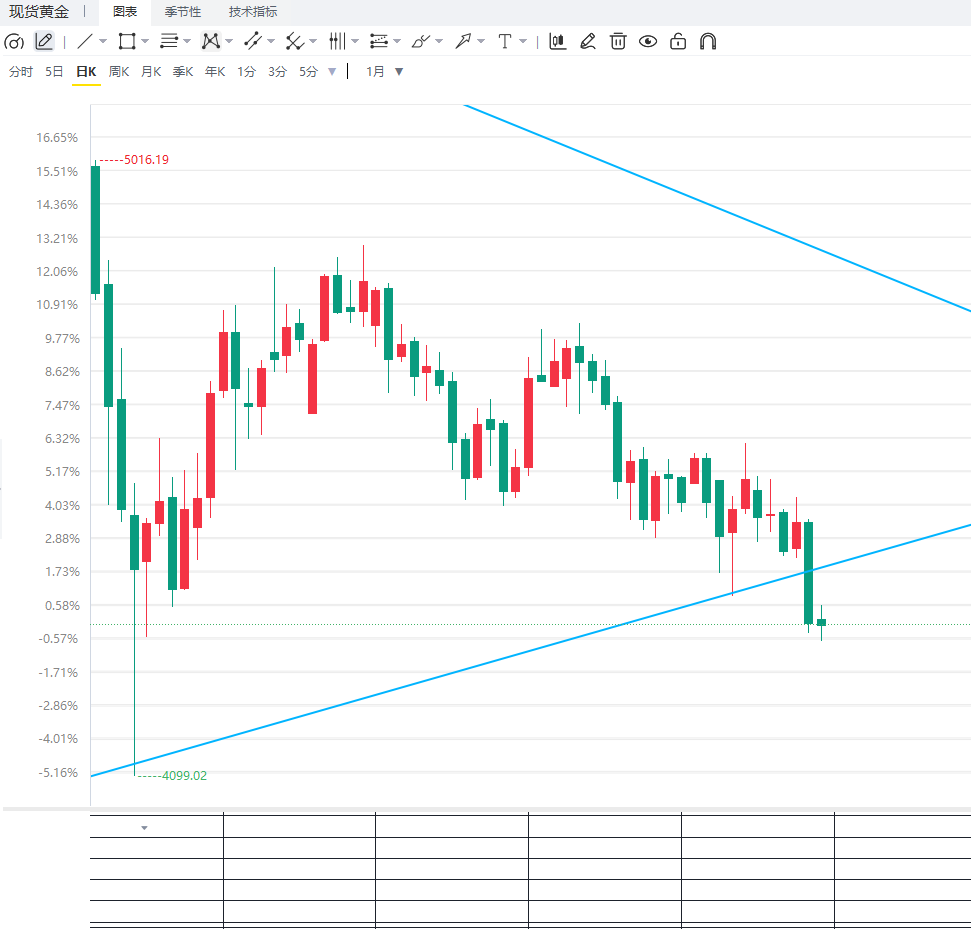
From a technical perspective, the daily chart for gold has shown signs of weakening. After breaking below the lower support of the previous consolidation pattern, the short-term trend has entered a critical testing phase. If it fails to regain a foothold above $4400, it signifies a valid downward break of the previous consolidation platform, and the market may gradually transition into a downward-trending structure. The moving average system is flattening, indicating a significant weakening of short-term bullish momentum. The MACD indicator, after a bearish crossover at a high level, continues to diverge downwards, showing increasing bearish pressure. The RSI indicator has fallen back to near the neutral zone, reflecting a cooling of market buying interest. The key support level to watch is $4300; a decisive break below this level would open up further downside potential, with targets potentially reaching $4250 or even lower. On the upside, the resistance level to watch is around $4400; only a recapture of this level can alleviate the current technical pressure.
From a 4-hour chart perspective, gold is exhibiting a short-term weak and volatile trading pattern. The price center continues to shift downwards, and the rebound is gradually limited, indicating a cautious market sentiment. The MACD indicator is running below the zero line, and short-term moving averages are providing resistance, reflecting that bears still hold the upper hand. If the price continues to be capped below $4400, the downward trend is likely to continue; a break below $4300 could trigger more technical selling, pushing gold prices further down. Conversely, if safe-haven demand significantly increases and pushes the price back above $4400, the short-term downward pressure is expected to ease.
Editor's Summary : The current gold market is caught in a tug-of-war between two forces. On one hand, continued tensions in the Middle East are increasing safe-haven demand, providing solid support for gold prices. On the other hand, strong performance in the US job market is causing the market to further postpone expectations of a Fed rate cut, and the high-interest-rate environment is putting downward pressure on gold. In the short term, gold is likely to maintain a high level of fluctuation. Investors need to pay close attention to the development of the Middle East situation, US inflation data, and speeches by Fed officials. If geopolitical risks escalate further, gold may challenge the $4450 area; if the US economy continues to be strong, gold may face some downward pressure. However, from a medium- to long-term perspective, global uncertainty remains high, and gold's value as a safe-haven asset remains.
Tensions between Israel and Iran escalated again over the weekend. The Israeli military stated it had successfully intercepted multiple missile attacks from Iran, marking a significant resurgence in tensions since early April. Meanwhile, Iran warned of a "full and forceful response" should further military action be taken against Lebanon or Iranian territory. Market concerns about a potential escalation of the regional conflict have led to a renewed flow of safe-haven funds into the gold market. As a traditional safe-haven asset, gold typically attracts investors during periods of heightened global uncertainty, and the ongoing geopolitical tensions continue to provide support for gold prices.
Meanwhile, the United States is pushing for diplomatic mediation. President Trump stated he would communicate with Israeli Prime Minister Netanyahu in hopes of preventing further escalation. Trump also emphasized his desire to continue negotiations with Iran, believing there is still a chance for an agreement. However, given the current situation, the market remains cautious about a full de-escalation in the short term. Despite a slight recovery in safe-haven demand, gold's upside potential is significantly limited by strong US economic data.
Data released by the U.S. Bureau of Labor Statistics showed that U.S. nonfarm payrolls increased by 172,000 in May, significantly higher than the market expectation of 85,000 and far exceeding the levels previously predicted by most institutions. Although slightly slower than the revised previous figure of 179,000, the overall job market still showed strong resilience. Furthermore, the U.S. unemployment rate remained at 4.3% in May, in line with market expectations, indicating that there are no obvious signs of deterioration in the labor market.
Following the data release, the market quickly adjusted its expectations for monetary policy. Interest rate futures indicate that investors have largely ruled out the possibility of an interest rate cut in the coming months. With the high-interest-rate environment potentially persisting for longer, US Treasury yields are supported, and the US dollar index remains high, significantly suppressing gold prices. Historically, gold itself does not generate interest income; therefore, when market interest rates rise or remain high, the opportunity cost of holding gold increases, often hindering sustained price increases. The current market is in a phase of balancing safe-haven demand and high-interest-rate pressure, making it difficult for gold to establish a one-sided trend.
Furthermore, the situation in the Middle East has impacted the energy market, raising concerns among investors about future inflation trends. International crude oil prices have recently rebounded to high levels, with markets worried that rising energy costs could push up global inflation, forcing the Federal Reserve to maintain its tightening policy for a longer period. This logic further limits the upside potential for gold.
From a fund flow perspective, institutional investors still have demand for gold allocation, but their willingness to chase rising prices has clearly declined. Some safe-haven funds have chosen to enter the gold market, while others have flowed into the US dollar and US Treasury markets, resulting in gold generally exhibiting a high-level consolidation pattern.
From a technical perspective, the daily chart for gold has shown signs of weakening. After breaking below the lower support of the previous consolidation pattern, the short-term trend has entered a critical testing phase. If it fails to regain a foothold above $4400, it signifies a valid downward break of the previous consolidation platform, and the market may gradually transition into a downward-trending structure. The moving average system is flattening, indicating a significant weakening of short-term bullish momentum. The MACD indicator, after a bearish crossover at a high level, continues to diverge downwards, showing increasing bearish pressure. The RSI indicator has fallen back to near the neutral zone, reflecting a cooling of market buying interest. The key support level to watch is $4300; a decisive break below this level would open up further downside potential, with targets potentially reaching $4250 or even lower. On the upside, the resistance level to watch is around $4400; only a recapture of this level can alleviate the current technical pressure.
From a 4-hour chart perspective, gold is exhibiting a short-term weak and volatile trading pattern. The price center continues to shift downwards, and the rebound is gradually limited, indicating a cautious market sentiment. The MACD indicator is running below the zero line, and short-term moving averages are providing resistance, reflecting that bears still hold the upper hand. If the price continues to be capped below $4400, the downward trend is likely to continue; a break below $4300 could trigger more technical selling, pushing gold prices further down. Conversely, if safe-haven demand significantly increases and pushes the price back above $4400, the short-term downward pressure is expected to ease.
Editor's Summary : The current gold market is caught in a tug-of-war between two forces. On one hand, continued tensions in the Middle East are increasing safe-haven demand, providing solid support for gold prices. On the other hand, strong performance in the US job market is causing the market to further postpone expectations of a Fed rate cut, and the high-interest-rate environment is putting downward pressure on gold. In the short term, gold is likely to maintain a high level of fluctuation. Investors need to pay close attention to the development of the Middle East situation, US inflation data, and speeches by Fed officials. If geopolitical risks escalate further, gold may challenge the $4450 area; if the US economy continues to be strong, gold may face some downward pressure. However, from a medium- to long-term perspective, global uncertainty remains high, and gold's value as a safe-haven asset remains.
- Risk Warning and Disclaimer
- The market involves risk, and trading may not be suitable for all investors. This article is for reference only and does not constitute personal investment advice, nor does it take into account certain users’ specific investment objectives, financial situation, or other needs. Any investment decisions made based on this information are at your own risk.