A stronger US dollar index pushed the dollar to a near three-month high against the Canadian dollar.
2026-06-08 13:39:03
On Monday during Asian trading hours, the US dollar continued its recent upward trend against the Canadian dollar, briefly hitting its highest level since the end of March and approaching the 1.3950 area. However, with international oil prices continuing to rise and Canadian economic data exceeding expectations, the Canadian dollar received significant support, limiting further upside potential.

The current market focus is primarily on the impact of escalating tensions in the Middle East on the energy market. Over the weekend, tensions between Iran and Israel worsened again, raising concerns that regional conflict could affect global energy supply security. Driven by this, WTI crude oil prices surged by approximately 4.5%, and energy market risk premiums rebounded significantly.
Energy exports play a vital role in Canada's economic structure. As one of the world's major crude oil exporters, rising oil prices typically improve Canada's terms of trade, increase export revenue, and enhance the attractiveness of the Canadian dollar. Therefore, the continued strength of international oil prices provides significant support for the Canadian dollar.
Meanwhile, the latest employment market data released by Canada also showed strong performance. Data showed that Canada added 87,800 jobs in May, far exceeding market expectations. At the same time, the national unemployment rate fell from its previous level to 6.6%, indicating that the labor market remains resilient.
Job growth and a declining unemployment rate together indicate that Canadian economic activity remains stable and expanding, further strengthening market confidence in the Canadian economic outlook. However, the US dollar also faces strong positive factors. The previously released US May non-farm payroll report significantly exceeded market expectations. Data showed that the US added 172,000 non-farm jobs in May, far exceeding the market forecast of 85,000. Meanwhile, the US unemployment rate remained at 4.3%, indicating that the US labor market remains robust.
Strong jobs data quickly shifted market expectations for monetary policy. Investors began reassessing the future path of interest rates and increased their bets on further tightening by the Federal Reserve. The market now expects a greater than 70% probability of another Fed rate hike before the end of the year, a significant increase from the previous week. High interest rate expectations continue to support the attractiveness of dollar assets and drive the dollar index to maintain its recent highs.
Furthermore, the escalating situation in the Middle East has also increased market demand for safe-haven assets. As one of the world's major safe-haven currencies, the US dollar typically attracts capital inflows during periods of heightened geopolitical risk. This safe-haven attribute further enhances the dollar's short-term performance.
From an overall market structure perspective, the USD/CAD exchange rate is currently influenced by two sets of forces. On the one hand, a strong US economy and expectations of interest rate hikes support the US dollar; on the other hand, rising international oil prices and improving Canadian economic data provide support for the Canadian dollar. Therefore, although the exchange rate maintains an upward trend, the pace of increase has slowed significantly.
With no major economic data releases expected from the US and Canada on Monday, short-term market movements will be more influenced by oil price fluctuations and news regarding the Middle East situation.
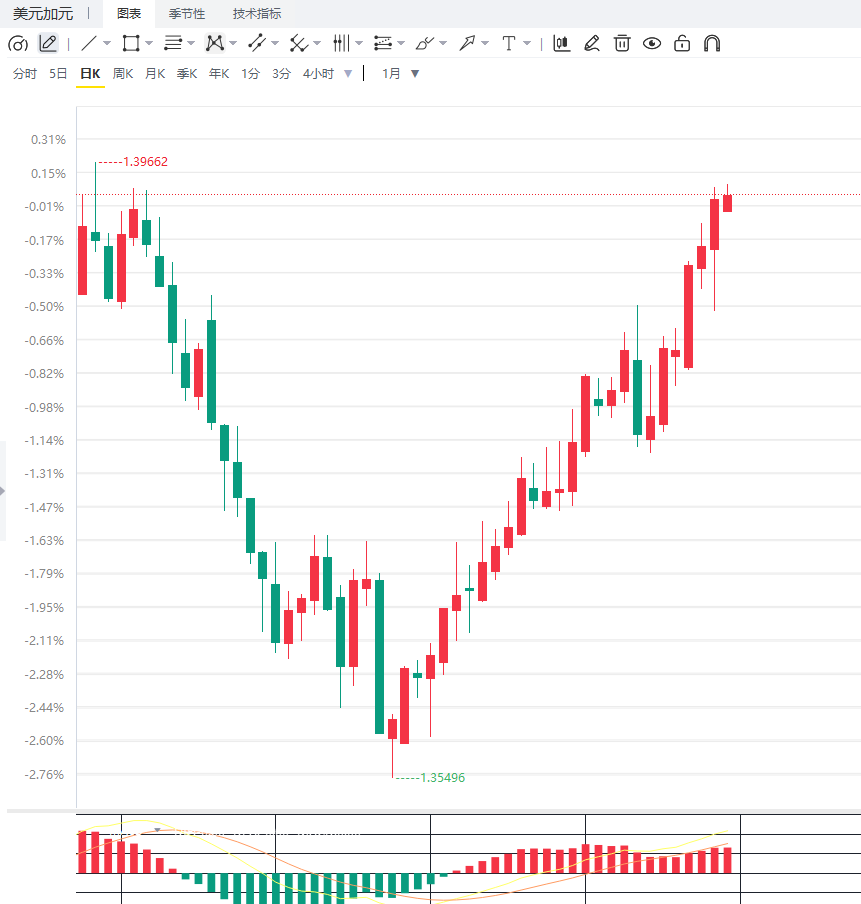
From a technical perspective, the USD/CAD daily chart maintains a clear upward trend. The price has consistently traded above the 5-day, 10-day, and 20-day moving averages, indicating that the bullish trend remains dominant. The MACD indicator remains in a golden cross state, with the red bars continuing to expand, reflecting that upward momentum has not yet weakened. The RSI indicator is hovering around 68, approaching overbought territory but has not yet shown a clear top divergence. Key support levels to watch are 1.3880 and 1.3800, while key resistance levels are around 1.4000 and 1.4080.
From a 4-hour chart perspective, the exchange rate continues to move along an upward channel. The short-term moving average system remains in a bullish alignment, indicating that buying power still dominates. However, the MACD indicator has shown some signs of consolidation after operating at high levels, suggesting a potential short-term technical correction. A break above the 1.4000 level could lead to a further test of the 1.4080 area; conversely, a continued sharp rise in oil prices could push the exchange rate back down to test support around 1.3880.
Editor's Summary : The current USD/CAD exchange rate exhibits a clear tug-of-war between bulls and bears. Strong US employment data has increased market expectations for further Fed rate hikes, providing support for the US dollar; while rising international oil prices and better-than-expected performance in the Canadian job market have strengthened the Canadian dollar's fundamentals. Going forward, the market will focus on developments in the Middle East, international oil price trends, and changes in Fed policy expectations. If energy prices continue to rise, the Canadian dollar is expected to receive further support; conversely, if US economic data continues to be strong and strengthens rate hike expectations, USD/CAD still has a chance to challenge the area above 1.40. Overall, the exchange rate is likely to maintain a high-level, slightly bullish trend in the short term.
The current market focus is primarily on the impact of escalating tensions in the Middle East on the energy market. Over the weekend, tensions between Iran and Israel worsened again, raising concerns that regional conflict could affect global energy supply security. Driven by this, WTI crude oil prices surged by approximately 4.5%, and energy market risk premiums rebounded significantly.
Energy exports play a vital role in Canada's economic structure. As one of the world's major crude oil exporters, rising oil prices typically improve Canada's terms of trade, increase export revenue, and enhance the attractiveness of the Canadian dollar. Therefore, the continued strength of international oil prices provides significant support for the Canadian dollar.
Meanwhile, the latest employment market data released by Canada also showed strong performance. Data showed that Canada added 87,800 jobs in May, far exceeding market expectations. At the same time, the national unemployment rate fell from its previous level to 6.6%, indicating that the labor market remains resilient.
Job growth and a declining unemployment rate together indicate that Canadian economic activity remains stable and expanding, further strengthening market confidence in the Canadian economic outlook. However, the US dollar also faces strong positive factors. The previously released US May non-farm payroll report significantly exceeded market expectations. Data showed that the US added 172,000 non-farm jobs in May, far exceeding the market forecast of 85,000. Meanwhile, the US unemployment rate remained at 4.3%, indicating that the US labor market remains robust.
Strong jobs data quickly shifted market expectations for monetary policy. Investors began reassessing the future path of interest rates and increased their bets on further tightening by the Federal Reserve. The market now expects a greater than 70% probability of another Fed rate hike before the end of the year, a significant increase from the previous week. High interest rate expectations continue to support the attractiveness of dollar assets and drive the dollar index to maintain its recent highs.
Furthermore, the escalating situation in the Middle East has also increased market demand for safe-haven assets. As one of the world's major safe-haven currencies, the US dollar typically attracts capital inflows during periods of heightened geopolitical risk. This safe-haven attribute further enhances the dollar's short-term performance.
From an overall market structure perspective, the USD/CAD exchange rate is currently influenced by two sets of forces. On the one hand, a strong US economy and expectations of interest rate hikes support the US dollar; on the other hand, rising international oil prices and improving Canadian economic data provide support for the Canadian dollar. Therefore, although the exchange rate maintains an upward trend, the pace of increase has slowed significantly.
With no major economic data releases expected from the US and Canada on Monday, short-term market movements will be more influenced by oil price fluctuations and news regarding the Middle East situation.
From a technical perspective, the USD/CAD daily chart maintains a clear upward trend. The price has consistently traded above the 5-day, 10-day, and 20-day moving averages, indicating that the bullish trend remains dominant. The MACD indicator remains in a golden cross state, with the red bars continuing to expand, reflecting that upward momentum has not yet weakened. The RSI indicator is hovering around 68, approaching overbought territory but has not yet shown a clear top divergence. Key support levels to watch are 1.3880 and 1.3800, while key resistance levels are around 1.4000 and 1.4080.
From a 4-hour chart perspective, the exchange rate continues to move along an upward channel. The short-term moving average system remains in a bullish alignment, indicating that buying power still dominates. However, the MACD indicator has shown some signs of consolidation after operating at high levels, suggesting a potential short-term technical correction. A break above the 1.4000 level could lead to a further test of the 1.4080 area; conversely, a continued sharp rise in oil prices could push the exchange rate back down to test support around 1.3880.
Editor's Summary : The current USD/CAD exchange rate exhibits a clear tug-of-war between bulls and bears. Strong US employment data has increased market expectations for further Fed rate hikes, providing support for the US dollar; while rising international oil prices and better-than-expected performance in the Canadian job market have strengthened the Canadian dollar's fundamentals. Going forward, the market will focus on developments in the Middle East, international oil price trends, and changes in Fed policy expectations. If energy prices continue to rise, the Canadian dollar is expected to receive further support; conversely, if US economic data continues to be strong and strengthens rate hike expectations, USD/CAD still has a chance to challenge the area above 1.40. Overall, the exchange rate is likely to maintain a high-level, slightly bullish trend in the short term.
- Risk Warning and Disclaimer
- The market involves risk, and trading may not be suitable for all investors. This article is for reference only and does not constitute personal investment advice, nor does it take into account certain users’ specific investment objectives, financial situation, or other needs. Any investment decisions made based on this information are at your own risk.