Better-than-expected non-farm payrolls do not mean the economy is worry-free. What is the market really concerned about?
2026-06-08 15:24:39
On Monday, June 8th, the core of market repricing was no longer the individual employment data point itself, but rather the resonance between interest rate paths, AI capital expenditures, and highly valued tech stocks. The US non-farm payrolls report released on June 5th showed an increase of 172,000 jobs in May, with the unemployment rate remaining at 4.3%, higher than the market's previous expectation of approximately 85,000. The Nasdaq Composite Index fell 4.2% to 25,709.43 points, the S&P 500 Index fell 2.6% to 7,383.74 points, and the Philadelphia Semiconductor Index fell by 10.3%, bringing the crowded nature of tech trading to a concentrated test.

The US non-farm payrolls report for May superficially signaled resilience, but the structure was uneven. The majority of new jobs were added in the leisure and hospitality sector (+70,000), local government (+55,000), and healthcare (+35,000), while financial activities saw a decrease of 22,000 jobs, down 107,000 from the peak in May 2025. In other words, the job expansion did not extend to all high-paying sectors; instead, it indicates that some interest rate-sensitive and technology-substitution-sensitive sectors are still contracting.
More importantly, wages haven't accelerated in tandem. In May, average hourly earnings for private nonfarm payrolls rose 0.3% month-over-month and 3.4% year-over-year, reaching an average of $37.53 per hour. Simply attributing a broad-based surge in demand based solely on higher-than-expected job growth is illogical. What the market is truly worried about is that, given the combination of a persistently low unemployment rate and stagnant wages, the Federal Reserve lacks the urgency to shift to an easing stance and may even maintain restrictive policies for an extended period.
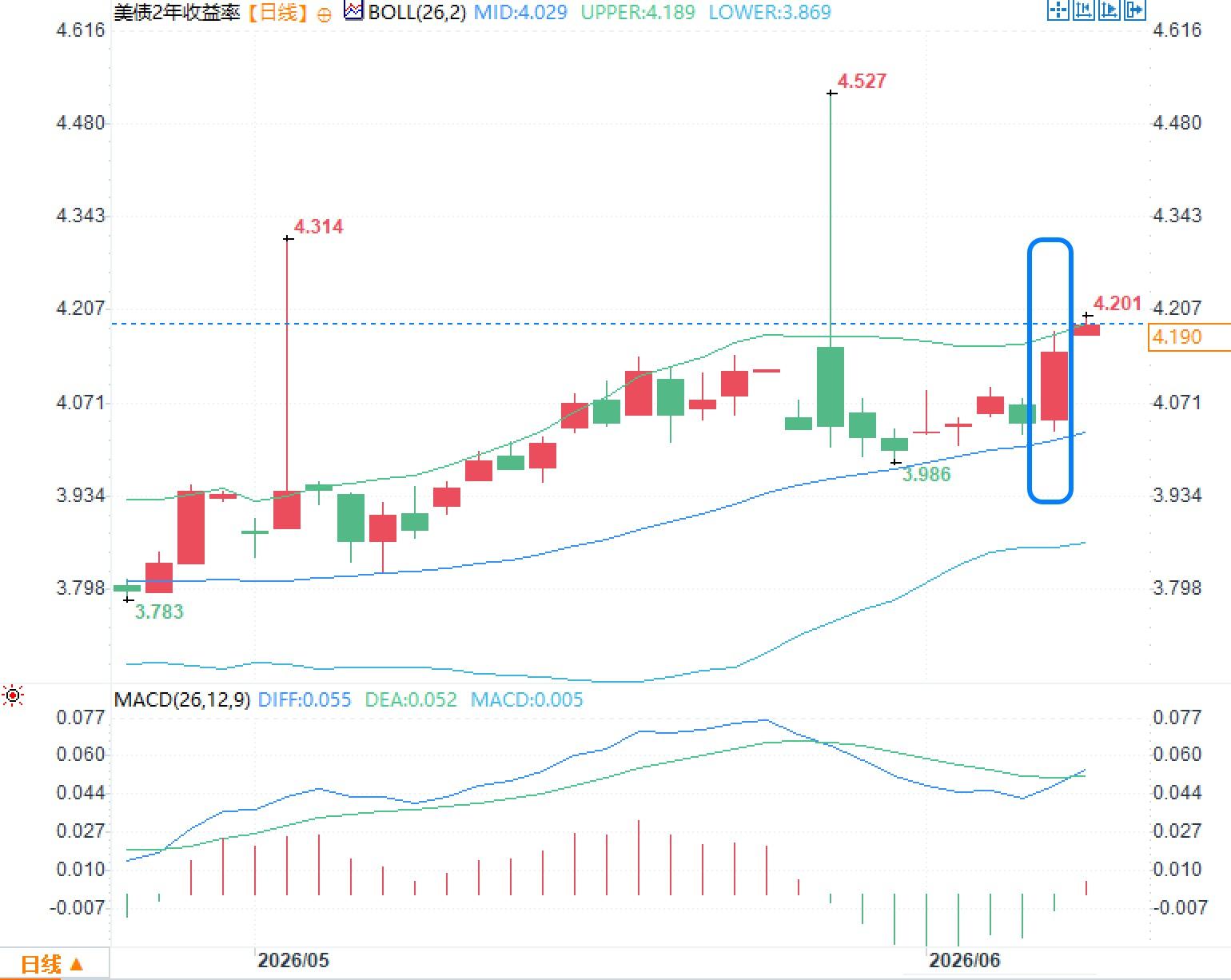
The interest rate environment had already given a warning. The Federal Reserve's interest rate update on June 5 showed that the effective federal funds rate remained at 3.62%; the two-year yield was around 4.17% and the ten-year yield was around 4.55% on the same day. The rise in short-term interest rates reinforced the trading logic that "policy rates may still move higher."
The US stock market has previously reacted slowly to signals from the bond market because the narrative of artificial intelligence has continued to support long-term profit expectations. However, when rising discount rates coincide with expanding financing demand, long-term cash flow valuations will face a double squeeze. On the one hand, the cost of capital for high-capital-expenditure projects increases; on the other hand, the present value of discounted long-term profits declines. For the technology chain, whose valuations rely heavily on earnings realization many years later, this impact is more direct than for ordinary cyclical stocks.
This adjustment is not simply a matter of macroeconomic fluctuations; it also involves capital supply issues. Market sources indicate that some large technology companies may use equity financing to supplement their investment in artificial intelligence infrastructure. Coupled with existing large-scale financing arrangements, investors are beginning to reassess the impact of high-intensity capital expenditures on free cash flow, equity dilution, and payback periods. Tech stocks are not afraid of growth stories; what they truly fear is that these growth stories require continuous external financing to support them.
The significant decline in the semiconductor sector reflects the fragility of the trading structure. For some time, funds have been concentrated on computing power, cloud infrastructure, and the spread of artificial intelligence applications, resulting in highly consistent positioning. When employment data alters interest rate expectations, the sectors most sensitive to valuation and with the most concentrated gains are naturally the first to see reduced holdings. It's important to note that this does not equate to a failure of industry logic, but rather a shift in the market from "only looking at the demand curve" to simultaneously examining the "cost of capital curve."
Energy prices and geopolitical conflicts remain disruptive variables. On June 8, international oil prices rose again due to the situation in the Middle East, with West Texas Intermediate crude approaching $94 per barrel and Brent crude rising above $97 per barrel. If energy prices remain high, the downward path of inflation expectations will be prolonged, further limiting the Federal Reserve's room for easing monetary policy before growth slows.
Interest rate futures are also correcting in tandem. Latest market pricing indicates that the probability of a Fed rate hike in December has risen to over 70%, with some institutions pushing back their expectations for the Fed's first rate cut to 2027. The implications of this change for the market are clear: traders are not facing a single day's data shock, but rather a rewriting of their full-year assumptions about funding costs.
Question 1: Why did the stock market fall despite better-than-expected US employment data?
A: Because the market's focus is not on employment itself, but on the weakening of employment resilience, which undermines the logic of interest rate cuts and raises the pricing of further interest rate hikes, thereby depressing the valuation of long-duration growth stocks.
Question 2: Has the main storyline of artificial intelligence in the United States come to an end?
A: Industry demand remains, but capital expenditure, financing dilution, and high discount rates are beginning to enter valuation models, and the market is shifting from narrative pricing to cash flow-constrained pricing.
Question 3: What is the most critical variable going forward?
A: The key factors are inflation data, oil prices, short-term yields, and the financing pace of large technology companies. These variables will determine whether this round of adjustment is a valuation correction or a cyclical turning point.
The employment data did not trigger optimistic trading, but rather a revaluation of the discount rate.
The US non-farm payrolls report for May superficially signaled resilience, but the structure was uneven. The majority of new jobs were added in the leisure and hospitality sector (+70,000), local government (+55,000), and healthcare (+35,000), while financial activities saw a decrease of 22,000 jobs, down 107,000 from the peak in May 2025. In other words, the job expansion did not extend to all high-paying sectors; instead, it indicates that some interest rate-sensitive and technology-substitution-sensitive sectors are still contracting.
More importantly, wages haven't accelerated in tandem. In May, average hourly earnings for private nonfarm payrolls rose 0.3% month-over-month and 3.4% year-over-year, reaching an average of $37.53 per hour. Simply attributing a broad-based surge in demand based solely on higher-than-expected job growth is illogical. What the market is truly worried about is that, given the combination of a persistently low unemployment rate and stagnant wages, the Federal Reserve lacks the urgency to shift to an easing stance and may even maintain restrictive policies for an extended period.
Bonds exerted pressure first, and the subsequent stock market decline was merely a belated reaction.
The interest rate environment had already given a warning. The Federal Reserve's interest rate update on June 5 showed that the effective federal funds rate remained at 3.62%; the two-year yield was around 4.17% and the ten-year yield was around 4.55% on the same day. The rise in short-term interest rates reinforced the trading logic that "policy rates may still move higher."
The US stock market has previously reacted slowly to signals from the bond market because the narrative of artificial intelligence has continued to support long-term profit expectations. However, when rising discount rates coincide with expanding financing demand, long-term cash flow valuations will face a double squeeze. On the one hand, the cost of capital for high-capital-expenditure projects increases; on the other hand, the present value of discounted long-term profits declines. For the technology chain, whose valuations rely heavily on earnings realization many years later, this impact is more direct than for ordinary cyclical stocks.
US AI transactions enter a phase of financing constraints.
This adjustment is not simply a matter of macroeconomic fluctuations; it also involves capital supply issues. Market sources indicate that some large technology companies may use equity financing to supplement their investment in artificial intelligence infrastructure. Coupled with existing large-scale financing arrangements, investors are beginning to reassess the impact of high-intensity capital expenditures on free cash flow, equity dilution, and payback periods. Tech stocks are not afraid of growth stories; what they truly fear is that these growth stories require continuous external financing to support them.
The significant decline in the semiconductor sector reflects the fragility of the trading structure. For some time, funds have been concentrated on computing power, cloud infrastructure, and the spread of artificial intelligence applications, resulting in highly consistent positioning. When employment data alters interest rate expectations, the sectors most sensitive to valuation and with the most concentrated gains are naturally the first to see reduced holdings. It's important to note that this does not equate to a failure of industry logic, but rather a shift in the market from "only looking at the demand curve" to simultaneously examining the "cost of capital curve."
Macroeconomic risks have shifted from growth to the tail of stagflation.
Energy prices and geopolitical conflicts remain disruptive variables. On June 8, international oil prices rose again due to the situation in the Middle East, with West Texas Intermediate crude approaching $94 per barrel and Brent crude rising above $97 per barrel. If energy prices remain high, the downward path of inflation expectations will be prolonged, further limiting the Federal Reserve's room for easing monetary policy before growth slows.
Interest rate futures are also correcting in tandem. Latest market pricing indicates that the probability of a Fed rate hike in December has risen to over 70%, with some institutions pushing back their expectations for the Fed's first rate cut to 2027. The implications of this change for the market are clear: traders are not facing a single day's data shock, but rather a rewriting of their full-year assumptions about funding costs.
Frequently Asked Questions
Question 1: Why did the stock market fall despite better-than-expected US employment data?
A: Because the market's focus is not on employment itself, but on the weakening of employment resilience, which undermines the logic of interest rate cuts and raises the pricing of further interest rate hikes, thereby depressing the valuation of long-duration growth stocks.
Question 2: Has the main storyline of artificial intelligence in the United States come to an end?
A: Industry demand remains, but capital expenditure, financing dilution, and high discount rates are beginning to enter valuation models, and the market is shifting from narrative pricing to cash flow-constrained pricing.
Question 3: What is the most critical variable going forward?
A: The key factors are inflation data, oil prices, short-term yields, and the financing pace of large technology companies. These variables will determine whether this round of adjustment is a valuation correction or a cyclical turning point.
- Risk Warning and Disclaimer
- The market involves risk, and trading may not be suitable for all investors. This article is for reference only and does not constitute personal investment advice, nor does it take into account certain users’ specific investment objectives, financial situation, or other needs. Any investment decisions made based on this information are at your own risk.