After halving from its high of 4773, is the gold rally over? Only two confirmations remain for the bulls to save themselves.
2026-06-08 19:59:08
On Monday, June 8th, the core issue for spot gold shifted from simple safe-haven demand to "interest rate repricing suppressing precious metals." Gold prices traded around $4330/ounce in pre-market trading, having briefly dipped to around $4268/ounce during the day. Meanwhile, US non-farm payrolls increased by 172,000 in May, with the unemployment rate remaining at 4.3%, and the combined upward revisions of 93,000 for March and April significantly increasing market expectations that the Federal Reserve will maintain a tight stance throughout the year.
The decline in gold prices since last Friday is not simply a case of "good data causing a drop in gold prices," but rather a result of renewed increases in real interest rate expectations. Average hourly earnings in May rose 0.3% month-over-month and 3.4% year-over-year, with average weekly working hours remaining at 34.3 hours, indicating that the labor market has not cooled rapidly, and wage growth has not provided the Federal Reserve with sufficient room for easing. For gold, a non-interest-bearing asset, the issue is not whether monthly employment figures are strong, but whether the Federal Reserve needs to abandon its previous easing stance after continuous upward revisions.
The current target range for the federal funds rate remains at 3.50% to 3.75%. The April statement reiterated high inflation and mentioned uncertainties arising from the Middle East situation, while also noting internal disagreements regarding a more accommodative stance. If the Fed's June 16-17 meeting confirms the risk of tightening this year, gold's valuation anchor will continue to tilt towards real interest rates.
The US Consumer Price Index (CPI) rose 0.6% month-over-month and 3.8% year-over-year in April. The core CPI, excluding food and energy, rose 0.4% month-over-month and 2.8% year-over-year. May's data will be released on June 10th, a date that will directly determine how the market interprets the policy response following the non-farm payrolls report. If inflation remains high, gold will face not just simple selling pressure, but a double squeeze of "safe-haven assets encountering tightening discounting."
The Middle East conflict continues to support gold, but its marginal effect is diminishing. US President Trump recently stated on social media that Israel and Iran must immediately cease firing, leading to a temporary easing of market risks. However, as long as energy transportation risks persist, the impact of oil prices on inflation expectations will continue to reinforce the Federal Reserve's cautious stance. In other words, while the conflict should have increased demand for gold as a safe haven, if it pushes up energy costs and raises tail risks of inflation, it could ultimately suppress gold prices through interest rate channels.
From the daily chart, spot gold retreated from its high of $4773.37/oz, with the subsequent rebound high dropping to $4595.01/oz, indicating a continued downward shift in the price center. The Bollinger Band middle line is at $4548.23/oz, the upper line at $4768.53/oz, and the lower line at $4327.92/oz, with the latest price almost touching the lower line. The intraday low of $4268.42/oz signifies a brief breach of the lower line, indicating a significant increase in the sensitivity of technical trading funds to trend continuation.
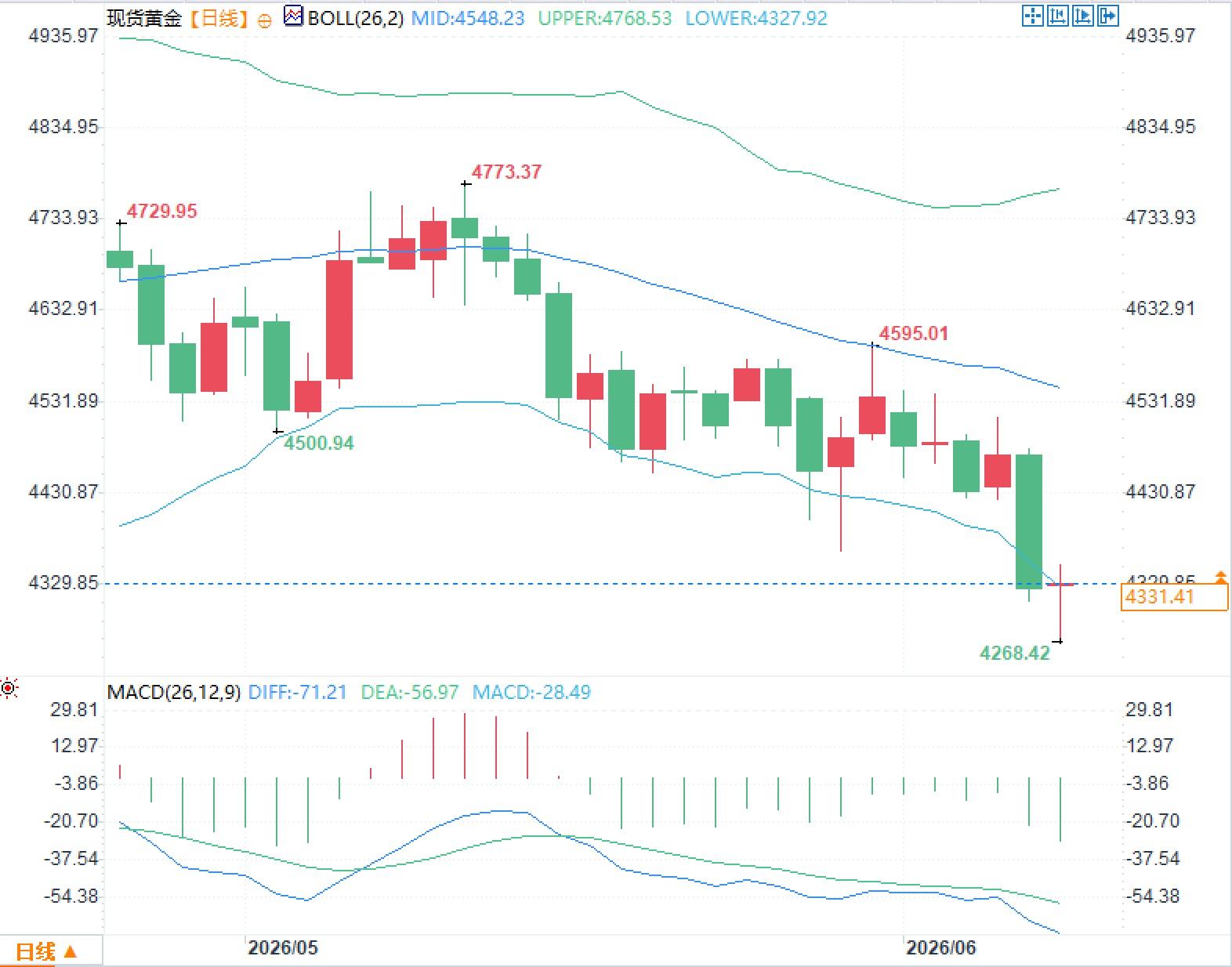
In terms of MACD, the DIFF is -71.21, the DEA is -56.97, and the histogram is -28.49, indicating that the bearish momentum has not yet been restored. More importantly, the price did not touch the lower Bollinger Band during a wide-range fluctuation, but rather approached the lower band against the backdrop of the middle band continuing to decline. This means that the "lower support" attribute of the Bollinger Bands is weakening. For traders, the current focus is not on predicting a single-point rebound, but on identifying whether the $4327 to $4350/oz area can regain trading acceptance. If the rebound fails to return above this area, the market will continue to regard the area around $4268/oz as a volatility anchor.
The medium-term logic for gold remains intact; fiscal deficits, central bank reserve allocations, geopolitical risks, and sticky inflation all continue to provide long-term support. However, short-term pricing priorities have shifted, with interest rate expectations now overshadowing the safe-haven narrative. The most dangerous aspect for traders is not the price decline itself, but rather the market's shift from "buying on dips to absorb safe-haven premiums" to "correcting overcrowded positions on rallies." If the Federal Reserve softens its dovish stance at its June meeting, gold may continue to experience valuation compression.
Two confirmations are needed going forward. First, whether May's inflation is sufficient to ease expectations of an interest rate hike this year; second, whether gold prices can quickly recover to the $4327-$4350/ounce range after breaking below the lower Bollinger Band. If either of these is lacking, gold's rebound is more likely to be interpreted as a technical correction rather than a renewed trend reversal. The market isn't lacking in stories, but rather in evidence that could drive down real interest rates.
Non-farm payrolls repricing gold: the problem isn't employment itself, but the interest rate path.
The decline in gold prices since last Friday is not simply a case of "good data causing a drop in gold prices," but rather a result of renewed increases in real interest rate expectations. Average hourly earnings in May rose 0.3% month-over-month and 3.4% year-over-year, with average weekly working hours remaining at 34.3 hours, indicating that the labor market has not cooled rapidly, and wage growth has not provided the Federal Reserve with sufficient room for easing. For gold, a non-interest-bearing asset, the issue is not whether monthly employment figures are strong, but whether the Federal Reserve needs to abandon its previous easing stance after continuous upward revisions.
The current target range for the federal funds rate remains at 3.50% to 3.75%. The April statement reiterated high inflation and mentioned uncertainties arising from the Middle East situation, while also noting internal disagreements regarding a more accommodative stance. If the Fed's June 16-17 meeting confirms the risk of tightening this year, gold's valuation anchor will continue to tilt towards real interest rates.
Inflation data becomes the next hurdle, with the safe-haven premium for gold being covered by interest rate premiums.
The US Consumer Price Index (CPI) rose 0.6% month-over-month and 3.8% year-over-year in April. The core CPI, excluding food and energy, rose 0.4% month-over-month and 2.8% year-over-year. May's data will be released on June 10th, a date that will directly determine how the market interprets the policy response following the non-farm payrolls report. If inflation remains high, gold will face not just simple selling pressure, but a double squeeze of "safe-haven assets encountering tightening discounting."
The Middle East conflict continues to support gold, but its marginal effect is diminishing. US President Trump recently stated on social media that Israel and Iran must immediately cease firing, leading to a temporary easing of market risks. However, as long as energy transportation risks persist, the impact of oil prices on inflation expectations will continue to reinforce the Federal Reserve's cautious stance. In other words, while the conflict should have increased demand for gold as a safe haven, if it pushes up energy costs and raises tail risks of inflation, it could ultimately suppress gold prices through interest rate channels.
The technical structure is weakening, and the struggle around the lower Bollinger Band will determine the short-term sentiment.
From the daily chart, spot gold retreated from its high of $4773.37/oz, with the subsequent rebound high dropping to $4595.01/oz, indicating a continued downward shift in the price center. The Bollinger Band middle line is at $4548.23/oz, the upper line at $4768.53/oz, and the lower line at $4327.92/oz, with the latest price almost touching the lower line. The intraday low of $4268.42/oz signifies a brief breach of the lower line, indicating a significant increase in the sensitivity of technical trading funds to trend continuation.
In terms of MACD, the DIFF is -71.21, the DEA is -56.97, and the histogram is -28.49, indicating that the bearish momentum has not yet been restored. More importantly, the price did not touch the lower Bollinger Band during a wide-range fluctuation, but rather approached the lower band against the backdrop of the middle band continuing to decline. This means that the "lower support" attribute of the Bollinger Bands is weakening. For traders, the current focus is not on predicting a single-point rebound, but on identifying whether the $4327 to $4350/oz area can regain trading acceptance. If the rebound fails to return above this area, the market will continue to regard the area around $4268/oz as a volatility anchor.
The main macroeconomic theme remains real interest rates; gold bulls need to wait for two confirmations.
The medium-term logic for gold remains intact; fiscal deficits, central bank reserve allocations, geopolitical risks, and sticky inflation all continue to provide long-term support. However, short-term pricing priorities have shifted, with interest rate expectations now overshadowing the safe-haven narrative. The most dangerous aspect for traders is not the price decline itself, but rather the market's shift from "buying on dips to absorb safe-haven premiums" to "correcting overcrowded positions on rallies." If the Federal Reserve softens its dovish stance at its June meeting, gold may continue to experience valuation compression.
Two confirmations are needed going forward. First, whether May's inflation is sufficient to ease expectations of an interest rate hike this year; second, whether gold prices can quickly recover to the $4327-$4350/ounce range after breaking below the lower Bollinger Band. If either of these is lacking, gold's rebound is more likely to be interpreted as a technical correction rather than a renewed trend reversal. The market isn't lacking in stories, but rather in evidence that could drive down real interest rates.
- Risk Warning and Disclaimer
- The market involves risk, and trading may not be suitable for all investors. This article is for reference only and does not constitute personal investment advice, nor does it take into account certain users’ specific investment objectives, financial situation, or other needs. Any investment decisions made based on this information are at your own risk.