Gold Trading Alert: A Glimmer of Hope for a Ceasefire Leads to a Gold Price Rebound After Hitting a Bottom; Keep a Close Eye on These Two Key Data Points for the Future.
2026-06-09 07:18:42
On Monday (June 8), gold prices briefly fell to around $4,268, their lowest level in nearly two and a half months, but then miraculously recovered most of their losses. On the surface, this appears to be a drama orchestrated by Middle East geopolitical tensions and US economic data, but at a deeper level, it reveals the most genuine fears and expectations of gold traders. On one hand, there's the sudden ceasefire signal from Israel and Iran; on the other, a much stronger-than-expected US jobs report. Bulls and bears are locked in a tug-of-war around the $4,300 per ounce mark, with neither side able to gain a decisive advantage. This indecisive movement points investors to a clear path of understanding: gold prices are driven by geopolitical sentiment in the short term, by Federal Reserve interest rates in the medium term, and ultimately, the decisive variable remains the age-old but ever-present topic—inflation.
Monday's trading in spot gold was a mini-thriller. Shortly after the Asian session opened, gold prices suddenly plummeted, hitting a low of $4,268.42 per ounce. This price was not only the day's low but also the lowest gold had reached in nearly two months since March 23. Just as the market worried about a further collapse in gold prices, bullish forces quietly gathered, pushing prices up slowly, ultimately closing at $4,329.67, almost unchanged from the previous trading day.
The catalyst for this desperate counterattack came from a statement by US President Trump. On Monday, he publicly stated that both Israel and Iran were "seeking an immediate ceasefire" and that final peace negotiations were underway. The significance of this news lies in its direct impact on one of the most important supporting factors for the gold market in recent months—Middle East safe-haven demand. Since the outbreak of the new round of conflict last spring, gold, as a traditional safe-haven asset, has benefited from a geopolitical risk premium. However, once a ceasefire agreement is actually implemented, this premium could quickly evaporate.
Peter Grant, Vice President and Senior Metals Strategist at Zaner Metals, commented that the mere news of ceasefire negotiations was enough to cause gold prices to rebound from their lows in overseas markets. His exact words were, "This has eased downward pressure to some extent," but in simpler terms, without this news, gold prices might have fallen even further from $4,268. This demonstrates the current gold market's extreme sensitivity to geopolitical news; any slight disturbance can trigger dramatic price fluctuations.
It's worth noting that the impact of ceasefire expectations on gold isn't solely negative. Traditionally, peace is seen as reducing safe-haven demand for gold, but Grant also points out a more subtle transmission path: a peace agreement would reduce the risk of energy-driven inflation and alleviate pressure on central banks to maintain high interest rates. In other words, if the situation in the Middle East de-escalates and oil prices fall, the Federal Reserve wouldn't need to use such aggressively high interest rates to combat inflation, which is a potential boon for gold, which yields no returns. Lower interest rates reduce the opportunity cost of holding gold, so this logic actually supports gold prices. The same ceasefire news both reduced safe-haven demand and eased interest rate pressures; these two completely opposite forces acted simultaneously on gold prices, which is the fundamental reason for Monday's complex price movements.
If geopolitics acted as a "firefighter" to manage gold prices that day, then US employment data was the constant "straitjacket" hanging over gold's head. Last Friday's non-farm payroll report showed that the US added a whopping 172,000 jobs last month, far exceeding market expectations. A strong job market indicates a still-hot economy, and a hot economy is often accompanied by stubborn inflation, giving the Federal Reserve ample reason to continue tightening monetary policy.
The market reaction has been immediate. According to the CME Group's FedWatch tool, traders now expect a 72% probability of the Federal Reserve raising interest rates by at least 25 basis points before December. This figure may not sound particularly high on its own, but just a month ago, the probability was only around 45%. In just one month, market expectations for rate hikes have almost doubled, and this dramatic shift in expectations is bound to be reflected in the pricing of major asset classes.
The US dollar index surged to 100.21 on Monday, hitting a near two-month high. While it retreated slightly by the close, it remained firmly above the 100 mark. A stronger dollar is a clear negative for gold, as gold is priced in dollars. A stronger dollar means investors holding other currencies need to pay more in their own currency to buy the same amount of gold, naturally suppressing demand. In short, strong employment data, through a complete transmission chain of "increasing expectations of interest rate hikes → boosting the dollar exchange rate → suppressing gold prices," has clearly defined an upward ceiling for gold prices.
This was particularly evident during the gold price rebound. Although the ceasefire news propelled gold prices up by nearly $80 from a low of $4,268, upward momentum clearly weakened as prices approached the $4,350 level. Market participants understood that as long as interest rate hike expectations continued to rise, gold would struggle to achieve a smooth, one-sided upward trend. Every attempt by the bulls was suppressed by the looming threat of a potential Fed rate hike.
The market's primary concern is no longer "what will the employment data look like?" but rather "what signals will the upcoming inflation data send?" Investors are holding their breath awaiting Wednesday's release of the US Consumer Price Index (CPI) and Thursday's release of the Producer Price Index (PPI). These two sets of data will directly determine the Federal Reserve's next interest rate move, thus indicating the medium-term direction for gold.
Economists generally predict that the core consumer price index (CPI) will likely see a slight month-on-month decline to 0.3% in May from 0.4% in April, but the year-on-year increase may rise to 2.9% from 2.8%. This forecast reflects a worrying reality: while monthly inflation has slowed, annual inflationary pressures remain stubborn, and may even be slightly increasing. If the final data exceeds expectations, market bets on interest rate hikes are likely to rise further from the current 43%, giving the dollar new upward momentum and gold facing renewed selling pressure. Conversely, if the data is moderate or even below expectations, it may temporarily alleviate concerns about interest rate hikes, giving gold a breather.
Alarmingly, some on Wall Street have already begun to lower their gold price targets ahead of schedule. Citigroup lowered its short-term gold price target from $4,300 to $4,000 per ounce, a reduction of $300. Citigroup analysts cited the Strait of Hormuz stalemate and high energy prices as reasons for expecting US interest rates to rise this year. The significance of this news lies in the fact that it is not based on short-term market fluctuations, but on a medium-term assessment of energy price and interest rate trends. If oil prices remain high, inflation will be difficult to truly subside, further strengthening the necessity for the Federal Reserve to raise interest rates, which would be a systemic downward pressure on gold.
The performance of the crude oil market also demonstrates the profound impact of energy prices on inflation expectations. Brent crude closed at $94.25 per barrel on Monday, having risen by approximately 31% since the outbreak of the conflict, even reaching a peak of over $126 in April. High oil prices not only directly push up inflation but also transmit through the supply chain to various economic sectors, ultimately reflected in consumer prices. As Thomas Simons, chief U.S. economist at Jefferies Group, stated, energy inflation is indeed significantly pushing up overall inflation data, pushing the Federal Reserve further away from its 2% inflation target. However, he also believes that energy prices will eventually fall considerably, at which point inflation will drop below 2% within a year. This divergence itself illustrates that the market has not reached a consensus on the future inflation path, and this uncertainty is precisely the breeding ground for increased volatility in the gold market.
In summary, the current gold market is in a typical "mixed" phase, with bulls and bears vying for dominance. Bulls hold the cards of Middle East geopolitical uncertainty and the potential for valuation recovery should interest rate hike expectations cool, while bears are emboldened by strong US economic data and the resulting rise in interest rate hike expectations. The fact that gold prices rebounded from a low of $4268 on Monday and closed near $4329 shows considerable resilience in the short term, but the $4350 level clearly presents resistance. For gold prices to rise further, a new catalyst is needed.
The next 48 hours will be crucial. Wednesday's CPI data and Thursday's PPI data will determine the market's final pricing in the Fed's interest rate path. If inflation data exceeds expectations, market bets on a December rate hike could easily exceed 80% or even 90%, at which point the dollar index could challenge the 101 level, while gold could retest the support level of $4268, or even further decline to the $4000 target mentioned by Citi. Conversely, if inflation data is moderate, the market may reassess the necessity of a rate hike, at which point gold could break through the short-term resistance of $4350 and challenge $4400 or even higher.
From a medium- to long-term perspective, global uncertainties have not been completely eliminated. Potential risks in the Strait of Hormuz, energy price volatility, and central banks' continued focus on inflation all provide fundamental support for gold. Investors need to closely monitor the progress of the peace negotiations led by Trump and the signals from the first FOMC meeting under the leadership of new Federal Reserve Chairman Warsh.
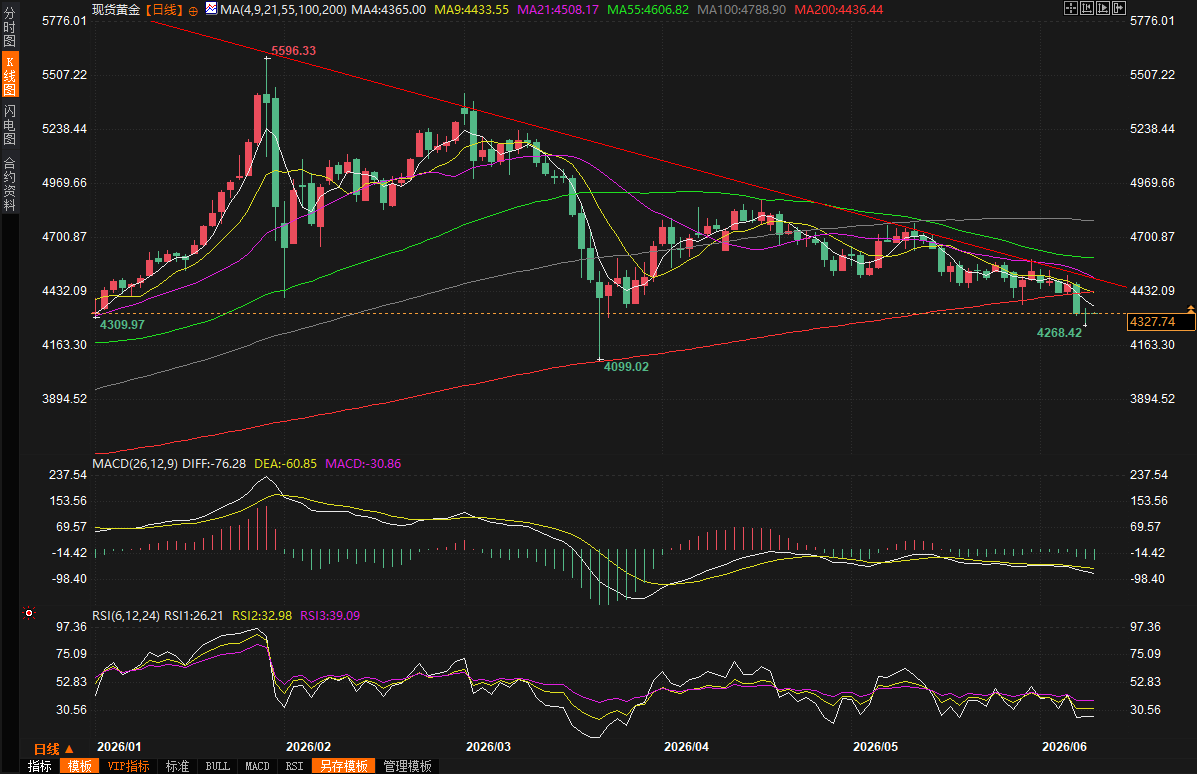
(Spot gold daily chart, source: FX678)
At 07:17 Beijing time, spot gold was trading at $4327.84 per ounce.
A glimmer of hope for a ceasefire has triggered a dramatic rebound in gold prices from their lowest point.
Monday's trading in spot gold was a mini-thriller. Shortly after the Asian session opened, gold prices suddenly plummeted, hitting a low of $4,268.42 per ounce. This price was not only the day's low but also the lowest gold had reached in nearly two months since March 23. Just as the market worried about a further collapse in gold prices, bullish forces quietly gathered, pushing prices up slowly, ultimately closing at $4,329.67, almost unchanged from the previous trading day.
The catalyst for this desperate counterattack came from a statement by US President Trump. On Monday, he publicly stated that both Israel and Iran were "seeking an immediate ceasefire" and that final peace negotiations were underway. The significance of this news lies in its direct impact on one of the most important supporting factors for the gold market in recent months—Middle East safe-haven demand. Since the outbreak of the new round of conflict last spring, gold, as a traditional safe-haven asset, has benefited from a geopolitical risk premium. However, once a ceasefire agreement is actually implemented, this premium could quickly evaporate.
Peter Grant, Vice President and Senior Metals Strategist at Zaner Metals, commented that the mere news of ceasefire negotiations was enough to cause gold prices to rebound from their lows in overseas markets. His exact words were, "This has eased downward pressure to some extent," but in simpler terms, without this news, gold prices might have fallen even further from $4,268. This demonstrates the current gold market's extreme sensitivity to geopolitical news; any slight disturbance can trigger dramatic price fluctuations.
It's worth noting that the impact of ceasefire expectations on gold isn't solely negative. Traditionally, peace is seen as reducing safe-haven demand for gold, but Grant also points out a more subtle transmission path: a peace agreement would reduce the risk of energy-driven inflation and alleviate pressure on central banks to maintain high interest rates. In other words, if the situation in the Middle East de-escalates and oil prices fall, the Federal Reserve wouldn't need to use such aggressively high interest rates to combat inflation, which is a potential boon for gold, which yields no returns. Lower interest rates reduce the opportunity cost of holding gold, so this logic actually supports gold prices. The same ceasefire news both reduced safe-haven demand and eased interest rate pressures; these two completely opposite forces acted simultaneously on gold prices, which is the fundamental reason for Monday's complex price movements.
Strong employment data casts a shadow over interest rate hikes, and a strong dollar limits the ceiling for gold prices.
If geopolitics acted as a "firefighter" to manage gold prices that day, then US employment data was the constant "straitjacket" hanging over gold's head. Last Friday's non-farm payroll report showed that the US added a whopping 172,000 jobs last month, far exceeding market expectations. A strong job market indicates a still-hot economy, and a hot economy is often accompanied by stubborn inflation, giving the Federal Reserve ample reason to continue tightening monetary policy.
The market reaction has been immediate. According to the CME Group's FedWatch tool, traders now expect a 72% probability of the Federal Reserve raising interest rates by at least 25 basis points before December. This figure may not sound particularly high on its own, but just a month ago, the probability was only around 45%. In just one month, market expectations for rate hikes have almost doubled, and this dramatic shift in expectations is bound to be reflected in the pricing of major asset classes.
The US dollar index surged to 100.21 on Monday, hitting a near two-month high. While it retreated slightly by the close, it remained firmly above the 100 mark. A stronger dollar is a clear negative for gold, as gold is priced in dollars. A stronger dollar means investors holding other currencies need to pay more in their own currency to buy the same amount of gold, naturally suppressing demand. In short, strong employment data, through a complete transmission chain of "increasing expectations of interest rate hikes → boosting the dollar exchange rate → suppressing gold prices," has clearly defined an upward ceiling for gold prices.
This was particularly evident during the gold price rebound. Although the ceasefire news propelled gold prices up by nearly $80 from a low of $4,268, upward momentum clearly weakened as prices approached the $4,350 level. Market participants understood that as long as interest rate hike expectations continued to rise, gold would struggle to achieve a smooth, one-sided upward trend. Every attempt by the bulls was suppressed by the looming threat of a potential Fed rate hike.
Inflation data becomes the next key turning point; Citibank lowers its target price as a warning.
The market's primary concern is no longer "what will the employment data look like?" but rather "what signals will the upcoming inflation data send?" Investors are holding their breath awaiting Wednesday's release of the US Consumer Price Index (CPI) and Thursday's release of the Producer Price Index (PPI). These two sets of data will directly determine the Federal Reserve's next interest rate move, thus indicating the medium-term direction for gold.
Economists generally predict that the core consumer price index (CPI) will likely see a slight month-on-month decline to 0.3% in May from 0.4% in April, but the year-on-year increase may rise to 2.9% from 2.8%. This forecast reflects a worrying reality: while monthly inflation has slowed, annual inflationary pressures remain stubborn, and may even be slightly increasing. If the final data exceeds expectations, market bets on interest rate hikes are likely to rise further from the current 43%, giving the dollar new upward momentum and gold facing renewed selling pressure. Conversely, if the data is moderate or even below expectations, it may temporarily alleviate concerns about interest rate hikes, giving gold a breather.
Alarmingly, some on Wall Street have already begun to lower their gold price targets ahead of schedule. Citigroup lowered its short-term gold price target from $4,300 to $4,000 per ounce, a reduction of $300. Citigroup analysts cited the Strait of Hormuz stalemate and high energy prices as reasons for expecting US interest rates to rise this year. The significance of this news lies in the fact that it is not based on short-term market fluctuations, but on a medium-term assessment of energy price and interest rate trends. If oil prices remain high, inflation will be difficult to truly subside, further strengthening the necessity for the Federal Reserve to raise interest rates, which would be a systemic downward pressure on gold.
The performance of the crude oil market also demonstrates the profound impact of energy prices on inflation expectations. Brent crude closed at $94.25 per barrel on Monday, having risen by approximately 31% since the outbreak of the conflict, even reaching a peak of over $126 in April. High oil prices not only directly push up inflation but also transmit through the supply chain to various economic sectors, ultimately reflected in consumer prices. As Thomas Simons, chief U.S. economist at Jefferies Group, stated, energy inflation is indeed significantly pushing up overall inflation data, pushing the Federal Reserve further away from its 2% inflation target. However, he also believes that energy prices will eventually fall considerably, at which point inflation will drop below 2% within a year. This divergence itself illustrates that the market has not reached a consensus on the future inflation path, and this uncertainty is precisely the breeding ground for increased volatility in the gold market.
Summary and Outlook
In summary, the current gold market is in a typical "mixed" phase, with bulls and bears vying for dominance. Bulls hold the cards of Middle East geopolitical uncertainty and the potential for valuation recovery should interest rate hike expectations cool, while bears are emboldened by strong US economic data and the resulting rise in interest rate hike expectations. The fact that gold prices rebounded from a low of $4268 on Monday and closed near $4329 shows considerable resilience in the short term, but the $4350 level clearly presents resistance. For gold prices to rise further, a new catalyst is needed.
The next 48 hours will be crucial. Wednesday's CPI data and Thursday's PPI data will determine the market's final pricing in the Fed's interest rate path. If inflation data exceeds expectations, market bets on a December rate hike could easily exceed 80% or even 90%, at which point the dollar index could challenge the 101 level, while gold could retest the support level of $4268, or even further decline to the $4000 target mentioned by Citi. Conversely, if inflation data is moderate, the market may reassess the necessity of a rate hike, at which point gold could break through the short-term resistance of $4350 and challenge $4400 or even higher.
From a medium- to long-term perspective, global uncertainties have not been completely eliminated. Potential risks in the Strait of Hormuz, energy price volatility, and central banks' continued focus on inflation all provide fundamental support for gold. Investors need to closely monitor the progress of the peace negotiations led by Trump and the signals from the first FOMC meeting under the leadership of new Federal Reserve Chairman Warsh.
(Spot gold daily chart, source: FX678)
At 07:17 Beijing time, spot gold was trading at $4327.84 per ounce.
- Risk Warning and Disclaimer
- The market involves risk, and trading may not be suitable for all investors. This article is for reference only and does not constitute personal investment advice, nor does it take into account certain users’ specific investment objectives, financial situation, or other needs. Any investment decisions made based on this information are at your own risk.