Why didn't Brent crude oil prices rise after Israel launched a new round of military strikes against Iran last night?
2026-06-10 18:22:00
Despite Israel's latest military strike against Iran last night, and the continuation of subsequent attacks, Brent crude oil futures prices fluctuated narrowly around $93 on the day, with the closing price even lower than the previous trading day. This trend completely defied market expectations.
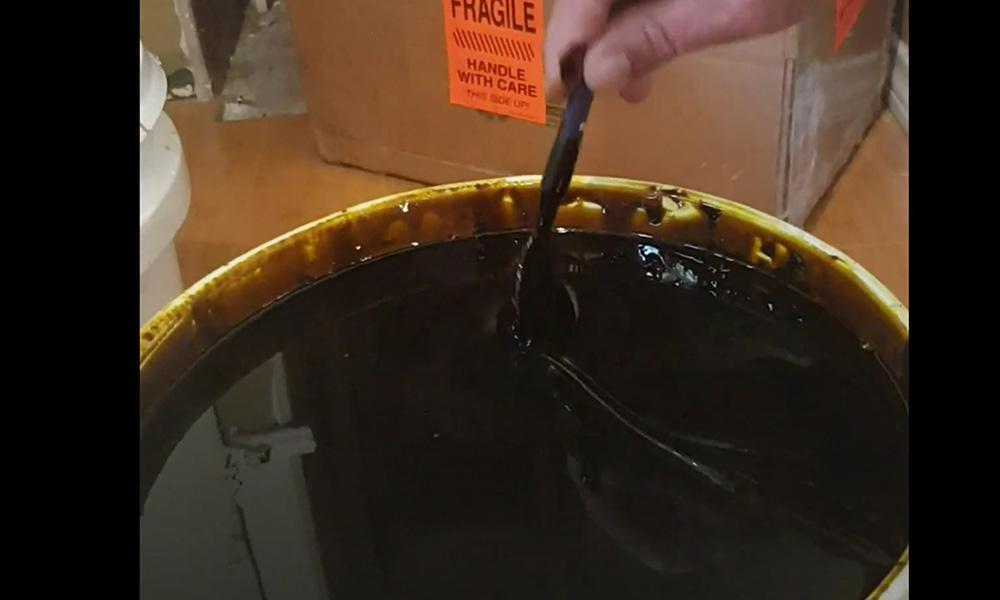
According to traditional market logic, escalating geopolitical conflicts in the Middle East, especially military actions directly impacting Iran, a core global oil producer, would rapidly increase oil price risk premiums, often leading to a single-day surge of over 5% in Brent crude. However, the market reaction this time was extremely calm, even showing a slight pullback.
Behind this unusual trend lies a complex interplay of bullish and bearish factors in the oil market. Is the foundation of the crude oil bull market crumbling, or is it merely a temporary consolidation driven by "buy the rumor, sell the fact"? This article analyzes the core logic from multiple dimensions, including geopolitics, supply and demand, macroeconomics, and technology.
Geopolitical risk repricing: Military strikes become mere bargaining chips, and risk premiums quickly diminish.
The core reason why oil prices did not rise due to geopolitical conflicts is that the market has already repriced the situation in the Middle East. Multiple sources confirm that Israel and Iran reached a preliminary consensus this week through third-party channels, agreeing to temporarily suspend direct military attacks against each other.
Meanwhile, US President Trump publicly stated that peace talks between the US and Iran have entered the "final stage" and are highly likely to achieve substantial progress within the next two weeks, repeatedly emphasizing that a peace agreement is "within reach." This series of signals has completely reversed the market's pessimistic expectations for this round of conflict.
Investors no longer view Israel's military strikes as the start of a full-scale war, but rather as a tactical maneuver to increase their bargaining power on the eve of peace talks. Historically, this scenario is quite common in the oil market: geopolitical conflicts trigger short-term panic and drive up oil prices, but once signals of peace talks are released and the risks subside, prices quickly fall back, absorbing the premium.
Current market trading behavior has shifted significantly, with fund managers and speculators massively closing out previously established long positions in crude oil, awaiting substantial progress in subsequent peace negotiations. Trump's diplomatic strategy has further stabilized market sentiment, tacitly approving Israeli military action while actively promoting US-Iran dialogue, creating a market consensus that the conflict is "controllable and will not escalate fully." As long as the peace talks do not completely break down, oil prices are unlikely to maintain a sustained upward trend.
Demand continues to weaken: Global crude oil demand is sluggish, significantly weakening demand support.
Besides the easing of geopolitical risks, weak global crude oil demand is the core fundamental factor putting downward pressure on oil prices. As the world's largest crude oil importer, China's purchasing data directly influences the demand tone of the international oil market. Currently, domestic refinery operating rates are low, leading to a significant contraction in crude oil purchases to meet immediate needs.
Meanwhile, domestic crude oil procurement strategies further suppressed market demand. Faced with high crude oil prices driven by tensions in the Middle East, Chinese buyers generally opted to deplete existing inventories and avoid purchasing high-priced spot goods, thus avoiding the stockpiling seen in previous geopolitical conflicts.
Furthermore, China's ample strategic petroleum reserves (SPR) provide a strong buffer. During the earlier period of low prices, China completed a large-scale stockpiling of crude oil reserves, and the current reserve surplus is sufficient to reduce immediate imports, further offsetting potential supply gaps on the global side and depriving the oil market of support from rising demand.
Supply-side easing: OPEC+ continues to increase production, resulting in ample global crude oil supply.
Echoing the weak demand, the global crude oil supply has gradually eased, completely alleviating market anxieties about shortages. Since 2026, the OPEC+ alliance has continued to relax its previous production cut agreement, and in July it further increased crude oil production quotas, continuously releasing incremental crude oil into the global market.
The core objective of OPEC+'s production increase is to regain global crude oil market share and offset the competitive pressure from non-OPEC oil-producing countries such as US shale oil producers. Even though the current geopolitical conflicts in the Middle East have slightly affected production capacity in some regions, core OPEC+ oil-producing countries such as Saudi Arabia and the UAE still have ample spare capacity and have clearly stated that they can increase production at any time to stabilize the global oil market.
Coupled with persistently high US crude oil production and stable overall supply, even with short-term shipping disruptions in the Strait of Hormuz, the total amount of globally available and tradable crude oil remains ample. This ample supply fundamentals directly limit any potential upward movement in oil prices, becoming a significant factor putting downward pressure on prices.
Potential risks remain: The "Sword of Damocles" hanging over the Strait of Hormuz.
It is important to be wary that the current weak oil price trend is not stable, the bearish logic is extremely fragile, and sudden geopolitical events could trigger a violent reversal in oil prices at any time.
As a crucial choke point for global energy, the Strait of Hormuz handles approximately 20% of the world's crude oil shipments. A prolonged blockade of the strait and disruption of transport would have a catastrophic impact on the global energy supply chain. Currently, Iran and Israel have only reached a temporary ceasefire agreement, and Iran retains the option of strong retaliation.
If Iran retaliates with asymmetric measures, including attacks on international oil tankers, drone strikes on key Middle Eastern oil facilities, or a sudden breakdown in US-Iran peace talks and a renewed escalation of the conflict, oil prices will rebound rapidly, likely surging to above $98-$100 in the short term. Historically, whenever tensions in the Strait of Hormuz escalate, oil prices have frequently surged by more than 20% within a few days, and the market has not yet fully priced in this tail risk.
Macroeconomic variables are coming: US CPI data may trigger sharp fluctuations in oil prices.
The US May CPI data released on June 10 is a key macroeconomic catalyst that will dominate short-term oil price trends and may completely break the current narrow range of fluctuations.
Driven by earlier geopolitical conflicts in the Middle East that pushed up energy prices, the market generally expects the upcoming US CPI data to be strong, with the energy component being the main driver of the increase. If the core CPI, excluding food and energy, also exceeds expectations, it will strengthen market expectations that the Federal Reserve will maintain high interest rates and postpone rate cuts.
This expectation will exert double pressure on dollar-denominated crude oil: on the one hand, high interest rate expectations will support a stronger dollar, suppressing commodity prices; on the other hand, the high interest rate environment will further slow the pace of global economic recovery, exacerbating market concerns about weakening oil demand. Conversely, if the CPI data is released moderately and market risk appetite recovers, it will provide support for a rebound in oil prices. Overall, crude oil volatility will rise sharply before and after the CPI data release, and the 0.3%-0.5% month-on-month fluctuation should be closely monitored.
Technical Analysis: The market is mainly in a range-bound trading pattern, with a stalemate between bulls and bears.
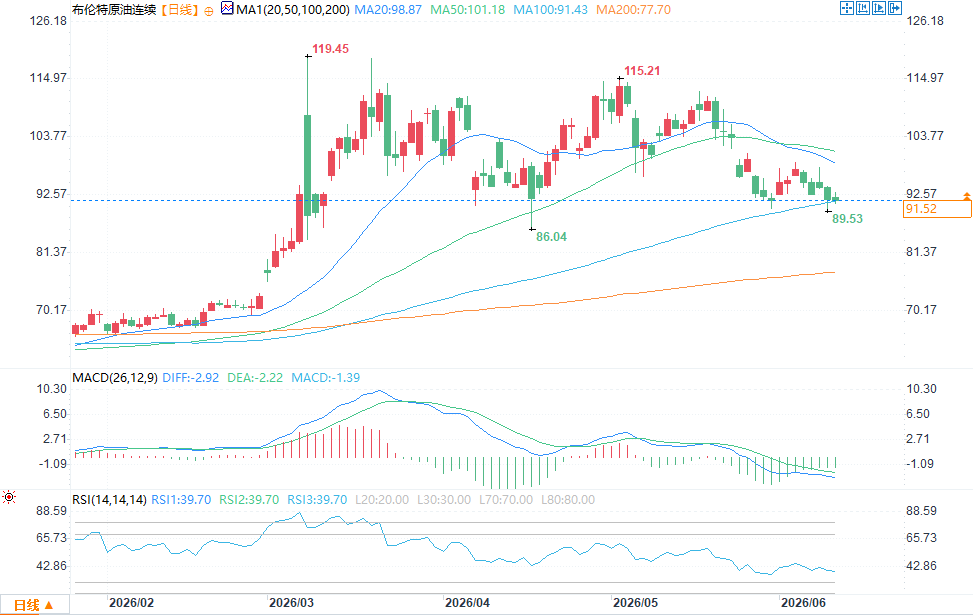
(Brent crude oil daily chart source: FX678)
From a technical perspective, Brent crude oil is currently in a typical range-bound market, with no clear trend direction for bulls or bears, and key price levels are clear and well-defined.
The key short-term resistance level is $95. A sustained move above this level would likely see oil prices test $98, while the medium- to long-term resistance zone is concentrated around the previous high of $100-$102. The key short-term support level is $89.50. A break below this level would likely lead to a rapid decline to $87, or even further down to lower psychological levels.
From a technical perspective, the RSI indicator is in the neutral range, with no obvious overbought or oversold conditions; the MACD indicator shows that the upward momentum of crude oil continues to weaken, but the Bollinger Band middle line provides effective support for oil prices. The overall trend is judged to be short-term range-bound trading, with geopolitical risks providing a floor in the medium term.
In terms of trading strategy, to adapt to the current volatile pattern, it is recommended to adopt a range trading model: try long positions with small positions near support levels, reduce positions and short to hedge near resistance levels, and at the same time strictly set stop loss to control the risk of single trades and avoid the risk of extreme market conditions under high volatility.
Market Outlook and Risk Warning: Consolidation and Accumulation, Beware of Extreme Two-Way Market Conditions
In summary, the current decline in oil prices does not represent a complete collapse of the bull market logic for crude oil, but rather a short-term equilibrium formed after the offsetting of three negative factors—cooling geopolitical tensions, weak demand, and ample supply—with tail-end geopolitical risks.
The market outlook is polarized between bulls and bears: In the short term, if the US-Iran talks continue and achieve substantial breakthroughs, the geopolitical risk premium will be completely cleared, and oil prices will likely fall back to the $85-90 range. In the medium to long term, shipping risks in the Strait of Hormuz, potential Iranian retaliation, and uncertainties surrounding the global energy transition collectively form a bottom support for oil prices, limiting downside potential. If both sides break the ceasefire and the conflict escalates again, oil prices will quickly return above $100.
For ordinary investors, in the current highly volatile and mixed market environment, three core principles should be followed: First, maintain flexible positions and avoid heavy one-sided betting; second, closely monitor real-time news, paying close attention to geopolitical signals such as statements from the US and official developments from Iran; third, make comprehensive judgments from multiple dimensions, combining cross-analysis of the US dollar index, global stock market trends, and supply and demand data; and fourth, make good use of hedging tools, using derivatives such as options to resist the risk of extreme volatility.
The oil market is never a simple supply and demand market, but rather a complex interplay of geopolitics, economic cycles, monetary policy, and energy supply and demand. The current calm fluctuations around $93 are merely a preparatory phase for a new trend. Investors need to remain cautiously optimistic, closely monitor developments, strictly manage risks, and calmly navigate volatile oil price movements.
According to traditional market logic, escalating geopolitical conflicts in the Middle East, especially military actions directly impacting Iran, a core global oil producer, would rapidly increase oil price risk premiums, often leading to a single-day surge of over 5% in Brent crude. However, the market reaction this time was extremely calm, even showing a slight pullback.
Behind this unusual trend lies a complex interplay of bullish and bearish factors in the oil market. Is the foundation of the crude oil bull market crumbling, or is it merely a temporary consolidation driven by "buy the rumor, sell the fact"? This article analyzes the core logic from multiple dimensions, including geopolitics, supply and demand, macroeconomics, and technology.
Geopolitical risk repricing: Military strikes become mere bargaining chips, and risk premiums quickly diminish.
The core reason why oil prices did not rise due to geopolitical conflicts is that the market has already repriced the situation in the Middle East. Multiple sources confirm that Israel and Iran reached a preliminary consensus this week through third-party channels, agreeing to temporarily suspend direct military attacks against each other.
Meanwhile, US President Trump publicly stated that peace talks between the US and Iran have entered the "final stage" and are highly likely to achieve substantial progress within the next two weeks, repeatedly emphasizing that a peace agreement is "within reach." This series of signals has completely reversed the market's pessimistic expectations for this round of conflict.
Investors no longer view Israel's military strikes as the start of a full-scale war, but rather as a tactical maneuver to increase their bargaining power on the eve of peace talks. Historically, this scenario is quite common in the oil market: geopolitical conflicts trigger short-term panic and drive up oil prices, but once signals of peace talks are released and the risks subside, prices quickly fall back, absorbing the premium.
Current market trading behavior has shifted significantly, with fund managers and speculators massively closing out previously established long positions in crude oil, awaiting substantial progress in subsequent peace negotiations. Trump's diplomatic strategy has further stabilized market sentiment, tacitly approving Israeli military action while actively promoting US-Iran dialogue, creating a market consensus that the conflict is "controllable and will not escalate fully." As long as the peace talks do not completely break down, oil prices are unlikely to maintain a sustained upward trend.
Demand continues to weaken: Global crude oil demand is sluggish, significantly weakening demand support.
Besides the easing of geopolitical risks, weak global crude oil demand is the core fundamental factor putting downward pressure on oil prices. As the world's largest crude oil importer, China's purchasing data directly influences the demand tone of the international oil market. Currently, domestic refinery operating rates are low, leading to a significant contraction in crude oil purchases to meet immediate needs.
Meanwhile, domestic crude oil procurement strategies further suppressed market demand. Faced with high crude oil prices driven by tensions in the Middle East, Chinese buyers generally opted to deplete existing inventories and avoid purchasing high-priced spot goods, thus avoiding the stockpiling seen in previous geopolitical conflicts.
Furthermore, China's ample strategic petroleum reserves (SPR) provide a strong buffer. During the earlier period of low prices, China completed a large-scale stockpiling of crude oil reserves, and the current reserve surplus is sufficient to reduce immediate imports, further offsetting potential supply gaps on the global side and depriving the oil market of support from rising demand.
Supply-side easing: OPEC+ continues to increase production, resulting in ample global crude oil supply.
Echoing the weak demand, the global crude oil supply has gradually eased, completely alleviating market anxieties about shortages. Since 2026, the OPEC+ alliance has continued to relax its previous production cut agreement, and in July it further increased crude oil production quotas, continuously releasing incremental crude oil into the global market.
The core objective of OPEC+'s production increase is to regain global crude oil market share and offset the competitive pressure from non-OPEC oil-producing countries such as US shale oil producers. Even though the current geopolitical conflicts in the Middle East have slightly affected production capacity in some regions, core OPEC+ oil-producing countries such as Saudi Arabia and the UAE still have ample spare capacity and have clearly stated that they can increase production at any time to stabilize the global oil market.
Coupled with persistently high US crude oil production and stable overall supply, even with short-term shipping disruptions in the Strait of Hormuz, the total amount of globally available and tradable crude oil remains ample. This ample supply fundamentals directly limit any potential upward movement in oil prices, becoming a significant factor putting downward pressure on prices.
Potential risks remain: The "Sword of Damocles" hanging over the Strait of Hormuz.
It is important to be wary that the current weak oil price trend is not stable, the bearish logic is extremely fragile, and sudden geopolitical events could trigger a violent reversal in oil prices at any time.
As a crucial choke point for global energy, the Strait of Hormuz handles approximately 20% of the world's crude oil shipments. A prolonged blockade of the strait and disruption of transport would have a catastrophic impact on the global energy supply chain. Currently, Iran and Israel have only reached a temporary ceasefire agreement, and Iran retains the option of strong retaliation.
If Iran retaliates with asymmetric measures, including attacks on international oil tankers, drone strikes on key Middle Eastern oil facilities, or a sudden breakdown in US-Iran peace talks and a renewed escalation of the conflict, oil prices will rebound rapidly, likely surging to above $98-$100 in the short term. Historically, whenever tensions in the Strait of Hormuz escalate, oil prices have frequently surged by more than 20% within a few days, and the market has not yet fully priced in this tail risk.
Macroeconomic variables are coming: US CPI data may trigger sharp fluctuations in oil prices.
The US May CPI data released on June 10 is a key macroeconomic catalyst that will dominate short-term oil price trends and may completely break the current narrow range of fluctuations.
Driven by earlier geopolitical conflicts in the Middle East that pushed up energy prices, the market generally expects the upcoming US CPI data to be strong, with the energy component being the main driver of the increase. If the core CPI, excluding food and energy, also exceeds expectations, it will strengthen market expectations that the Federal Reserve will maintain high interest rates and postpone rate cuts.
This expectation will exert double pressure on dollar-denominated crude oil: on the one hand, high interest rate expectations will support a stronger dollar, suppressing commodity prices; on the other hand, the high interest rate environment will further slow the pace of global economic recovery, exacerbating market concerns about weakening oil demand. Conversely, if the CPI data is released moderately and market risk appetite recovers, it will provide support for a rebound in oil prices. Overall, crude oil volatility will rise sharply before and after the CPI data release, and the 0.3%-0.5% month-on-month fluctuation should be closely monitored.
Technical Analysis: The market is mainly in a range-bound trading pattern, with a stalemate between bulls and bears.
(Brent crude oil daily chart source: FX678)
From a technical perspective, Brent crude oil is currently in a typical range-bound market, with no clear trend direction for bulls or bears, and key price levels are clear and well-defined.
The key short-term resistance level is $95. A sustained move above this level would likely see oil prices test $98, while the medium- to long-term resistance zone is concentrated around the previous high of $100-$102. The key short-term support level is $89.50. A break below this level would likely lead to a rapid decline to $87, or even further down to lower psychological levels.
From a technical perspective, the RSI indicator is in the neutral range, with no obvious overbought or oversold conditions; the MACD indicator shows that the upward momentum of crude oil continues to weaken, but the Bollinger Band middle line provides effective support for oil prices. The overall trend is judged to be short-term range-bound trading, with geopolitical risks providing a floor in the medium term.
In terms of trading strategy, to adapt to the current volatile pattern, it is recommended to adopt a range trading model: try long positions with small positions near support levels, reduce positions and short to hedge near resistance levels, and at the same time strictly set stop loss to control the risk of single trades and avoid the risk of extreme market conditions under high volatility.
Market Outlook and Risk Warning: Consolidation and Accumulation, Beware of Extreme Two-Way Market Conditions
In summary, the current decline in oil prices does not represent a complete collapse of the bull market logic for crude oil, but rather a short-term equilibrium formed after the offsetting of three negative factors—cooling geopolitical tensions, weak demand, and ample supply—with tail-end geopolitical risks.
The market outlook is polarized between bulls and bears: In the short term, if the US-Iran talks continue and achieve substantial breakthroughs, the geopolitical risk premium will be completely cleared, and oil prices will likely fall back to the $85-90 range. In the medium to long term, shipping risks in the Strait of Hormuz, potential Iranian retaliation, and uncertainties surrounding the global energy transition collectively form a bottom support for oil prices, limiting downside potential. If both sides break the ceasefire and the conflict escalates again, oil prices will quickly return above $100.
For ordinary investors, in the current highly volatile and mixed market environment, three core principles should be followed: First, maintain flexible positions and avoid heavy one-sided betting; second, closely monitor real-time news, paying close attention to geopolitical signals such as statements from the US and official developments from Iran; third, make comprehensive judgments from multiple dimensions, combining cross-analysis of the US dollar index, global stock market trends, and supply and demand data; and fourth, make good use of hedging tools, using derivatives such as options to resist the risk of extreme volatility.
The oil market is never a simple supply and demand market, but rather a complex interplay of geopolitics, economic cycles, monetary policy, and energy supply and demand. The current calm fluctuations around $93 are merely a preparatory phase for a new trend. Investors need to remain cautiously optimistic, closely monitor developments, strictly manage risks, and calmly navigate volatile oil price movements.
- Risk Warning and Disclaimer
- The market involves risk, and trading may not be suitable for all investors. This article is for reference only and does not constitute personal investment advice, nor does it take into account certain users’ specific investment objectives, financial situation, or other needs. Any investment decisions made based on this information are at your own risk.