Analysts: Historical data highly correlates with the current bull market; future gold prices could be three times higher than they are now.
2026-06-11 10:46:08
International gold prices have recently experienced a sharp correction, with the short-term plunge causing many investors to worry about the end of the bull market. However, experienced precious metals analysts point out that this round of price declines is merely a phase adjustment within an upward cycle. The current gold market trend highly overlaps with the epic bull market of the 1970s, and the long-term upward logic has not collapsed. Coupled with deep-seated supporting factors such as the global monetary system and debt structure, the medium- to long-term bull market for gold remains solid, and the short-term pullback actually presents an opportunity for investment.
The gold market has experienced a volatile year. At the beginning of the year, gold prices surged, breaking historical highs to reach $5,600 per ounce, marking the best performance in history. However, after this surge, gold weakened continuously, entering a months-long downward trend. Last Friday, after breaking below the key long-term support level of the 200-day moving average, the selling pressure accelerated significantly. Currently, spot gold is holding above $4,000 per ounce, having fallen by approximately 5.5% this week.
From a historical perspective, the current gold price correction has been relatively mild, far less than the 30% drop during the 2008 financial crisis and the 28% drop during the 2020 pandemic, falling within a reasonable recovery range. However, the rapid short-term decline still raises strong doubts about the sustainability of the gold bull market.
Jeff Clark, a senior precious metals analyst, founder and publisher of The Gold Advisor, and editor-in-chief of a well-known gold investment newsletter, offered a fresh perspective in a professional interview, providing an in-depth analysis of historical market trends. He stated that he compared the current gold bull market with the legendary bull market of 1976-1980, calculating a 95% correlation coefficient between the two periods, indicating that their price movements were almost perfectly replicated.
Clark stated that during the gold bull market of the 1970s, there was a period of rapid and sharp decline followed by a strong rebound and new highs. The current gold price movement is completely replicating this pattern. Based on historical trends, after this round of gold price adjustment, a new round of significant gains is highly likely, with prices potentially nearly tripling from current levels, mirroring the surge of the 1970s super bull market.
From a cyclical perspective, the current gold bull market is far shorter than the historical average. Clark added that if the current rally were to end now, this bull market would be the shortest in modern gold history, completely contrary to historical patterns. Based on cycle calculations, this bull market is expected to continue for at least two more years, and the current pullback presents a rare entry opportunity . He himself has already significantly increased his gold holdings.
Gold prices have been under pressure recently, primarily due to overseas inflation and changing expectations regarding the Federal Reserve's policy. The situation in the Middle East has led to a sharp rise in global energy prices, increasing inflation risks. The recently released US CPI data shows that overall US inflation rose to 4.2% year-on-year in May, while core inflation was 2.9%, highlighting inflation stickiness. This has led the market to anticipate that the Federal Reserve may tighten monetary policy and begin raising interest rates, directly suppressing gold prices.
Clark believes the market is overly focused on short-term inflation and the negative impact of interest rate hikes, while ignoring deeper economic risks. He states that continued interest rate hikes will severely damage the already fragile US economy, and coupled with the continued rise in US government debt interest payments, the Federal Reserve's room for further rate increases is extremely limited. If the downside risks to the economy intensify, the Federal Reserve will eventually abandon tightening and shift to easing, paving the way for rising gold prices.
Overall, rising inflation and increasing expectations of interest rate hikes are short-term factors suppressing gold prices, while the flaws in the global fiat currency system, high sovereign debt, and persistent geopolitical uncertainty are the core long-term logic supporting the gold bull market. The current gold price correction is a normal fluctuation within a historical bull market; the trend has not reversed. Supported by both cyclical and fundamental factors, gold still has ample room for medium- to long-term upward movement.
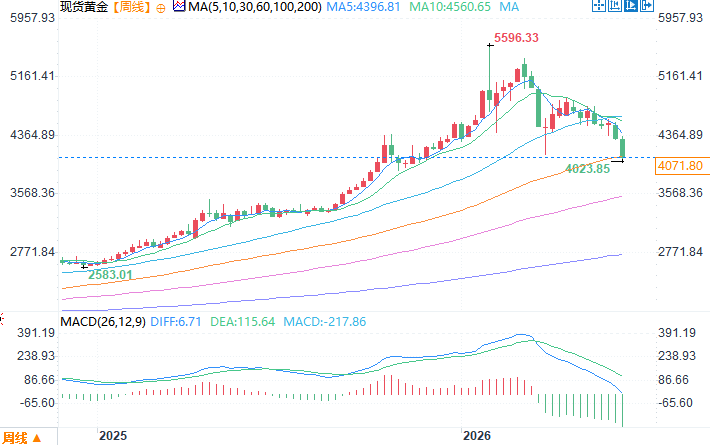
Spot gold weekly chart source: EasyForex
At 10:45 AM Beijing time on June 11, spot gold was trading at $4059.80 per ounce.
Gold prices experienced a sharp short-term correction, and market panic spread.
The gold market has experienced a volatile year. At the beginning of the year, gold prices surged, breaking historical highs to reach $5,600 per ounce, marking the best performance in history. However, after this surge, gold weakened continuously, entering a months-long downward trend. Last Friday, after breaking below the key long-term support level of the 200-day moving average, the selling pressure accelerated significantly. Currently, spot gold is holding above $4,000 per ounce, having fallen by approximately 5.5% this week.
From a historical perspective, the current gold price correction has been relatively mild, far less than the 30% drop during the 2008 financial crisis and the 28% drop during the 2020 pandemic, falling within a reasonable recovery range. However, the rapid short-term decline still raises strong doubts about the sustainability of the gold bull market.
Historical trends have largely overlapped, and this bull market still has room to rise.
Jeff Clark, a senior precious metals analyst, founder and publisher of The Gold Advisor, and editor-in-chief of a well-known gold investment newsletter, offered a fresh perspective in a professional interview, providing an in-depth analysis of historical market trends. He stated that he compared the current gold bull market with the legendary bull market of 1976-1980, calculating a 95% correlation coefficient between the two periods, indicating that their price movements were almost perfectly replicated.
Clark stated that during the gold bull market of the 1970s, there was a period of rapid and sharp decline followed by a strong rebound and new highs. The current gold price movement is completely replicating this pattern. Based on historical trends, after this round of gold price adjustment, a new round of significant gains is highly likely, with prices potentially nearly tripling from current levels, mirroring the surge of the 1970s super bull market.
From a cyclical perspective, the current gold bull market is far shorter than the historical average. Clark added that if the current rally were to end now, this bull market would be the shortest in modern gold history, completely contrary to historical patterns. Based on cycle calculations, this bull market is expected to continue for at least two more years, and the current pullback presents a rare entry opportunity . He himself has already significantly increased his gold holdings.
Short-term negative factors are suppressing gold prices, while long-term support remains solid.
Gold prices have been under pressure recently, primarily due to overseas inflation and changing expectations regarding the Federal Reserve's policy. The situation in the Middle East has led to a sharp rise in global energy prices, increasing inflation risks. The recently released US CPI data shows that overall US inflation rose to 4.2% year-on-year in May, while core inflation was 2.9%, highlighting inflation stickiness. This has led the market to anticipate that the Federal Reserve may tighten monetary policy and begin raising interest rates, directly suppressing gold prices.
Clark believes the market is overly focused on short-term inflation and the negative impact of interest rate hikes, while ignoring deeper economic risks. He states that continued interest rate hikes will severely damage the already fragile US economy, and coupled with the continued rise in US government debt interest payments, the Federal Reserve's room for further rate increases is extremely limited. If the downside risks to the economy intensify, the Federal Reserve will eventually abandon tightening and shift to easing, paving the way for rising gold prices.
Summarize
Overall, rising inflation and increasing expectations of interest rate hikes are short-term factors suppressing gold prices, while the flaws in the global fiat currency system, high sovereign debt, and persistent geopolitical uncertainty are the core long-term logic supporting the gold bull market. The current gold price correction is a normal fluctuation within a historical bull market; the trend has not reversed. Supported by both cyclical and fundamental factors, gold still has ample room for medium- to long-term upward movement.
Spot gold weekly chart source: EasyForex
At 10:45 AM Beijing time on June 11, spot gold was trading at $4059.80 per ounce.
- Risk Warning and Disclaimer
- The market involves risk, and trading may not be suitable for all investors. This article is for reference only and does not constitute personal investment advice, nor does it take into account certain users’ specific investment objectives, financial situation, or other needs. Any investment decisions made based on this information are at your own risk.