Brent crude oil briefly broke through $95: Geopolitical risk premium shifted from the Hormuz to the Caspian Sea, and the divergence between gold and oil prices serves as a warning.
2026-06-11 14:20:30
On Thursday (June 11) during the Asian session, the crude oil market opened with a clear buying-driven pattern, but the information conveyed by the price movement was far more complex than a simple "rebound in risk appetite".
Brent crude oil prices briefly broke through $95 per barrel and are currently trading around $93.60 per barrel; WTI crude oil prices rose and then fell back, rising more than 3% to around $93.50 per barrel and are currently trading around $90.60 per barrel. The risk premium implied in Brent crude oil prices is no longer the vague "fear of war," but rather a disconnect between physical flows and financial positions.
Geopolitical risk premiums have shifted from the Strait of Hormuz to pipeline corridors in the Caspian Sea and refinery gates in Northwest Europe.

For months, the market has been pricing in a binary outcome: either a major supply disruption in the Middle East or a diplomatic solution.
This binary logic is now outdated. Risk premiums have been dispersed into localized bottleneck constraints.
Brent crude's price above $94.50 reflects three distinct levels of premium: a premium of $2.50 to $3.00 per barrel due to uncertainty surrounding the Black Sea transit; a premium of $1.50 to $2.00 per barrel due to force majeure events at key Nigerian export terminals, resulting in a premium based on crude grade spreads; and a further premium of $0.80 to $1.20 per barrel due to the continued possibility of escalation in the Red Sea. These premiums are not simply added together, but rather compounded through refining margins.
The Brent-WTI spread has narrowed to about $3 from around $4 the previous week. This narrowing is not due to converging fundamentals, but rather to differences in premium composition. WTI's rise is largely a function of declining US inventories and the end of refinery maintenance, while Brent bears the full weight of the fragility of the non-OPEC+ supply chain. The transatlantic arbitrage window is closing, which has a significant impact on European diesel crack spreads.
Gas-diesel crack spreads widened by 12% month-on-month, and the Brent-Dubai EFS spread broadened to $1.45 per barrel. This is the key transmission mechanism: when Brent carries a geopolitical premium that Dubai crude lacks, Asian refiners turn to Middle Eastern sour crude, forcing Atlantic basin crude to chase a shrinking pool of European buyers. The result is a self-reinforcing Brent buying spree, decoupled from global demand signals.
Brent crude oil is currently in a high-level consolidation phase with a slight downward bias on the daily chart. In terms of moving averages, the price has broken below the 20-day and 50-day moving averages, and short-term moving averages are turning downwards, indicating an overall signal of short-term weakness but a still bullish medium-term bias.
At key price levels, support lies in the 89.53-86.04 range, while resistance is concentrated around 98-101. Recently, prices have been fluctuating narrowly around $94, with intense competition between bulls and bears, and a clear trend has yet to emerge.
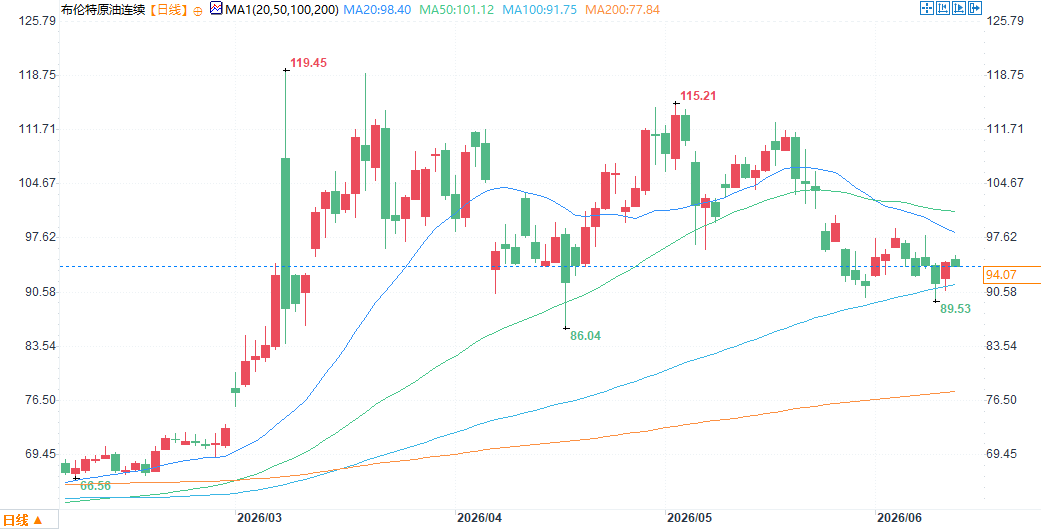
(Brent crude oil futures daily chart, source: FX678)
The precious metals sector is sending warning signals. Spot gold has fallen to around $4,070 per ounce, while spot silver is trading around $63.50 per ounce. This is not a safe-haven rotation—but rather a liquidation event in the precious metals market, which is typically correlated with crude oil movements under geopolitical pressure. This divergence suggests that the buying in crude oil is not a broad inflow of safe-haven funds, but rather a supply panic specific to commodities.
The US dollar index remained stable, with the euro trading around 1.1545 against the dollar and the dollar around 160.50 against the yen, neither providing support for crude oil. The dollar fell to around 1.3935 against the Canadian dollar, the only exchange rate signal aligned with crude oil buying, reflecting the boost to the Canadian dollar from rising WTI crude.
The new risk premium geographic pattern is anchored to specific supply chain nodes. The CPC pipeline, which transports Kazakh crude oil to the Black Sea, remains the most vulnerable. The 10-day maintenance window in July has been priced in by the market, but the risk of unplanned production stoppages due to drone activity in the region has not yet been factored in.
Based on the skewness of Brent call options with a strike price of $100, the market is currently pricing in a 15% to 18% probability of a 500,000 barrel per day supply disruption in the corridor within the next 30 days.
The Forkados export terminal in Nigeria has been hit by force majeure, resulting in the removal of approximately 250,000 barrels per day of light, sweet crude oil from the Atlantic basin. This grade of crude is crucial for European refineries, which have shifted to Nigerian crude in favor of Russian oil since sanctions were imposed. The Brent-Dubai crude price spread will only normalize once exports from the Forkados terminal resume, a process that is optimistically estimated to take four to six weeks.
Bullish Scenario (35% probability): Black Sea supply disruptions materialize, causing Brent crude to surge to $98-$100 within two weeks. Speculative long positions flood in, spot buyers scramble to purchase, and the risk premium becomes self-fulfilling. WTI lags behind, and the Brent-WTI spread widens again to over $5.
Baseline Scenario (50% probability): No new supply disruptions occur, but the existing premium persists. Brent crude trades in the $92-$97 range, consolidating around $94-$95. The premium gradually diminishes as the market digests tail risks over the next 4-6 weeks.
Bearish Scenario (15% probability): The current risk premium could be eliminated if a diplomatic breakthrough occurs in the Caspian region or if exports resume at the Forcados terminal in Nigeria. Brent crude prices could fall back to the $89-$90 range, and the Brent-WTI spread would narrow to $1.50-$2.00. However, this scenario requires a clear catalyst, and no visible triggers have been observed at present.
At 13:49 Beijing time on June 11, Brent crude oil futures were trading at $93.28 per barrel.
Brent crude oil prices briefly broke through $95 per barrel and are currently trading around $93.60 per barrel; WTI crude oil prices rose and then fell back, rising more than 3% to around $93.50 per barrel and are currently trading around $90.60 per barrel. The risk premium implied in Brent crude oil prices is no longer the vague "fear of war," but rather a disconnect between physical flows and financial positions.
Geopolitical risk premiums have shifted from the Strait of Hormuz to pipeline corridors in the Caspian Sea and refinery gates in Northwest Europe.
The geographical shift of risk premiums: from a single focus to a multi-point distribution
For months, the market has been pricing in a binary outcome: either a major supply disruption in the Middle East or a diplomatic solution.
This binary logic is now outdated. Risk premiums have been dispersed into localized bottleneck constraints.
Brent crude's price above $94.50 reflects three distinct levels of premium: a premium of $2.50 to $3.00 per barrel due to uncertainty surrounding the Black Sea transit; a premium of $1.50 to $2.00 per barrel due to force majeure events at key Nigerian export terminals, resulting in a premium based on crude grade spreads; and a further premium of $0.80 to $1.20 per barrel due to the continued possibility of escalation in the Red Sea. These premiums are not simply added together, but rather compounded through refining margins.
The Brent-WTI spread has narrowed to about $3 from around $4 the previous week. This narrowing is not due to converging fundamentals, but rather to differences in premium composition. WTI's rise is largely a function of declining US inventories and the end of refinery maintenance, while Brent bears the full weight of the fragility of the non-OPEC+ supply chain. The transatlantic arbitrage window is closing, which has a significant impact on European diesel crack spreads.
Refining Profit Feedback Loop: An Underestimated Transmission Mechanism
Gas-diesel crack spreads widened by 12% month-on-month, and the Brent-Dubai EFS spread broadened to $1.45 per barrel. This is the key transmission mechanism: when Brent carries a geopolitical premium that Dubai crude lacks, Asian refiners turn to Middle Eastern sour crude, forcing Atlantic basin crude to chase a shrinking pool of European buyers. The result is a self-reinforcing Brent buying spree, decoupled from global demand signals.
Brent crude oil is currently in a high-level consolidation phase with a slight downward bias on the daily chart. In terms of moving averages, the price has broken below the 20-day and 50-day moving averages, and short-term moving averages are turning downwards, indicating an overall signal of short-term weakness but a still bullish medium-term bias.
At key price levels, support lies in the 89.53-86.04 range, while resistance is concentrated around 98-101. Recently, prices have been fluctuating narrowly around $94, with intense competition between bulls and bears, and a clear trend has yet to emerge.
(Brent crude oil futures daily chart, source: FX678)
Cross-asset verification: The divergence between gold and oil prices sends a warning signal
The precious metals sector is sending warning signals. Spot gold has fallen to around $4,070 per ounce, while spot silver is trading around $63.50 per ounce. This is not a safe-haven rotation—but rather a liquidation event in the precious metals market, which is typically correlated with crude oil movements under geopolitical pressure. This divergence suggests that the buying in crude oil is not a broad inflow of safe-haven funds, but rather a supply panic specific to commodities.
The US dollar index remained stable, with the euro trading around 1.1545 against the dollar and the dollar around 160.50 against the yen, neither providing support for crude oil. The dollar fell to around 1.3935 against the Canadian dollar, the only exchange rate signal aligned with crude oil buying, reflecting the boost to the Canadian dollar from rising WTI crude.
Supply chain node risks: Premiums anchored to specific bottlenecks
The new risk premium geographic pattern is anchored to specific supply chain nodes. The CPC pipeline, which transports Kazakh crude oil to the Black Sea, remains the most vulnerable. The 10-day maintenance window in July has been priced in by the market, but the risk of unplanned production stoppages due to drone activity in the region has not yet been factored in.
Based on the skewness of Brent call options with a strike price of $100, the market is currently pricing in a 15% to 18% probability of a 500,000 barrel per day supply disruption in the corridor within the next 30 days.
The Forkados export terminal in Nigeria has been hit by force majeure, resulting in the removal of approximately 250,000 barrels per day of light, sweet crude oil from the Atlantic basin. This grade of crude is crucial for European refineries, which have shifted to Nigerian crude in favor of Russian oil since sanctions were imposed. The Brent-Dubai crude price spread will only normalize once exports from the Forkados terminal resume, a process that is optimistically estimated to take four to six weeks.
Scenario Outlook and Position Analysis
Bullish Scenario (35% probability): Black Sea supply disruptions materialize, causing Brent crude to surge to $98-$100 within two weeks. Speculative long positions flood in, spot buyers scramble to purchase, and the risk premium becomes self-fulfilling. WTI lags behind, and the Brent-WTI spread widens again to over $5.
Baseline Scenario (50% probability): No new supply disruptions occur, but the existing premium persists. Brent crude trades in the $92-$97 range, consolidating around $94-$95. The premium gradually diminishes as the market digests tail risks over the next 4-6 weeks.
Bearish Scenario (15% probability): The current risk premium could be eliminated if a diplomatic breakthrough occurs in the Caspian region or if exports resume at the Forcados terminal in Nigeria. Brent crude prices could fall back to the $89-$90 range, and the Brent-WTI spread would narrow to $1.50-$2.00. However, this scenario requires a clear catalyst, and no visible triggers have been observed at present.
At 13:49 Beijing time on June 11, Brent crude oil futures were trading at $93.28 per barrel.
- Risk Warning and Disclaimer
- The market involves risk, and trading may not be suitable for all investors. This article is for reference only and does not constitute personal investment advice, nor does it take into account certain users’ specific investment objectives, financial situation, or other needs. Any investment decisions made based on this information are at your own risk.