The Australian dollar weakened against the US dollar as stronger-than-expected US PPI data boosted the dollar, and the Reserve Bank of Australia is expected to keep rates steady next week.
2026-06-12 12:21:37
On Friday (June 12) during the Asian session, the Australian dollar fell to around 0.7035 against the US dollar.
Overnight, the stronger-than-expected US PPI data boosted the US dollar while putting downward pressure on the Australian dollar.
Data released by the U.S. Bureau of Labor Statistics on Thursday showed that the strong performance of the producer price index further confirms that inflationary pressures are building.
The U.S. Producer Price Index (PPI) rose 6.5% year-on-year in May, up from 5.7% in April and exceeding market expectations of 6.4%, reaching its highest level since November 2022. On a month-on-month basis, the PPI rose 1.1% in May, far exceeding market expectations of 0.7%, and significantly accelerating from April's 0.5% increase. This report provides further evidence that the Middle East conflict is pushing up energy product costs, and inflationary pressures are continuing to accumulate.
Looking at the breakdown of data, energy prices were the main driver of the unexpected rise in PPI. In May, the energy component rose 5.2% month-on-month, contributing nearly half of the overall PPI increase.
At the same time, food prices and service costs remained firm, indicating that inflationary pressures are spreading from the energy sector to a wider range of areas. Notably, the core PPI (excluding food and energy) rose 4.8% year-on-year, also higher than the previous figure and market expectations, suggesting that underlying inflationary pressures remain persistent.
According to the CME Group's FedWatch Tool, the market is currently pricing in a 43% probability of a 25-basis-point rate hike in December, compared to about 14% a month ago. This change reflects rising investor expectations that the Fed will maintain high interest rates.
More noteworthy is the rising market expectation of no rate cuts in 2026, with some traders even pricing in the possibility of further rate hikes in 2027.
The better-than-expected performance of the PPI data, coupled with the previously released CPI data returning above 4%, is gradually changing market expectations for the Federal Reserve's policy path—from "when to cut interest rates" to "whether to raise interest rates again."
If inflation data continues to be stubborn in the coming months, the Federal Reserve may be forced to tighten its policy stance again.
The Reserve Bank of Australia (RBA) will announce its next interest rate decision next Tuesday, and market expectations for further rate hikes are cooling. Since February this year, the RBA has raised interest rates three times, totaling 75 basis points, increasing the benchmark cash rate to 4.35% to curb inflationary pressures that had begun to build before the outbreak of the Middle East conflict.
However, the tightening monetary policy has begun to transmit to the real economy—first-quarter GDP growth slowed sharply to 0.3% from 0.9% in the previous quarter, and the unemployment rate climbed to 4.5% in April, the highest level since November 2021. The cooling economic data provides policymakers with breathing room to assess the impact of previous interest rate hikes.
Australia's four major banks all expect the Reserve Bank of Australia (RBA) to keep interest rates unchanged at its upcoming meeting. National Australia Bank has abandoned its previous expectation of an August rate hike, believing that the cash rate has peaked in this cycle and that a rate cut is more likely, although the specific timing remains uncertain. Westpac holds a different view, maintaining its forecast of rate hikes in August and September, predicting rates will rise to 4.85%, but also noting that the risks are skewed towards a smaller tightening cycle—the probability of zero or one rate hike is higher than three. Commonwealth Bank and ANZ believe that 4.35% is the end of this cycle.
Westpac expects the Reserve Bank of Australia to keep interest rates unchanged at its June meeting, but has left open the possibility of further rate hikes in August and September.
The bank lowered its inflation peak forecast from 5.0% to 4.7%, but emphasized that its inflation forecast path remains above the Reserve Bank of Australia's own target, meaning policymakers may face continued upward inflationary pressures.
Westpac also noted that downside risks dominate – if economic data weakens further, the likelihood of zero or one rate hike is higher than three. For the Australian dollar, this means interest rate expectations will be a source of volatility. If a rate hike occurs as expected in August, the Australian dollar may receive short-term support; conversely, if the Reserve Bank of Australia (RBA) signals a clearer pause, the Australian dollar may come under further pressure. The market needs to pay attention to the RBA's wording after next week's meeting.
Rabobank maintains its bullish stance on the Australian dollar in the medium term. The bank notes that the Australian dollar is one of the best-performing G10 currencies in 2026, benefiting from the Reserve Bank of Australia's three rate hikes and its decisive abandonment of dovish guidance. Despite recent weaker domestic economic data suggesting the rate hike cycle may be nearing its peak, Rabobank believes the Australian dollar remains well-positioned from a relative economic fundamentals perspective. The bank expects the RBA to raise rates once more this year, possibly in August.
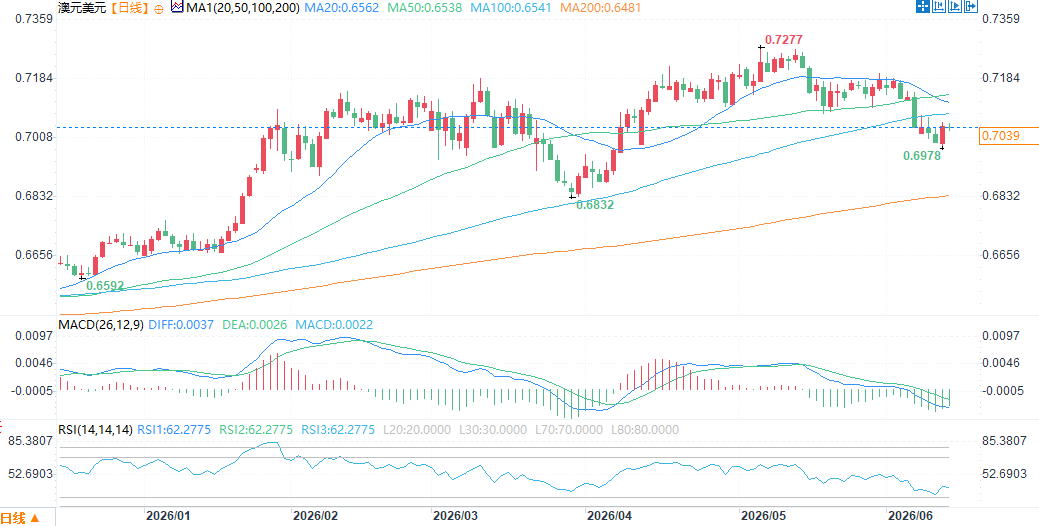
From a daily chart perspective, the Australian dollar against the US dollar previously surged and then retreated, currently in a consolidation phase. The price has broken below the short-term moving average, indicating a weakening short-term upward trend, but it remains above the medium- and long-term moving averages, meaning the overall upward trend has not been reversed. Multiple key support levels exist below, while previous highs pose significant resistance above.
In terms of indicators, the MACD histogram is gradually shrinking, indicating a continued decline in upward momentum. The two lines are showing signs of converging, suggesting an increased risk of a short-term pullback. The RSI indicator has fallen from a high level to the neutral range, indicating a balance between bullish and bearish forces, with no overbought or oversold signals at present.
(AUD/USD daily chart, source: FX678)
Overall, the better-than-expected US PPI data strengthened market expectations that the Federal Reserve would maintain high interest rates, providing support for the US dollar; while the expectation that the Reserve Bank of Australia would hold rates steady next week left the Australian dollar lacking upward momentum. These two factors combined put significant pressure on the Australian dollar against the US dollar in the short term.
Market focus will shift to the US consumer confidence data later in the day and the Reserve Bank of Australia's interest rate decision next week; any unexpected signals could trigger volatility in the Australian dollar.
At 12:21 Beijing time on June 12, the Australian dollar was trading at 0.7038/39 against the US dollar.
Overnight, the stronger-than-expected US PPI data boosted the US dollar while putting downward pressure on the Australian dollar.
Data released by the U.S. Bureau of Labor Statistics on Thursday showed that the strong performance of the producer price index further confirms that inflationary pressures are building.
US PPI saw its biggest increase in three and a half years, fueling expectations of an interest rate hike.
The U.S. Producer Price Index (PPI) rose 6.5% year-on-year in May, up from 5.7% in April and exceeding market expectations of 6.4%, reaching its highest level since November 2022. On a month-on-month basis, the PPI rose 1.1% in May, far exceeding market expectations of 0.7%, and significantly accelerating from April's 0.5% increase. This report provides further evidence that the Middle East conflict is pushing up energy product costs, and inflationary pressures are continuing to accumulate.
Looking at the breakdown of data, energy prices were the main driver of the unexpected rise in PPI. In May, the energy component rose 5.2% month-on-month, contributing nearly half of the overall PPI increase.
At the same time, food prices and service costs remained firm, indicating that inflationary pressures are spreading from the energy sector to a wider range of areas. Notably, the core PPI (excluding food and energy) rose 4.8% year-on-year, also higher than the previous figure and market expectations, suggesting that underlying inflationary pressures remain persistent.
According to the CME Group's FedWatch Tool, the market is currently pricing in a 43% probability of a 25-basis-point rate hike in December, compared to about 14% a month ago. This change reflects rising investor expectations that the Fed will maintain high interest rates.
More noteworthy is the rising market expectation of no rate cuts in 2026, with some traders even pricing in the possibility of further rate hikes in 2027.
The better-than-expected performance of the PPI data, coupled with the previously released CPI data returning above 4%, is gradually changing market expectations for the Federal Reserve's policy path—from "when to cut interest rates" to "whether to raise interest rates again."
If inflation data continues to be stubborn in the coming months, the Federal Reserve may be forced to tighten its policy stance again.
The Reserve Bank of Australia will hold its interest rate meeting next week, and the market expects it to remain unchanged.
The Reserve Bank of Australia (RBA) will announce its next interest rate decision next Tuesday, and market expectations for further rate hikes are cooling. Since February this year, the RBA has raised interest rates three times, totaling 75 basis points, increasing the benchmark cash rate to 4.35% to curb inflationary pressures that had begun to build before the outbreak of the Middle East conflict.
However, the tightening monetary policy has begun to transmit to the real economy—first-quarter GDP growth slowed sharply to 0.3% from 0.9% in the previous quarter, and the unemployment rate climbed to 4.5% in April, the highest level since November 2021. The cooling economic data provides policymakers with breathing room to assess the impact of previous interest rate hikes.
Australia's four major banks all expect the Reserve Bank of Australia (RBA) to keep interest rates unchanged at its upcoming meeting. National Australia Bank has abandoned its previous expectation of an August rate hike, believing that the cash rate has peaked in this cycle and that a rate cut is more likely, although the specific timing remains uncertain. Westpac holds a different view, maintaining its forecast of rate hikes in August and September, predicting rates will rise to 4.85%, but also noting that the risks are skewed towards a smaller tightening cycle—the probability of zero or one rate hike is higher than three. Commonwealth Bank and ANZ believe that 4.35% is the end of this cycle.
Institutional Views
Westpac expects the Reserve Bank of Australia to keep interest rates unchanged at its June meeting, but has left open the possibility of further rate hikes in August and September.
The bank lowered its inflation peak forecast from 5.0% to 4.7%, but emphasized that its inflation forecast path remains above the Reserve Bank of Australia's own target, meaning policymakers may face continued upward inflationary pressures.
Westpac also noted that downside risks dominate – if economic data weakens further, the likelihood of zero or one rate hike is higher than three. For the Australian dollar, this means interest rate expectations will be a source of volatility. If a rate hike occurs as expected in August, the Australian dollar may receive short-term support; conversely, if the Reserve Bank of Australia (RBA) signals a clearer pause, the Australian dollar may come under further pressure. The market needs to pay attention to the RBA's wording after next week's meeting.
Rabobank maintains its bullish stance on the Australian dollar in the medium term. The bank notes that the Australian dollar is one of the best-performing G10 currencies in 2026, benefiting from the Reserve Bank of Australia's three rate hikes and its decisive abandonment of dovish guidance. Despite recent weaker domestic economic data suggesting the rate hike cycle may be nearing its peak, Rabobank believes the Australian dollar remains well-positioned from a relative economic fundamentals perspective. The bank expects the RBA to raise rates once more this year, possibly in August.
Technical Analysis
From a daily chart perspective, the Australian dollar against the US dollar previously surged and then retreated, currently in a consolidation phase. The price has broken below the short-term moving average, indicating a weakening short-term upward trend, but it remains above the medium- and long-term moving averages, meaning the overall upward trend has not been reversed. Multiple key support levels exist below, while previous highs pose significant resistance above.
In terms of indicators, the MACD histogram is gradually shrinking, indicating a continued decline in upward momentum. The two lines are showing signs of converging, suggesting an increased risk of a short-term pullback. The RSI indicator has fallen from a high level to the neutral range, indicating a balance between bullish and bearish forces, with no overbought or oversold signals at present.
(AUD/USD daily chart, source: FX678)
Conclusion: The strong US dollar and the Reserve Bank of Australia's wait-and-see attitude are both putting downward pressure on the Australian dollar.
Overall, the better-than-expected US PPI data strengthened market expectations that the Federal Reserve would maintain high interest rates, providing support for the US dollar; while the expectation that the Reserve Bank of Australia would hold rates steady next week left the Australian dollar lacking upward momentum. These two factors combined put significant pressure on the Australian dollar against the US dollar in the short term.
Market focus will shift to the US consumer confidence data later in the day and the Reserve Bank of Australia's interest rate decision next week; any unexpected signals could trigger volatility in the Australian dollar.
At 12:21 Beijing time on June 12, the Australian dollar was trading at 0.7038/39 against the US dollar.
- Risk Warning and Disclaimer
- The market involves risk, and trading may not be suitable for all investors. This article is for reference only and does not constitute personal investment advice, nor does it take into account certain users’ specific investment objectives, financial situation, or other needs. Any investment decisions made based on this information are at your own risk.