Trump's words sent the dollar plummeting! US-Iran talks and European and Japanese interest rate hikes are all intertwined; next week will be even more volatile.
2026-06-13 16:29:50
Over the past week, the global foreign exchange market has experienced significant volatility, torn between geopolitical turmoil in the Middle East and expectations surrounding major central bank monetary policies. While the US dollar index briefly surged to a near two-month high following strong non-farm payroll data on Friday, risk aversion has been on a rollercoaster ride as the conflict between Iran and Israel first eased, then escalated, and finally showed signs of a peace agreement. Meanwhile, US inflation data met expectations, slightly reducing market bets on aggressive rate hikes by the Federal Reserve, while the European Central Bank proceeded with its expected rate hike, and the Bank of Japan is at a crossroads between intervention and rate increases. With a "super central bank week" approaching, forex traders are carefully weighing every variable.
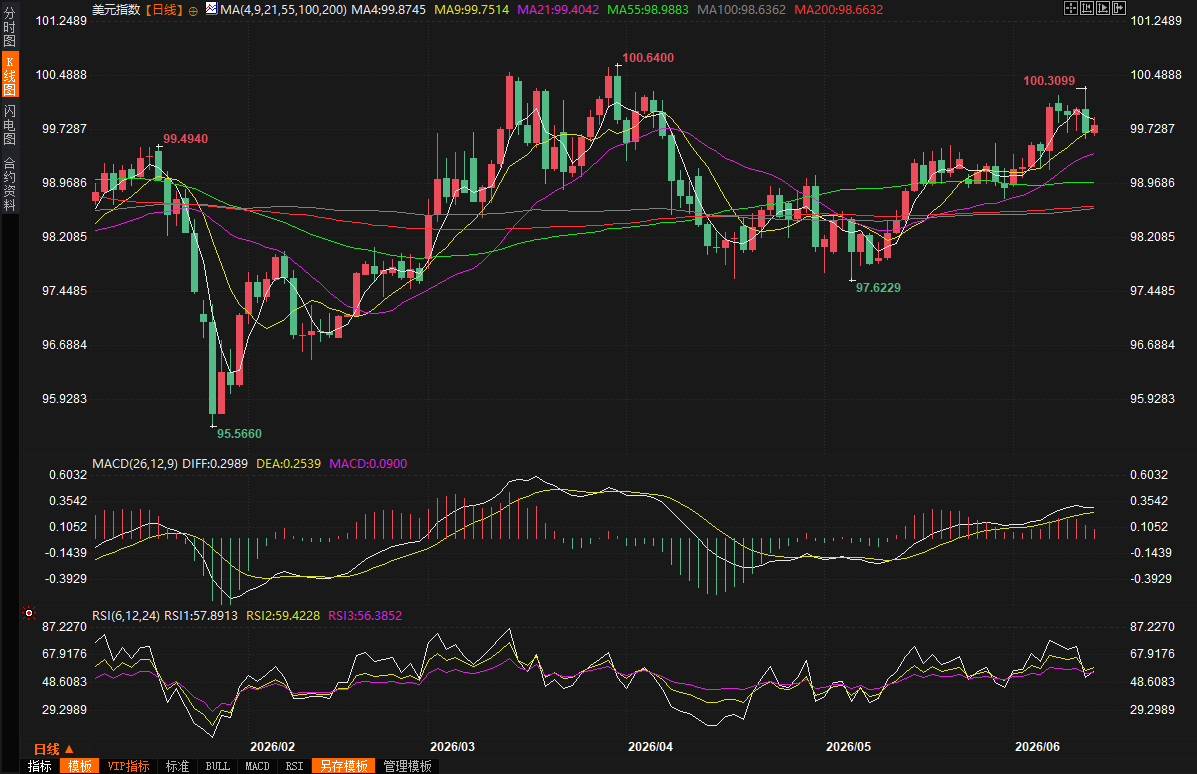
At the start of this week, the US dollar continued its strong performance from the previous weekend. The much stronger-than-expected US non-farm payroll data for May, released last Friday, immediately triggered a chain reaction in the market. Traders quickly increased their bets on a Federal Reserve rate hike this year; according to the CME Group's FedWatch tool, the market expects the probability of a rate hike before the end of October to have climbed to around 40%. This shift in expectations directly boosted the dollar, with the dollar index reaching its highest point since April 6th at 100.21 on Monday, just shy of a two-month high.
Meanwhile, adjustments in investor positioning also reflect this shift in expectations. According to weekly data from the Federal Reserve, the day before the non-farm payrolls report was released, investors had already reduced their euro long positions to a three-month low, while significantly increasing their short bets on the yen, with these short positions exceeding $10 billion. The market is clearly preparing for a further widening of the interest rate divergence between the US and Europe.
However, geopolitical news quickly injected new uncertainty into the foreign exchange market. Following President Trump's appeal, Iran and Israel agreed on Monday (June 8th) to cease attacks on each other, temporarily easing market concerns about a full-blown escalation of the situation in the Middle East. Investors began to turn their attention to other currencies that had previously suffered setbacks; the dollar retreated slightly from its highs, while the euro and pound sterling both saw modest rebounds.
But this calm didn't last long. On Tuesday (June 9), a U.S. Apache helicopter was shot down near the Strait of Hormuz, prompting Trump to vow retaliation and escalating tensions again. More worryingly, Israel attacked the historic southern Lebanese city of Tyre on Tuesday, killing at least eight people. This series of escalating conflicts deepened doubts about the prospects for peace, and the dollar quickly narrowed its earlier losses.
Amo Sahota, Managing Director of Klarity FX, commented that the market has seen a strange calm regarding the Iranian conflict, with both sides trying to avoid a major escalation, especially Trump's desire to prevent a surge in oil prices. However, it is precisely this volatile situation that keeps forex traders on their toes. When tensions escalate, the US dollar, with its safe-haven asset characteristics and the relatively low resilience of the US economy to energy shocks, continues to attract inflows; conversely, once peace expectations rise, funds quickly flow into risk assets, putting pressure on the dollar.
U.S. inflation data released on Wednesday (June 10) provided new clues for the market. The Consumer Price Index (CPI) rose 4.2% year-on-year in May, the largest increase since April 2023, but this figure was entirely in line with economists' expectations. More importantly, core inflation did not accelerate as widely feared by the market, indicating that soaring energy prices have not yet been transmitted to key indicators monitored by the Federal Reserve.
This result brought a sigh of relief to the market. Karl Schamotta, chief market strategist at Corpay in Toronto, noted that traders are beginning to prepare for a more neutral statement from Federal Reserve officials at next week's meeting and have slightly lowered their expectations for a rate hike before the end of the year. Short-term Treasury traders have gradually reduced their bets on a September rate hike, although they remain convinced of the possibility of a rate hike before the end of October. Surveys also show that the vast majority of economists believe the Fed will keep interest rates unchanged for the remainder of 2026.
In a report, Jason Pride, Head of Investment Strategy and Research at Glenmede, emphasized that three months after the surge in energy costs, core commodity prices have not seen a substantial transmission of these costs. This is the most explicit data point in the report, indicating that although the Iranian impact was significant in gas station prices, it did not evolve into a widespread wave of inflation. This assessment has, to some extent, weakened the momentum for further dollar appreciation.
Thursday (June 11) witnessed the most dramatic moment of the week in the foreign exchange market. Trump initially stated that the United States would launch a "very powerful strike against Iran," leading the market to believe that a full-scale war was imminent. However, he then called off the airstrikes at the last minute, citing progress in negotiations and stating that talks with Tehran were moving towards an agreement, with a peace agreement possibly being signed as early as this weekend.
This sudden shift immediately reversed the foreign exchange market. The US dollar fell sharply against major currencies, with the dollar index briefly touching a near one-week low of 99.64. Marc Chandler, chief market strategist at Bannockburn Global Forex, analyzed that the market's reaction to this type of news is as usual: increased risk exposure, which means buying stocks and risk assets, and selling the dollar is an inevitable part of this. All three major Wall Street stock indexes closed higher that day, with the Nasdaq surging 2.5%, while the 10-year US Treasury yield fell 8.7 basis points to 4.453%.
The euro reversed its earlier losses against the dollar on Thursday, rising 0.42% to around $1.1580, thanks to the European Central Bank's announcement of its first interest rate hike in three years on the same day. The dollar fell 0.68% against the Swiss franc to 0.7948 on Thursday, ending a four-day winning streak. Spot gold surged 3.35% to $4209.81 per ounce, reflecting the market's high sensitivity to geopolitical news.
Among major currency pairs, the euro and the yen were particularly noteworthy this week. The European Central Bank (ECB) announced a 25-basis-point rate hike on Thursday, its first since 2021, aimed at curbing energy inflation triggered by the war with Iran. Markets widely expect the ECB to raise rates again in September, as it struggles to balance energy-driven inflation with a weak economy. Kit Juckes, chief FX strategist at Societe Generale, noted that if the ECB hints that this rate hike might be a "one-off," it won't solve the euro's problems. Nevertheless, the euro still recorded a weekly gain, closing near $1.1570.
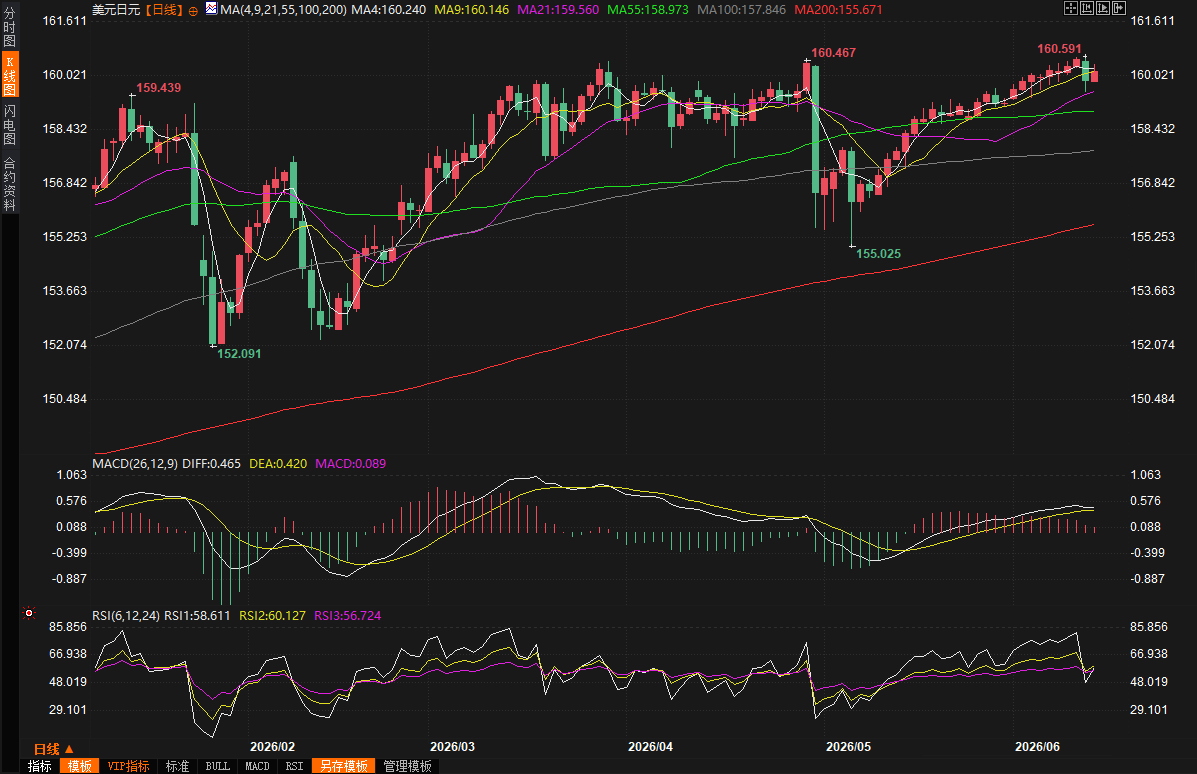
The yen continues to struggle near the 160 level. It has given back most of the gains made after Japan's intervention about a month ago, with the dollar/yen pair briefly touching 160.59 this week, its highest level since July 2024. The market generally views 160 as a psychological threshold that could trigger official intervention. Japanese authorities reiterated this week that they would take decisive action to curb the yen's excessive depreciation, but these verbal warnings have failed to pull the yen away from danger.
The market has fully priced in the Bank of Japan's (BOJ) expected rate hike at its June 16 policy meeting, meaning that even if the hike materializes, it's unlikely to trigger a significant reversal in the yen's value. IG Markets analyst Tony Sycamore stated that this would require BOJ Governor Kazuo Ueda to make hawkish comments, hinting at a possible move to September for the next rate hike instead of December, and a third hike before the end of the year. However, Ueda will be absent from the meeting due to hospitalization, with Deputy Governor Shinichi Uchida hosting the post-meeting press conference. Rakuten Securities Research Institute Chief Economist Nobuyasu Atago pointed out that while Uchida is considered one of the more dovish members of the committee, he may try to project a more hawkish image to avoid triggering an unwelcome yen depreciation.
Looking ahead to next week, the foreign exchange market will usher in a true "super central bank week." The Federal Reserve will chair its first meeting since Warsh took over as chairman, with the market widely expecting interest rates to remain unchanged at 3.5% to 3.75%, although traders believe the probability of a rate hike before the end of the year remains above 50%. The Bank of Japan is expected to raise interest rates to a 31-year high, and the market will closely watch Shinichi Uchida's remarks at the press conference. The Bank of England, the Reserve Bank of Australia, the Swedish central bank, the Swiss National Bank, and the Norwegian central bank will also hold policy meetings, all of which are expected to hold rates steady.
Westpac analysts wrote in a report that the latest developments, including Trump's cancellation of the planned strikes against Iran and hints at a possible agreement, weighed on the US dollar, causing the Australian dollar to strengthen against the US dollar and other major currencies. However, if the Strait of Hormuz truly reopens, oil prices are likely to fall sharply, thereby reducing inflationary pressures from energy and easing pressure on central banks to raise interest rates. This means that next week's central bank decisions and geopolitical news will continue to be deeply intertwined, jointly determining the direction of the foreign exchange market.
Overall, while the US dollar held steady on Friday, it still recorded a weekly decline, ending its previous upward trend. The market is currently in a delicate balance: on the one hand, strong US employment data and relatively robust inflation continue to support expectations of a Fed rate hike this year; on the other hand, the volatile situation in the Middle East makes investors hesitant to bet on a single direction. Meanwhile, Trump's comments about a possible imminent peace agreement between the US and Iran have opened up room for a rebound in risk assets. With a super central bank week approaching, volatility in the foreign exchange market is unlikely to decrease quickly, as traders are holding their breath awaiting the latest signals from a series of central bank meetings next week.
Non-farm payrolls data fuels interest rate hike expectations, dollar starts strong.
At the start of this week, the US dollar continued its strong performance from the previous weekend. The much stronger-than-expected US non-farm payroll data for May, released last Friday, immediately triggered a chain reaction in the market. Traders quickly increased their bets on a Federal Reserve rate hike this year; according to the CME Group's FedWatch tool, the market expects the probability of a rate hike before the end of October to have climbed to around 40%. This shift in expectations directly boosted the dollar, with the dollar index reaching its highest point since April 6th at 100.21 on Monday, just shy of a two-month high.
Meanwhile, adjustments in investor positioning also reflect this shift in expectations. According to weekly data from the Federal Reserve, the day before the non-farm payrolls report was released, investors had already reduced their euro long positions to a three-month low, while significantly increasing their short bets on the yen, with these short positions exceeding $10 billion. The market is clearly preparing for a further widening of the interest rate divergence between the US and Europe.
Middle East Situation: From Ceasefire to Renewed Conflict, Risk Aversion Continues to Plunge
However, geopolitical news quickly injected new uncertainty into the foreign exchange market. Following President Trump's appeal, Iran and Israel agreed on Monday (June 8th) to cease attacks on each other, temporarily easing market concerns about a full-blown escalation of the situation in the Middle East. Investors began to turn their attention to other currencies that had previously suffered setbacks; the dollar retreated slightly from its highs, while the euro and pound sterling both saw modest rebounds.
But this calm didn't last long. On Tuesday (June 9), a U.S. Apache helicopter was shot down near the Strait of Hormuz, prompting Trump to vow retaliation and escalating tensions again. More worryingly, Israel attacked the historic southern Lebanese city of Tyre on Tuesday, killing at least eight people. This series of escalating conflicts deepened doubts about the prospects for peace, and the dollar quickly narrowed its earlier losses.
Amo Sahota, Managing Director of Klarity FX, commented that the market has seen a strange calm regarding the Iranian conflict, with both sides trying to avoid a major escalation, especially Trump's desire to prevent a surge in oil prices. However, it is precisely this volatile situation that keeps forex traders on their toes. When tensions escalate, the US dollar, with its safe-haven asset characteristics and the relatively low resilience of the US economy to energy shocks, continues to attract inflows; conversely, once peace expectations rise, funds quickly flow into risk assets, putting pressure on the dollar.
Easing CPI data eases concerns about interest rate hikes, putting further pressure on the US dollar.
U.S. inflation data released on Wednesday (June 10) provided new clues for the market. The Consumer Price Index (CPI) rose 4.2% year-on-year in May, the largest increase since April 2023, but this figure was entirely in line with economists' expectations. More importantly, core inflation did not accelerate as widely feared by the market, indicating that soaring energy prices have not yet been transmitted to key indicators monitored by the Federal Reserve.
This result brought a sigh of relief to the market. Karl Schamotta, chief market strategist at Corpay in Toronto, noted that traders are beginning to prepare for a more neutral statement from Federal Reserve officials at next week's meeting and have slightly lowered their expectations for a rate hike before the end of the year. Short-term Treasury traders have gradually reduced their bets on a September rate hike, although they remain convinced of the possibility of a rate hike before the end of October. Surveys also show that the vast majority of economists believe the Fed will keep interest rates unchanged for the remainder of 2026.
In a report, Jason Pride, Head of Investment Strategy and Research at Glenmede, emphasized that three months after the surge in energy costs, core commodity prices have not seen a substantial transmission of these costs. This is the most explicit data point in the report, indicating that although the Iranian impact was significant in gas station prices, it did not evolve into a widespread wave of inflation. This assessment has, to some extent, weakened the momentum for further dollar appreciation.
A glimmer of hope for peace appears, and the US dollar suffers a sharp decline.
Thursday (June 11) witnessed the most dramatic moment of the week in the foreign exchange market. Trump initially stated that the United States would launch a "very powerful strike against Iran," leading the market to believe that a full-scale war was imminent. However, he then called off the airstrikes at the last minute, citing progress in negotiations and stating that talks with Tehran were moving towards an agreement, with a peace agreement possibly being signed as early as this weekend.
This sudden shift immediately reversed the foreign exchange market. The US dollar fell sharply against major currencies, with the dollar index briefly touching a near one-week low of 99.64. Marc Chandler, chief market strategist at Bannockburn Global Forex, analyzed that the market's reaction to this type of news is as usual: increased risk exposure, which means buying stocks and risk assets, and selling the dollar is an inevitable part of this. All three major Wall Street stock indexes closed higher that day, with the Nasdaq surging 2.5%, while the 10-year US Treasury yield fell 8.7 basis points to 4.453%.
The euro reversed its earlier losses against the dollar on Thursday, rising 0.42% to around $1.1580, thanks to the European Central Bank's announcement of its first interest rate hike in three years on the same day. The dollar fell 0.68% against the Swiss franc to 0.7948 on Thursday, ending a four-day winning streak. Spot gold surged 3.35% to $4209.81 per ounce, reflecting the market's high sensitivity to geopolitical news.
Euro and Japanese Yen: Each Moving Independently
Among major currency pairs, the euro and the yen were particularly noteworthy this week. The European Central Bank (ECB) announced a 25-basis-point rate hike on Thursday, its first since 2021, aimed at curbing energy inflation triggered by the war with Iran. Markets widely expect the ECB to raise rates again in September, as it struggles to balance energy-driven inflation with a weak economy. Kit Juckes, chief FX strategist at Societe Generale, noted that if the ECB hints that this rate hike might be a "one-off," it won't solve the euro's problems. Nevertheless, the euro still recorded a weekly gain, closing near $1.1570.
The yen continues to struggle near the 160 level. It has given back most of the gains made after Japan's intervention about a month ago, with the dollar/yen pair briefly touching 160.59 this week, its highest level since July 2024. The market generally views 160 as a psychological threshold that could trigger official intervention. Japanese authorities reiterated this week that they would take decisive action to curb the yen's excessive depreciation, but these verbal warnings have failed to pull the yen away from danger.
The market has fully priced in the Bank of Japan's (BOJ) expected rate hike at its June 16 policy meeting, meaning that even if the hike materializes, it's unlikely to trigger a significant reversal in the yen's value. IG Markets analyst Tony Sycamore stated that this would require BOJ Governor Kazuo Ueda to make hawkish comments, hinting at a possible move to September for the next rate hike instead of December, and a third hike before the end of the year. However, Ueda will be absent from the meeting due to hospitalization, with Deputy Governor Shinichi Uchida hosting the post-meeting press conference. Rakuten Securities Research Institute Chief Economist Nobuyasu Atago pointed out that while Uchida is considered one of the more dovish members of the committee, he may try to project a more hawkish image to avoid triggering an unwelcome yen depreciation.
Ahead of the Super Central Bank Week: Markets Hold Their Breath
Looking ahead to next week, the foreign exchange market will usher in a true "super central bank week." The Federal Reserve will chair its first meeting since Warsh took over as chairman, with the market widely expecting interest rates to remain unchanged at 3.5% to 3.75%, although traders believe the probability of a rate hike before the end of the year remains above 50%. The Bank of Japan is expected to raise interest rates to a 31-year high, and the market will closely watch Shinichi Uchida's remarks at the press conference. The Bank of England, the Reserve Bank of Australia, the Swedish central bank, the Swiss National Bank, and the Norwegian central bank will also hold policy meetings, all of which are expected to hold rates steady.
Westpac analysts wrote in a report that the latest developments, including Trump's cancellation of the planned strikes against Iran and hints at a possible agreement, weighed on the US dollar, causing the Australian dollar to strengthen against the US dollar and other major currencies. However, if the Strait of Hormuz truly reopens, oil prices are likely to fall sharply, thereby reducing inflationary pressures from energy and easing pressure on central banks to raise interest rates. This means that next week's central bank decisions and geopolitical news will continue to be deeply intertwined, jointly determining the direction of the foreign exchange market.
Summarize
Overall, while the US dollar held steady on Friday, it still recorded a weekly decline, ending its previous upward trend. The market is currently in a delicate balance: on the one hand, strong US employment data and relatively robust inflation continue to support expectations of a Fed rate hike this year; on the other hand, the volatile situation in the Middle East makes investors hesitant to bet on a single direction. Meanwhile, Trump's comments about a possible imminent peace agreement between the US and Iran have opened up room for a rebound in risk assets. With a super central bank week approaching, volatility in the foreign exchange market is unlikely to decrease quickly, as traders are holding their breath awaiting the latest signals from a series of central bank meetings next week.
- Risk Warning and Disclaimer
- The market involves risk, and trading may not be suitable for all investors. This article is for reference only and does not constitute personal investment advice, nor does it take into account certain users’ specific investment objectives, financial situation, or other needs. Any investment decisions made based on this information are at your own risk.