A sudden reconciliation after three months of US-Iran conflict? Crude oil experienced an extreme rollercoaster ride this week, with Brent crude returning to its March lows.
2026-06-13 11:56:06
This week, the international crude oil market experienced significant volatility amidst the turbulent geopolitical conflict between the US, Iran, and Israel. From the missile exchanges between Iran and Israel, to Trump's repeated signals of "fierce strikes" followed by the cancellation of airstrikes, and finally to the positive news of an impending peace memorandum of understanding, oil prices staged a classic rollercoaster ride. Brent crude oil surged to nearly $95 at the beginning of the week before ultimately closing at $87.33, its lowest level since March; US WTI crude oil also fell from around $91 to $84.88. Throughout the week, geopolitical risk premiums rose and then fell, with supply concerns and weak demand intertwined, causing market sentiment to shift repeatedly between anxiety and optimism.

On Monday morning (June 8), the market was shrouded in the shadow of war. Israel launched airstrikes on ballistic missile-related petrochemical facilities in southwestern Iran, and Iran swiftly retaliated by striking similar targets in Haifa, Israel. Earlier over the weekend, Israel also launched airstrikes on Hezbollah strongholds in Beirut, further escalating regional tensions. Investors' concerns about a large-scale, all-out war intensified sharply, pushing oil prices up by more than 5% immediately after the market opened. Brent crude briefly approached its highs, and US WTI crude also followed suit with a significant increase.
Despite Iran and Israel subsequently announcing a cessation of direct attacks on each other at Trump's urging, oil prices closed higher. Brent crude rose $1.16 to $94.25, a gain of 1.3%; WTI crude rose 76 cents to $91.30, a gain of 0.8%. Analysts pointed out that the previous 100-plus days of conflict had caused Brent to rise by about 31% and WTI by 37%, peaking at over $126 in April. Dennis Kissler of BOK Financial stated that the tense atmosphere created by the weekend missile attacks was the main driver of the early morning price increase. The Iranian ambassador also hinted at the possibility of imposing fees on transit through the Strait of Hormuz, further amplifying market concerns about supply disruptions.
Meanwhile, OPEC+ agreed to raise its production target for the fourth time, but the market believes the impact of the increased production will be limited due to actual capacity constraints in most member countries (such as a potential blockade of the Strait of Hormuz or damage to Russian facilities). Saudi Arabia's second consecutive month of lowering its official selling prices to Asia also reflects a certain degree of easing on the supply side.
On Tuesday (June 9), market focus shifted to the positive news of the ceasefire. Iran and Israel suspended direct attacks under Trump's mediation, although Tehran reserved the right to resume operations if Israel continued its attacks on Hezbollah in Lebanon. Oil prices fell by about 3% in response, with Brent crude settling at $91.45 and U.S. crude at $88.20, both hitting multi-week lows. Brent even broke below the important technical support level of the 100-day moving average.
Energy consultancy Ritterbusch and Associates points out that the latest round of clashes between Israel and Iran was resolved with a ceasefire, and Trump's statement that the war could end within two or three days further depressed oil prices. Crude oil imports by a major Asian country plummeted 29% in May to an eight-year low. As the world's largest importer, its weak demand significantly suppressed global oil prices. The U.S. Energy Information Administration (EIA) predicts that, affected by the war with Iran, global oil production will fall to 99 million barrels per day in 2026 (down from a record 106.1 million barrels per day in 2025), and demand will also fall from 104 million barrels per day in 2025 to 102.9 million barrels per day. Countries will draw heavily on their inventories, potentially causing OECD commercial inventories to fall to their lowest level since 2003.
Despite a brief rebound in oil prices following Trump's mention of Iran shooting down a US helicopter and his threat to retaliate, the overall downward trend remains clear.
The situation reversed again on Wednesday (June 10). Trump accused Iran of slow progress in negotiations, threatened to "strike hard" Iran, and indicated that further action might be taken on Wednesday. Oil prices surged, with Brent crude ultimately rising $1.65 to $93.10 and WTI crude rising $1.83 to $90.03, both gains approaching 2%. Late in the session, Trump's mention of the US military secretly escorting over 100 million barrels of oil through the Strait of Hormuz caused some of the gains to be reversed.
Fundamental data provided additional support. EIA data showed that U.S. crude oil inventories fell by 7.2 million barrels last week, far exceeding market expectations of 4 million barrels, as refiners actively filled the supply gap caused by the war. Strategic petroleum reserves are also at low levels, and the U.S. Department of Energy plans to lend up to 40 million barrels to stabilize fuel prices. Phil Flynn of Price Futures Group summarized that the escalating U.S.-Iran conflict has caused oil prices to fluctuate between anxiety and indifference.
On Thursday (June 11), Trump canceled the planned airstrikes against Iran, citing progress in negotiations, which boosted market confidence in ending the more than three-month-long war. Oil prices came under pressure, with Brent crude falling $2.72 to $90.38 and WTI crude falling $2.32 to $87.71. Although Trump had issued a "heavy blow" threat earlier in the day, and Iran announced the temporary closure of the Strait of Hormuz, the US military confirmed that merchant ships were still able to pass through, and the actual risk of disruption had not fully materialized.
Iran's Fars News Agency reported that while the full text of the agreement has not yet been reached, indirect negotiations are accelerating. Indian refiners stated they have stockpiled enough crude oil until August, easing short-term supply concerns.
On the last trading day of the week, market expectations for the imminent signing of a memorandum of understanding between the US and Iran reached a fever pitch. US officials stated that the two sides had reached an agreement on the text, which could be signed as early as Sunday (June 14) in Geneva. Iran's foreign minister indicated that while the agreement might be adjusted, it demonstrated Iran's increased strength in the conflict. Key aspects of the agreement include reopening the Strait of Hormuz, lifting port blockades, and nuclear negotiations will begin within the next 60 days. Israel is not involved in the negotiations.
Brent crude fell $3.05 to $87.33 on Friday (June 12), its lowest level since March, while WTI crude fell $2.83 to $84.88, its lowest level since April. John Kilduff of Again Capital stated that the news of an impending memorandum of understanding with Iran was the main drag on prices. Goldman Sachs lowered its 2027 average Brent price forecast to $80 per barrel, but still expects a safety premium to support oil prices above 2025 levels.
OPEC on Thursday lowered its 2026 global oil demand growth forecast to 970,000 barrels per day from 1.17 million barrels per day, but raised its 2027 forecast to 1.73 million barrels per day, indicating confidence in a long-term consumption rebound.
This week's dramatic fluctuations in crude oil prices fully demonstrate the amplifying effect of geopolitical events on the market. From escalating conflict to ceasefire expectations, and then to the release of agreement signals, oil prices have undergone multiple highs and lows in just five days. Currently, if a peace agreement is successfully signed, the short-term risk premium will further decline; however, after Trump's "core objectives" are achieved, uncertainties remain regarding the implementation details, the reactions of other forces in the Middle East, and the progress of nuclear negotiations.
On the fundamental front, declining demand from major countries, global inventory reduction, and the potential for increased OPEC+ production are creating a stalemate with seasonal demand recovery. Analysts generally believe that upside risks remain—if the agreement is delayed or new conflicts arise, oil prices could rebound quickly; conversely, in a weak supply and demand environment, oil prices may continue to be under pressure and test lower support levels. Investors should closely monitor possible signing news over the weekend, next week's API and EIA inventory reports, and subsequent statements from Trump.
Overall, this week's oil market once again proved that in a geopolitically driven market, any tweet or diplomatic statement can create ripples, while final pricing will still return to the supply and demand fundamentals.
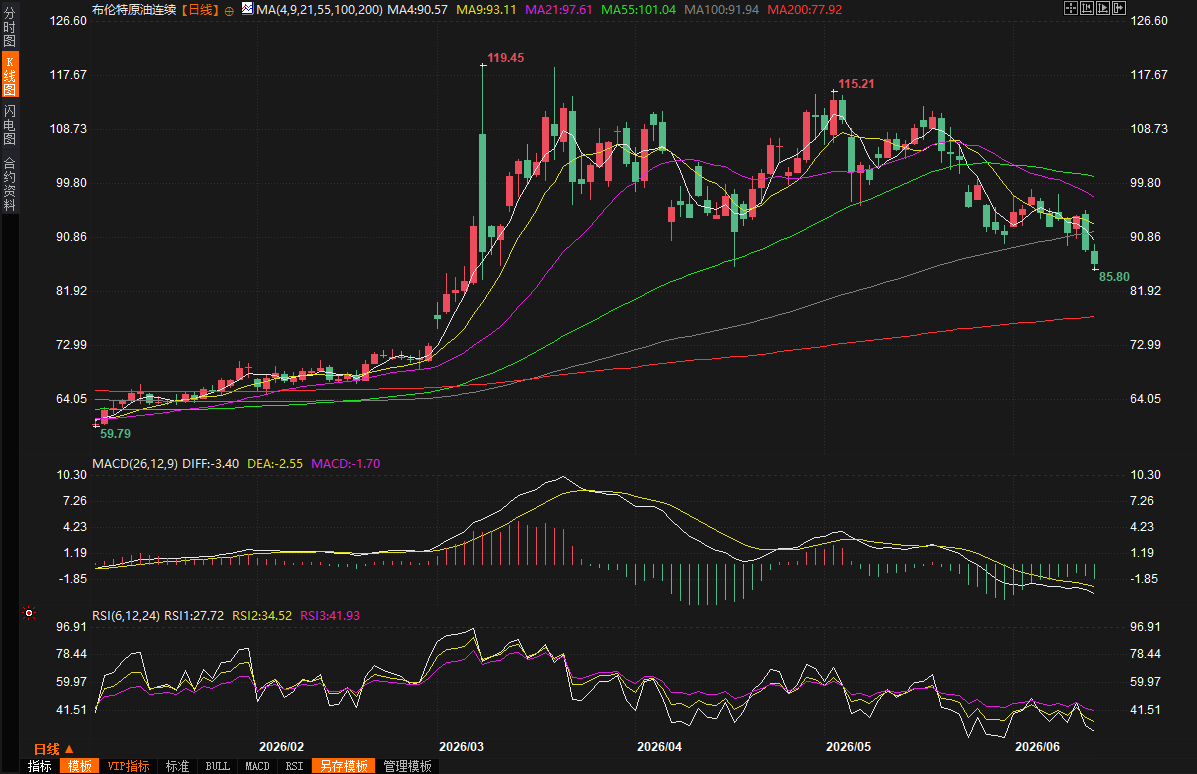
(Brent crude oil daily chart, source: EasyForex)
Conflict escalates early week: Oil prices surge over 5% at one point, geopolitical tensions push up risk premiums.
On Monday morning (June 8), the market was shrouded in the shadow of war. Israel launched airstrikes on ballistic missile-related petrochemical facilities in southwestern Iran, and Iran swiftly retaliated by striking similar targets in Haifa, Israel. Earlier over the weekend, Israel also launched airstrikes on Hezbollah strongholds in Beirut, further escalating regional tensions. Investors' concerns about a large-scale, all-out war intensified sharply, pushing oil prices up by more than 5% immediately after the market opened. Brent crude briefly approached its highs, and US WTI crude also followed suit with a significant increase.
Despite Iran and Israel subsequently announcing a cessation of direct attacks on each other at Trump's urging, oil prices closed higher. Brent crude rose $1.16 to $94.25, a gain of 1.3%; WTI crude rose 76 cents to $91.30, a gain of 0.8%. Analysts pointed out that the previous 100-plus days of conflict had caused Brent to rise by about 31% and WTI by 37%, peaking at over $126 in April. Dennis Kissler of BOK Financial stated that the tense atmosphere created by the weekend missile attacks was the main driver of the early morning price increase. The Iranian ambassador also hinted at the possibility of imposing fees on transit through the Strait of Hormuz, further amplifying market concerns about supply disruptions.
Meanwhile, OPEC+ agreed to raise its production target for the fourth time, but the market believes the impact of the increased production will be limited due to actual capacity constraints in most member countries (such as a potential blockade of the Strait of Hormuz or damage to Russian facilities). Saudi Arabia's second consecutive month of lowering its official selling prices to Asia also reflects a certain degree of easing on the supply side.
Signals of a medium-term ceasefire emerge: Oil prices quickly fall to a seven-week low, with a sharp drop in demand from major countries exacerbating the pressure.
On Tuesday (June 9), market focus shifted to the positive news of the ceasefire. Iran and Israel suspended direct attacks under Trump's mediation, although Tehran reserved the right to resume operations if Israel continued its attacks on Hezbollah in Lebanon. Oil prices fell by about 3% in response, with Brent crude settling at $91.45 and U.S. crude at $88.20, both hitting multi-week lows. Brent even broke below the important technical support level of the 100-day moving average.
Energy consultancy Ritterbusch and Associates points out that the latest round of clashes between Israel and Iran was resolved with a ceasefire, and Trump's statement that the war could end within two or three days further depressed oil prices. Crude oil imports by a major Asian country plummeted 29% in May to an eight-year low. As the world's largest importer, its weak demand significantly suppressed global oil prices. The U.S. Energy Information Administration (EIA) predicts that, affected by the war with Iran, global oil production will fall to 99 million barrels per day in 2026 (down from a record 106.1 million barrels per day in 2025), and demand will also fall from 104 million barrels per day in 2025 to 102.9 million barrels per day. Countries will draw heavily on their inventories, potentially causing OECD commercial inventories to fall to their lowest level since 2003.
Despite a brief rebound in oil prices following Trump's mention of Iran shooting down a US helicopter and his threat to retaliate, the overall downward trend remains clear.
Wednesday's renewed threats and inventory data: Oil prices rebounded by nearly $2, with supply shortages providing support.
The situation reversed again on Wednesday (June 10). Trump accused Iran of slow progress in negotiations, threatened to "strike hard" Iran, and indicated that further action might be taken on Wednesday. Oil prices surged, with Brent crude ultimately rising $1.65 to $93.10 and WTI crude rising $1.83 to $90.03, both gains approaching 2%. Late in the session, Trump's mention of the US military secretly escorting over 100 million barrels of oil through the Strait of Hormuz caused some of the gains to be reversed.
Fundamental data provided additional support. EIA data showed that U.S. crude oil inventories fell by 7.2 million barrels last week, far exceeding market expectations of 4 million barrels, as refiners actively filled the supply gap caused by the war. Strategic petroleum reserves are also at low levels, and the U.S. Department of Energy plans to lend up to 40 million barrels to stabilize fuel prices. Phil Flynn of Price Futures Group summarized that the escalating U.S.-Iran conflict has caused oil prices to fluctuate between anxiety and indifference.
Airstrike plans cancelled on Thursday: Peace expectations rise, oil prices fall again
On Thursday (June 11), Trump canceled the planned airstrikes against Iran, citing progress in negotiations, which boosted market confidence in ending the more than three-month-long war. Oil prices came under pressure, with Brent crude falling $2.72 to $90.38 and WTI crude falling $2.32 to $87.71. Although Trump had issued a "heavy blow" threat earlier in the day, and Iran announced the temporary closure of the Strait of Hormuz, the US military confirmed that merchant ships were still able to pass through, and the actual risk of disruption had not fully materialized.
Iran's Fars News Agency reported that while the full text of the agreement has not yet been reached, indirect negotiations are accelerating. Indian refiners stated they have stockpiled enough crude oil until August, easing short-term supply concerns.
A peace agreement is imminent on Friday: Oil prices fell to their lowest level since March, but upside risks remain.
On the last trading day of the week, market expectations for the imminent signing of a memorandum of understanding between the US and Iran reached a fever pitch. US officials stated that the two sides had reached an agreement on the text, which could be signed as early as Sunday (June 14) in Geneva. Iran's foreign minister indicated that while the agreement might be adjusted, it demonstrated Iran's increased strength in the conflict. Key aspects of the agreement include reopening the Strait of Hormuz, lifting port blockades, and nuclear negotiations will begin within the next 60 days. Israel is not involved in the negotiations.
Brent crude fell $3.05 to $87.33 on Friday (June 12), its lowest level since March, while WTI crude fell $2.83 to $84.88, its lowest level since April. John Kilduff of Again Capital stated that the news of an impending memorandum of understanding with Iran was the main drag on prices. Goldman Sachs lowered its 2027 average Brent price forecast to $80 per barrel, but still expects a safety premium to support oil prices above 2025 levels.
OPEC on Thursday lowered its 2026 global oil demand growth forecast to 970,000 barrels per day from 1.17 million barrels per day, but raised its 2027 forecast to 1.73 million barrels per day, indicating confidence in a long-term consumption rebound.
Market Outlook: Geopolitical risk premiums are fading, and the weak supply and demand situation may continue.
This week's dramatic fluctuations in crude oil prices fully demonstrate the amplifying effect of geopolitical events on the market. From escalating conflict to ceasefire expectations, and then to the release of agreement signals, oil prices have undergone multiple highs and lows in just five days. Currently, if a peace agreement is successfully signed, the short-term risk premium will further decline; however, after Trump's "core objectives" are achieved, uncertainties remain regarding the implementation details, the reactions of other forces in the Middle East, and the progress of nuclear negotiations.
On the fundamental front, declining demand from major countries, global inventory reduction, and the potential for increased OPEC+ production are creating a stalemate with seasonal demand recovery. Analysts generally believe that upside risks remain—if the agreement is delayed or new conflicts arise, oil prices could rebound quickly; conversely, in a weak supply and demand environment, oil prices may continue to be under pressure and test lower support levels. Investors should closely monitor possible signing news over the weekend, next week's API and EIA inventory reports, and subsequent statements from Trump.
Overall, this week's oil market once again proved that in a geopolitically driven market, any tweet or diplomatic statement can create ripples, while final pricing will still return to the supply and demand fundamentals.
(Brent crude oil daily chart, source: EasyForex)
- Risk Warning and Disclaimer
- The market involves risk, and trading may not be suitable for all investors. This article is for reference only and does not constitute personal investment advice, nor does it take into account certain users’ specific investment objectives, financial situation, or other needs. Any investment decisions made based on this information are at your own risk.