Lagarde warned that the energy shock would drive persistent inflation, and the ECB's hawkish stance strengthened expectations of interest rate hikes in the Eurozone.
2026-06-15 16:06:56
The European Central Bank (ECB) has become increasingly wary of inflation risks. ECB President Christine Lagarde recently stated that the impact of rising energy prices is no longer limited to the energy market, but is gradually spreading to broader sectors such as services, manufacturing, and consumer prices. She pointed out that in recent weeks, almost all sectors of the economy have begun to show the indirect effects of inflation, meaning that price pressures may be more persistent than previously expected by the market.

Following significant fluctuations in energy costs caused by conflicts in the Middle East, the European Central Bank (ECB) last week decided to raise its policy rate for the first time since 2023 to prevent rising energy prices from escalating into a broader and longer-term inflation problem. Currently, several ECB policymakers have not ruled out the possibility of further rate hikes at their July meeting. Officials, including Bundesbank President Joachim Nagel, believe that even if the military conflict involving Iran ends quickly, the transmission effects of previous energy price increases could keep inflation high for an extended period.
However, the European Central Bank's continued tightening policy has also raised concerns among some market participants about the economic growth outlook. Higher financing costs could dampen business investment, real estate market activity, and household consumption, especially given the already weak economic growth momentum; further interest rate hikes could increase downward pressure on the economy.
In response, Lagarde acknowledged concerns that interest rate hikes could harm economic growth, particularly criticism from some European countries regarding the risk of an economic slowdown. However, she emphasized that the ECB's core mission is to maintain price stability. If inflation is not controlled in time, further inflationary pressures could lead to more aggressive tightening measures that could have a greater impact on the economy. Therefore, the ECB is likely to maintain a hawkish policy stance until inflation risks have fully subsided.
From a technical perspective, the EUR/USD pair rebounded after a rapid correction on the daily chart, and has now returned to its previous consolidation range. The short-term movement is more of a technical correction after an oversold condition, and no clear trend reversal signal has yet formed. Currently, attention needs to be paid to the subsequent second pullback for confirmation. If the key support area around 1.1540 can be held during the pullback, the EUR/USD pair is likely to maintain its upward-biased trend. Meanwhile, the daily MACD indicator has formed a golden cross again, indicating that the previous bearish momentum is gradually weakening, and the short-term bullish recovery force has strengthened.
From a 4-hour chart perspective, the euro/dollar pair's short-term rebound momentum has improved, but it still faces resistance from the previous densely traded area. If the exchange rate can effectively break through and hold above the key resistance area of 1.1650, it will further open up room for a rebound and push the price towards higher target areas; conversely, if the rebound is blocked and falls below the support of 1.1540, it may re-enter a correction phase, and downside risks should still be noted in the short term.
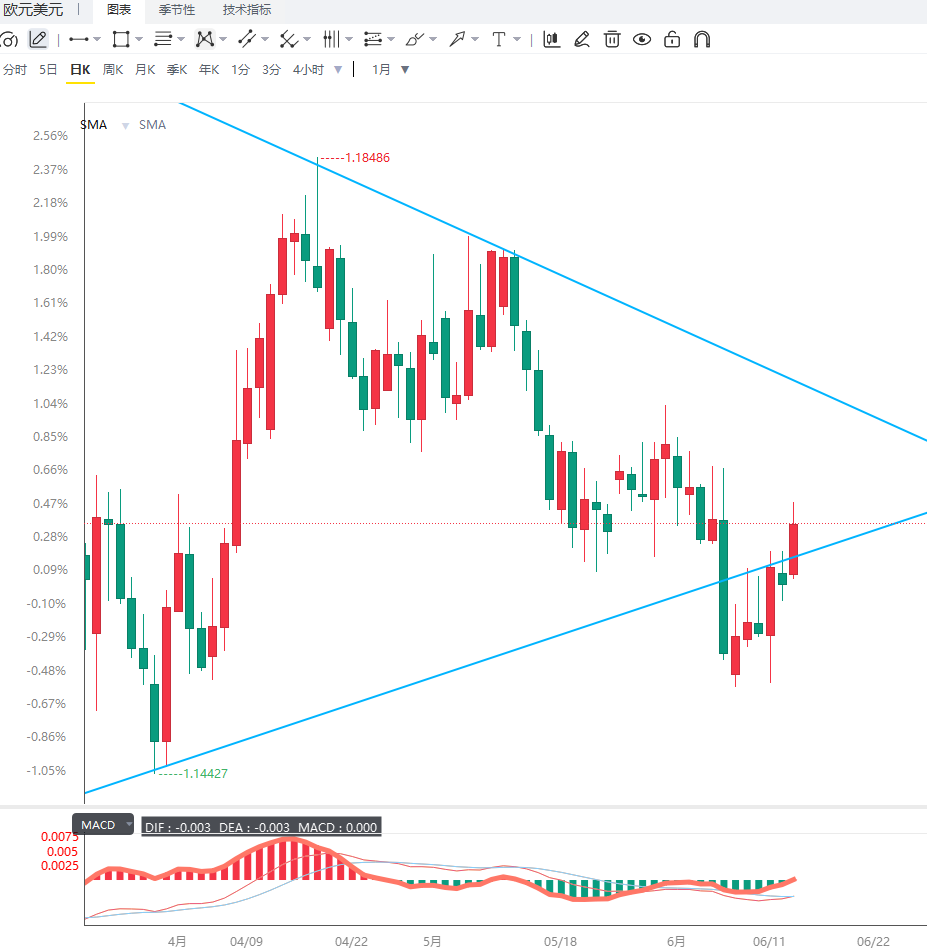
Editor's Summary : Lagarde's latest remarks indicate that the European Central Bank (ECB) remains inclined to maintain a hawkish stance in the face of a second round of inflation risks stemming from energy prices. Rising market expectations for a further rate hike in July provide some fundamental support for the euro. However, from a technical perspective, the current rebound in the euro against the US dollar is still a correction after a decline, and a new upward trend has not yet been confirmed. Going forward, the market will need to focus on the ECB's policy path, Eurozone inflation performance, and whether the exchange rate can break through the key resistance level of 1.1650. If it breaks through successfully, the euro's short-term rebound potential is expected to expand further.
Following significant fluctuations in energy costs caused by conflicts in the Middle East, the European Central Bank (ECB) last week decided to raise its policy rate for the first time since 2023 to prevent rising energy prices from escalating into a broader and longer-term inflation problem. Currently, several ECB policymakers have not ruled out the possibility of further rate hikes at their July meeting. Officials, including Bundesbank President Joachim Nagel, believe that even if the military conflict involving Iran ends quickly, the transmission effects of previous energy price increases could keep inflation high for an extended period.
However, the European Central Bank's continued tightening policy has also raised concerns among some market participants about the economic growth outlook. Higher financing costs could dampen business investment, real estate market activity, and household consumption, especially given the already weak economic growth momentum; further interest rate hikes could increase downward pressure on the economy.
In response, Lagarde acknowledged concerns that interest rate hikes could harm economic growth, particularly criticism from some European countries regarding the risk of an economic slowdown. However, she emphasized that the ECB's core mission is to maintain price stability. If inflation is not controlled in time, further inflationary pressures could lead to more aggressive tightening measures that could have a greater impact on the economy. Therefore, the ECB is likely to maintain a hawkish policy stance until inflation risks have fully subsided.
From a technical perspective, the EUR/USD pair rebounded after a rapid correction on the daily chart, and has now returned to its previous consolidation range. The short-term movement is more of a technical correction after an oversold condition, and no clear trend reversal signal has yet formed. Currently, attention needs to be paid to the subsequent second pullback for confirmation. If the key support area around 1.1540 can be held during the pullback, the EUR/USD pair is likely to maintain its upward-biased trend. Meanwhile, the daily MACD indicator has formed a golden cross again, indicating that the previous bearish momentum is gradually weakening, and the short-term bullish recovery force has strengthened.
From a 4-hour chart perspective, the euro/dollar pair's short-term rebound momentum has improved, but it still faces resistance from the previous densely traded area. If the exchange rate can effectively break through and hold above the key resistance area of 1.1650, it will further open up room for a rebound and push the price towards higher target areas; conversely, if the rebound is blocked and falls below the support of 1.1540, it may re-enter a correction phase, and downside risks should still be noted in the short term.
Editor's Summary : Lagarde's latest remarks indicate that the European Central Bank (ECB) remains inclined to maintain a hawkish stance in the face of a second round of inflation risks stemming from energy prices. Rising market expectations for a further rate hike in July provide some fundamental support for the euro. However, from a technical perspective, the current rebound in the euro against the US dollar is still a correction after a decline, and a new upward trend has not yet been confirmed. Going forward, the market will need to focus on the ECB's policy path, Eurozone inflation performance, and whether the exchange rate can break through the key resistance level of 1.1650. If it breaks through successfully, the euro's short-term rebound potential is expected to expand further.
- Risk Warning and Disclaimer
- The market involves risk, and trading may not be suitable for all investors. This article is for reference only and does not constitute personal investment advice, nor does it take into account certain users’ specific investment objectives, financial situation, or other needs. Any investment decisions made based on this information are at your own risk.