Oil prices initially fell before rising, but geopolitical risks have not completely disappeared – Deutsche Bank's latest report clarifies the current logic behind crude oil prices.
2026-06-19 15:59:10
On Friday (June 19) during the European session, US crude oil futures opened lower but rebounded, currently trading around $76 per barrel.
In its latest research report, Deutsche Bank pointed out that international oil prices have been declining since the signing of the US-Iran memorandum of understanding. The main reason is that investors quickly digested the expected increase in supply brought about by the agreement, and the geopolitical risk premium related to war significantly decreased.
However, this decline did not last long. Following media reports on Wednesday that US Vice President Vance would not depart for Switzerland as originally planned that evening, market sentiment gradually improved, and oil prices saw a significant reversal. This trend reflects investors' complex interpretation of the long-term impact of the agreement: short-term supply recovery is bearish for oil prices, but continued uncertainty in the Middle East situation limited the decline.
Deutsche Bank analysts believe that in the early stages of the agreement signing, a rebound in risk appetite drove funds out of the energy sector, but the schedules of officials such as US Vice President Vance boosted market confidence again.
The report further analyzes that although the agreement paves the way for the reopening of the Strait of Hormuz, the geopolitical premium has not completely disappeared.
The ongoing negotiations on the Iranian nuclear issue, regional proxy forces, and concerns from Israel could still cause volatility in the next 60-day window.
Deutsche Bank expects oil prices to remain volatile at high levels in the short term. Investors should closely monitor the implementation of OPEC+ production cuts, global demand data, and changes in macroeconomic policies in the US, China, and Europe.
The bank suggests that, in the current environment, energy companies can use futures instruments to hedge risks, while it is optimistic about the long-term opportunities in the refining and downstream sectors against the backdrop of supply recovery.
Overall, the market's initial decline followed by a rebound indicates that it is gradually adapting to the new reality of easing tensions in the Middle East. The process of diminishing geopolitical premiums will continue, but it will not happen overnight.
The Deutsche Bank report paid particular attention to the actual progress of the resumption of navigation in the Strait of Hormuz.
U.S. Vice President Vance confirmed that 12.5 million barrels of crude oil had successfully passed through the Strait of Hormuz on the eve of the agreement's signing, and nearly 12 oil tankers had smoothly traversed the blockade zone previously established by the U.S. military. This data vividly demonstrates the early effectiveness of the agreement's implementation and significantly alleviates market concerns about disruptions to global crude oil supply.
According to the report, Iran has pledged to provide free safe passage for merchant ships within a 60-day window, which will significantly reduce transportation costs and boost traders' confidence.
Meanwhile, Iran will engage in dialogue with Oman on the long-term governance and maritime services of the Strait of Hormuz, with the aim of establishing a more stable regional shipping mechanism.
Deutsche Bank believes that this arrangement will not only help Iran quickly recover its oil export revenues, but also inject stability into the global energy market.
Analysts point out that the Strait of Hormuz is the world's most important oil shipping chokepoint, and has historically faced the risk of blockade due to geopolitical conflicts on numerous occasions. This rapid opening of the 12.5 million barrel strait is equivalent to adding approximately 2 million barrels of potential supply capacity per day. If this capacity continues to be released, it will have a substantial impact on the currently tight oil market balance.
The report cautions that while the short-term resumption of air traffic has proceeded smoothly, long-term implementation risks remain, including progress in technical negotiations, third-party monitoring mechanisms, and changes in the regional security situation.
Deutsche Bank advises energy traders and shipping companies to position themselves in related derivatives in advance, while also monitoring satellite data to verify actual traffic flow.
The bank expects global crude oil inventories to gradually accumulate in the second half of 2026 as air travel becomes more normalized, pushing oil prices down moderately. Investors should balance the dual impacts of fading short-term geopolitical premiums and long-term supply easing, and adjust their positions flexibly.
President Trump actively promoted the progress of the interim US-Iran agreement on social media, posting the message "Oil is flowing" and explicitly stating his expectation for a comprehensive ceasefire on all fronts, including those involving Lebanon, Hezbollah, and Israel. This statement further strengthened market optimism regarding a comprehensive easing of tensions in the Middle East and became a significant catalyst for the intraday reversal in oil prices.
A Deutsche Bank report argues that Trump's statement reflects the continuation of the US government's "America First" foreign policy strategy, which aims to reduce military costs through diplomatic means while creating a stable external environment for the domestic energy industry.
The president emphasized the positive aspects of the agreement, which helped shift market attention from potential risks to actual benefits, such as the global economic dividends brought about by the resumption of oil trade.
The report analyzes that this statement's support for oil prices is mainly reflected in two aspects: first, it boosts risk appetite and reduces the inflow of safe-haven funds; second, it creates a favorable atmosphere for the subsequent 60-day technical negotiations. Trump has repeatedly influenced market expectations through social media at key junctures, and this time is no exception. Deutsche Bank cautions that while the prospect of a comprehensive ceasefire is promising, substantial challenges remain, including Israeli security concerns, the handling of Iranian proxy forces, and the implementation of nuclear facility verification mechanisms.
The bank suggests that investors should view Trump's remarks as a short-term sentiment catalyst rather than a long-term trend reversal. In actual trading, they can combine technical indicators and fundamental data for operation, paying particular attention to the indirect impact of next month's NATO summit and related discussions in Ankara on the energy geopolitical landscape.
Overall, Trump's optimistic remarks helped stabilize market confidence, but the ultimate success of the agreement still depends on the subsequent implementation efforts of all parties.
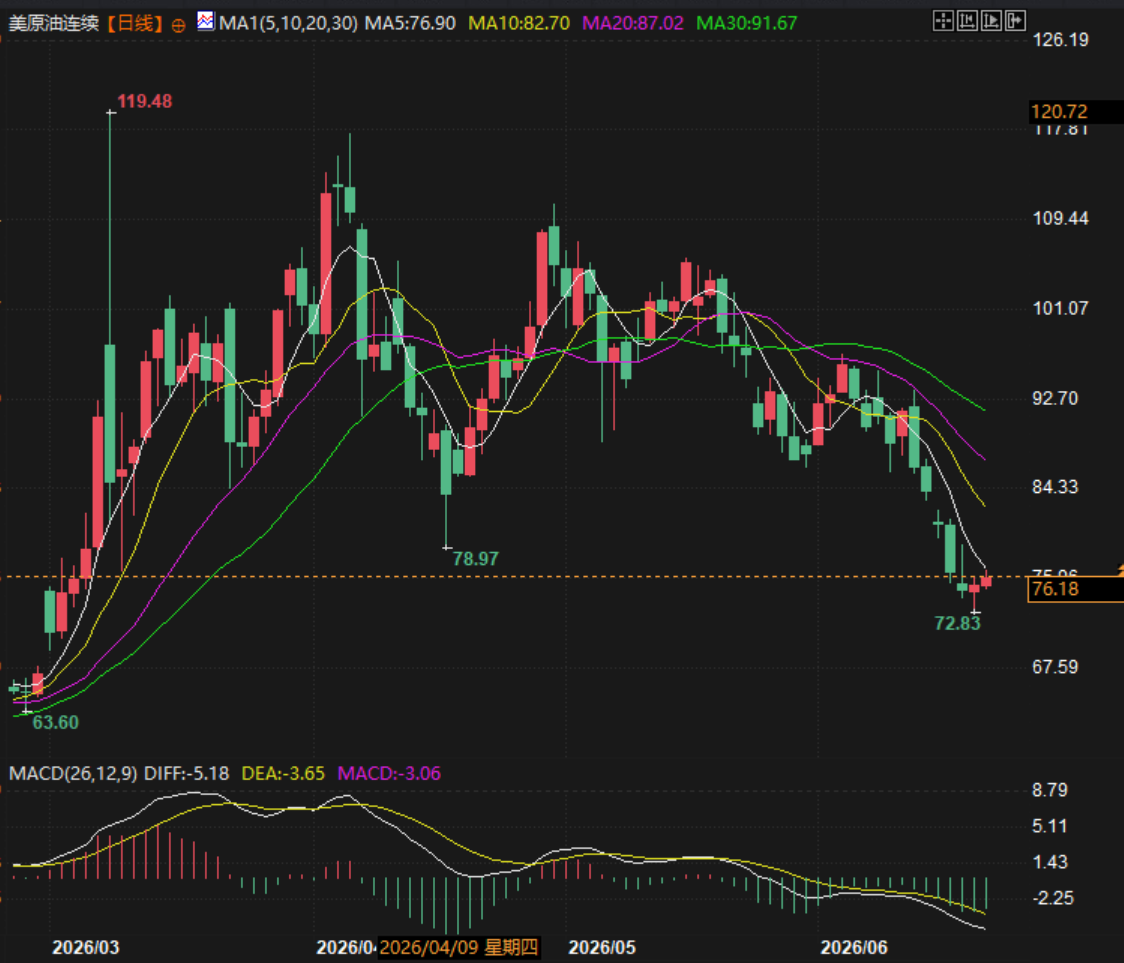
(US crude oil futures daily chart, source: FX678)
At 15:58 Beijing time on June 19, US crude oil futures were trading at $76.14 per barrel.
In its latest research report, Deutsche Bank pointed out that international oil prices have been declining since the signing of the US-Iran memorandum of understanding. The main reason is that investors quickly digested the expected increase in supply brought about by the agreement, and the geopolitical risk premium related to war significantly decreased.
Vance's schedule changes
However, this decline did not last long. Following media reports on Wednesday that US Vice President Vance would not depart for Switzerland as originally planned that evening, market sentiment gradually improved, and oil prices saw a significant reversal. This trend reflects investors' complex interpretation of the long-term impact of the agreement: short-term supply recovery is bearish for oil prices, but continued uncertainty in the Middle East situation limited the decline.
Deutsche Bank analysts believe that in the early stages of the agreement signing, a rebound in risk appetite drove funds out of the energy sector, but the schedules of officials such as US Vice President Vance boosted market confidence again.
The report further analyzes that although the agreement paves the way for the reopening of the Strait of Hormuz, the geopolitical premium has not completely disappeared.
The ongoing negotiations on the Iranian nuclear issue, regional proxy forces, and concerns from Israel could still cause volatility in the next 60-day window.
Deutsche Bank expects oil prices to remain volatile at high levels in the short term. Investors should closely monitor the implementation of OPEC+ production cuts, global demand data, and changes in macroeconomic policies in the US, China, and Europe.
The bank suggests that, in the current environment, energy companies can use futures instruments to hedge risks, while it is optimistic about the long-term opportunities in the refining and downstream sectors against the backdrop of supply recovery.
Overall, the market's initial decline followed by a rebound indicates that it is gradually adapting to the new reality of easing tensions in the Middle East. The process of diminishing geopolitical premiums will continue, but it will not happen overnight.
Air traffic details: 12.5 million barrels of crude oil will transit through the area, with 60 days of free and safe passage.
The Deutsche Bank report paid particular attention to the actual progress of the resumption of navigation in the Strait of Hormuz.
U.S. Vice President Vance confirmed that 12.5 million barrels of crude oil had successfully passed through the Strait of Hormuz on the eve of the agreement's signing, and nearly 12 oil tankers had smoothly traversed the blockade zone previously established by the U.S. military. This data vividly demonstrates the early effectiveness of the agreement's implementation and significantly alleviates market concerns about disruptions to global crude oil supply.
According to the report, Iran has pledged to provide free safe passage for merchant ships within a 60-day window, which will significantly reduce transportation costs and boost traders' confidence.
Meanwhile, Iran will engage in dialogue with Oman on the long-term governance and maritime services of the Strait of Hormuz, with the aim of establishing a more stable regional shipping mechanism.
Deutsche Bank believes that this arrangement will not only help Iran quickly recover its oil export revenues, but also inject stability into the global energy market.
Analysts point out that the Strait of Hormuz is the world's most important oil shipping chokepoint, and has historically faced the risk of blockade due to geopolitical conflicts on numerous occasions. This rapid opening of the 12.5 million barrel strait is equivalent to adding approximately 2 million barrels of potential supply capacity per day. If this capacity continues to be released, it will have a substantial impact on the currently tight oil market balance.
The report cautions that while the short-term resumption of air traffic has proceeded smoothly, long-term implementation risks remain, including progress in technical negotiations, third-party monitoring mechanisms, and changes in the regional security situation.
Deutsche Bank advises energy traders and shipping companies to position themselves in related derivatives in advance, while also monitoring satellite data to verify actual traffic flow.
The bank expects global crude oil inventories to gradually accumulate in the second half of 2026 as air travel becomes more normalized, pushing oil prices down moderately. Investors should balance the dual impacts of fading short-term geopolitical premiums and long-term supply easing, and adjust their positions flexibly.
Trump stated: Focusing on the positive aspects of the agreement, he expects a comprehensive ceasefire.
President Trump actively promoted the progress of the interim US-Iran agreement on social media, posting the message "Oil is flowing" and explicitly stating his expectation for a comprehensive ceasefire on all fronts, including those involving Lebanon, Hezbollah, and Israel. This statement further strengthened market optimism regarding a comprehensive easing of tensions in the Middle East and became a significant catalyst for the intraday reversal in oil prices.
A Deutsche Bank report argues that Trump's statement reflects the continuation of the US government's "America First" foreign policy strategy, which aims to reduce military costs through diplomatic means while creating a stable external environment for the domestic energy industry.
The president emphasized the positive aspects of the agreement, which helped shift market attention from potential risks to actual benefits, such as the global economic dividends brought about by the resumption of oil trade.
The report analyzes that this statement's support for oil prices is mainly reflected in two aspects: first, it boosts risk appetite and reduces the inflow of safe-haven funds; second, it creates a favorable atmosphere for the subsequent 60-day technical negotiations. Trump has repeatedly influenced market expectations through social media at key junctures, and this time is no exception. Deutsche Bank cautions that while the prospect of a comprehensive ceasefire is promising, substantial challenges remain, including Israeli security concerns, the handling of Iranian proxy forces, and the implementation of nuclear facility verification mechanisms.
The bank suggests that investors should view Trump's remarks as a short-term sentiment catalyst rather than a long-term trend reversal. In actual trading, they can combine technical indicators and fundamental data for operation, paying particular attention to the indirect impact of next month's NATO summit and related discussions in Ankara on the energy geopolitical landscape.
Overall, Trump's optimistic remarks helped stabilize market confidence, but the ultimate success of the agreement still depends on the subsequent implementation efforts of all parties.
(US crude oil futures daily chart, source: FX678)
At 15:58 Beijing time on June 19, US crude oil futures were trading at $76.14 per barrel.
- Risk Warning and Disclaimer
- The market involves risk, and trading may not be suitable for all investors. This article is for reference only and does not constitute personal investment advice, nor does it take into account certain users’ specific investment objectives, financial situation, or other needs. Any investment decisions made based on this information are at your own risk.