The interim US-Iran agreement eased inflationary pressures, sending gold prices soaring over 2%, as the market reassessed the outlook for Federal Reserve policy.
2026-06-15 16:27:38
With the US and Iran reaching a provisional agreement, the months-long regional military conflict has shown signs of easing, and market concerns about disruptions to shipping through the Strait of Hormuz have significantly decreased. As a vital global energy transport route, the Strait of Hormuz handles approximately 20% of the world's seaborne crude oil shipments . Its resumption of normal navigation signifies a reduction in the risk of global crude oil supply shortages, leading to a noticeable decline in international oil prices.

The decline in energy prices has improved market expectations for future inflation. Previously, escalating tensions in the Middle East had driven oil prices up rapidly, raising concerns among investors that rising energy costs would trigger broader price pressures and prompt major central banks worldwide to maintain tighter monetary policies for an extended period. With the peace agreement now in place, the market is readjusting its assessment of the path of inflation and interest rates.
Market analysts believe that the decline in oil prices has reduced the upside risk of inflation, decreasing the need for major central banks to further tighten policies. XTB analyst Catherine Brooks pointed out that the peace agreement put significant pressure on oil prices, thereby alleviating market concerns about inflation. This news, coming on the eve of a series of meetings of major central banks around the world, has changed market expectations for future monetary policy.
As a result, the gold market saw a significant rebound, with both spot gold and gold futures prices rising by more than 2% . As concerns about further interest rate increases eased, the attractiveness of gold, a non-yielding asset, improved, leading to a renewed inflow of funds into the precious metals market.
This week, market focus will shift to the Federal Reserve's interest rate decision. Investors will pay close attention to the Federal Open Market Committee (FOMC) meeting, the first meeting attended by new Fed Chairman Kevin Warsh, hoping to glean more clues about the future direction of monetary policy from the policy statement and his remarks. With energy prices falling, market expectations for another rate hike later this year have cooled significantly, and the Fed's future policy path may depend more heavily on subsequent inflation and economic data.
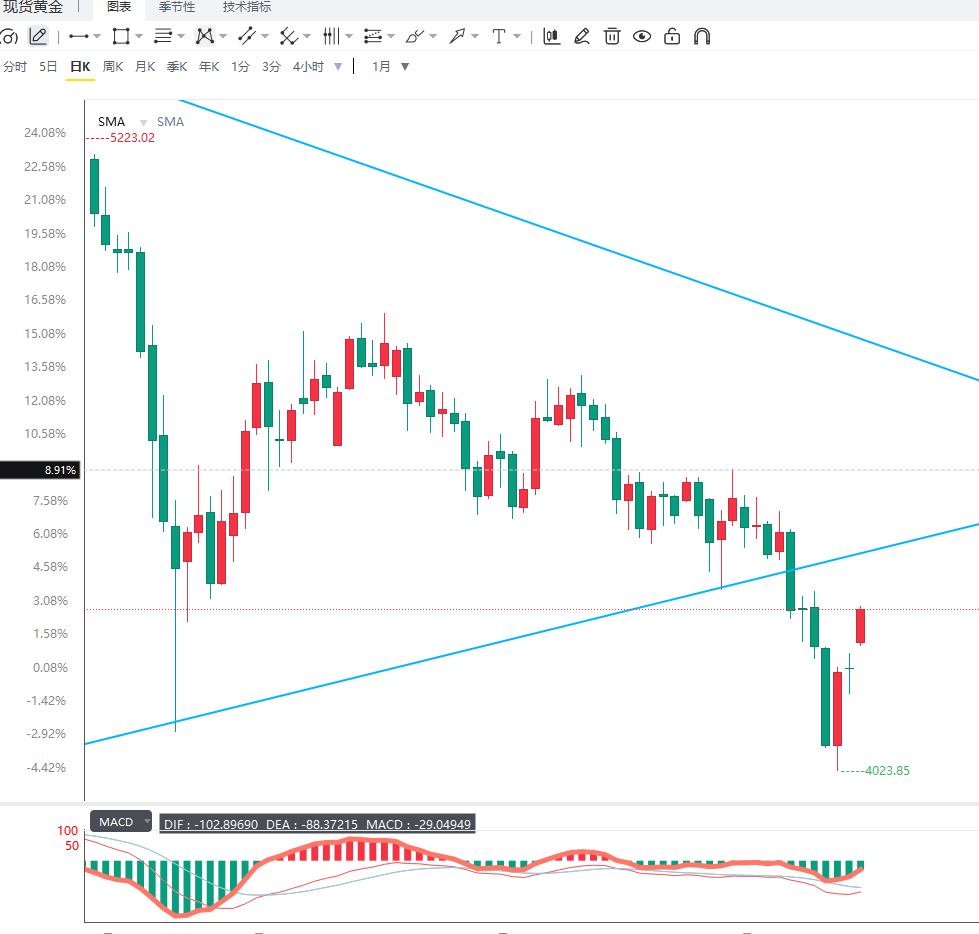
From a daily chart perspective, gold has rebounded strongly after a period of consolidation, but it remains in a recovery phase after the decline and has not yet formed a clear trend reversal. Currently, the price is still trading below key long-term moving averages, indicating that upward pressure remains. Daily momentum indicators have improved somewhat, but a further breakout of the important resistance area is needed to confirm a stronger rebound. In the short term, watch the first resistance level around $4400 ; a successful break above this level could lead to further gains towards $4680 and $4760 . On the downside, watch the support levels around $4250 and $4140 ; a break below these levels could reopen room for further consolidation.
From a 4-hour chart perspective, gold's short-term rebound momentum has clearly strengthened, with market sentiment improving due to a weaker dollar and cooling interest rate expectations. However, the current rise is more of a technical correction after an oversold condition and has not yet broken free from the previous consolidation structure. If the price can stabilize above $4400, bullish momentum is expected to strengthen further; but if the rebound is met with resistance and the price breaks below the key support area again, the risk of a second decline due to profit-taking should be noted.
Editor's Summary : The interim US-Iran agreement reduced the risk of global energy supply disruptions, pushing oil prices down significantly. It also eased market concerns about persistently high inflation and further central bank interest rate hikes, giving gold a significant rebound momentum. However, the Fed's future policy still depends on inflation and economic data performance. Gold's current movement is mainly a corrective rebound, and a new upward trend has not yet been confirmed. Investors should focus on the Fed meeting results and whether gold can break through key resistance areas in the short term to determine the potential for further gains.
The decline in energy prices has improved market expectations for future inflation. Previously, escalating tensions in the Middle East had driven oil prices up rapidly, raising concerns among investors that rising energy costs would trigger broader price pressures and prompt major central banks worldwide to maintain tighter monetary policies for an extended period. With the peace agreement now in place, the market is readjusting its assessment of the path of inflation and interest rates.
Market analysts believe that the decline in oil prices has reduced the upside risk of inflation, decreasing the need for major central banks to further tighten policies. XTB analyst Catherine Brooks pointed out that the peace agreement put significant pressure on oil prices, thereby alleviating market concerns about inflation. This news, coming on the eve of a series of meetings of major central banks around the world, has changed market expectations for future monetary policy.
As a result, the gold market saw a significant rebound, with both spot gold and gold futures prices rising by more than 2% . As concerns about further interest rate increases eased, the attractiveness of gold, a non-yielding asset, improved, leading to a renewed inflow of funds into the precious metals market.
This week, market focus will shift to the Federal Reserve's interest rate decision. Investors will pay close attention to the Federal Open Market Committee (FOMC) meeting, the first meeting attended by new Fed Chairman Kevin Warsh, hoping to glean more clues about the future direction of monetary policy from the policy statement and his remarks. With energy prices falling, market expectations for another rate hike later this year have cooled significantly, and the Fed's future policy path may depend more heavily on subsequent inflation and economic data.
From a daily chart perspective, gold has rebounded strongly after a period of consolidation, but it remains in a recovery phase after the decline and has not yet formed a clear trend reversal. Currently, the price is still trading below key long-term moving averages, indicating that upward pressure remains. Daily momentum indicators have improved somewhat, but a further breakout of the important resistance area is needed to confirm a stronger rebound. In the short term, watch the first resistance level around $4400 ; a successful break above this level could lead to further gains towards $4680 and $4760 . On the downside, watch the support levels around $4250 and $4140 ; a break below these levels could reopen room for further consolidation.
From a 4-hour chart perspective, gold's short-term rebound momentum has clearly strengthened, with market sentiment improving due to a weaker dollar and cooling interest rate expectations. However, the current rise is more of a technical correction after an oversold condition and has not yet broken free from the previous consolidation structure. If the price can stabilize above $4400, bullish momentum is expected to strengthen further; but if the rebound is met with resistance and the price breaks below the key support area again, the risk of a second decline due to profit-taking should be noted.
Editor's Summary : The interim US-Iran agreement reduced the risk of global energy supply disruptions, pushing oil prices down significantly. It also eased market concerns about persistently high inflation and further central bank interest rate hikes, giving gold a significant rebound momentum. However, the Fed's future policy still depends on inflation and economic data performance. Gold's current movement is mainly a corrective rebound, and a new upward trend has not yet been confirmed. Investors should focus on the Fed meeting results and whether gold can break through key resistance areas in the short term to determine the potential for further gains.
- Risk Warning and Disclaimer
- The market involves risk, and trading may not be suitable for all investors. This article is for reference only and does not constitute personal investment advice, nor does it take into account certain users’ specific investment objectives, financial situation, or other needs. Any investment decisions made based on this information are at your own risk.