USD/JPY is nearing a key turning point; the 160 level hides a triple pricing conflict.
2026-06-15 20:17:31
On Monday, June 15th, the USD/JPY pair remained in a high-level consolidation range around 160. The chart shows the exchange rate currently fluctuating around 160.15. The daily Bollinger Band middle line is at 159.302, the upper line at 161.058, and the lower line at 157.547. The price is close to the upper line but has not yet broken through effectively.
Meanwhile, oil prices fell significantly due to expectations of a de-escalation in the US-Iran conflict, with Brent crude dropping to around $83 per barrel, easing market concerns about energy-related imported inflation. Interest rates remain the main driver of exchange rates; market pricing for continued tightening by the Federal Reserve this year has cooled somewhat, but not completely disappeared. The Bank of Japan is expected to raise interest rates by 25 basis points at its latest meeting and may adjust the pace of its bond-buying tapering.

Easing inflation risks do not equate to the disappearance of the dollar's interest rate advantage. The current USD/JPY exchange rate remains around 160, indicating that the market has not completely eliminated its demand for dollar yields. In other words, while falling oil prices can compress the dollar's safe-haven and inflation premium, they are insufficient to immediately reverse the USD/JPY interest rate differential. As long as US Treasury yields remain relatively high, the yen's rebound is more likely to be a temporary correction rather than a trend reversal.
More importantly, if the decline in oil prices further improves business costs and consumer expectations, the market may shift from a view of "easing inflationary shocks" back to one of "strengthened demand resilience." This would likely prompt the Federal Reserve to exercise restraint in its statements, avoiding premature signals of easing. Therefore, the core issue for the USD/JPY exchange rate has not shifted from interest rates to risk appetite, but rather risk appetite is repricing the interest rate path.
This week's Federal Reserve interest rate meeting is the core variable for short-term USD/JPY pricing. The market widely expects the Fed to keep policy rates unchanged, with the focus on the latest economic forecasts. If the Fed downplays its inclination to cut rates and emphasizes that inflation still needs to be observed, the dollar may receive some support; if its statements place more emphasis on the improvement in inflation expectations due to falling oil prices, the dollar may continue its mild correction.
Current market pricing in a rate hike this year has fallen from its pre-de-escalation high levels, but it still retains a certain probability. Some market quotes indicate that a 25 basis point rate hike this year is still included in the pricing scenario. This means that the USD/JPY exchange rate is also constrained by the forward yield curve. As long as the Federal Reserve does not clearly shift towards easing, it will be difficult for bears to form a unified downward pressure below 160.
For traders, the most important thing to watch is not whether the Fed will hold off, but how it explains the decline in oil prices. If it views the drop in oil prices as a short-term disturbance fading rather than a trend improvement in inflation, the dollar may remain resilient after the pullback. Only if it acknowledges a significant decrease in inflation risks will the USD/JPY pair likely test the Bollinger Band middle line support around 159.30.
The variables surrounding the yen are more complex. The market expects the Bank of Japan to raise interest rates by 25 basis points, pushing the policy rate to 1.00%, while also potentially announcing a pause in its bond-buying tapering program starting in the next fiscal year. This combination isn't entirely hawkish: a rate hike is generally beneficial for the yen, but pausing the tapering could weaken the upward potential of yields.
Bank of Japan Governor Kazuo Ueda was absent from the meeting and vote due to hospitalization, offering his opinions remotely only. Deputy Governor Shinichi Uchida hosted the press conference. This amplifies the importance of external communication. If Uchida emphasizes that there is still room for further tightening in the second half of the year, the yen may receive more substantial support; however, if his wording leans towards observing wages, consumption, and the overseas environment, the market may interpret this rate hike as "realizing expectations" rather than the start of a new tightening cycle.
From the daily chart, the USD/JPY pair has been rising steadily from a low of 155.025, with the price gradually approaching the upper Bollinger Band, indicating that the upward momentum has not been completely broken. However, recent selling pressure has repeatedly appeared above the 160.30 to 160.60 area, suggesting that the upward momentum has weakened.
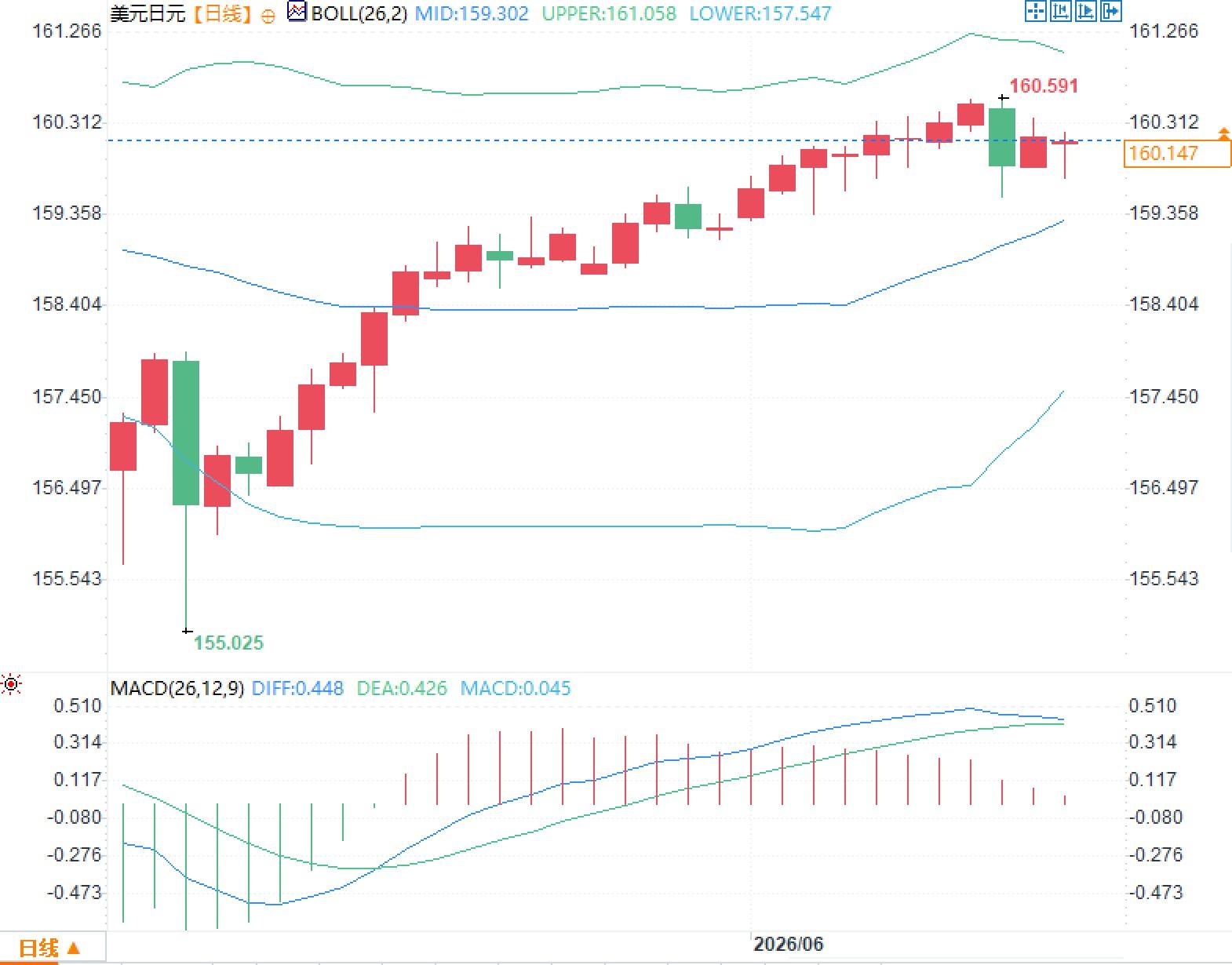
The Bollinger Band middle line at 159.302 is a crucial level to watch for short-term strength or weakness. As long as the price remains above the middle line, the technical structure remains biased towards high-level consolidation. However, if it breaks below and closes below 159.30, the market may reassess the potential for a pullback in the 157.55 to 158.40 range. On the upside, watch for resistance around 160.60 and 161, the latter corresponding to the upper Bollinger Band, which is also a key level for determining whether the trend has resumed its expansion.
In terms of MACD, the DIFF is 0.448, the DEA is 0.426, and the histogram has narrowed to 0.045, indicating that the upward momentum is weakening but a clear death cross has not yet formed. This structure suggests that USD/JPY has not entered a one-sided reversal phase, but is in a period of weakening momentum at high levels. If the fundamentals provide support for USD interest rates, the technical outlook may continue to show sideways consolidation; if the Federal Reserve and the Bank of Japan jointly lower interest rate differential expectations, the probability of a pullback from the highs will increase.
Meanwhile, oil prices fell significantly due to expectations of a de-escalation in the US-Iran conflict, with Brent crude dropping to around $83 per barrel, easing market concerns about energy-related imported inflation. Interest rates remain the main driver of exchange rates; market pricing for continued tightening by the Federal Reserve this year has cooled somewhat, but not completely disappeared. The Bank of Japan is expected to raise interest rates by 25 basis points at its latest meeting and may adjust the pace of its bond-buying tapering.
The decline in oil prices has altered the inflation narrative, not the reality of interest rate differentials.
Easing inflation risks do not equate to the disappearance of the dollar's interest rate advantage. The current USD/JPY exchange rate remains around 160, indicating that the market has not completely eliminated its demand for dollar yields. In other words, while falling oil prices can compress the dollar's safe-haven and inflation premium, they are insufficient to immediately reverse the USD/JPY interest rate differential. As long as US Treasury yields remain relatively high, the yen's rebound is more likely to be a temporary correction rather than a trend reversal.
More importantly, if the decline in oil prices further improves business costs and consumer expectations, the market may shift from a view of "easing inflationary shocks" back to one of "strengthened demand resilience." This would likely prompt the Federal Reserve to exercise restraint in its statements, avoiding premature signals of easing. Therefore, the core issue for the USD/JPY exchange rate has not shifted from interest rates to risk appetite, but rather risk appetite is repricing the interest rate path.
The downside potential of the dollar is limited ahead of the Federal Reserve meeting.
This week's Federal Reserve interest rate meeting is the core variable for short-term USD/JPY pricing. The market widely expects the Fed to keep policy rates unchanged, with the focus on the latest economic forecasts. If the Fed downplays its inclination to cut rates and emphasizes that inflation still needs to be observed, the dollar may receive some support; if its statements place more emphasis on the improvement in inflation expectations due to falling oil prices, the dollar may continue its mild correction.
Current market pricing in a rate hike this year has fallen from its pre-de-escalation high levels, but it still retains a certain probability. Some market quotes indicate that a 25 basis point rate hike this year is still included in the pricing scenario. This means that the USD/JPY exchange rate is also constrained by the forward yield curve. As long as the Federal Reserve does not clearly shift towards easing, it will be difficult for bears to form a unified downward pressure below 160.
For traders, the most important thing to watch is not whether the Fed will hold off, but how it explains the decline in oil prices. If it views the drop in oil prices as a short-term disturbance fading rather than a trend improvement in inflation, the dollar may remain resilient after the pullback. Only if it acknowledges a significant decrease in inflation risks will the USD/JPY pair likely test the Bollinger Band middle line support around 159.30.
Can the Bank of Japan's interest rate hike expectations truly translate into support for the yen?
The variables surrounding the yen are more complex. The market expects the Bank of Japan to raise interest rates by 25 basis points, pushing the policy rate to 1.00%, while also potentially announcing a pause in its bond-buying tapering program starting in the next fiscal year. This combination isn't entirely hawkish: a rate hike is generally beneficial for the yen, but pausing the tapering could weaken the upward potential of yields.
Bank of Japan Governor Kazuo Ueda was absent from the meeting and vote due to hospitalization, offering his opinions remotely only. Deputy Governor Shinichi Uchida hosted the press conference. This amplifies the importance of external communication. If Uchida emphasizes that there is still room for further tightening in the second half of the year, the yen may receive more substantial support; however, if his wording leans towards observing wages, consumption, and the overseas environment, the market may interpret this rate hike as "realizing expectations" rather than the start of a new tightening cycle.
Technical analysis indicates a high level of consolidation, with the 160 level remaining a key dividing line between bullish and bearish sentiment.
From the daily chart, the USD/JPY pair has been rising steadily from a low of 155.025, with the price gradually approaching the upper Bollinger Band, indicating that the upward momentum has not been completely broken. However, recent selling pressure has repeatedly appeared above the 160.30 to 160.60 area, suggesting that the upward momentum has weakened.
The Bollinger Band middle line at 159.302 is a crucial level to watch for short-term strength or weakness. As long as the price remains above the middle line, the technical structure remains biased towards high-level consolidation. However, if it breaks below and closes below 159.30, the market may reassess the potential for a pullback in the 157.55 to 158.40 range. On the upside, watch for resistance around 160.60 and 161, the latter corresponding to the upper Bollinger Band, which is also a key level for determining whether the trend has resumed its expansion.
In terms of MACD, the DIFF is 0.448, the DEA is 0.426, and the histogram has narrowed to 0.045, indicating that the upward momentum is weakening but a clear death cross has not yet formed. This structure suggests that USD/JPY has not entered a one-sided reversal phase, but is in a period of weakening momentum at high levels. If the fundamentals provide support for USD interest rates, the technical outlook may continue to show sideways consolidation; if the Federal Reserve and the Bank of Japan jointly lower interest rate differential expectations, the probability of a pullback from the highs will increase.
- Risk Warning and Disclaimer
- The market involves risk, and trading may not be suitable for all investors. This article is for reference only and does not constitute personal investment advice, nor does it take into account certain users’ specific investment objectives, financial situation, or other needs. Any investment decisions made based on this information are at your own risk.