45% of central banks plan to increase their gold holdings, so why is the market still hesitant to declare a reversal?
2026-06-16 15:17:05
On Tuesday, June 16th, spot gold experienced a corrective rebound after a sharp decline, currently trading around $4320. Meanwhile, the latest survey by the World Gold Council shows that among the 74 central banks surveyed, 45% plan to increase their gold reserves in the coming year, the highest percentage since the survey began in 2018, with only one indicating a possible reduction. The simultaneous occurrence of price pullbacks and official buying intentions has shifted the gold market from a purely safe-haven transaction to a repricing process between "high interest rate suppression and reserve reallocation support."
This round of gold price adjustments does not signify the disappearance of medium- to long-term supporting factors. On the contrary, the signals from central bank reserve management are stronger. The latest survey shows that 93% of surveyed central banks already hold gold, up from 81% in 2025; 45% of surveyed institutions plan to increase their gold holdings in the next 12 months, up from 43% last year. This indicates that official buying is not entirely dependent on short-term price momentum, but is embedded within a framework of reserve structure adjustments, asset diversification, and liquidity security.
First-quarter data also confirms this. Industry statistics show that global central banks made net purchases of 244 tons of gold in the first quarter of 2026, an increase of 3% year-on-year; central banks resumed net purchases in April, with a net purchase of 17 tons in a single month, reversing the disturbance caused by the large-scale net selling in March. In other words, the temporary selling by some central banks did not change the overall net buying pattern, and the market should pay more attention to the pace of reallocation by official departments after the price decline.
The survey also revealed that potential buyers will primarily come from central banks in emerging markets and developing economies, with approximately 53% expecting to increase their gold reserves, compared to about 18% for central banks in developed economies. More importantly, among the central banks planning to increase their gold holdings, about half intend to complete the purchases through local accumulation programs, using their own currency to buy gold from their domestic mining systems, rather than consuming scarce hard currency reserves; another 38% indicated they might fund the purchases by selling existing reserve assets. This suggests that official buying is more diversified and not entirely constrained by the dollar liquidity cycle.
Gold prices have retreated from their highs this year, with the core pressure stemming from two main factors. First, fluctuations in energy prices and inflation expectations led the market to bet again on prolonged high interest rates, increasing the opportunity cost of holding non-interest-bearing assets. Second, excessive crowding of long positions in the previous period meant that once prices broke below key moving averages and the middle band of the trading range, algorithmic and trend-following funds were prone to concentrated selling, resulting in a technical amplification.
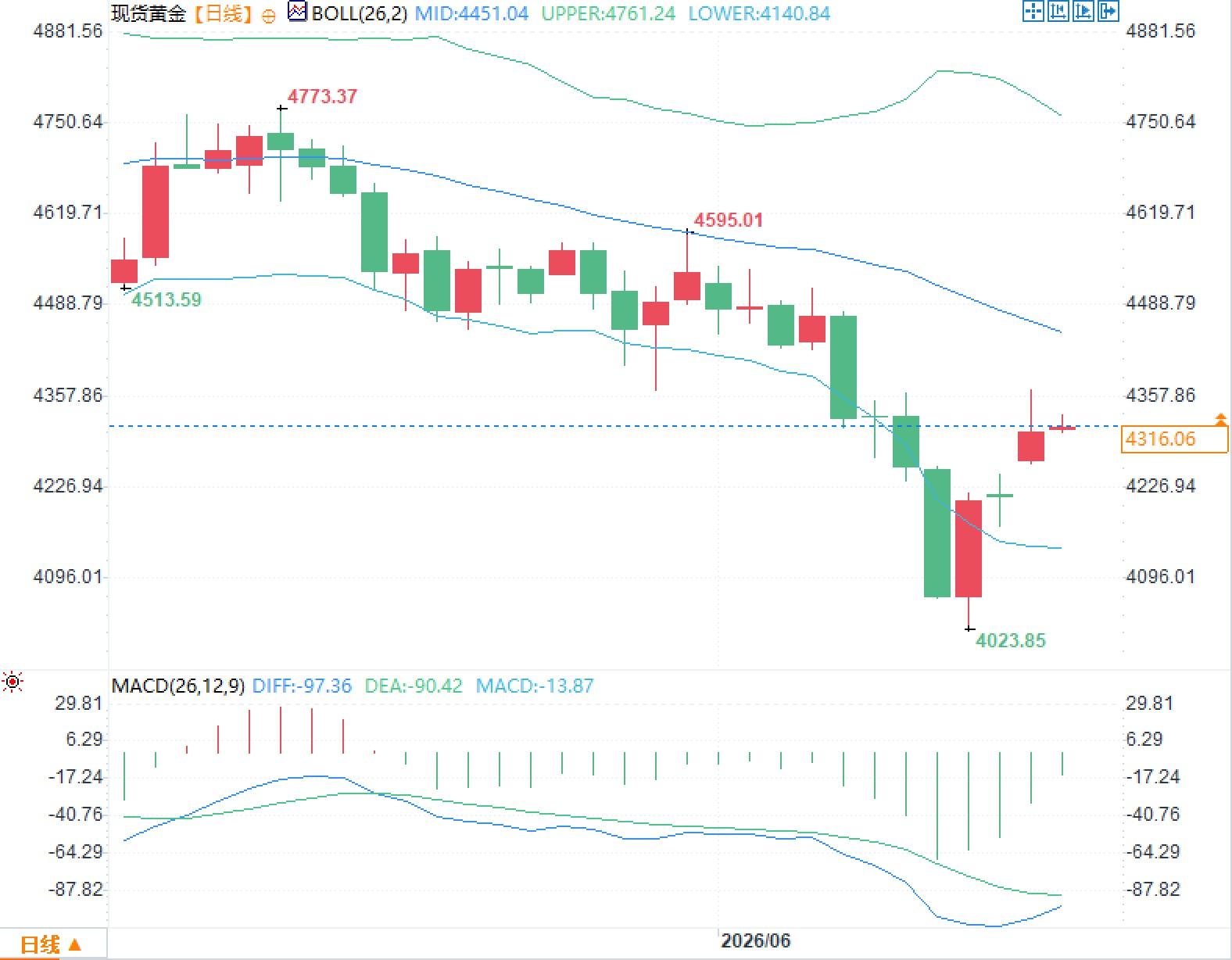
From the daily chart, spot gold is still trading below the Bollinger Band's middle band. The middle band is around $4451.04, the upper band around $4761.24, and the lower band around $4140.84; the current price is significantly below the middle band. In the MACD indicator, the DIFF is around -97.36, the DEA is around -90.42, and the histogram is still negative, indicating that the trend correction at the daily level is not yet complete. After rebounding from the low of $4023.85, the price has recovered some of the oversold condition, but has not yet regained the trend watershed around $4450.
The core change in gold prices is not just about price, but also about the shift in reserve management logic. A recent survey shows that the Bank of England remains the most commonly used location for central bank gold storage, with 57% of surveyed institutions using this channel; however, 9% of central banks reported increasing their domestic holdings over the past year, and 10% reported increasing the diversification of their gold holdings across different locations, up from 5% and 2% in the previous year.
This reflects the increasing emphasis placed by official departments on asset availability, continuity of cross-border settlements, and custody security. As an asset without sovereign credit risk, gold functions differently from bonds and foreign currency deposits in extreme market environments. Bonds carry duration risk, foreign currency deposits rely on the banking system and clearing networks, while gold's value storage attribute is more direct. Increased gold allocations by official departments do not necessarily represent a pursuit of rising prices, but rather a rebalancing of tail risks in the reserve portfolio.
Shaokai Fan, an official from the association, recently stated that the price decline may provide some central banks with an opportunity to repurchase, and mentioned that some central banks believed prices were too high in 2025 and hoped to wait for a suitable purchasing window.
In the short term, gold prices will remain inextricably linked to the Federal Reserve's policy path. The market is largely focused on the June policy meeting. Currently, the benchmark interest rate range remains around 3.5% to 3.75%, and persistently high interest rates will continue to suppress gold's valuation elasticity. If the policy statement emphasizes sticky inflation and a cautious stance, gold's upside may continue to be constrained by real interest rates; conversely, if energy disturbances subside and inflation expectations decline, market concerns about further tightening will decrease, easing valuation pressures on gold.
On the demand side, the situation was mixed. In the first quarter, gold-backed ETFs saw net inflows of 62 tons, but this was lower than the 230 tons expected in the first quarter of 2025, indicating that while financial investment demand had recovered, it was no longer in an extremely euphoric state. During the same period, demand for gold jewelry decreased by 23% year-on-year, but the value of the jewelry increased by 31%, suggesting that high gold prices compressed physical purchases but did not completely weaken demand for storing value. On the supply side, total supply increased by 2% to 1231 tons in the first quarter, with moderate growth in mined gold and a 5% increase in recycled gold, providing some buffer against price fluctuations.
In summary, the gold market has moved from a phase of unilateral upward movement to a phase of high-level repricing. Central bank buying provides a structural foundation, the high-interest-rate environment limits valuation expansion, and the clearing of speculative positions brings higher volatility. Whether prices can break free from their weakness depends on whether three variables resonate: whether real interest rates decline, whether official net purchases continue, and whether spot prices can effectively recover from the medium-term resistance zone around $4450.
Central bank buying has not stopped, and the underlying logic of gold pricing remains.
This round of gold price adjustments does not signify the disappearance of medium- to long-term supporting factors. On the contrary, the signals from central bank reserve management are stronger. The latest survey shows that 93% of surveyed central banks already hold gold, up from 81% in 2025; 45% of surveyed institutions plan to increase their gold holdings in the next 12 months, up from 43% last year. This indicates that official buying is not entirely dependent on short-term price momentum, but is embedded within a framework of reserve structure adjustments, asset diversification, and liquidity security.
First-quarter data also confirms this. Industry statistics show that global central banks made net purchases of 244 tons of gold in the first quarter of 2026, an increase of 3% year-on-year; central banks resumed net purchases in April, with a net purchase of 17 tons in a single month, reversing the disturbance caused by the large-scale net selling in March. In other words, the temporary selling by some central banks did not change the overall net buying pattern, and the market should pay more attention to the pace of reallocation by official departments after the price decline.
The survey also revealed that potential buyers will primarily come from central banks in emerging markets and developing economies, with approximately 53% expecting to increase their gold reserves, compared to about 18% for central banks in developed economies. More importantly, among the central banks planning to increase their gold holdings, about half intend to complete the purchases through local accumulation programs, using their own currency to buy gold from their domestic mining systems, rather than consuming scarce hard currency reserves; another 38% indicated they might fund the purchases by selling existing reserve assets. This suggests that official buying is more diversified and not entirely constrained by the dollar liquidity cycle.
The root causes of the price pullback: real interest rates, energy costs, and the clearing of speculative positions.
Gold prices have retreated from their highs this year, with the core pressure stemming from two main factors. First, fluctuations in energy prices and inflation expectations led the market to bet again on prolonged high interest rates, increasing the opportunity cost of holding non-interest-bearing assets. Second, excessive crowding of long positions in the previous period meant that once prices broke below key moving averages and the middle band of the trading range, algorithmic and trend-following funds were prone to concentrated selling, resulting in a technical amplification.
From the daily chart, spot gold is still trading below the Bollinger Band's middle band. The middle band is around $4451.04, the upper band around $4761.24, and the lower band around $4140.84; the current price is significantly below the middle band. In the MACD indicator, the DIFF is around -97.36, the DEA is around -90.42, and the histogram is still negative, indicating that the trend correction at the daily level is not yet complete. After rebounding from the low of $4023.85, the price has recovered some of the oversold condition, but has not yet regained the trend watershed around $4450.
With the repricing of reserve security, gold's financial attributes have been further strengthened.
The core change in gold prices is not just about price, but also about the shift in reserve management logic. A recent survey shows that the Bank of England remains the most commonly used location for central bank gold storage, with 57% of surveyed institutions using this channel; however, 9% of central banks reported increasing their domestic holdings over the past year, and 10% reported increasing the diversification of their gold holdings across different locations, up from 5% and 2% in the previous year.
This reflects the increasing emphasis placed by official departments on asset availability, continuity of cross-border settlements, and custody security. As an asset without sovereign credit risk, gold functions differently from bonds and foreign currency deposits in extreme market environments. Bonds carry duration risk, foreign currency deposits rely on the banking system and clearing networks, while gold's value storage attribute is more direct. Increased gold allocations by official departments do not necessarily represent a pursuit of rising prices, but rather a rebalancing of tail risks in the reserve portfolio.
Shaokai Fan, an official from the association, recently stated that the price decline may provide some central banks with an opportunity to repurchase, and mentioned that some central banks believed prices were too high in 2025 and hoped to wait for a suitable purchasing window.
Subsequent variables: interest rate meeting, rebalancing of dollar liquidity and real demand.
In the short term, gold prices will remain inextricably linked to the Federal Reserve's policy path. The market is largely focused on the June policy meeting. Currently, the benchmark interest rate range remains around 3.5% to 3.75%, and persistently high interest rates will continue to suppress gold's valuation elasticity. If the policy statement emphasizes sticky inflation and a cautious stance, gold's upside may continue to be constrained by real interest rates; conversely, if energy disturbances subside and inflation expectations decline, market concerns about further tightening will decrease, easing valuation pressures on gold.
On the demand side, the situation was mixed. In the first quarter, gold-backed ETFs saw net inflows of 62 tons, but this was lower than the 230 tons expected in the first quarter of 2025, indicating that while financial investment demand had recovered, it was no longer in an extremely euphoric state. During the same period, demand for gold jewelry decreased by 23% year-on-year, but the value of the jewelry increased by 31%, suggesting that high gold prices compressed physical purchases but did not completely weaken demand for storing value. On the supply side, total supply increased by 2% to 1231 tons in the first quarter, with moderate growth in mined gold and a 5% increase in recycled gold, providing some buffer against price fluctuations.
In summary, the gold market has moved from a phase of unilateral upward movement to a phase of high-level repricing. Central bank buying provides a structural foundation, the high-interest-rate environment limits valuation expansion, and the clearing of speculative positions brings higher volatility. Whether prices can break free from their weakness depends on whether three variables resonate: whether real interest rates decline, whether official net purchases continue, and whether spot prices can effectively recover from the medium-term resistance zone around $4450.
- Risk Warning and Disclaimer
- The market involves risk, and trading may not be suitable for all investors. This article is for reference only and does not constitute personal investment advice, nor does it take into account certain users’ specific investment objectives, financial situation, or other needs. Any investment decisions made based on this information are at your own risk.