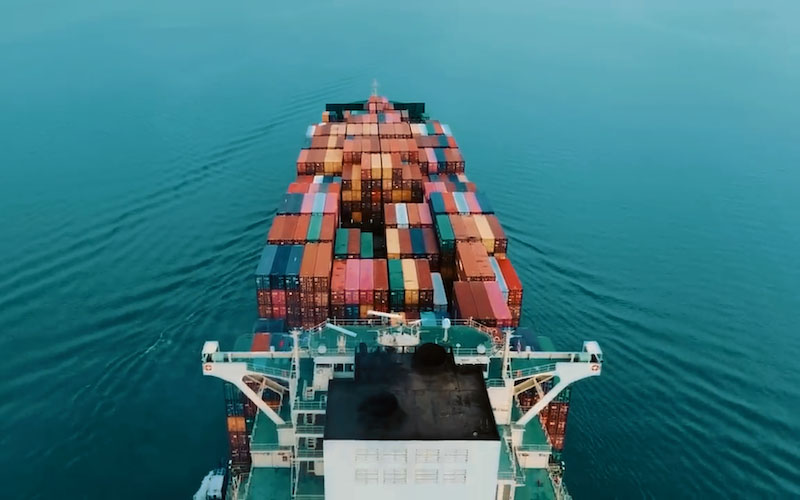
Trump pushes for deal to divert public attention; global oil market cautiously optimistic.
2026-06-16 21:51:52
On Tuesday (June 16), during the European and American trading sessions, international oil prices continued to decline. As mentioned in a previous article, the signing of the electronic version of the US-Iran memorandum was more than expected, and the oil price trend reflects this. Currently, WTI oil prices have slightly rebounded after hitting a low. It once fell by 4.36% during the session, but the decline has now narrowed to -3.55% and is currently trading at 77.91.
In the early hours of June 15, 2026, US President Trump officially announced a memorandum of understanding with the Islamic Republic of Iran, and a cautiously optimistic mood immediately spread in global markets.
The core of this highly anticipated agreement includes the reopening of the Strait of Hormuz, an extension of the 60-day ceasefire, and the reservation of room for negotiation on key issues such as Iran's nuclear program and the lifting of sanctions. The US also announced the immediate lifting of the maritime blockade against Iran, and Trump stated that the Strait of Hormuz would be "permanently free to navigate".
If the terms of the agreement are fully implemented, this could be the most significant breakthrough in Middle Eastern geopolitics in recent years.
The Middle East is currently mired in a multifaceted predicament of military rivalry, political antagonism, and economic pressure. This preliminary consensus is expected to reverse the regional geopolitical landscape, stabilize the global energy supply chain, and avert a large-scale conflict involving the US, Iran, Israel, and regional proxy forces.
However, despite the official signals of easing tensions, the market remains highly concerned about the effectiveness of the agreement. Israel's reaction, the implementation of details regarding navigation in the Strait of Hormuz, and whether the US and Iran can truly fulfill their obligations are the three major uncertainties hanging over the peace process.
Geopolitical observers point out that the practical developments in the coming weeks will determine whether this agreement is a long-term, sustainable peace solution or a temporary consensus that crumbles under pressure.
According to Kpler analyst Amena Bakr, as of June 15, the number of confirmed passages through the monitored Strait of Hormuz area (including commercial and non-commercial vessels) remained at 5, unchanged from the previous day.
As the core lifeline of global crude oil storage, transportation, and commercial shipping, the issue of navigation in the Strait of Hormuz has become the first test of the agreement.
While Trump's statement of "permanent free passage" boosted market expectations for smooth supply chains, the US and Iran still have differences on key details: the US emphasizes that the Strait should be opened unconditionally and free of charge, while Iran claims sovereign security oversight of the waterway and only agrees to grant a 60-day free passage period.
The plan is to charge fees for services such as navigation safety and environmental protection, and the management of the strait will be jointly decided by Iran and Oman.
Such differing interpretations could easily lead to new frictions. However, mine clearance in waterways, port repairs, and oil field resumption all take time. Morgan Stanley analysts predict that Iranian oil production will only recover to 50% by September and 80% by December, while full recovery of tanker traffic will take several weeks.
If fees or restrictions are imposed during the operation of the route, the agreement will face its first substantial crisis, directly impacting international crude oil pricing and global inflation trends.
Israel's attitude has become another major risk variable.
The Middle East has long been characterized by a complex situation of "diplomatic détente and military conflict running in parallel." Israeli Prime Minister Netanyahu has made it clear that the Israeli army will continue to be stationed in the "safety buffer zones" of southern Lebanon, Syria, and the Gaza Strip. The Minister of National Security has even stated that the agreement is "not binding on" Israel.
If Israel views the US-Iran agreement as a threat to its own security interests or takes targeted military action, it will directly destroy the hard-won foundation of peace.
Regional macroeconomic researchers believe that the United States' responsibility is not limited to signing the agreement, but also requires the introduction of supporting measures to counter potential sabotage, especially in playing a key role in restraining Israel.
Hezbollah in Lebanon made it clear on Tuesday that it had received assurances from Iran that Tehran would demand Israel's withdrawal from Lebanon in the next phase of negotiations, while drawing a hard red line: "No nuclear agreement will be reached unless Israeli troops withdraw," directly linking the Lebanese issue to the nuclear negotiations.
However, the US position is completely opposite, clearly stating that the memorandum of understanding does not include a clause on troop withdrawal, and that Israel has the right to defend itself if Hezbollah launches an attack. The conflict has rapidly escalated: on the morning of June 15, Israeli airstrikes in several parts of southern Lebanon caused casualties, and the Lebanese government urged its citizens not to return home. President Aoun has listed troop withdrawal and a ceasefire as prerequisites for ending the hostilities.
Israel's recent military operations, including its occupation of southern Lebanon and Gaza, and the benefits gained there, seem to be the last thing it can offer to its people, and the only remaining victory in its ongoing war.
The trust deficit in fulfilling contractual obligations is equally significant.
The US and Iran have agreed to divide the negotiations into two phases. The first phase will focus on a ceasefire and the opening of the Strait of Hormuz. The second phase will take 60 days to resolve core issues such as the nuclear issue and the lifting of sanctions. However, the full details of the memorandum of understanding have not yet been made public. The two sides still hold different views on key demands: Iran demands that the US unfreeze $24 billion in frozen assets, half of which must be in the account before the negotiations begin. The US, on the other hand, emphasizes that the funds will only be unfrozen after the agreement is fulfilled.
Trump denied that he would provide $300 billion in reconstruction funding, but Iran included it in the draft agreement.
The international community expects Iran to stop its provocative statements and restrain its proxy armed groups in the region, while demanding that the United States earnestly fulfill its commitments to lift sanctions and withdraw its troops. Only when both sides abandon domestic political hype and take concrete actions to rebuild mutual trust can the agreement have a foundation for long-term sustainability.
Market institutions are divided on the trend of oil prices: Shenwan Futures believes that the current price is at the lower end of the fluctuation range and the downside is limited; Galaxy Futures, on the other hand, judges that the price will continue to weaken and decline in the short term.
JPMorgan Chase further predicts that the average price of Brent crude oil for the whole year may fall back to around $60.
DBS Bank’s Head of Energy Research, Suvro Sarkar, emphasized that the market is most concerned about the complete and synchronized reopening of Phase Two. If there are any setbacks in the process, oil prices will fluctuate again.
In conclusion, the current oil price movement is still driven by optimistic sentiment, leading to a short squeeze. As oil prices fall rapidly, long positions will be quickly liquidated, while short covering and profit-taking by short sellers may limit further downside potential.
At the same time, while pushing forward the two-phase agreement between the US and Iran, Trump made it clear that the US would not invest funds in Iran, but only seek to acquire Iranian nuclear materials, sending a clear signal of withdrawing from the Middle East.
He quickly shifted his diplomatic focus to Russia and Ukraine, stating that he would do everything in his power to end the conflict, saying that Russia should take the initiative to reach a reconciliation, and that he planned to meet with Zelensky again later. He believed that subsequent negotiations with Iran would be simpler, intending to quickly resolve Middle Eastern affairs and transfer diplomatic resources and strategic attention to the Russian and European fronts.
The global economy has been impacted by energy shocks, leading to weak imports in some countries. Coupled with the structural pressure of OPEC's weakened influence following the UAE's withdrawal, oil prices will move forward amid multiple interplays of agreement implementation progress, recurring geopolitical risks, and changes in the supply and demand landscape. This will become a core indicator reflecting the effectiveness of the US-Iran peace process.
From a technical perspective, WTI oil prices have fallen below the 0.382 percentile of this round of gains at 79.4. Although oil prices have confirmed a bear market, there is still a possibility of a rapid rebound. Currently, oil prices are only up 14% from the starting point of the US-Iran conflict, and a rebound could occur at any time at this level.
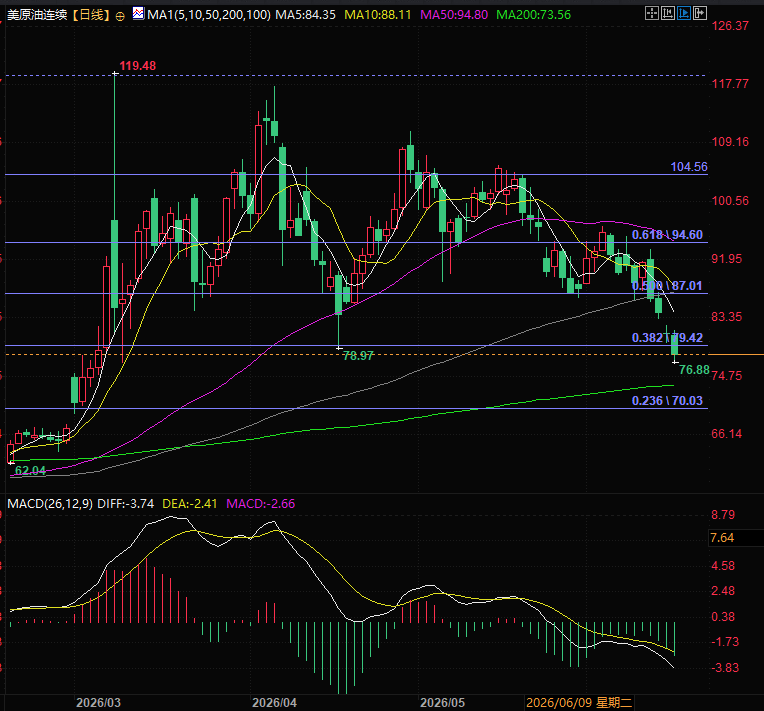
(WTI crude oil futures daily chart, source: FX678)
At 21:47 Beijing time, WTI crude oil is currently trading at $78.01 per barrel.
In the early hours of June 15, 2026, US President Trump officially announced a memorandum of understanding with the Islamic Republic of Iran, and a cautiously optimistic mood immediately spread in global markets.
The core of this highly anticipated agreement includes the reopening of the Strait of Hormuz, an extension of the 60-day ceasefire, and the reservation of room for negotiation on key issues such as Iran's nuclear program and the lifting of sanctions. The US also announced the immediate lifting of the maritime blockade against Iran, and Trump stated that the Strait of Hormuz would be "permanently free to navigate".
If the terms of the agreement are fully implemented, this could be the most significant breakthrough in Middle Eastern geopolitics in recent years.
The Middle East is currently mired in a multifaceted predicament of military rivalry, political antagonism, and economic pressure. This preliminary consensus is expected to reverse the regional geopolitical landscape, stabilize the global energy supply chain, and avert a large-scale conflict involving the US, Iran, Israel, and regional proxy forces.
However, despite the official signals of easing tensions, the market remains highly concerned about the effectiveness of the agreement. Israel's reaction, the implementation of details regarding navigation in the Strait of Hormuz, and whether the US and Iran can truly fulfill their obligations are the three major uncertainties hanging over the peace process.
Geopolitical observers point out that the practical developments in the coming weeks will determine whether this agreement is a long-term, sustainable peace solution or a temporary consensus that crumbles under pressure.
According to Kpler analyst Amena Bakr, as of June 15, the number of confirmed passages through the monitored Strait of Hormuz area (including commercial and non-commercial vessels) remained at 5, unchanged from the previous day.
Key Challenge 1: Disagreements over navigation in the Strait of Hormuz and slower-than-expected resumption of production.
As the core lifeline of global crude oil storage, transportation, and commercial shipping, the issue of navigation in the Strait of Hormuz has become the first test of the agreement.
While Trump's statement of "permanent free passage" boosted market expectations for smooth supply chains, the US and Iran still have differences on key details: the US emphasizes that the Strait should be opened unconditionally and free of charge, while Iran claims sovereign security oversight of the waterway and only agrees to grant a 60-day free passage period.
The plan is to charge fees for services such as navigation safety and environmental protection, and the management of the strait will be jointly decided by Iran and Oman.
Such differing interpretations could easily lead to new frictions. However, mine clearance in waterways, port repairs, and oil field resumption all take time. Morgan Stanley analysts predict that Iranian oil production will only recover to 50% by September and 80% by December, while full recovery of tanker traffic will take several weeks.
If fees or restrictions are imposed during the operation of the route, the agreement will face its first substantial crisis, directly impacting international crude oil pricing and global inflation trends.
Second key challenge: Israel's tough stance, with hidden geopolitical risks.
Israel's attitude has become another major risk variable.
The Middle East has long been characterized by a complex situation of "diplomatic détente and military conflict running in parallel." Israeli Prime Minister Netanyahu has made it clear that the Israeli army will continue to be stationed in the "safety buffer zones" of southern Lebanon, Syria, and the Gaza Strip. The Minister of National Security has even stated that the agreement is "not binding on" Israel.
If Israel views the US-Iran agreement as a threat to its own security interests or takes targeted military action, it will directly destroy the hard-won foundation of peace.
Regional macroeconomic researchers believe that the United States' responsibility is not limited to signing the agreement, but also requires the introduction of supporting measures to counter potential sabotage, especially in playing a key role in restraining Israel.
Hezbollah in Lebanon made it clear on Tuesday that it had received assurances from Iran that Tehran would demand Israel's withdrawal from Lebanon in the next phase of negotiations, while drawing a hard red line: "No nuclear agreement will be reached unless Israeli troops withdraw," directly linking the Lebanese issue to the nuclear negotiations.
However, the US position is completely opposite, clearly stating that the memorandum of understanding does not include a clause on troop withdrawal, and that Israel has the right to defend itself if Hezbollah launches an attack. The conflict has rapidly escalated: on the morning of June 15, Israeli airstrikes in several parts of southern Lebanon caused casualties, and the Lebanese government urged its citizens not to return home. President Aoun has listed troop withdrawal and a ceasefire as prerequisites for ending the hostilities.
Israel's recent military operations, including its occupation of southern Lebanon and Gaza, and the benefits gained there, seem to be the last thing it can offer to its people, and the only remaining victory in its ongoing war.
The third core challenge: a trust deficit in fulfilling obligations, with key demands still diverging.
The trust deficit in fulfilling contractual obligations is equally significant.
The US and Iran have agreed to divide the negotiations into two phases. The first phase will focus on a ceasefire and the opening of the Strait of Hormuz. The second phase will take 60 days to resolve core issues such as the nuclear issue and the lifting of sanctions. However, the full details of the memorandum of understanding have not yet been made public. The two sides still hold different views on key demands: Iran demands that the US unfreeze $24 billion in frozen assets, half of which must be in the account before the negotiations begin. The US, on the other hand, emphasizes that the funds will only be unfrozen after the agreement is fulfilled.
Trump denied that he would provide $300 billion in reconstruction funding, but Iran included it in the draft agreement.
The international community expects Iran to stop its provocative statements and restrain its proxy armed groups in the region, while demanding that the United States earnestly fulfill its commitments to lift sanctions and withdraw its troops. Only when both sides abandon domestic political hype and take concrete actions to rebuild mutual trust can the agreement have a foundation for long-term sustainability.
Institutional Viewpoint:
Market institutions are divided on the trend of oil prices: Shenwan Futures believes that the current price is at the lower end of the fluctuation range and the downside is limited; Galaxy Futures, on the other hand, judges that the price will continue to weaken and decline in the short term.
JPMorgan Chase further predicts that the average price of Brent crude oil for the whole year may fall back to around $60.
DBS Bank’s Head of Energy Research, Suvro Sarkar, emphasized that the market is most concerned about the complete and synchronized reopening of Phase Two. If there are any setbacks in the process, oil prices will fluctuate again.
Summary and Technical Analysis:
In conclusion, the current oil price movement is still driven by optimistic sentiment, leading to a short squeeze. As oil prices fall rapidly, long positions will be quickly liquidated, while short covering and profit-taking by short sellers may limit further downside potential.
At the same time, while pushing forward the two-phase agreement between the US and Iran, Trump made it clear that the US would not invest funds in Iran, but only seek to acquire Iranian nuclear materials, sending a clear signal of withdrawing from the Middle East.
He quickly shifted his diplomatic focus to Russia and Ukraine, stating that he would do everything in his power to end the conflict, saying that Russia should take the initiative to reach a reconciliation, and that he planned to meet with Zelensky again later. He believed that subsequent negotiations with Iran would be simpler, intending to quickly resolve Middle Eastern affairs and transfer diplomatic resources and strategic attention to the Russian and European fronts.
The global economy has been impacted by energy shocks, leading to weak imports in some countries. Coupled with the structural pressure of OPEC's weakened influence following the UAE's withdrawal, oil prices will move forward amid multiple interplays of agreement implementation progress, recurring geopolitical risks, and changes in the supply and demand landscape. This will become a core indicator reflecting the effectiveness of the US-Iran peace process.
From a technical perspective, WTI oil prices have fallen below the 0.382 percentile of this round of gains at 79.4. Although oil prices have confirmed a bear market, there is still a possibility of a rapid rebound. Currently, oil prices are only up 14% from the starting point of the US-Iran conflict, and a rebound could occur at any time at this level.
(WTI crude oil futures daily chart, source: FX678)
At 21:47 Beijing time, WTI crude oil is currently trading at $78.01 per barrel.
- Risk Warning and Disclaimer
- The market involves risk, and trading may not be suitable for all investors. This article is for reference only and does not constitute personal investment advice, nor does it take into account certain users’ specific investment objectives, financial situation, or other needs. Any investment decisions made based on this information are at your own risk.