After the tail risks of the energy sector are squeezed out, the global bond market is "moving in the same direction but not in sync": Is the yield curve shape more frightening than oil prices?
2026-06-17 14:43:20
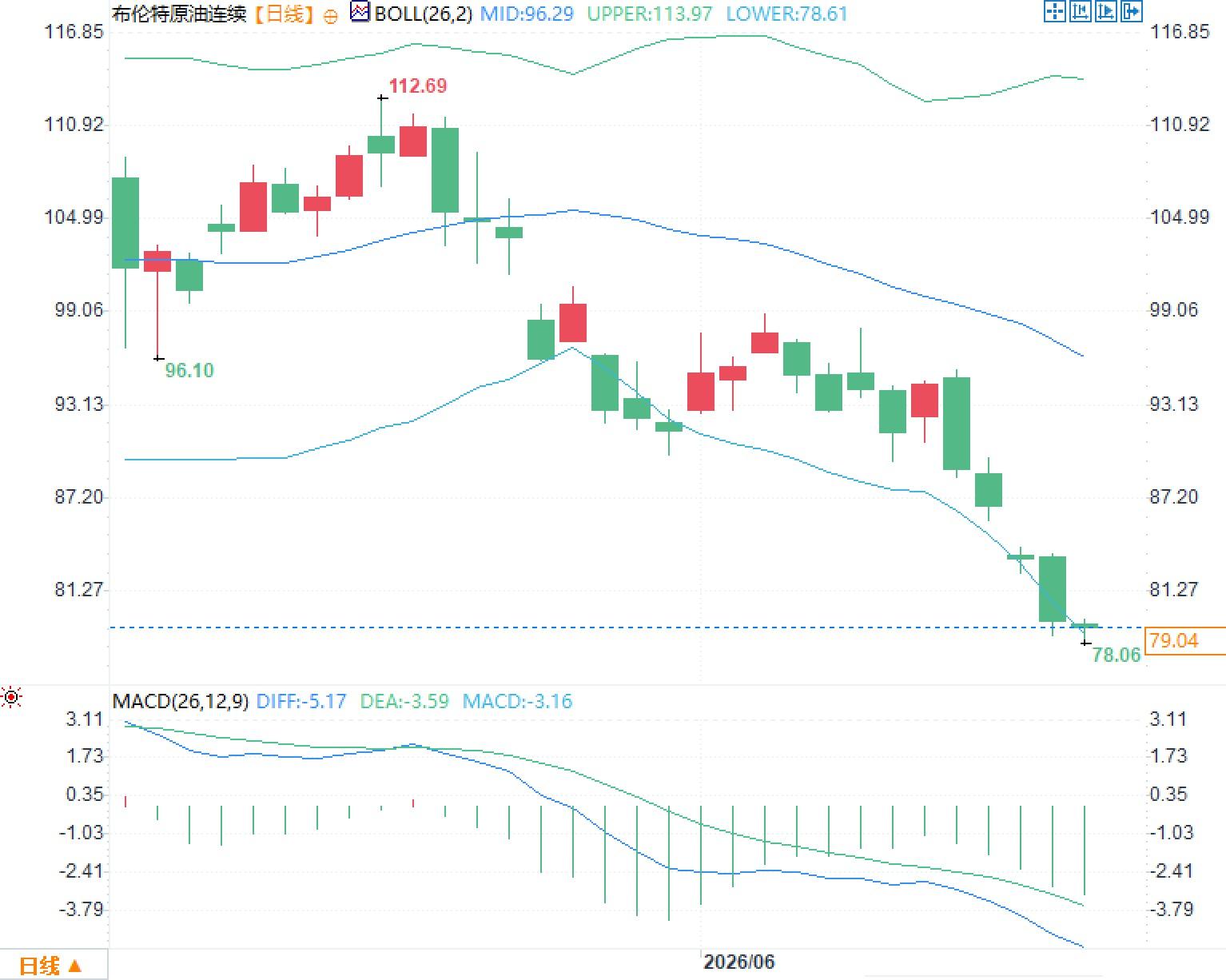
On Wednesday, June 17th, the global market's main focus shifted back from energy shocks to interest rate expectations. Brent crude oil is currently trading around $79 per barrel, and West Texas Intermediate crude oil around $75.50 per barrel, with oil prices near three-month lows. The core reason is that the interim agreement between the US and Iran has improved expectations for the reopening of the Strait of Hormuz. Meanwhile, the 10-year US Treasury yield has fallen to around 4.44%, and the US dollar index is trading weakly around 99.53, indicating that the market has not simply entered a one-sided recovery in risk appetite, but rather is repricing the relationship between inflation, central bank policy, and safe-haven premiums.
Over the past few trading days, energy prices have quickly shifted from amplifying inflationary risks to a trigger for lower interest rates. Brent crude oil has fallen by nearly 15%, not due to a sudden collapse in demand, but rather because supply risk premiums have been squeezed out. Following improved expectations regarding the Strait of Hormuz, the market initially revised downwards on tail risks stemming from transportation disruptions, rising insurance costs, and actual supply interruptions.
This has a very direct impact on the bond market. Previously, rising oil prices reinforced the narrative that "energy inflation slows interest rate cuts and may even force rate hikes," while the sharp drop in oil prices has led traders to reassess the persistence of inflationary pressures. The 10-year US Treasury yield has returned to near a one-month low, and long-term yields in Australia and Japan have declined in tandem, reflecting that cross-market funds are reducing their demand for long-term inflation compensation.
However, declining energy prices do not equate to the disappearance of inflation risks. If the resumption of cross-strait traffic is slower than expected, or if the purchasing pace of insurance companies, shipping companies, and refineries remains disrupted, the risk premium for oil prices may still fluctuate. The key to current trading is not whether oil prices are "safe," but whether the chain of transmission from energy shocks to inflation expectations has been broken.
The Federal Reserve is highly likely to keep its policy rate unchanged this week. The market is really watching the communication style of new Chairman Warsh after his first meeting. There is considerable disagreement at present. Some institutions believe that a rate hike is still possible this year, while others believe that the decline in oil prices has reduced policy pressure, leaving room for a shift towards easing. In other words, the point of contention has shifted from "whether it will happen this time" to "how the reaction function will change in the future."
Warsh was previously seen by the market as a policymaker who placed greater emphasis on inflation constraints. If he downplays the dot plot or reduces excessive forward guidance, the market will lose a familiar pricing anchor. This means that short-term interest rate option volatility may remain high, as traders will need to piece together the policy path from the statement's wording, economic forecasts, and press conference details.
The drop in oil prices provides the Federal Reserve with a wider window of observation, but this does not automatically translate into a dovish conclusion. If inflation, wage growth, and demand data remain resilient, the Fed has no need to rush to confirm a shift. Conversely, if the statement emphasizes that "the decline in energy prices has reduced short-term inflationary pressures, but medium-term inflation remains to be seen," market bets on easing this year may continue to be limited.
The overnight structure of US stocks was crucial. The Dow Jones Industrial Average closed at a record high, but the S&P 500 and Nasdaq were under pressure, with the Nasdaq falling about 1.15% and the semiconductor index dropping as much as 5.7%. This indicates that funds are not entirely withdrawing from risky assets, but rather withdrawing some of their risk exposure from the crowded valuations and highly concentrated earnings expectations of the technology chain, and shifting to sectors such as finance and industrials that are more sensitive to declining interest rates and cyclical recovery.
This kind of divergence is important for traders. Lower oil prices typically help reduce cost pressures and may improve expectations for consumer and corporate profits, but if there's a concentrated pullback in tech stocks, the rebound potential at the index level will be suppressed. The slight rise in S&P 500 futures does not indicate that market risks have been completely eliminated; it's more of a position adjustment ahead of policy events.
Amidst a general trend of most major central banks holding rates steady this week, the Bank of Japan opted to raise its policy rate to 1%, a 31-year high. This move failed to significantly boost the yen, which remained hovering around 160, indicating that the market believes that while the Bank of Japan continues its normalization efforts, interest rate differentials and external energy shocks continue to limit exchange rate recovery.
The Bank of Japan's signal signifies that global central banks have not entered a cycle moving in the same direction. While falling energy prices have eased some imported inflationary pressures, wage, inflation expectations, and exchange rate pressures vary across economies. For the global interest rate market, this means that yield curve trading cannot solely rely on oil prices; it must also consider the differing assessments of the causes of inflation by various central banks.
If the Federal Reserve remains on hold, the Bank of Japan continues its cautious approach to interest rate hikes, and the European Central Bank and the Bank of England maintain restraint, the global bond market will exhibit a characteristic of "shared direction but divergent pace." Long-term yields will be dragged down in the short term by oil prices, but short-term yields will still be dominated by central bank statements; the yield curve shape may reflect true expectations better than a single yield level.
The sharp drop in oil prices has changed the core of interest rate trading pricing.
Over the past few trading days, energy prices have quickly shifted from amplifying inflationary risks to a trigger for lower interest rates. Brent crude oil has fallen by nearly 15%, not due to a sudden collapse in demand, but rather because supply risk premiums have been squeezed out. Following improved expectations regarding the Strait of Hormuz, the market initially revised downwards on tail risks stemming from transportation disruptions, rising insurance costs, and actual supply interruptions.
This has a very direct impact on the bond market. Previously, rising oil prices reinforced the narrative that "energy inflation slows interest rate cuts and may even force rate hikes," while the sharp drop in oil prices has led traders to reassess the persistence of inflationary pressures. The 10-year US Treasury yield has returned to near a one-month low, and long-term yields in Australia and Japan have declined in tandem, reflecting that cross-market funds are reducing their demand for long-term inflation compensation.
However, declining energy prices do not equate to the disappearance of inflation risks. If the resumption of cross-strait traffic is slower than expected, or if the purchasing pace of insurance companies, shipping companies, and refineries remains disrupted, the risk premium for oil prices may still fluctuate. The key to current trading is not whether oil prices are "safe," but whether the chain of transmission from energy shocks to inflation expectations has been broken.
The focus of the Federal Reserve meeting was not on interest rates themselves.
The Federal Reserve is highly likely to keep its policy rate unchanged this week. The market is really watching the communication style of new Chairman Warsh after his first meeting. There is considerable disagreement at present. Some institutions believe that a rate hike is still possible this year, while others believe that the decline in oil prices has reduced policy pressure, leaving room for a shift towards easing. In other words, the point of contention has shifted from "whether it will happen this time" to "how the reaction function will change in the future."
Warsh was previously seen by the market as a policymaker who placed greater emphasis on inflation constraints. If he downplays the dot plot or reduces excessive forward guidance, the market will lose a familiar pricing anchor. This means that short-term interest rate option volatility may remain high, as traders will need to piece together the policy path from the statement's wording, economic forecasts, and press conference details.
The drop in oil prices provides the Federal Reserve with a wider window of observation, but this does not automatically translate into a dovish conclusion. If inflation, wage growth, and demand data remain resilient, the Fed has no need to rush to confirm a shift. Conversely, if the statement emphasizes that "the decline in energy prices has reduced short-term inflationary pressures, but medium-term inflation remains to be seen," market bets on easing this year may continue to be limited.
The divergence in the stock market indicates that risk appetite is not solid.
The overnight structure of US stocks was crucial. The Dow Jones Industrial Average closed at a record high, but the S&P 500 and Nasdaq were under pressure, with the Nasdaq falling about 1.15% and the semiconductor index dropping as much as 5.7%. This indicates that funds are not entirely withdrawing from risky assets, but rather withdrawing some of their risk exposure from the crowded valuations and highly concentrated earnings expectations of the technology chain, and shifting to sectors such as finance and industrials that are more sensitive to declining interest rates and cyclical recovery.
This kind of divergence is important for traders. Lower oil prices typically help reduce cost pressures and may improve expectations for consumer and corporate profits, but if there's a concentrated pullback in tech stocks, the rebound potential at the index level will be suppressed. The slight rise in S&P 500 futures does not indicate that market risks have been completely eliminated; it's more of a position adjustment ahead of policy events.
The Bank of Japan has raised interest rates this week.
Amidst a general trend of most major central banks holding rates steady this week, the Bank of Japan opted to raise its policy rate to 1%, a 31-year high. This move failed to significantly boost the yen, which remained hovering around 160, indicating that the market believes that while the Bank of Japan continues its normalization efforts, interest rate differentials and external energy shocks continue to limit exchange rate recovery.
The Bank of Japan's signal signifies that global central banks have not entered a cycle moving in the same direction. While falling energy prices have eased some imported inflationary pressures, wage, inflation expectations, and exchange rate pressures vary across economies. For the global interest rate market, this means that yield curve trading cannot solely rely on oil prices; it must also consider the differing assessments of the causes of inflation by various central banks.
If the Federal Reserve remains on hold, the Bank of Japan continues its cautious approach to interest rate hikes, and the European Central Bank and the Bank of England maintain restraint, the global bond market will exhibit a characteristic of "shared direction but divergent pace." Long-term yields will be dragged down in the short term by oil prices, but short-term yields will still be dominated by central bank statements; the yield curve shape may reflect true expectations better than a single yield level.
- Risk Warning and Disclaimer
- The market involves risk, and trading may not be suitable for all investors. This article is for reference only and does not constitute personal investment advice, nor does it take into account certain users’ specific investment objectives, financial situation, or other needs. Any investment decisions made based on this information are at your own risk.