The 14-point details of the US-Iran agreement have been revealed, leading to a de-escalation in geopolitical tensions, but gold prices are stagfl, prompting reflection.
2026-06-17 16:43:18
The United States and Iran recently reached a provisional memorandum of understanding, scheduled to be formally signed in Switzerland this Friday. This provisional agreement has put a pause on the months-long Middle East conflict, and shipping in the Strait of Hormuz, Iranian oil exports, nuclear competition among major powers, and the geopolitical crisis in Israel have all seen a new easing of restrictions. However, the agreement has not addressed the core differences between the two sides, and beneath the short-term easing lies a multitude of long-term contradictions that continue to influence the direction of global energy and capital markets.
Early this morning, Saudi Arabia's Al Arabiya television released the detailed terms of the 14-point memorandum of understanding between the US and Iran, further demonstrating the sincerity of both sides in reaching a settlement. Coupled with marginal improvements in cross-strait shipping, this significantly boosts market confidence in the agreement's implementation.
Based on the previous logic of the US dollar index and real interest rates, a reduction in geopolitical risks should be beneficial to gold prices and detrimental to oil prices. However, gold's performance has been somewhat hesitant, indicating a subtle shift in market sentiment towards gold.

From the perspective of shipping and crude oil trade, the most direct change in the agreement is the lifting of the maritime blockade of the Persian Gulf and the reopening of the Strait of Hormuz.
This crucial shipping route, carrying one-fifth of the world's crude oil and liquefied natural gas, has been nearly shut down since the US-Israel joint military action against Iran at the end of February, pushing up the risk premium for crude oil for several months.
With the lifting of the blockade, Iran's crude oil exports have recovered rapidly. According to data from maritime intelligence agencies, Iran has broken through the blockade for the first time in nearly two months and shipped out crude oil. Two very large crude carriers carrying a total of 3.8 million barrels of crude oil left the Persian Gulf blockade line, and a third tanker carrying 1 million barrels of crude oil followed suit.
The Iranian oil tanker "Strium", which had been stranded in Pakistan's exclusive economic zone for seven weeks, has also set sail again.
The market reacted just as quickly, with several ocean-going oil tankers urgently changing course within hours of the agreement's implementation. Two large oil tankers originally destined for Africa changed course and headed to Fujairah Port in the UAE to seize the shipping capacity advantage in the Middle East.
Most shipowners are still taking a wait-and-see approach, but shipping companies with stronger risk tolerance have begun to finalize cross-strait voyages. At present, ocean freight rates still come with a geopolitical risk premium, and shipping companies that make early moves are expected to reap excess profits.
This interim agreement sets a 60-day special negotiation period, with the core objective of discussing Iran's nuclear program, the root cause of the long-standing confrontation between the US and Iran. However, all parties generally predict that it will be difficult to reach a mature and complete nuclear agreement in the short term.
The 2015 Joint Comprehensive Plan of Action (the old Iran nuclear deal) took more than 18 months to finalize. It relied on the deep involvement of multiple parties, including China, the United States, Russia, and Europe, as well as the International Atomic Energy Agency, and repeated consultations with dozens of top technical experts. The agreement included extremely detailed technical constraints on uranium enrichment, advanced centrifuges, and heavy water production. Trump unilaterally withdrew from the old agreement in 2018. Because the signing method was similar to a memorandum, there were no penalties for withdrawal.
Despite Vice President Vance's public expressions of confidence, stating that the agreement employs a "compliance-for-benefits" mechanism, meaning that Iran can only receive incentives such as sanctions waivers and financial support by implementing denuclearization-related actions, and despite Iran's consistent assertion that its nuclear program is solely for peaceful purposes, members of both parties in the U.S. Congress remain highly skeptical.
Industry experts bluntly stated that Kushner and Vitkov, who were in charge of the negotiations, had no professional background in nuclear negotiations. The current government is unlikely to focus on complex technical issues for an extended period, and there is a high risk of a shift in attention and a disruption in the pace of negotiations.
Republican Senator Lindsey Graham made it clear that a qualified agreement must result in Iran completely halting uranium enrichment, and whether negotiations can proceed to the second phase at this stage is highly uncertain.
The Republican camp also insists that any finalized Iran nuclear deal must be submitted to Congress for approval, with the Senate retaining the final decision-making power. Some senators even directly predict that Iran will use the negotiations to delay the process and take the opportunity to expand its military.
In addition, disputes such as Iran's ballistic missile program, support for armed proxies in the Middle East, and domestic livelihood control were not included in the scope of the interim agreement negotiations. Even if the consultations proceed smoothly within the 60-day window, it will be difficult to resolve all differences at once.
The enormous impact of the easing of tensions between the US and Iran is concentrated in the Israeli political arena and the regional security landscape, with Israeli Prime Minister Netanyahu facing a severe dual crisis of politics and geopolitics.
Previously, Trump declared that he would join Israel in launching a war against Iran in February, with the core objective of preventing Iran from developing nuclear weapons. Netanyahu has also long regarded "containing Iran's nuclear forces" as the core banner of his administration, relying on exaggerating the security threat posed by Iran to build domestic consensus and counter the opposition's offensive.
However, the interim agreement between the US and Iran shelved the core nuclear issue and opened up Iranian crude oil exports and financial channels, which is equivalent to significantly easing restrictions on Iran. The Israeli government and opposition parties generally believe that this agreement ignores the country's survival and security, and the opposition party and senior defense officials have successively criticized the US for its compromise.
Former US Secretary of State Hillary Clinton bluntly stated that Netanyahu's political foundation is highly dependent on external conflicts created by the Middle East conflict, and this interim agreement between the US and Iran may be the key blow to destroying his ruling foundation and accelerating his resignation in the future election.
Currently, Israel has made it clear that it is not bound by the US-Iran memorandum and retains the authority to conduct independent military operations. The Israeli army has not withdrawn from its positions in southern Lebanon. Even if the US and Iran achieve a short-term ceasefire, the risk of Israel unilaterally launching a military strike against Iran and its regional armed groups still exists, and the hidden danger of a resurgence of local conflicts in the Middle East has not been completely eliminated.
The real interest rate equals the nominal interest rate minus inflation expectations. We can observe this through 10-year inflation-hedging bonds. The real interest rate is still trending upward. One reason is that inflation expectations continue to decline, with the market anticipating that the Strait of Hormuz will eventually open. Another reason is that the slowdown in global economic growth has led to a rapid decline in inflation expectations. However, due to the significant increase in global AI capital expenditure, global funding costs have been passively raised, and government bond issuance costs and yields are both rising.
Meanwhile, there is a substitution effect between the equity market and the precious metals market such as gold, with funds tending to go where the returns are higher. Finally, as the hedging effect of gold in investment portfolios declines, the demand for related hedging weakens.
Note that the current gold bull market started when US real interest rates peaked and then corrected. If the US continues to cut interest rates, or if real interest rates reach an inflection point, gold is expected to continue to rise. However, this inflection point may be far away due to the AI revolution, and high growth, high inflation, and high interest rates may become the norm.
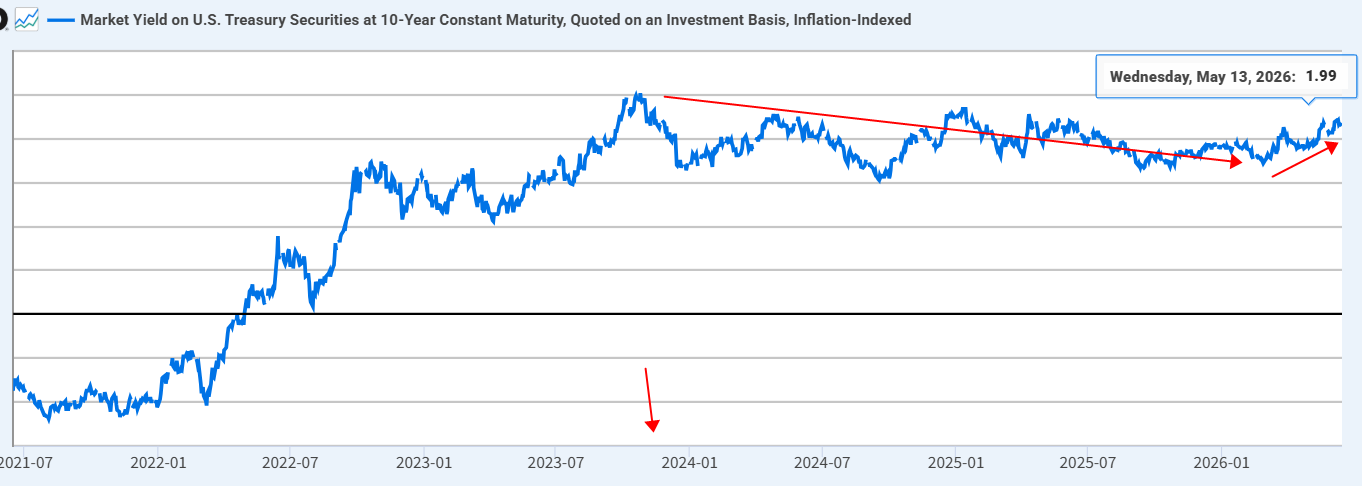
(Trend chart of yields on 10-year US inflation-protected bonds, source: Federal Reserve)
Peace talks are conducive to a decline in inflation and a decrease in real interest rates, leading to a rebound in gold prices. On the surface, the end of the Russia-Ukraine conflict and the US-Iran war are unfavorable to gold. However, what is truly suppressing gold prices is the weakening of gold's hedging function and the narrative that real interest rates will be higher and longer.
Technical Analysis: After rebounding and breaking through the descending channel, spot gold has entered a consolidation phase, with support at the 5-day moving average and the middle line of the descending channel. The measured upside is around 4430. However, if the price of gold stops here and instead turns down, market risk appetite may be affected and eventually deteriorate rapidly.
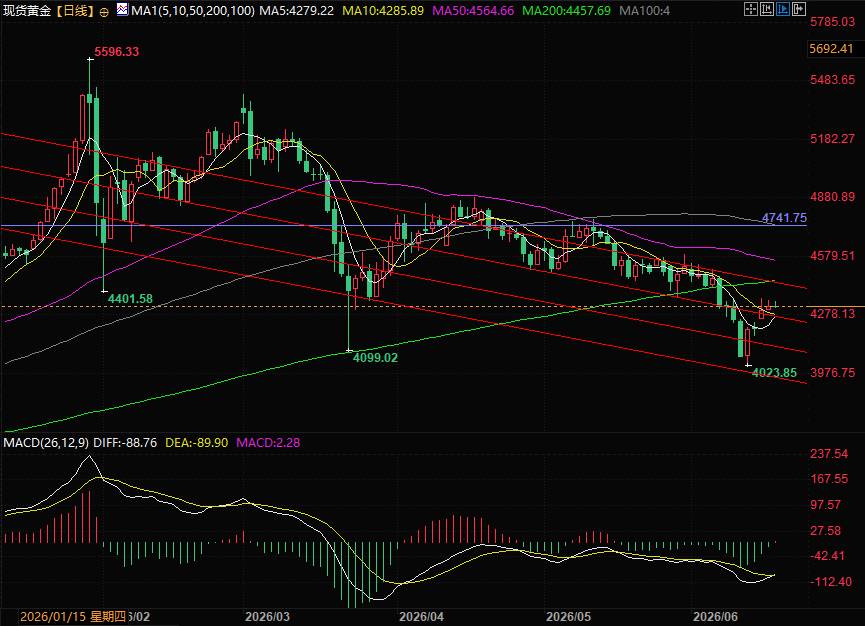
(Spot gold daily chart, source: FX678)
At 16:08 Beijing time, spot gold was trading at $4,327 per ounce.
To facilitate readers' detailed understanding of the core provisions of the interim US-Iran agreement, the complete 14-point Memorandum of Understanding disclosed by Saudi Arabia's Al Arabiya television is presented below:
Full terms of the 14-point Memorandum of Understanding between the US and Iran:
1. Iran and the United States, along with their allies in the current war, declare an immediate and permanent end to the war on all fronts, including Lebanon, effective from the date of signing this Memorandum of Understanding, and pledge to refrain from any further hostile actions against each other, nor from threatening or using force against one another. The final agreement will confirm the provisions of this article and other clauses.
2. Iran and the United States pledged to respect each other's sovereignty and territorial integrity and not to interfere in each other's internal affairs.
3. Iran and the United States pledged to negotiate and reach a final agreement within a period of no more than 60 days, which could be extended by mutual agreement.
4. Upon signing this Memorandum of Understanding, the United States will immediately lift its naval blockade against Iran, prevent any interference or obstruction, and restore Iran's full shipping capacity within a maximum of 30 days; the volume of ship traffic should be proportional to the pre-war volume. The United States also pledges to withdraw its troops from the surrounding area within 30 days of the final agreement being reached.
5. Upon signing this Memorandum of Understanding, Iran will immediately take measures to ensure that merchant shipping between the Persian Gulf and the Sea of Oman is restored to pre-war levels within 30 days, while also taking into account Iran's need to clear technical obstacles and neutralize mines.
6. The United States will work with regional partners to develop a comprehensive, mutually agreed-upon plan for Iran's resurgence and development, and will guarantee at least $300 billion in financial support. The implementation mechanism for this plan will be finalized within 60 days, within the framework of a final agreement.
7. The United States pledged to end all types of sanctions currently in place against Iran within the timeframe agreed in the final agreement, including UN Security Council resolutions, International Atomic Energy Agency (IAEA) Board of Governors resolutions, and all major and minor sanctions unilaterally imposed by the United States.
8. Iran reiterated that it will never develop nuclear weapons. Iran and the United States have reached an agreement to properly resolve the fate of enriched uranium and all other nuclear-related issues agreed upon by both sides, including Iran's nuclear needs, through a final agreement; this final agreement will confirm the contents of this clause.
9. Iran and the United States agreed to maintain the status quo until a final agreement is reached: Iran will continue with its nuclear program as it is, and the United States will not impose new sanctions on Iran or increase its military presence in the region.
10. The United States undertakes that, following the signing of this Memorandum of Understanding, the U.S. Treasury Department will grant exemptions to Iranian exports of crude oil, petrochemical products and their derivatives, as well as all related services (including banking, insurance, transportation, etc.) until the date of lifting of sanctions.
11. The United States pledged that, given the progress made in the negotiations, frozen or restricted funds and assets in Iran would be released and fully utilized. Whether these funds were held in a master account or had been transferred, they would be used in full by the ultimate beneficiaries identified by the Central Bank of Iran. The United States pledged to issue all necessary permits on this basis.
12. Iran and the United States agreed to establish an implementation mechanism to monitor the successful implementation of the final agreement and the fulfillment of future commitments.
13. Upon signing this Memorandum of Understanding and receiving assurances regarding the commencement of implementation of Articles 4, 5, 10, and 11 of this Memorandum and the continued implementation of the aforementioned measures, Iran and the United States will negotiate the remaining terms to reach a final agreement.
14. The final agreement will be approved by a legally binding resolution of the UN Security Council.
Early this morning, Saudi Arabia's Al Arabiya television released the detailed terms of the 14-point memorandum of understanding between the US and Iran, further demonstrating the sincerity of both sides in reaching a settlement. Coupled with marginal improvements in cross-strait shipping, this significantly boosts market confidence in the agreement's implementation.
Based on the previous logic of the US dollar index and real interest rates, a reduction in geopolitical risks should be beneficial to gold prices and detrimental to oil prices. However, gold's performance has been somewhat hesitant, indicating a subtle shift in market sentiment towards gold.
With the resumption of navigation across the strait, Iranian crude oil exports are recovering rapidly.
From the perspective of shipping and crude oil trade, the most direct change in the agreement is the lifting of the maritime blockade of the Persian Gulf and the reopening of the Strait of Hormuz.
This crucial shipping route, carrying one-fifth of the world's crude oil and liquefied natural gas, has been nearly shut down since the US-Israel joint military action against Iran at the end of February, pushing up the risk premium for crude oil for several months.
With the lifting of the blockade, Iran's crude oil exports have recovered rapidly. According to data from maritime intelligence agencies, Iran has broken through the blockade for the first time in nearly two months and shipped out crude oil. Two very large crude carriers carrying a total of 3.8 million barrels of crude oil left the Persian Gulf blockade line, and a third tanker carrying 1 million barrels of crude oil followed suit.
The Iranian oil tanker "Strium", which had been stranded in Pakistan's exclusive economic zone for seven weeks, has also set sail again.
The market reacted just as quickly, with several ocean-going oil tankers urgently changing course within hours of the agreement's implementation. Two large oil tankers originally destined for Africa changed course and headed to Fujairah Port in the UAE to seize the shipping capacity advantage in the Middle East.
Most shipowners are still taking a wait-and-see approach, but shipping companies with stronger risk tolerance have begun to finalize cross-strait voyages. At present, ocean freight rates still come with a geopolitical risk premium, and shipping companies that make early moves are expected to reap excess profits.
Nuclear negotiations face multiple obstacles, and the 60-day window is fraught with uncertainty.
This interim agreement sets a 60-day special negotiation period, with the core objective of discussing Iran's nuclear program, the root cause of the long-standing confrontation between the US and Iran. However, all parties generally predict that it will be difficult to reach a mature and complete nuclear agreement in the short term.
The 2015 Joint Comprehensive Plan of Action (the old Iran nuclear deal) took more than 18 months to finalize. It relied on the deep involvement of multiple parties, including China, the United States, Russia, and Europe, as well as the International Atomic Energy Agency, and repeated consultations with dozens of top technical experts. The agreement included extremely detailed technical constraints on uranium enrichment, advanced centrifuges, and heavy water production. Trump unilaterally withdrew from the old agreement in 2018. Because the signing method was similar to a memorandum, there were no penalties for withdrawal.
Despite Vice President Vance's public expressions of confidence, stating that the agreement employs a "compliance-for-benefits" mechanism, meaning that Iran can only receive incentives such as sanctions waivers and financial support by implementing denuclearization-related actions, and despite Iran's consistent assertion that its nuclear program is solely for peaceful purposes, members of both parties in the U.S. Congress remain highly skeptical.
Industry experts bluntly stated that Kushner and Vitkov, who were in charge of the negotiations, had no professional background in nuclear negotiations. The current government is unlikely to focus on complex technical issues for an extended period, and there is a high risk of a shift in attention and a disruption in the pace of negotiations.
Republican Senator Lindsey Graham made it clear that a qualified agreement must result in Iran completely halting uranium enrichment, and whether negotiations can proceed to the second phase at this stage is highly uncertain.
The Republican camp also insists that any finalized Iran nuclear deal must be submitted to Congress for approval, with the Senate retaining the final decision-making power. Some senators even directly predict that Iran will use the negotiations to delay the process and take the opportunity to expand its military.
In addition, disputes such as Iran's ballistic missile program, support for armed proxies in the Middle East, and domestic livelihood control were not included in the scope of the interim agreement negotiations. Even if the consultations proceed smoothly within the 60-day window, it will be difficult to resolve all differences at once.
Israel's political situation is in turmoil, and the risk of regional conflict remains.
The enormous impact of the easing of tensions between the US and Iran is concentrated in the Israeli political arena and the regional security landscape, with Israeli Prime Minister Netanyahu facing a severe dual crisis of politics and geopolitics.
Previously, Trump declared that he would join Israel in launching a war against Iran in February, with the core objective of preventing Iran from developing nuclear weapons. Netanyahu has also long regarded "containing Iran's nuclear forces" as the core banner of his administration, relying on exaggerating the security threat posed by Iran to build domestic consensus and counter the opposition's offensive.
However, the interim agreement between the US and Iran shelved the core nuclear issue and opened up Iranian crude oil exports and financial channels, which is equivalent to significantly easing restrictions on Iran. The Israeli government and opposition parties generally believe that this agreement ignores the country's survival and security, and the opposition party and senior defense officials have successively criticized the US for its compromise.
Former US Secretary of State Hillary Clinton bluntly stated that Netanyahu's political foundation is highly dependent on external conflicts created by the Middle East conflict, and this interim agreement between the US and Iran may be the key blow to destroying his ruling foundation and accelerating his resignation in the future election.
Currently, Israel has made it clear that it is not bound by the US-Iran memorandum and retains the authority to conduct independent military operations. The Israeli army has not withdrawn from its positions in southern Lebanon. Even if the US and Iran achieve a short-term ceasefire, the risk of Israel unilaterally launching a military strike against Iran and its regional armed groups still exists, and the hidden danger of a resurgence of local conflicts in the Middle East has not been completely eliminated.
Inflation expectations have eased, but real interest rates remain high.
The real interest rate equals the nominal interest rate minus inflation expectations. We can observe this through 10-year inflation-hedging bonds. The real interest rate is still trending upward. One reason is that inflation expectations continue to decline, with the market anticipating that the Strait of Hormuz will eventually open. Another reason is that the slowdown in global economic growth has led to a rapid decline in inflation expectations. However, due to the significant increase in global AI capital expenditure, global funding costs have been passively raised, and government bond issuance costs and yields are both rising.
Meanwhile, there is a substitution effect between the equity market and the precious metals market such as gold, with funds tending to go where the returns are higher. Finally, as the hedging effect of gold in investment portfolios declines, the demand for related hedging weakens.
Note that the current gold bull market started when US real interest rates peaked and then corrected. If the US continues to cut interest rates, or if real interest rates reach an inflection point, gold is expected to continue to rise. However, this inflection point may be far away due to the AI revolution, and high growth, high inflation, and high interest rates may become the norm.
(Trend chart of yields on 10-year US inflation-protected bonds, source: Federal Reserve)
Summary and Technical Analysis:
Peace talks are conducive to a decline in inflation and a decrease in real interest rates, leading to a rebound in gold prices. On the surface, the end of the Russia-Ukraine conflict and the US-Iran war are unfavorable to gold. However, what is truly suppressing gold prices is the weakening of gold's hedging function and the narrative that real interest rates will be higher and longer.
Technical Analysis: After rebounding and breaking through the descending channel, spot gold has entered a consolidation phase, with support at the 5-day moving average and the middle line of the descending channel. The measured upside is around 4430. However, if the price of gold stops here and instead turns down, market risk appetite may be affected and eventually deteriorate rapidly.
(Spot gold daily chart, source: FX678)
At 16:08 Beijing time, spot gold was trading at $4,327 per ounce.
To facilitate readers' detailed understanding of the core provisions of the interim US-Iran agreement, the complete 14-point Memorandum of Understanding disclosed by Saudi Arabia's Al Arabiya television is presented below:
Full terms of the 14-point Memorandum of Understanding between the US and Iran:
1. Iran and the United States, along with their allies in the current war, declare an immediate and permanent end to the war on all fronts, including Lebanon, effective from the date of signing this Memorandum of Understanding, and pledge to refrain from any further hostile actions against each other, nor from threatening or using force against one another. The final agreement will confirm the provisions of this article and other clauses.
2. Iran and the United States pledged to respect each other's sovereignty and territorial integrity and not to interfere in each other's internal affairs.
3. Iran and the United States pledged to negotiate and reach a final agreement within a period of no more than 60 days, which could be extended by mutual agreement.
4. Upon signing this Memorandum of Understanding, the United States will immediately lift its naval blockade against Iran, prevent any interference or obstruction, and restore Iran's full shipping capacity within a maximum of 30 days; the volume of ship traffic should be proportional to the pre-war volume. The United States also pledges to withdraw its troops from the surrounding area within 30 days of the final agreement being reached.
5. Upon signing this Memorandum of Understanding, Iran will immediately take measures to ensure that merchant shipping between the Persian Gulf and the Sea of Oman is restored to pre-war levels within 30 days, while also taking into account Iran's need to clear technical obstacles and neutralize mines.
6. The United States will work with regional partners to develop a comprehensive, mutually agreed-upon plan for Iran's resurgence and development, and will guarantee at least $300 billion in financial support. The implementation mechanism for this plan will be finalized within 60 days, within the framework of a final agreement.
7. The United States pledged to end all types of sanctions currently in place against Iran within the timeframe agreed in the final agreement, including UN Security Council resolutions, International Atomic Energy Agency (IAEA) Board of Governors resolutions, and all major and minor sanctions unilaterally imposed by the United States.
8. Iran reiterated that it will never develop nuclear weapons. Iran and the United States have reached an agreement to properly resolve the fate of enriched uranium and all other nuclear-related issues agreed upon by both sides, including Iran's nuclear needs, through a final agreement; this final agreement will confirm the contents of this clause.
9. Iran and the United States agreed to maintain the status quo until a final agreement is reached: Iran will continue with its nuclear program as it is, and the United States will not impose new sanctions on Iran or increase its military presence in the region.
10. The United States undertakes that, following the signing of this Memorandum of Understanding, the U.S. Treasury Department will grant exemptions to Iranian exports of crude oil, petrochemical products and their derivatives, as well as all related services (including banking, insurance, transportation, etc.) until the date of lifting of sanctions.
11. The United States pledged that, given the progress made in the negotiations, frozen or restricted funds and assets in Iran would be released and fully utilized. Whether these funds were held in a master account or had been transferred, they would be used in full by the ultimate beneficiaries identified by the Central Bank of Iran. The United States pledged to issue all necessary permits on this basis.
12. Iran and the United States agreed to establish an implementation mechanism to monitor the successful implementation of the final agreement and the fulfillment of future commitments.
13. Upon signing this Memorandum of Understanding and receiving assurances regarding the commencement of implementation of Articles 4, 5, 10, and 11 of this Memorandum and the continued implementation of the aforementioned measures, Iran and the United States will negotiate the remaining terms to reach a final agreement.
14. The final agreement will be approved by a legally binding resolution of the UN Security Council.
- Risk Warning and Disclaimer
- The market involves risk, and trading may not be suitable for all investors. This article is for reference only and does not constitute personal investment advice, nor does it take into account certain users’ specific investment objectives, financial situation, or other needs. Any investment decisions made based on this information are at your own risk.