Crude oil trading alert: Oil prices are struggling to rebound and may continue to decline in the short term.
2026-06-18 09:26:08
International crude oil markets showed signs of stabilization during Asian trading hours on Thursday, with West Texas Intermediate (WTI) crude rebounding slightly after five consecutive days of decline, trading around $75.00. However, from a fundamental perspective, the geopolitical supply risks that previously drove up oil prices are continuing to ease, and market sentiment is gradually shifting from risk aversion to a focus on global supply recovery and future demand prospects.

US President Donald Trump and Iranian President Masoud Pezechiyan have signed a preliminary memorandum of understanding aimed at ending the regional conflict. Previously, US Vice President James David Vance and Iranian Parliament Speaker Mohammad Bagher Ghalibaf had completed a framework agreement, paving the way for a formal peace agreement.
According to the agreement, both sides will advance negotiations on a final peace agreement within the next 60 days, focusing on key aspects such as the resumption of shipping in the Strait of Hormuz, the lifting of restrictions on Iranian crude oil exports, and the establishment of a long-term security mechanism. The market believes that this agreement will help alleviate the risk of supply disruptions that have plagued the global energy market in recent months. The Strait of Hormuz handles approximately 20% of global seaborne crude oil transport, and its resumption of normal operations means that the Middle East's crude oil export capacity is expected to increase significantly.
Meanwhile, expectations for the return of Iranian crude oil exports to the international market continue to strengthen. Analysts believe that if sanctions are gradually lifted, Iranian crude oil supply may grow rapidly in the coming months, thereby further improving the global crude oil supply situation.
On the macro level, the Federal Reserve's latest interest rate decision also put pressure on oil prices. The Federal Open Market Committee unanimously decided to keep the federal funds rate unchanged at 3.50%-3.75%. Newly appointed Fed Chairman Kevin Warsh emphasized at his first meeting in office that he would continue to push inflation back to the target level.
While maintaining interest rates was in line with market expectations, policy signals from the decision-making level leaned towards a hawkish stance. Several officials hinted that the likelihood of further monetary tightening this year is rising, given persistent energy price volatility and inflation risks. The market anticipates that higher financing costs could dampen corporate investment and consumer demand, thereby weakening expectations for future energy consumption growth.
Changes in supply-side expectations have further reinforced bearish sentiment in the market. The International Energy Agency (IEA)'s latest monthly report points out that with the recovery of exports from the Middle East and the continued expansion of production by non-OPEC+ oil-producing countries, the global crude oil market may face a significant oversupply in the coming years.
The report projects that global crude oil supply capacity will increase by approximately 8 million barrels per day by 2027, while global demand will only increase by about 2 million barrels per day during the same period. The International Energy Agency believes that the full recovery of Middle Eastern exports, the growth of US shale oil production, and the commissioning of new projects in South America will be important drivers of supply expansion, while the recovery in demand may be relatively limited against the backdrop of slowing global economic growth.
This expectation suggests that the risk premium previously driven by geopolitical tensions is gradually fading, and market trading logic is returning to supply and demand fundamentals. Investors will pay closer attention to global inventory changes, policy adjustments by major oil-producing countries, and economic data from major economies to determine whether the crude oil market has entered a new cycle of oversupply.
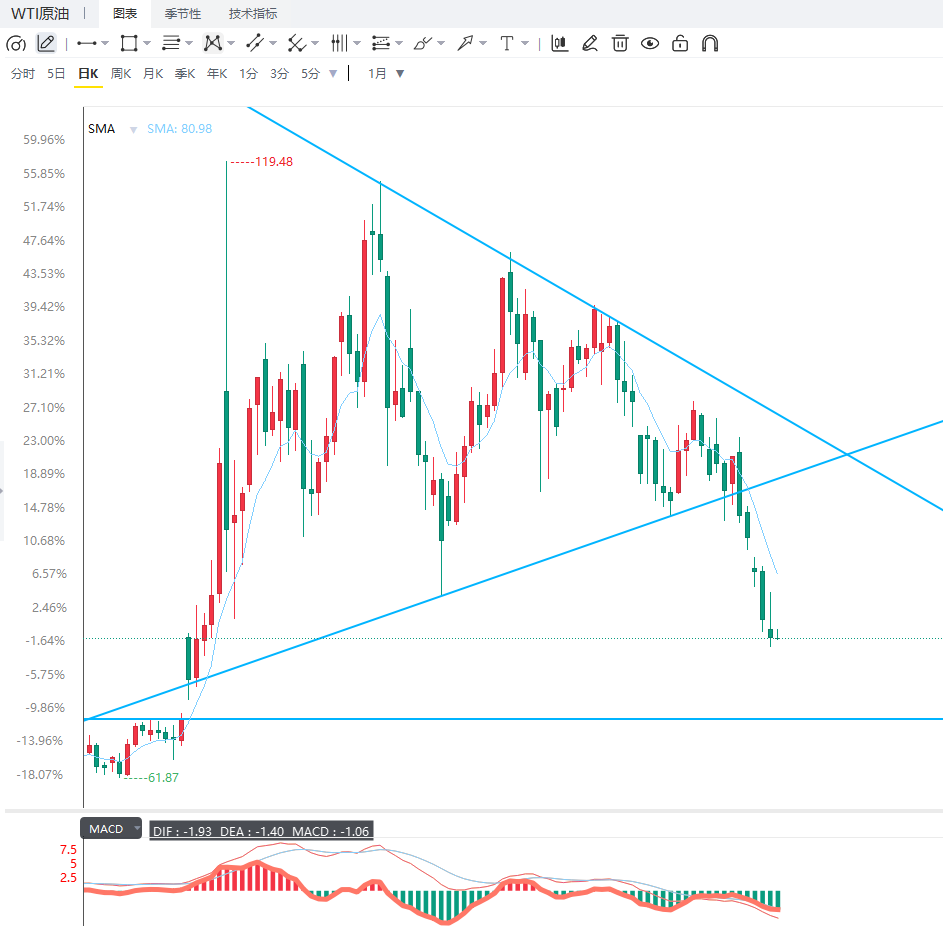
From a daily chart perspective, WTI crude oil has been declining since its previous surge, and has now broken below the short-term upward trend support area. The overall trend has gradually shifted from a strong upward movement to a high-level consolidation with a bearish bias. Although some technical buying support has appeared around $75, the price is still trading below the major moving average system, indicating a weakening of medium-term market momentum. The MACD indicator continues to run below the zero line, suggesting that bearish momentum still dominates. If the market cannot regain a foothold in the $76.80 to $78.00 area, it may continue its downward trend. Key resistance levels to watch are $76.80, $78.00, and $80.00; key support levels to watch are $74.00, $72.50, and the $70.00 area.
Observing the 4-hour chart, oil prices have seen a technical rebound after a continuous decline, and the short-term oversold condition has been somewhat corrected, but the rebound strength is still relatively limited. The MACD shows signs of a golden cross at a low level, indicating that the bearish momentum has weakened. However, the price has not yet broken through the key downtrend line resistance, and the overall trend is still in a correction phase within a downtrend. If it can effectively break through the resistance near $76.80, it may further test the $78 area; if the rebound is blocked and falls back below the $74 support, it may start a new round of correction, seeking support at the $72 or even $70 area.
Editor's Summary : The international crude oil market is currently undergoing a shift from being driven by geopolitical risks to being dominated by supply and demand logic. With the US-Iran peace talks making progress and expectations for the resumption of navigation in the Strait of Hormuz strengthening, the significant risk premium previously priced in by the market is gradually fading. Meanwhile, the Federal Reserve's hawkish stance and the International Energy Agency's forecast of future oversupply are also exerting sustained downward pressure on oil prices. In the short term, WTI crude oil may find some technical support around $75, and a temporary rebound cannot be ruled out. However, in the medium to long term, the market still faces the pressure of supply growth outpacing demand recovery. Going forward, the market will focus on global inventory changes, OPEC+ production policies, and economic data from major economies. If the pace of supply recovery continues to outpace demand growth, there is a risk of further downward shift in the oil price center; conversely, if improved global economic activity leads to a stronger-than-expected demand recovery, it could provide new upward momentum for oil prices.
US President Donald Trump and Iranian President Masoud Pezechiyan have signed a preliminary memorandum of understanding aimed at ending the regional conflict. Previously, US Vice President James David Vance and Iranian Parliament Speaker Mohammad Bagher Ghalibaf had completed a framework agreement, paving the way for a formal peace agreement.
According to the agreement, both sides will advance negotiations on a final peace agreement within the next 60 days, focusing on key aspects such as the resumption of shipping in the Strait of Hormuz, the lifting of restrictions on Iranian crude oil exports, and the establishment of a long-term security mechanism. The market believes that this agreement will help alleviate the risk of supply disruptions that have plagued the global energy market in recent months. The Strait of Hormuz handles approximately 20% of global seaborne crude oil transport, and its resumption of normal operations means that the Middle East's crude oil export capacity is expected to increase significantly.
Meanwhile, expectations for the return of Iranian crude oil exports to the international market continue to strengthen. Analysts believe that if sanctions are gradually lifted, Iranian crude oil supply may grow rapidly in the coming months, thereby further improving the global crude oil supply situation.
On the macro level, the Federal Reserve's latest interest rate decision also put pressure on oil prices. The Federal Open Market Committee unanimously decided to keep the federal funds rate unchanged at 3.50%-3.75%. Newly appointed Fed Chairman Kevin Warsh emphasized at his first meeting in office that he would continue to push inflation back to the target level.
While maintaining interest rates was in line with market expectations, policy signals from the decision-making level leaned towards a hawkish stance. Several officials hinted that the likelihood of further monetary tightening this year is rising, given persistent energy price volatility and inflation risks. The market anticipates that higher financing costs could dampen corporate investment and consumer demand, thereby weakening expectations for future energy consumption growth.
Changes in supply-side expectations have further reinforced bearish sentiment in the market. The International Energy Agency (IEA)'s latest monthly report points out that with the recovery of exports from the Middle East and the continued expansion of production by non-OPEC+ oil-producing countries, the global crude oil market may face a significant oversupply in the coming years.
The report projects that global crude oil supply capacity will increase by approximately 8 million barrels per day by 2027, while global demand will only increase by about 2 million barrels per day during the same period. The International Energy Agency believes that the full recovery of Middle Eastern exports, the growth of US shale oil production, and the commissioning of new projects in South America will be important drivers of supply expansion, while the recovery in demand may be relatively limited against the backdrop of slowing global economic growth.
This expectation suggests that the risk premium previously driven by geopolitical tensions is gradually fading, and market trading logic is returning to supply and demand fundamentals. Investors will pay closer attention to global inventory changes, policy adjustments by major oil-producing countries, and economic data from major economies to determine whether the crude oil market has entered a new cycle of oversupply.
From a daily chart perspective, WTI crude oil has been declining since its previous surge, and has now broken below the short-term upward trend support area. The overall trend has gradually shifted from a strong upward movement to a high-level consolidation with a bearish bias. Although some technical buying support has appeared around $75, the price is still trading below the major moving average system, indicating a weakening of medium-term market momentum. The MACD indicator continues to run below the zero line, suggesting that bearish momentum still dominates. If the market cannot regain a foothold in the $76.80 to $78.00 area, it may continue its downward trend. Key resistance levels to watch are $76.80, $78.00, and $80.00; key support levels to watch are $74.00, $72.50, and the $70.00 area.
Observing the 4-hour chart, oil prices have seen a technical rebound after a continuous decline, and the short-term oversold condition has been somewhat corrected, but the rebound strength is still relatively limited. The MACD shows signs of a golden cross at a low level, indicating that the bearish momentum has weakened. However, the price has not yet broken through the key downtrend line resistance, and the overall trend is still in a correction phase within a downtrend. If it can effectively break through the resistance near $76.80, it may further test the $78 area; if the rebound is blocked and falls back below the $74 support, it may start a new round of correction, seeking support at the $72 or even $70 area.
Editor's Summary : The international crude oil market is currently undergoing a shift from being driven by geopolitical risks to being dominated by supply and demand logic. With the US-Iran peace talks making progress and expectations for the resumption of navigation in the Strait of Hormuz strengthening, the significant risk premium previously priced in by the market is gradually fading. Meanwhile, the Federal Reserve's hawkish stance and the International Energy Agency's forecast of future oversupply are also exerting sustained downward pressure on oil prices. In the short term, WTI crude oil may find some technical support around $75, and a temporary rebound cannot be ruled out. However, in the medium to long term, the market still faces the pressure of supply growth outpacing demand recovery. Going forward, the market will focus on global inventory changes, OPEC+ production policies, and economic data from major economies. If the pace of supply recovery continues to outpace demand growth, there is a risk of further downward shift in the oil price center; conversely, if improved global economic activity leads to a stronger-than-expected demand recovery, it could provide new upward momentum for oil prices.
- Risk Warning and Disclaimer
- The market involves risk, and trading may not be suitable for all investors. This article is for reference only and does not constitute personal investment advice, nor does it take into account certain users’ specific investment objectives, financial situation, or other needs. Any investment decisions made based on this information are at your own risk.