The euro/dollar pair hit a two-and-a-half-month low, clearly indicating an overall downtrend.
2026-06-18 19:50:18
On Thursday (June 18), the euro/dollar exchange rate fell to 1.1459, a new low in two and a half months. The euro/dollar exchange rate has been declining since Tuesday's high above 1.1600 and is expected to continue falling by 0.9% this week. This downward trend is due to expectations that the Federal Reserve may further tighten monetary policy, as well as Germany's poor economic situation.

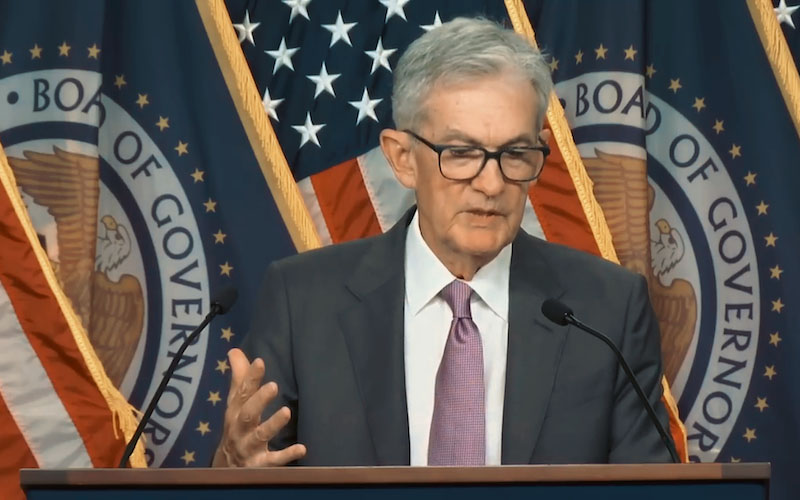
At its first meeting on Wednesday, chaired by Warsh, the Federal Reserve kept its benchmark interest rate between 3.50% and 3.75%. However, Warsh clearly stated its commitment to keeping inflation within its 2% target range, allaying investor concerns. Furthermore, the Fed's simplified monetary policy statement refrained from mentioning any inclination towards further easing.
Despite the uncertainty brought about by the Middle East conflict, Federal Reserve officials still believe that economic activity has improved and the labor market is stronger. The "dot plot" shows that nearly half of the committee members expect interest rates to be raised before the end of the year, although the plot does not include Warsh's forecast. Following this meeting, U.S. Treasury yields rose, and the dollar appreciated against other major currencies.
The euro/dollar exchange rate movement this week was mainly driven by three core factors.
First, and most importantly, at its first policy meeting since Warsh took office, the Federal Open Market Committee (FOMC) voted to keep the benchmark interest rate unchanged. However, nine FOMC members believed that the Fed would still need to raise interest rates this year.
The committee members' hawkish stance is primarily based on the continued rise in US household inflation and the relatively strong resilience of the domestic economy. Recent data shows that in May, overall US consumer price inflation surged 4.2% year-on-year, while the Producer Price Index (PPI) jumped 6.5% that month.
Another set of employment data also confirms the positive economic climate: data from the U.S. Bureau of Labor Statistics (BLS) shows that non-farm payrolls increased by more than 172,000 in April, far exceeding the market's median expectation of 85,000.
The euro/dollar weakened again after the release of US retail sales data, which further supported the Federal Reserve's hawkish policy stance. Data showed that US retail sales rose 0.9% month-on-month in May, while April's figure was revised down to 0.4%, outperforming market expectations of 0.5%.
In the Eurozone, the German Ifo Institute points out that major economies in the region will face high inflation and slow economic growth, further putting pressure on the euro. Ifo's forecasts show that Germany's inflation rate will be 2.9% this year and 2.7% in 2027; while economic growth is expected to be 0.8% this year, consistent with previous forecasts, while the 2027 forecast has been lowered to 0.8%.
Eurozone data released on Thursday showed that the current account surplus rose to €15.7 billion in April, up from €14.9 billion in March, but still well below the expected €18.5 billion. Subsequently, data from the European Union's Office of Statistics and Economic Studies (EUOS) indicated that construction growth slowed to 0.6% in April, after a 1.7% increase in March.
ING stated that the euro/dollar exchange rate briefly approached the key level of 1.1500 (but has since fallen below it) due to the hawkish FOMC decision last night. However, it seems the market lacks significant momentum for further declines. The situation is now back in the hands of the European Central Bank – will it raise interest rates at its July or September meeting, or will it decide against it? Given the current market consensus that the Federal Reserve will not raise rates, the 1.14/1.15 range could still be the lower limit for the exchange rate this summer.
Technical Analysis
(EUR/USD daily chart source: FX678)
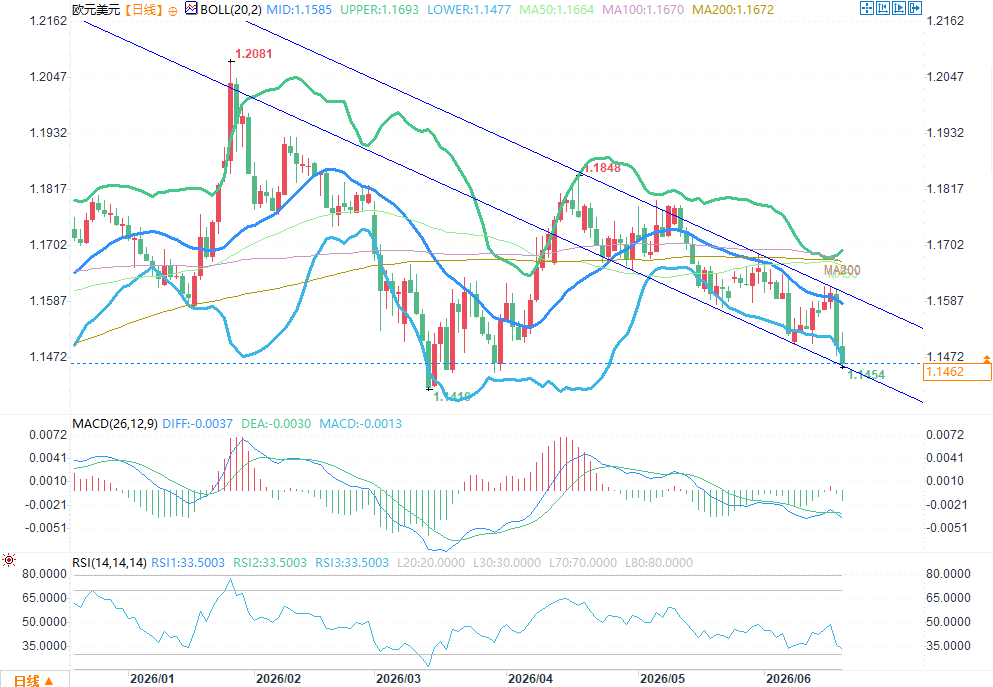
The euro/dollar pair is clearly in a downtrend on the daily chart, having fallen steadily since the April high of 1.1848. The current price of 1.1464 is approaching the lower Bollinger Band at 1.1478. The price has already broken below the Bollinger Band middle line at 1.1585, as well as multiple moving averages including the 50-day, 100-day, and 200-day moving averages. All medium-term moving averages have turned into resistance, and the Bollinger Bands are widening downwards, forming a complete downtrend channel.
On the indicator level, there are simultaneous negative factors: the daily MACD lines are below the zero axis, the bearish momentum has not yet subsided, and there is no golden cross stabilization signal; the RSI reading is 33.66, which is in the weak range, but has not yet reached the extreme oversold zone below 20, so there is still room for the bears to release their pressure, and there are no signs of bottom divergence or turning around in the indicators.
There are two possible scenarios for the market: The mainstream trend is a continued decline, with the previous low of 1.1454 and the lower Bollinger Band providing short-term support. If this level is broken, the next target is the March low of 1.1410. Even if there is a slight oversold rebound, the dense area of moving averages between 1.1585 and 1.1670 will form strong resistance, and any rebound is likely to be an opportunity to short.
Only when the daily chart firmly establishes itself above the Bollinger Middle Band at 1.1585, the RSI rises above 50, and the MACD forms a golden cross, will the short-term bearish trend reverse. At that point, the rebound target would be the upper Bollinger Band at 1.1693. Overall, the bears currently have the upper hand, with only a slight room for correction in the short term, and the medium-term downward trend remains unchanged.
At its first meeting on Wednesday, chaired by Warsh, the Federal Reserve kept its benchmark interest rate between 3.50% and 3.75%. However, Warsh clearly stated its commitment to keeping inflation within its 2% target range, allaying investor concerns. Furthermore, the Fed's simplified monetary policy statement refrained from mentioning any inclination towards further easing.
Despite the uncertainty brought about by the Middle East conflict, Federal Reserve officials still believe that economic activity has improved and the labor market is stronger. The "dot plot" shows that nearly half of the committee members expect interest rates to be raised before the end of the year, although the plot does not include Warsh's forecast. Following this meeting, U.S. Treasury yields rose, and the dollar appreciated against other major currencies.
The euro/dollar exchange rate movement this week was mainly driven by three core factors.
First, and most importantly, at its first policy meeting since Warsh took office, the Federal Open Market Committee (FOMC) voted to keep the benchmark interest rate unchanged. However, nine FOMC members believed that the Fed would still need to raise interest rates this year.
The committee members' hawkish stance is primarily based on the continued rise in US household inflation and the relatively strong resilience of the domestic economy. Recent data shows that in May, overall US consumer price inflation surged 4.2% year-on-year, while the Producer Price Index (PPI) jumped 6.5% that month.
Another set of employment data also confirms the positive economic climate: data from the U.S. Bureau of Labor Statistics (BLS) shows that non-farm payrolls increased by more than 172,000 in April, far exceeding the market's median expectation of 85,000.
The euro/dollar weakened again after the release of US retail sales data, which further supported the Federal Reserve's hawkish policy stance. Data showed that US retail sales rose 0.9% month-on-month in May, while April's figure was revised down to 0.4%, outperforming market expectations of 0.5%.
In the Eurozone, the German Ifo Institute points out that major economies in the region will face high inflation and slow economic growth, further putting pressure on the euro. Ifo's forecasts show that Germany's inflation rate will be 2.9% this year and 2.7% in 2027; while economic growth is expected to be 0.8% this year, consistent with previous forecasts, while the 2027 forecast has been lowered to 0.8%.
Eurozone data released on Thursday showed that the current account surplus rose to €15.7 billion in April, up from €14.9 billion in March, but still well below the expected €18.5 billion. Subsequently, data from the European Union's Office of Statistics and Economic Studies (EUOS) indicated that construction growth slowed to 0.6% in April, after a 1.7% increase in March.
ING stated that the euro/dollar exchange rate briefly approached the key level of 1.1500 (but has since fallen below it) due to the hawkish FOMC decision last night. However, it seems the market lacks significant momentum for further declines. The situation is now back in the hands of the European Central Bank – will it raise interest rates at its July or September meeting, or will it decide against it? Given the current market consensus that the Federal Reserve will not raise rates, the 1.14/1.15 range could still be the lower limit for the exchange rate this summer.
Technical Analysis
(EUR/USD daily chart source: FX678)
The euro/dollar pair is clearly in a downtrend on the daily chart, having fallen steadily since the April high of 1.1848. The current price of 1.1464 is approaching the lower Bollinger Band at 1.1478. The price has already broken below the Bollinger Band middle line at 1.1585, as well as multiple moving averages including the 50-day, 100-day, and 200-day moving averages. All medium-term moving averages have turned into resistance, and the Bollinger Bands are widening downwards, forming a complete downtrend channel.
On the indicator level, there are simultaneous negative factors: the daily MACD lines are below the zero axis, the bearish momentum has not yet subsided, and there is no golden cross stabilization signal; the RSI reading is 33.66, which is in the weak range, but has not yet reached the extreme oversold zone below 20, so there is still room for the bears to release their pressure, and there are no signs of bottom divergence or turning around in the indicators.
There are two possible scenarios for the market: The mainstream trend is a continued decline, with the previous low of 1.1454 and the lower Bollinger Band providing short-term support. If this level is broken, the next target is the March low of 1.1410. Even if there is a slight oversold rebound, the dense area of moving averages between 1.1585 and 1.1670 will form strong resistance, and any rebound is likely to be an opportunity to short.
Only when the daily chart firmly establishes itself above the Bollinger Middle Band at 1.1585, the RSI rises above 50, and the MACD forms a golden cross, will the short-term bearish trend reverse. At that point, the rebound target would be the upper Bollinger Band at 1.1693. Overall, the bears currently have the upper hand, with only a slight room for correction in the short term, and the medium-term downward trend remains unchanged.
- Risk Warning and Disclaimer
- The market involves risk, and trading may not be suitable for all investors. This article is for reference only and does not constitute personal investment advice, nor does it take into account certain users’ specific investment objectives, financial situation, or other needs. Any investment decisions made based on this information are at your own risk.