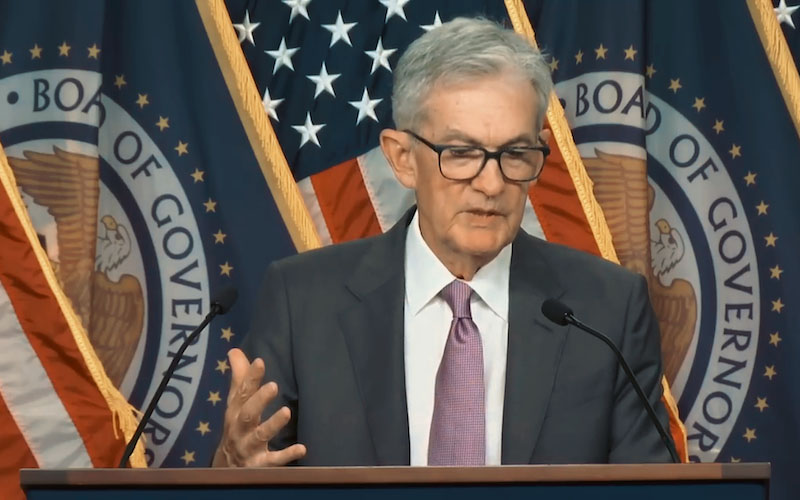
The Federal Reserve removed its easing guidance, causing the dollar to surge, but the details of the reforms may reveal a dovish stance.
2026-06-18 20:50:05
At his first policy meeting after taking the helm, newly appointed Federal Reserve Chairman Kevin Warsh unanimously voted to maintain the federal funds rate at 3.5%-3.75%, while also announcing a systematic review of the Fed's current operations, marking the official start of monetary policy reforms in the "Warsh era."
This marks the fourth consecutive time the Federal Reserve has kept interest rates unchanged. The previous decision to keep rates unchanged did not pass unanimously; instead, it was unusually met with three vetoes (the reason for the vetoes was that the wording of the interest rate decision statement should not contain dovish guidance). This time, however, it passed unanimously, which means that the wording favoring rate cuts was removed from the statement, and is one of the reasons why the market has significantly revised its hawkish expectations of the Federal Reserve.
Behind this interest rate decision lies a significant division within the Federal Reserve regarding the policy path: some governors advocate maintaining stable interest rates to observe economic trends, while the other side strongly advocates raising interest rates to address persistently high inflationary pressures.
The current US inflation rate has climbed to 3.8%, far exceeding the Federal Reserve's long-term target of 2%. The core cause of this situation stems from the US-Israel conflict that broke out in Iran. After the Trump administration launched airstrikes against Iran, Iran took retaliatory measures by closing the Strait of Hormuz, a key global shipping route, which directly triggered a surge in international energy prices. The US Bureau of Labor Statistics (BLS) clearly pointed out that soaring energy costs are the core driver of this price increase.
Despite President Trump's pressure on Warsh's predecessor, Federal Reserve Chairman Jerome Powell, to cut interest rates and placing the same expectations on Warsh, the uncertainty surrounding excessive inflation and the ceasefire agreement ultimately led the Federal Reserve's interest rate decision-making committee to reach a consensus and unanimously pass a resolution to keep interest rates unchanged.
In a statement unanimously endorsed by all 12 members, the Federal Open Market Committee (FOMC) noted: "Despite persistent high levels of uncertainty stemming from the Middle East conflict, U.S. economic activity has continued to expand robustly, with strong productivity growth and capital investment, job growth in line with labor supply, and the unemployment rate remaining largely unchanged."
It is worth noting that this statement is only 132 words long, a significant reduction from the nearly 350-word version in April. It not only removed the previous implicit suggestion of "future interest rate cuts", but also ended with "the Committee will firmly achieve price stability", marking a major shift in the Fed's communication paradigm - which was one of Warsh's core commitments at the beginning of his tenure.
The new chairman has fiercely criticized the Fed’s past “lengthy communication” model, advocating that the central bank should “do more and say less” and focus on policy implementation itself. The streamlined statements are intended to reduce the market’s over-interpretation of policy expectations and to present only objective factual judgments based on existing information.
The "dot plot" released alongside the interest rate decision also released key policy signals: of the 18 officials involved in the FOMC interest rate decision, 9 expect to start raising interest rates this year, only 1 supports a rate cut, and the remaining 8 believe that interest rates will remain at the current level.
It is worth noting that although Walsh himself opposed the dot plot mechanism and did not submit his own predictions, he respected his colleagues' wishes to publish them.
Samuel Thomas, chief U.S. economist at Pantheon Macroeconomics, pointed out that this change in the plot was the "core highlight" of the decision, and its clear signal that interest rates may be raised before the end of the year will directly affect the pricing logic of the dollar in the foreign exchange market, causing the dollar to surge.
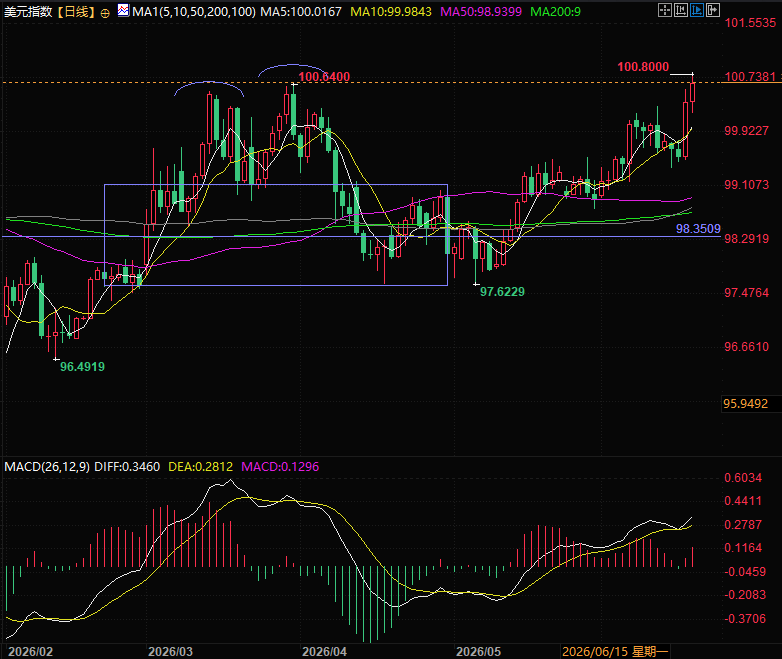
(US Dollar Index Daily Chart, Source: FX678)
In response to the Federal Reserve's decision, Trump said, "It's alright... I don't care." When asked about a possible rate hike, he said, "It's possible... It's hard to imagine," and believed that raising rates "would only drag down economic growth, and such an operation is highly unusual."
However, he also spoke highly of his nominee, Walsh: "We now have a very good leader, so I will respect his policy judgments."
Interestingly, when asked about rising cost of living earlier this month, Trump said, "I'm very happy, the data is very good... I approve of the current inflation level," in stark contrast to the Federal Reserve's anti-inflationary stance.
At the press conference following the resolution, Warsh further clarified the direction of reform: the change in the leadership of the Federal Reserve is "a natural and timely opportunity to reaffirm its core mission and review the current operating mechanisms."
He stated frankly that the Fed's past forward guidance had not been of substantial help in policy decision-making discussions, and revealed that the Fed would accelerate mechanism reform and policy framework reshaping—five special working groups have been established to conduct in-depth reviews of policy communication mechanisms, balance sheet size control, economic data application systems, productivity and employment linkage mechanisms, and inflation control frameworks.
This series of reforms aims to fundamentally optimize the Federal Reserve's policy-making logic. Among them, the reform of the communication mechanism will break the market's habit of relying on the central bank's "forward guidance" for pricing, allowing the market to make more independent judgments based on economic data.
For example, previously the decision to raise interest rates was based on the core PCE, but now it can be made based on observations from more departments. For instance, if the balance sheet size is well managed, a department can provide reasons to reject the rate hike if the balance sheet reduction has resulted in no excess reserves or liquidity in the market, then inflation may not be due to liquidity, and the conclusion can be drawn that no rate hike is needed.
From the underlying logic of monetary policy, when inflation is high, it is a routine operation for the central bank to curb price increases by raising interest rates to tighten market liquidity and suppress the excessive growth of the money supply.
Trump's call for interest rate cuts, on the other hand, aims to stimulate economic expansion by lowering borrowing costs and boosting consumer and investment spending.
Currently, for the Federal Reserve, traditional data-driven approaches fail to fully reflect interest rates that align with the needs of the US labor market, and they also do not align with the interests of the White House. Whether driven by the need to approach a reasonable interest rate or by the interests of the White House, this reform is likely something the market would like to see, because with traditional data already pointing to a hawkish stance, new reforms are unlikely to produce worse results.
Citigroup and domestic securities firms have also released reports that differ from the mainstream view, predicting that the Federal Reserve will continue to cut interest rates this year, but that the rate cuts will be significantly delayed.
This marks the fourth consecutive time the Federal Reserve has kept interest rates unchanged. The previous decision to keep rates unchanged did not pass unanimously; instead, it was unusually met with three vetoes (the reason for the vetoes was that the wording of the interest rate decision statement should not contain dovish guidance). This time, however, it passed unanimously, which means that the wording favoring rate cuts was removed from the statement, and is one of the reasons why the market has significantly revised its hawkish expectations of the Federal Reserve.
Behind the Interest Rate Decision: A Game Between Inflationary Pressures and Policy Divergence
Behind this interest rate decision lies a significant division within the Federal Reserve regarding the policy path: some governors advocate maintaining stable interest rates to observe economic trends, while the other side strongly advocates raising interest rates to address persistently high inflationary pressures.
The current US inflation rate has climbed to 3.8%, far exceeding the Federal Reserve's long-term target of 2%. The core cause of this situation stems from the US-Israel conflict that broke out in Iran. After the Trump administration launched airstrikes against Iran, Iran took retaliatory measures by closing the Strait of Hormuz, a key global shipping route, which directly triggered a surge in international energy prices. The US Bureau of Labor Statistics (BLS) clearly pointed out that soaring energy costs are the core driver of this price increase.
Despite President Trump's pressure on Warsh's predecessor, Federal Reserve Chairman Jerome Powell, to cut interest rates and placing the same expectations on Warsh, the uncertainty surrounding excessive inflation and the ceasefire agreement ultimately led the Federal Reserve's interest rate decision-making committee to reach a consensus and unanimously pass a resolution to keep interest rates unchanged.
Data supports the removal of any hints of interest rate cuts; FOMC statement becomes more concise.
In a statement unanimously endorsed by all 12 members, the Federal Open Market Committee (FOMC) noted: "Despite persistent high levels of uncertainty stemming from the Middle East conflict, U.S. economic activity has continued to expand robustly, with strong productivity growth and capital investment, job growth in line with labor supply, and the unemployment rate remaining largely unchanged."
It is worth noting that this statement is only 132 words long, a significant reduction from the nearly 350-word version in April. It not only removed the previous implicit suggestion of "future interest rate cuts", but also ended with "the Committee will firmly achieve price stability", marking a major shift in the Fed's communication paradigm - which was one of Warsh's core commitments at the beginning of his tenure.
The new chairman has fiercely criticized the Fed’s past “lengthy communication” model, advocating that the central bank should “do more and say less” and focus on policy implementation itself. The streamlined statements are intended to reduce the market’s over-interpretation of policy expectations and to present only objective factual judgments based on existing information.
The dot plot reveals a key signal: interest rate hikes may begin before the end of the year.
The "dot plot" released alongside the interest rate decision also released key policy signals: of the 18 officials involved in the FOMC interest rate decision, 9 expect to start raising interest rates this year, only 1 supports a rate cut, and the remaining 8 believe that interest rates will remain at the current level.
It is worth noting that although Walsh himself opposed the dot plot mechanism and did not submit his own predictions, he respected his colleagues' wishes to publish them.
Samuel Thomas, chief U.S. economist at Pantheon Macroeconomics, pointed out that this change in the plot was the "core highlight" of the decision, and its clear signal that interest rates may be raised before the end of the year will directly affect the pricing logic of the dollar in the foreign exchange market, causing the dollar to surge.
(US Dollar Index Daily Chart, Source: FX678)
Trump's statements are contradictory: he acknowledges Warsh but opposes interest rate hikes.
In response to the Federal Reserve's decision, Trump said, "It's alright... I don't care." When asked about a possible rate hike, he said, "It's possible... It's hard to imagine," and believed that raising rates "would only drag down economic growth, and such an operation is highly unusual."
However, he also spoke highly of his nominee, Walsh: "We now have a very good leader, so I will respect his policy judgments."
Interestingly, when asked about rising cost of living earlier this month, Trump said, "I'm very happy, the data is very good... I approve of the current inflation level," in stark contrast to the Federal Reserve's anti-inflationary stance.
Reform blueprint implemented: Five special working groups launched for review
At the press conference following the resolution, Warsh further clarified the direction of reform: the change in the leadership of the Federal Reserve is "a natural and timely opportunity to reaffirm its core mission and review the current operating mechanisms."
He stated frankly that the Fed's past forward guidance had not been of substantial help in policy decision-making discussions, and revealed that the Fed would accelerate mechanism reform and policy framework reshaping—five special working groups have been established to conduct in-depth reviews of policy communication mechanisms, balance sheet size control, economic data application systems, productivity and employment linkage mechanisms, and inflation control frameworks.
This series of reforms aims to fundamentally optimize the Federal Reserve's policy-making logic. Among them, the reform of the communication mechanism will break the market's habit of relying on the central bank's "forward guidance" for pricing, allowing the market to make more independent judgments based on economic data.
For example, previously the decision to raise interest rates was based on the core PCE, but now it can be made based on observations from more departments. For instance, if the balance sheet size is well managed, a department can provide reasons to reject the rate hike if the balance sheet reduction has resulted in no excess reserves or liquidity in the market, then inflation may not be due to liquidity, and the conclusion can be drawn that no rate hike is needed.
Policy game continues: Market fluctuations are affected by two factors.
From the underlying logic of monetary policy, when inflation is high, it is a routine operation for the central bank to curb price increases by raising interest rates to tighten market liquidity and suppress the excessive growth of the money supply.
Trump's call for interest rate cuts, on the other hand, aims to stimulate economic expansion by lowering borrowing costs and boosting consumer and investment spending.
Currently, for the Federal Reserve, traditional data-driven approaches fail to fully reflect interest rates that align with the needs of the US labor market, and they also do not align with the interests of the White House. Whether driven by the need to approach a reasonable interest rate or by the interests of the White House, this reform is likely something the market would like to see, because with traditional data already pointing to a hawkish stance, new reforms are unlikely to produce worse results.
Citigroup and domestic securities firms have also released reports that differ from the mainstream view, predicting that the Federal Reserve will continue to cut interest rates this year, but that the rate cuts will be significantly delayed.
- Risk Warning and Disclaimer
- The market involves risk, and trading may not be suitable for all investors. This article is for reference only and does not constitute personal investment advice, nor does it take into account certain users’ specific investment objectives, financial situation, or other needs. Any investment decisions made based on this information are at your own risk.