The US dollar continues to rise against the Japanese yen, the Federal Reserve is planning to raise interest rates, but the Bank of Japan can only offer verbal support.
2026-06-22 08:56:09
On Monday (June 22) in early Asian trading, the US dollar rose against the Japanese yen, currently trading around 161.55, a gain of about 0.2%. This is the second consecutive day of upward movement after a brief correction following Thursday's high of 161.81.
The threat of intervention from the Bank of Japan (BOJ) has once again loomed over the USD/JPY market. However, unless there is a fundamental shift in the outlook for US interest rates, the logic for an upward trend in the exchange rate remains solid, both from a fundamental and technical perspective.
Recently, the Middle East peace process and verbal intervention by the Japanese authorities have alternately disrupted the market, making the short-term drivers of the USD/JPY exchange rate unclear. However, amidst the complex and chaotic information, a main theme is becoming increasingly clear—the US-Japan government bond yield spread.
Since the June FOMC meeting, the market's repricing of expectations for Federal Reserve policy has been particularly dramatic. Federal funds futures indicate that the market has already priced in approximately 48 basis points of cumulative rate hikes by the middle of next year.
Against this backdrop, the spread between the yields on two-year US and Japanese government bonds has widened to over 280 basis points, the largest since the outbreak of the current Middle East conflict.
At the same time, the correlation between the USD/JPY exchange rate and this interest rate differential is rapidly increasing, meaning that exchange rate movements are returning to the classic anchoring logic of interest rate parity.
This week's US economic data is worth investors' attention, with the May PCE report and speeches by several Federal Reserve officials being the two key highlights.
PCE Inflation: As Expected, Unlikely to Cause Significant Changes. The market generally expects core PCE to grow 0.3% month-on-month, but some forecasts point to 0.4%. If this is the case, the annual rate will rebound to 3.4%, far exceeding the Fed's 2% target.
However, thanks to the effective guidance from the CPI and PPI data at the beginning of the month, the final PCE result usually does not deviate too much from expectations, and the market is already well prepared for this.
Consumer data is the real "subtext." Personal income and expenditure data released alongside PCE inflation data are perhaps even more worthy of attention.
As fuel for the US economic engine, if income or spending growth slows more than expected, the market will have to question how long consumer resilience can be maintained—and thus whether the Federal Reserve is truly capable of delivering on the further interest rate hikes hinted at by several FOMC members last week.
Officials' speeches are a key window into Warsh's signals. Following the June meeting, Federal Reserve Governor Warsh signaled a shift towards a policy that is "more data-dependent and more focused on inflation."
The speeches by Christopher Waller on Monday and New York Fed President Williams on Thursday will be key moments for the market to test whether this signal represents a consensus within the FOMC. If they confirm it, the dollar will receive further support; if they contradict or downplay it, it could trigger profit-taking.
Compared to US factors, Japanese domestic data has a lower weight in the USD/JPY pricing equation, but there are still some points to watch this week.
The Bank of Japan's June Monetary Policy Committee meeting summary, to be released Wednesday, will reveal internal divisions among committee members. Most members expect core CPI to reach the 2% target for fiscal year 2026-2027, are concerned about upside risks from supply shocks such as oil price fluctuations, and favor continuing a gradual interest rate hike approach. However, members like Asada may express caution regarding the impact on small and medium-sized enterprises and external uncertainties.
Market expectations suggest a possible further interest rate hike to 1.25% in the second half of the year (around October), depending on the strength of the economic recovery and the inflation trend. Continued government bond purchases will alleviate upward pressure on long-term gold prices, but the yen exchange rate and global uncertainties remain key variables.
Thursday – Governor Kazuo Ueda and prominent hawkish board member Naoki Tamura will both speak on the same day. Following Deputy Governor Ryozo Himino's hawkish signals last week, the market will be closely watching whether the two will continue this tone. Currently, overnight index swaps indicate that the market believes there is a 90% probability of the Bank of Japan raising interest rates by 25 basis points again before December; any deviation from this expectation could trigger market volatility.
The USD/JPY pair is currently trading above 160, a level that has historically triggered intervention orders from the Ministry of Finance, including earlier this year. Finance Minister Satsuki Katayama reiterated last week after the G7 meeting that "the authorities are prepared to act"—but the question remains: will intervention actually be effective?
A thought-provoking detail comes from last Friday. The US market was closed for the Juneteenth holiday, resulting in extremely thin liquidity—theoretically the optimal window for intervention to send the strongest signal at the lowest cost. However, despite the sharp intraday fluctuations in the USD/JPY exchange rate, no typical intervention characteristics (such as a rapid pullback after a sudden surge) were observed, suggesting that the authorities chose to remain inactive. This inaction itself is a signal: the authorities may also realize that intervening in the current environment would be tantamount to rowing against the current.
The fundamental contradiction lies in the fact that the intervention is completely contrary to the direction of fundamentals. Even though the market has priced in another interest rate hike by the Bank of Japan this year, and even though policymakers have repeatedly signaled their willingness to normalize policy, these positive factors for the yen still seem powerless in the face of the US-Japan interest rate differential. As witnessed from the end of April to the beginning of May—the intervention triggered a brief sharp drop, but the bulls quickly made a comeback, providing a better entry point.
Key takeaway: Before US economic data begins to soften and the market starts to question whether the Fed's next move is more likely to be a rate cut than a rate hike, any intervention can only slow the pace of the yen's depreciation, not reverse the trend. Intervention is a speed bump, not a finish line.
According to the daily chart, the USD/JPY pair maintains a medium- to long-term bullish trend. After testing a low of 155.03, it began a sustained upward correction, recently reaching a new high of 161.81. Currently, it is trading around 161.55, consolidating slightly at higher levels. The moving average system shows a complete bullish structure, with the price firmly above all four moving averages: MA20, MA50, MA100, and MA200. The medium- to long-term MA200 (156.07) provides solid bottom support, while the short-term MA20 (160.18) offers nearby support. The bullish moving average alignment continues to support upward momentum.
In terms of indicators, the MACD is above the zero line, the DIFF (0.608) has stabilized above the DEA (0.508), the red bars continue, and the bullish momentum is still being released, but the two lines are gradually flattening, and the upward momentum has slowed down; the RSI value is 69.64, approaching the 70 overbought threshold, and there is a short-term need for pressure and pullback.
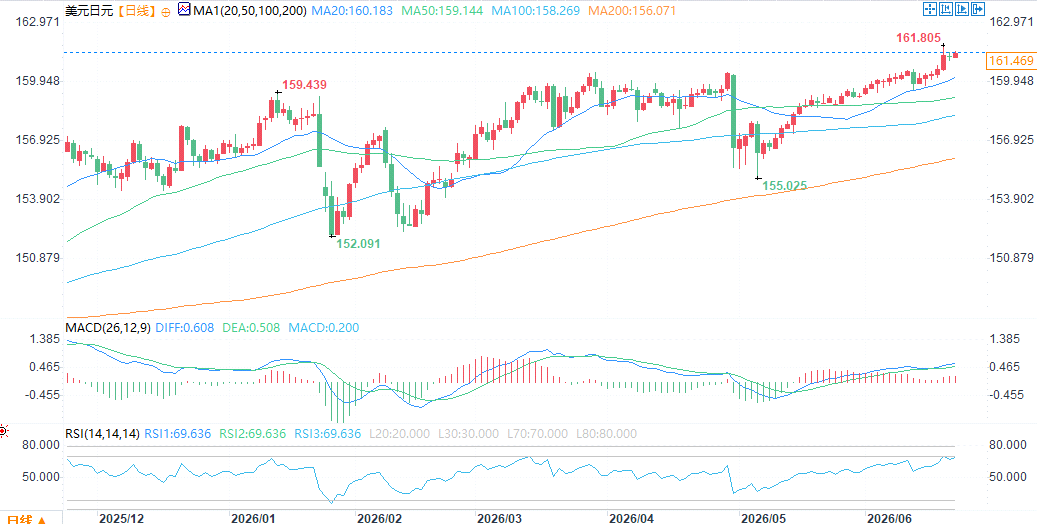
(USD/JPY daily chart, source: FX678)
At 8:55 AM Beijing time on June 22, the USD/JPY exchange rate was 161.55/56.
The threat of intervention from the Bank of Japan (BOJ) has once again loomed over the USD/JPY market. However, unless there is a fundamental shift in the outlook for US interest rates, the logic for an upward trend in the exchange rate remains solid, both from a fundamental and technical perspective.
Interest Rate Spread Logic: The Clearest Main Theme in the Fog
Recently, the Middle East peace process and verbal intervention by the Japanese authorities have alternately disrupted the market, making the short-term drivers of the USD/JPY exchange rate unclear. However, amidst the complex and chaotic information, a main theme is becoming increasingly clear—the US-Japan government bond yield spread.
Since the June FOMC meeting, the market's repricing of expectations for Federal Reserve policy has been particularly dramatic. Federal funds futures indicate that the market has already priced in approximately 48 basis points of cumulative rate hikes by the middle of next year.
Against this backdrop, the spread between the yields on two-year US and Japanese government bonds has widened to over 280 basis points, the largest since the outbreak of the current Middle East conflict.
At the same time, the correlation between the USD/JPY exchange rate and this interest rate differential is rapidly increasing, meaning that exchange rate movements are returning to the classic anchoring logic of interest rate parity.
This week's agenda: US data and Fed rhetoric will guide the direction.
This week's US economic data is worth investors' attention, with the May PCE report and speeches by several Federal Reserve officials being the two key highlights.
PCE Inflation: As Expected, Unlikely to Cause Significant Changes. The market generally expects core PCE to grow 0.3% month-on-month, but some forecasts point to 0.4%. If this is the case, the annual rate will rebound to 3.4%, far exceeding the Fed's 2% target.
However, thanks to the effective guidance from the CPI and PPI data at the beginning of the month, the final PCE result usually does not deviate too much from expectations, and the market is already well prepared for this.
Consumer data is the real "subtext." Personal income and expenditure data released alongside PCE inflation data are perhaps even more worthy of attention.
As fuel for the US economic engine, if income or spending growth slows more than expected, the market will have to question how long consumer resilience can be maintained—and thus whether the Federal Reserve is truly capable of delivering on the further interest rate hikes hinted at by several FOMC members last week.
Officials' speeches are a key window into Warsh's signals. Following the June meeting, Federal Reserve Governor Warsh signaled a shift towards a policy that is "more data-dependent and more focused on inflation."
The speeches by Christopher Waller on Monday and New York Fed President Williams on Thursday will be key moments for the market to test whether this signal represents a consensus within the FOMC. If they confirm it, the dollar will receive further support; if they contradict or downplay it, it could trigger profit-taking.
Japanese perspective
Compared to US factors, Japanese domestic data has a lower weight in the USD/JPY pricing equation, but there are still some points to watch this week.
The Bank of Japan's June Monetary Policy Committee meeting summary, to be released Wednesday, will reveal internal divisions among committee members. Most members expect core CPI to reach the 2% target for fiscal year 2026-2027, are concerned about upside risks from supply shocks such as oil price fluctuations, and favor continuing a gradual interest rate hike approach. However, members like Asada may express caution regarding the impact on small and medium-sized enterprises and external uncertainties.
Market expectations suggest a possible further interest rate hike to 1.25% in the second half of the year (around October), depending on the strength of the economic recovery and the inflation trend. Continued government bond purchases will alleviate upward pressure on long-term gold prices, but the yen exchange rate and global uncertainties remain key variables.
Thursday – Governor Kazuo Ueda and prominent hawkish board member Naoki Tamura will both speak on the same day. Following Deputy Governor Ryozo Himino's hawkish signals last week, the market will be closely watching whether the two will continue this tone. Currently, overnight index swaps indicate that the market believes there is a 90% probability of the Bank of Japan raising interest rates by 25 basis points again before December; any deviation from this expectation could trigger market volatility.
Intervention Dilemma: Why is it difficult for the "visible hand" to stop the trend?
The USD/JPY pair is currently trading above 160, a level that has historically triggered intervention orders from the Ministry of Finance, including earlier this year. Finance Minister Satsuki Katayama reiterated last week after the G7 meeting that "the authorities are prepared to act"—but the question remains: will intervention actually be effective?
A thought-provoking detail comes from last Friday. The US market was closed for the Juneteenth holiday, resulting in extremely thin liquidity—theoretically the optimal window for intervention to send the strongest signal at the lowest cost. However, despite the sharp intraday fluctuations in the USD/JPY exchange rate, no typical intervention characteristics (such as a rapid pullback after a sudden surge) were observed, suggesting that the authorities chose to remain inactive. This inaction itself is a signal: the authorities may also realize that intervening in the current environment would be tantamount to rowing against the current.
The fundamental contradiction lies in the fact that the intervention is completely contrary to the direction of fundamentals. Even though the market has priced in another interest rate hike by the Bank of Japan this year, and even though policymakers have repeatedly signaled their willingness to normalize policy, these positive factors for the yen still seem powerless in the face of the US-Japan interest rate differential. As witnessed from the end of April to the beginning of May—the intervention triggered a brief sharp drop, but the bulls quickly made a comeback, providing a better entry point.
Key takeaway: Before US economic data begins to soften and the market starts to question whether the Fed's next move is more likely to be a rate cut than a rate hike, any intervention can only slow the pace of the yen's depreciation, not reverse the trend. Intervention is a speed bump, not a finish line.
Technical Analysis
According to the daily chart, the USD/JPY pair maintains a medium- to long-term bullish trend. After testing a low of 155.03, it began a sustained upward correction, recently reaching a new high of 161.81. Currently, it is trading around 161.55, consolidating slightly at higher levels. The moving average system shows a complete bullish structure, with the price firmly above all four moving averages: MA20, MA50, MA100, and MA200. The medium- to long-term MA200 (156.07) provides solid bottom support, while the short-term MA20 (160.18) offers nearby support. The bullish moving average alignment continues to support upward momentum.
In terms of indicators, the MACD is above the zero line, the DIFF (0.608) has stabilized above the DEA (0.508), the red bars continue, and the bullish momentum is still being released, but the two lines are gradually flattening, and the upward momentum has slowed down; the RSI value is 69.64, approaching the 70 overbought threshold, and there is a short-term need for pressure and pullback.
(USD/JPY daily chart, source: FX678)
At 8:55 AM Beijing time on June 22, the USD/JPY exchange rate was 161.55/56.
- Risk Warning and Disclaimer
- The market involves risk, and trading may not be suitable for all investors. This article is for reference only and does not constitute personal investment advice, nor does it take into account certain users’ specific investment objectives, financial situation, or other needs. Any investment decisions made based on this information are at your own risk.