Trump's "peace talks while threatening" approach triggers safe-haven buying! The euro fluctuates and declines; can Lagarde become a "lifeline"?
2026-06-22 09:12:38
On Monday (June 22) in early Asian trading, the euro traded in a narrow range against the US dollar, currently hovering around 1.1470. Renewed uncertainty surrounding the US-Iran peace agreement, coupled with market expectations of further increases in US interest rates, has fueled demand for the safe-haven dollar, putting downward pressure on the euro. The euro had previously hit a three-month low of 1.1417 on Friday. Meanwhile, hawkish signals from European Central Bank officials provided some support for the euro.
On Sunday (June 21), tensions between the US and Iran escalated dramatically once again. While US Vice President Vance was leading a delegation in Switzerland for the first round of formal contacts with Iranian officials under the ceasefire agreement, President Trump issued a completely different, hardline stance on social media.
Trump posted on Truth Social, stating, "Iran must immediately stop its paid proxies in Lebanon from causing trouble. If they don't, we will strike Iran hard again—just like we did last week, and even harder!!!" This statement clearly targets Hezbollah, Iran's ally in Lebanon.
According to reports, the Iranian delegation protested Trump's remarks to the US side and left the meeting, suspending the 80-minute negotiations and turning to internal consultations.
This contradictory signal of "peace talks on one hand, threats on the other" has raised serious doubts in the market about the genuine progress of the US-Iran peace process. Iran had previously announced the re-closure of the Strait of Hormuz, and although the US stated it had not yet observed an actual blockade, these events were enough to trigger risk aversion in the market. Funds flowed back into dollar assets, becoming the direct trigger for the decline in the euro against the dollar.
ECB officials signaled a rate hike, echoing the Federal Reserve's hawkish stance across the Atlantic.
European Central Bank (ECB) Governing Council member and Belgian central bank governor Pierre Wunsch stated last Friday that the ECB could raise interest rates again as early as next month if it sees more evidence that eurozone inflation is spreading beyond the energy sector. This statement has fueled market expectations that the two major central banks in Europe and the US will simultaneously tighten monetary policy.
The European Central Bank's deposit rate is currently 2.25%, and financial markets have already priced in a 25 basis point rate hike in September or October, with expectations of another hike likely early next year. This anticipated rate hike path provides potential support for the euro, offsetting some of the downward pressure from geopolitical risks.
ECB President Christine Lagarde will speak later Monday, a key window for short-term market observation. Investors will be closely watching whether she echoes Winsch's hawkish tone or maintains her previous more cautious stance.
If Lagarde signals a clear interest rate hike, the euro could receive a short-term boost; conversely, if her wording is dovish or ambiguous, the euro may face the risk of further decline.
In summary, the direction of the euro against the dollar this week will depend on the interplay of the following three factors:
First, there's the ongoing evolution of the US-Iran situation. Whether US-Iran negotiations can continue, whether Trump will make more extreme statements, and the actual navigation status of the Strait of Hormuz—these will directly impact market risk appetite and the safe-haven demand for the US dollar.
Secondly, the US PCE data and speeches by Federal Reserve officials will be crucial. The US May PCE data released this Friday, along with a series of speeches from multiple Federal Reserve officials, will determine whether market expectations regarding the Fed's interest rate hike path strengthen further. If the data is strong and the rhetoric is hawkish, the dollar will gain more upward momentum.
Thirdly, there's ECB President Lagarde's speech. Lagarde's comments on the interest rate hike outlook will influence market expectations regarding the pace of narrowing interest rate differentials between Europe and the US. If a hawkish signal is clear, the euro is likely to find support above 1.14; if her stance softens, 1.1450 may be difficult to hold.
The euro/dollar pair has turned bearish on the daily chart, with the price trending downwards from its year-to-date high of 1.2081. Recently, it retested the 1.1417 low, a three-month low, clearly indicating a downtrend. The moving average system is providing comprehensive resistance, with the 20-day (1.1570), 50-day (1.1652), and 100-day (1.1662) moving averages all declining. The 200-day (1.1670) moving average has also become a resistance level, and the bullish support system has been completely breached.
In terms of indicators, the MACD lines are below the zero axis, the DIFF-0.0045 is below the DEA-0.0035, the green bars continue, and the bearish momentum continues to be released; the RSI value is 34.22, falling into the weak zone. Although it is close to the 30 oversold line, there is no clear bottom divergence stabilization signal yet, and the downward momentum has not been fully exhausted.
In terms of price structure, the market has formed a downtrend channel with gradually lower highs and constantly lower lows. The near 10-month low of 1.1410 reached on March 13th and the current low of 1.1417 form a short-term support zone. The first resistance level is the 20-day moving average (MA20) at 1.1570; any rebound to this level is likely to encounter selling pressure. The slight stabilization in the short-term price movement is merely a weak correction after an oversold condition; the medium-term downtrend has not reversed.
If the 1.1410 support level is breached, further downside potential will open up; if the support holds and a rebound occurs, it should only be considered a pullback within a downtrend, and the trading strategy should focus on selling on rallies, while being cautious about bottom-fishing for long positions.
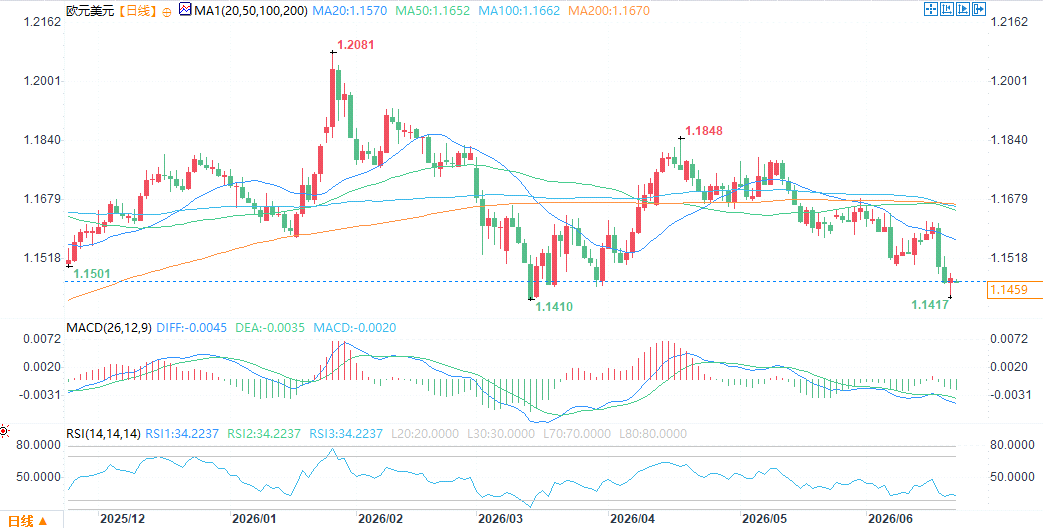
(Euro/USD daily chart, source: FX678)
At 09:10 Beijing time on June 22, the euro was trading at 1.1471/72 against the US dollar.
Geopolitical risks escalate: US-Iran peace talks are "two sides of the same coin," while the safe-haven dollar benefits.
On Sunday (June 21), tensions between the US and Iran escalated dramatically once again. While US Vice President Vance was leading a delegation in Switzerland for the first round of formal contacts with Iranian officials under the ceasefire agreement, President Trump issued a completely different, hardline stance on social media.
Trump posted on Truth Social, stating, "Iran must immediately stop its paid proxies in Lebanon from causing trouble. If they don't, we will strike Iran hard again—just like we did last week, and even harder!!!" This statement clearly targets Hezbollah, Iran's ally in Lebanon.
According to reports, the Iranian delegation protested Trump's remarks to the US side and left the meeting, suspending the 80-minute negotiations and turning to internal consultations.
This contradictory signal of "peace talks on one hand, threats on the other" has raised serious doubts in the market about the genuine progress of the US-Iran peace process. Iran had previously announced the re-closure of the Strait of Hormuz, and although the US stated it had not yet observed an actual blockade, these events were enough to trigger risk aversion in the market. Funds flowed back into dollar assets, becoming the direct trigger for the decline in the euro against the dollar.
Monetary policies diverge: The ECB's hawkish stance is growing, but it's too late to solve the immediate problem.
ECB officials signaled a rate hike, echoing the Federal Reserve's hawkish stance across the Atlantic.
European Central Bank (ECB) Governing Council member and Belgian central bank governor Pierre Wunsch stated last Friday that the ECB could raise interest rates again as early as next month if it sees more evidence that eurozone inflation is spreading beyond the energy sector. This statement has fueled market expectations that the two major central banks in Europe and the US will simultaneously tighten monetary policy.
The European Central Bank's deposit rate is currently 2.25%, and financial markets have already priced in a 25 basis point rate hike in September or October, with expectations of another hike likely early next year. This anticipated rate hike path provides potential support for the euro, offsetting some of the downward pressure from geopolitical risks.
ECB President Christine Lagarde will speak later Monday, a key window for short-term market observation. Investors will be closely watching whether she echoes Winsch's hawkish tone or maintains her previous more cautious stance.
If Lagarde signals a clear interest rate hike, the euro could receive a short-term boost; conversely, if her wording is dovish or ambiguous, the euro may face the risk of further decline.
Key variables this week: Three forces will determine the direction of the euro.
In summary, the direction of the euro against the dollar this week will depend on the interplay of the following three factors:
First, there's the ongoing evolution of the US-Iran situation. Whether US-Iran negotiations can continue, whether Trump will make more extreme statements, and the actual navigation status of the Strait of Hormuz—these will directly impact market risk appetite and the safe-haven demand for the US dollar.
Secondly, the US PCE data and speeches by Federal Reserve officials will be crucial. The US May PCE data released this Friday, along with a series of speeches from multiple Federal Reserve officials, will determine whether market expectations regarding the Fed's interest rate hike path strengthen further. If the data is strong and the rhetoric is hawkish, the dollar will gain more upward momentum.
Thirdly, there's ECB President Lagarde's speech. Lagarde's comments on the interest rate hike outlook will influence market expectations regarding the pace of narrowing interest rate differentials between Europe and the US. If a hawkish signal is clear, the euro is likely to find support above 1.14; if her stance softens, 1.1450 may be difficult to hold.
Technical Analysis
The euro/dollar pair has turned bearish on the daily chart, with the price trending downwards from its year-to-date high of 1.2081. Recently, it retested the 1.1417 low, a three-month low, clearly indicating a downtrend. The moving average system is providing comprehensive resistance, with the 20-day (1.1570), 50-day (1.1652), and 100-day (1.1662) moving averages all declining. The 200-day (1.1670) moving average has also become a resistance level, and the bullish support system has been completely breached.
In terms of indicators, the MACD lines are below the zero axis, the DIFF-0.0045 is below the DEA-0.0035, the green bars continue, and the bearish momentum continues to be released; the RSI value is 34.22, falling into the weak zone. Although it is close to the 30 oversold line, there is no clear bottom divergence stabilization signal yet, and the downward momentum has not been fully exhausted.
In terms of price structure, the market has formed a downtrend channel with gradually lower highs and constantly lower lows. The near 10-month low of 1.1410 reached on March 13th and the current low of 1.1417 form a short-term support zone. The first resistance level is the 20-day moving average (MA20) at 1.1570; any rebound to this level is likely to encounter selling pressure. The slight stabilization in the short-term price movement is merely a weak correction after an oversold condition; the medium-term downtrend has not reversed.
If the 1.1410 support level is breached, further downside potential will open up; if the support holds and a rebound occurs, it should only be considered a pullback within a downtrend, and the trading strategy should focus on selling on rallies, while being cautious about bottom-fishing for long positions.
(Euro/USD daily chart, source: FX678)
At 09:10 Beijing time on June 22, the euro was trading at 1.1471/72 against the US dollar.
- Risk Warning and Disclaimer
- The market involves risk, and trading may not be suitable for all investors. This article is for reference only and does not constitute personal investment advice, nor does it take into account certain users’ specific investment objectives, financial situation, or other needs. Any investment decisions made based on this information are at your own risk.